This year marks the centennial of the dedication of the Lassen County Courthouse. Of course it has under gone numerous changes in the past one hundred years. In September 1978 prison inmate Robert Clawson who was in the courtroom on pending kidnapping charge broke free of the bailiff and fled. He exited the courthouse by jumping out of the window on the second floor landing in the flower bed, From there he ran away, but was later apprehended. From this episode many of the windows were replaced with smaller openings to prevent future escapes.
One of the problems when Lassen Volcanic National Park was established, Congress was real stingy with funds with an annual appropriation of $5,000 a year, though for the first several years they did not even provide that. To make matters worse the initial administration of Lassen was handled by Yosemite National Park officials.
Yet, Lassen Park advocates were a persistent bunch and they explored a variety of avenues. Take for instance in 1919, when former U.S. President Theodore Roosevelt died, consideration was given to rename Lassen after Roosevelt. Not only would it be a memorial in his honor, but it was considered a venue to overcome its financial dilemma with Congress.
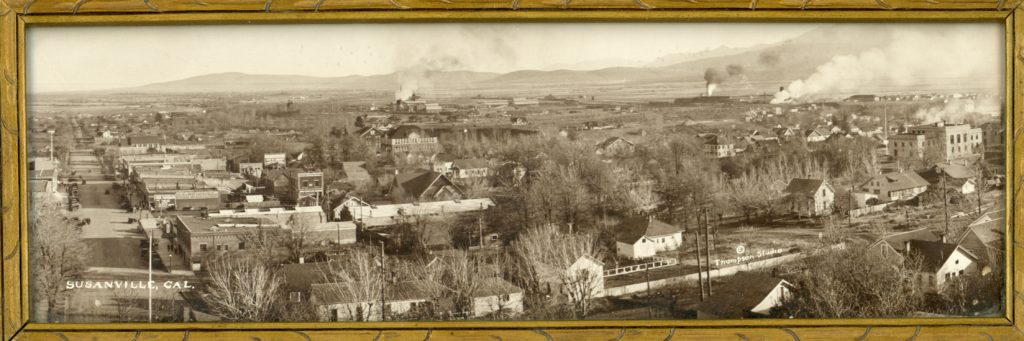
A minataure 1921 panaroma of Susanville depicting the neighborhood where the sale will take place.
When: Saturday, May 13, 2017 starting at 9:00 a.m.
Where: 500 Cottage Street, Susanville, California
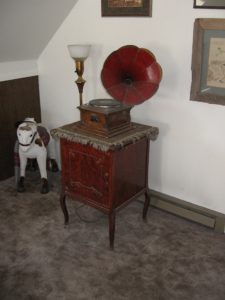
The gramaphone and cabinet are many of the items for sale.
Details: This is phase two of my mother’s estate sale, since there was more assorting to be done after phase one, since the basement and the garage had not even been touched. Everything at bargain prices, in preparation to place the property on the market. Come one, come all, spread the word.
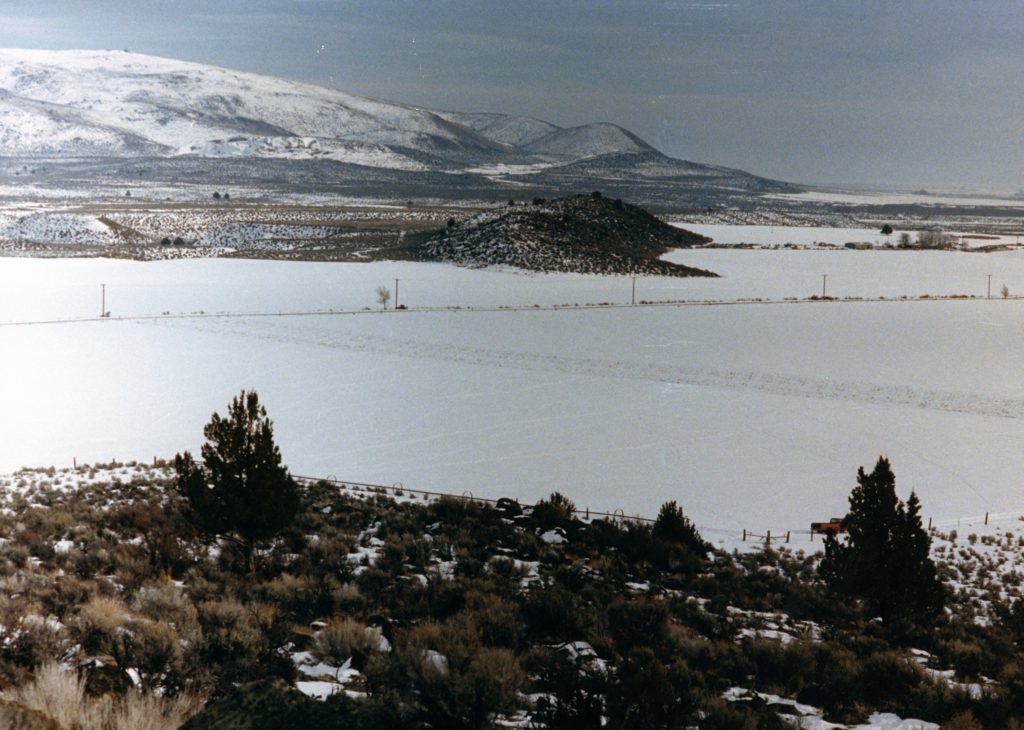
The Belfast District. Courtesy of Bernard McCallister
This rather obscure hill located in Honey Lake Valley’s Belfast District has an interesting tale behind it. Isaac Coulthurst was one of the first Anglo settlers of the region, but in time his sanity came into question.
In 1873 Coulthurst stated that the Lord commanded him to go to the top of this hill. Coulthurst held communion with the Lord in a cave there. He spent a portion of the winter in that cave. Coulthurst stated it was warmed by supernatural heat, but the cave became unbearably hot in the summer. It was then that he discarded his name of Coulthurst and changed his name to the “Second Coming of Christ.” His wife, Mary, had him declared insane. Twice he was placed in mental institutions, each time he spent only a few months. In 1881, a third examination was held on his competency. The courts two examining physicians stated he was fine in all aspects, especially keen in business dealings. They admitted to his religious peculiarity but did not think he would derive any benefit from being institutionalized. After that court hearing, the court proceeded with the divorce proceedings that had been filed by his wife and the court approved it. Coulthurst agreed to the divorce and to pay alimony, but would not divide the property with her. Coulthurst’s refusal to divide the ranch property was based on his belief that it would be the site of a new Jerusalem. Coulthurst contended that a large city would be built there, the streets paved with gold. In 1893, Coulthurst transferred the ranch to his son, Henry, with the provision that his son clothe, feed, maintain, and support him during his natural life. Coulthurst signed the deed “Christ the Lord.”
An interesting footnote when Coulthurst died in 1919, he was the first person interred in the Lassen Cemetery.
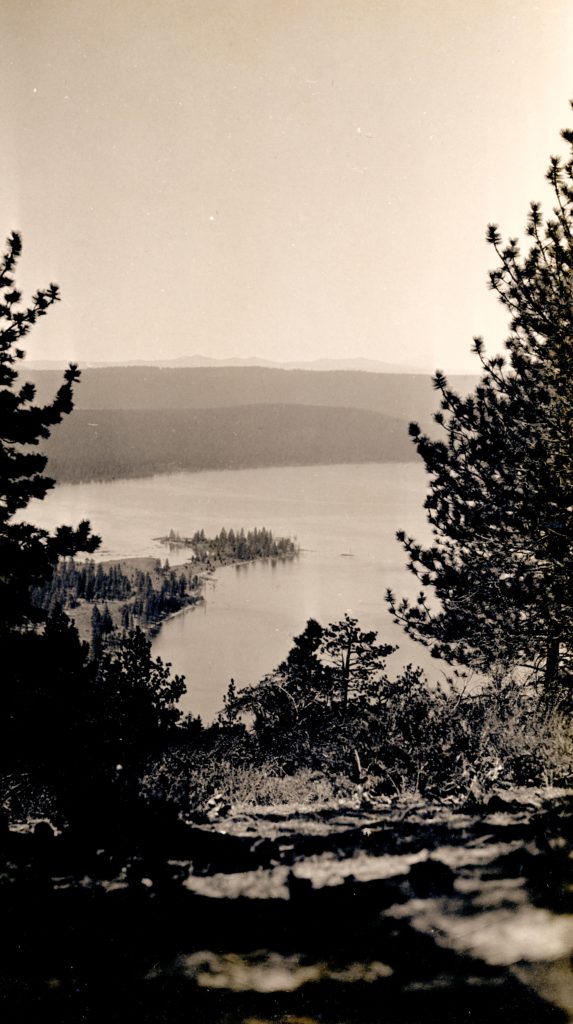
Pikes Point, Eagle Lake circa 1917. Courtesy of Wyn Wachhorst
In late April I made a whirlwind visit to the San Francisco Bay Area. The adventure was two fold–one a needed change of scenery and the other to obtain some new historical data pertaining to Eagle Lake.
The first stop was a visit to Wyn Wachhorst and a review of a fascinating photograph collection of Eagle Lake between the years 1914 to 1920 of the Gallatin family activities there. After some discussion with colleagues, we may attempt a re-photographic survey–then versus now–to examine how the landscape has evolved over the last 100 years. The completed project would be done in a powerpoint presentation and made available to various interested groups. Stay tuned.
The next excursion was to visit Michael Clynne a U.S.G.S. geologist. In a recent finding the Brockman Flat Lava Flow extends to the east side of the lake at Bly Tunnel and Pelican Point is part of that lava flow. In addition, Gallatin Peak is a spillover of the Sierra Nevada. More about these revelations in future posts.
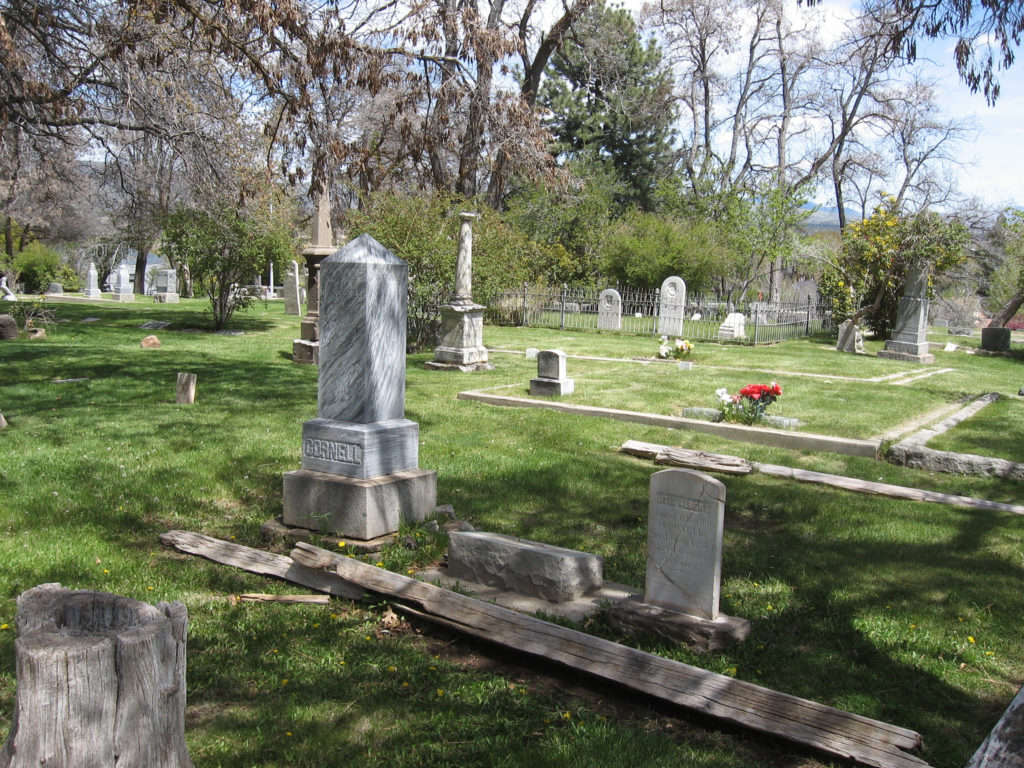
Cornell family plot, Susanville Cemetery, May 2, 2017
In 1864 Heiro K. Cornell and his brother-in-law William S. Hamilton constructed Susanville’s first warehouse. Cornell located on property that now occupies Lassen High School and extended past to McDow Street. In 1873, he sold out and moved to western Modoc County. In 1902, his son, John Cornell returned to Susanville and purchased a piece of his father’s original holdings. During the boom era ten years later Cornell sold to R.F. Pray, General Manager of the Red River Lumber Company. In 1920, Pray subdivided the property and created three streets–Cornell, Foss and Small.
Awhile back I wrote about Leon Bly’s bad karma. During the contested estate hearings, I left out an interesting piece of information. Louise Wick was one of the five beneficiaries to Bly’s Estate. In a letter to the probate judge she stated initially Bly was going to leave a large sum of his estate to Malvena Gallatin. Bly’s housekeeper/nurse Edith Rebhan resented that notion since Gallatin was a “rich woman.” Rebhan also countered she would put in a claim for services as a professional nurse, day and night and at the rate of $18 per day, and this would consume most of the estate. Wick continued, “Nevertheless she [Rebhan] was bitter against the idea of Mrs. Gallatin coming in to anything.” As it turned Rebhan received the bulk of the estate and Gallatin nothing.
Astute readers of this site have noticed that on the front page in the upper right hand corner there is an image of a magnifying glass. If one clicks on it, one can type in a name, E.C. Brown or a topic Eagle Lake and it will bring up links to everything about it. Enjoy your searching. In addition, each blog is archived, so if you click on Tim’s blog on the header, it will bring you the most recent posts. If you click on page 65 it will transport you to the beginning of February 2015.
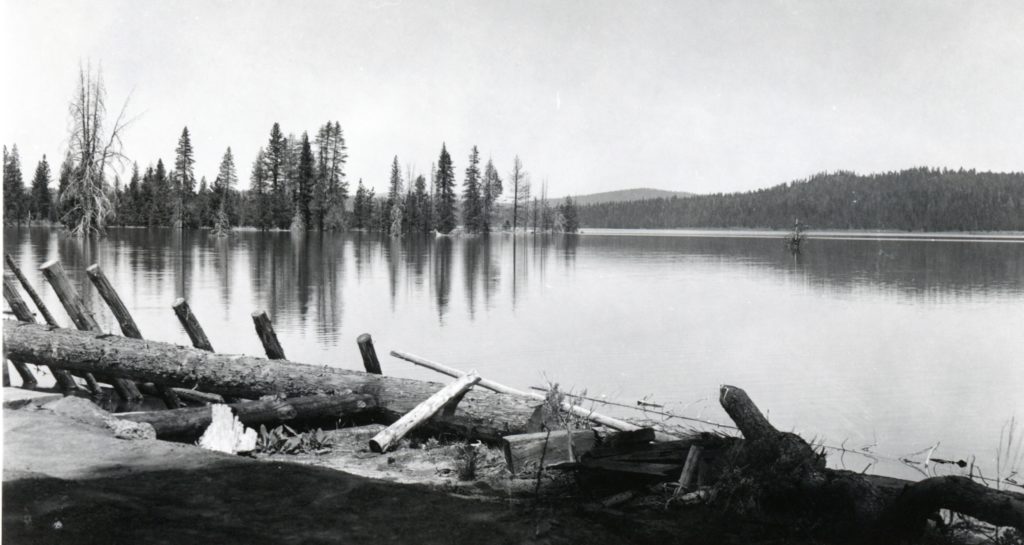
Hog Flat Reservoir, April 1940. Courtesy of Lola L. Tanner
Constructed in 1889 as part of Benjamin Leavitt’s expanding reclamation enterprise and now part of the Lassen Irrigation District. Lassen National Forest Service Supervisor, A. G. Brenneis, wrote an article about the origin of its name that was published in the California Ranger, August 1938: “Many years ago the residents of Honey Lake Valley joined together to start the Susan River Irrigation District and, as a first step, began the construction of the dams at the present sites of Hog Flat and McCoy Flat Reservoirs. The first winter this country received heavy storms and as a result the dam at Hog Flat was destroyed. The entire meadow, which should have been a lake was covered with a rank growth of vegetation and in order to salvage something from the reservoir, the farmers of the district banded together, placed a huge herd of hogs on the meadow, fattened them, and made some money to repay them for the loss of the dam. Ever since then the reservoir has carried its name of Hog Flat.”