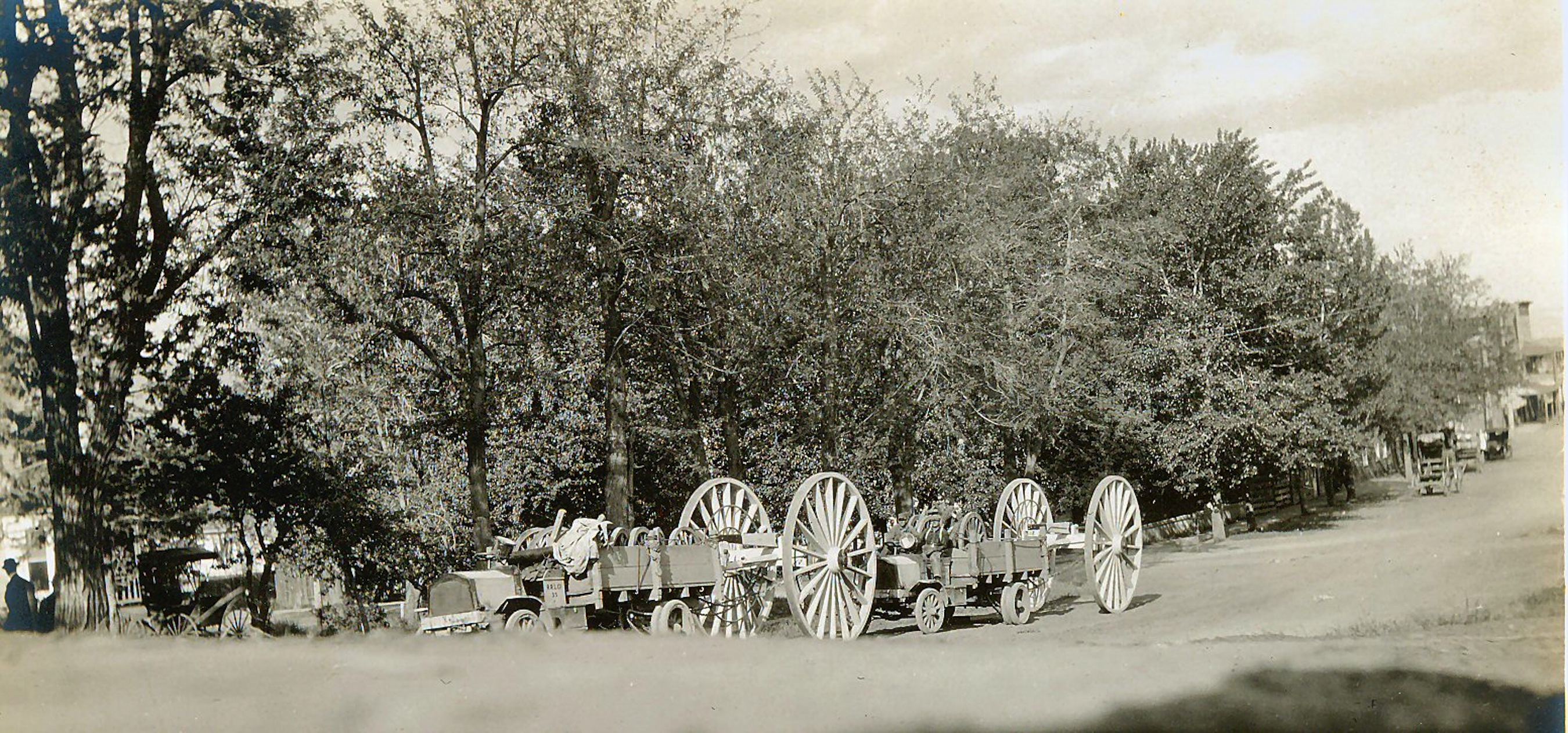
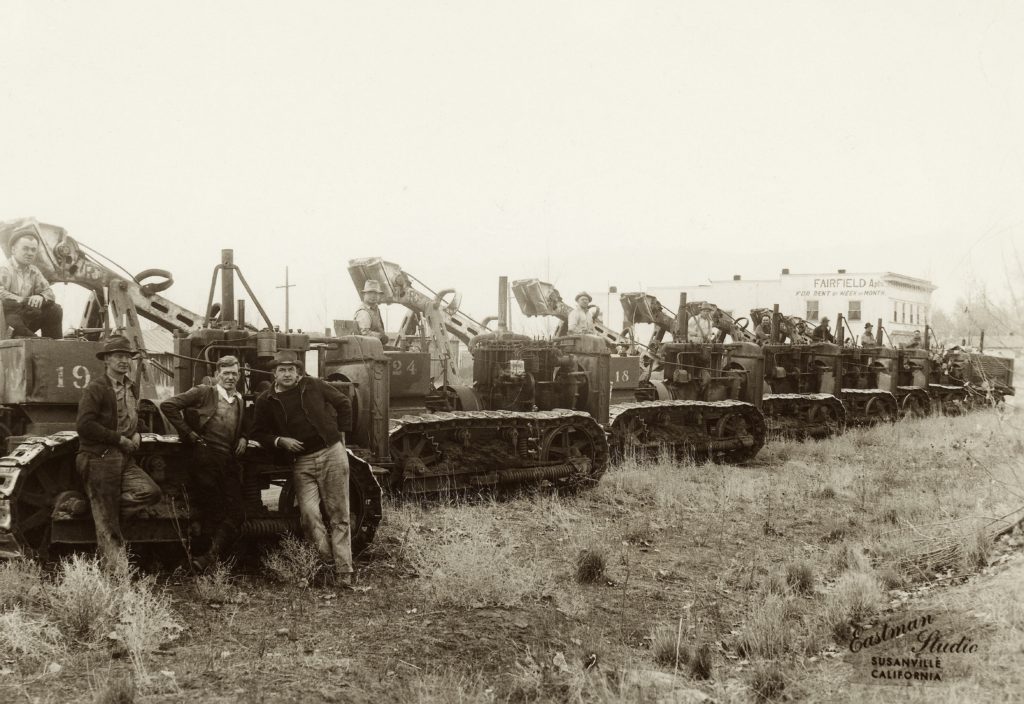
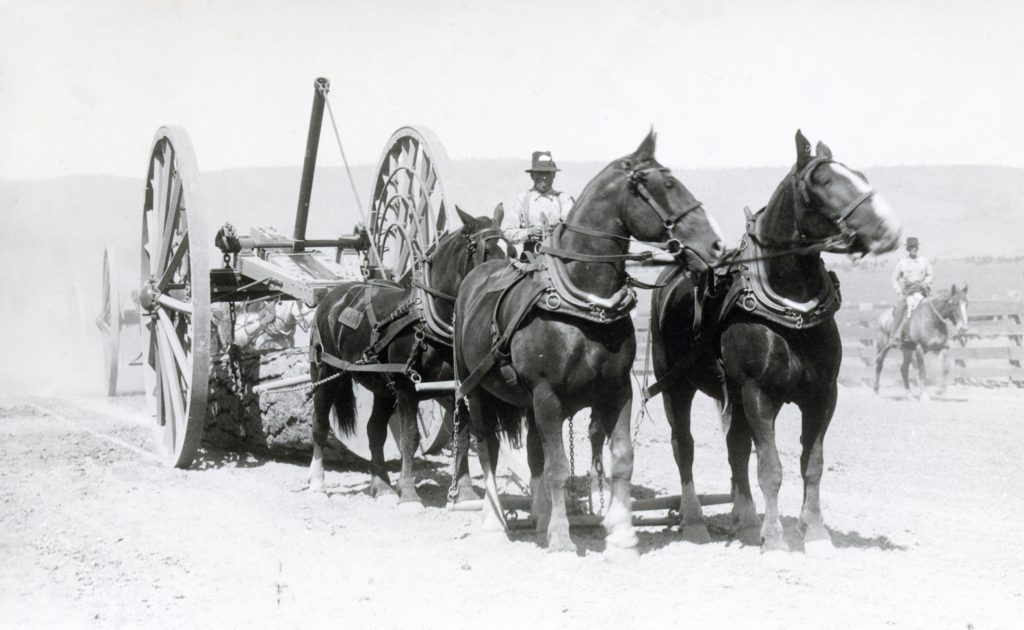
One of the nice features using this forum, instead of traditional print, some photographs will not print well. The above is a perfect example, yet it is an interesting photograph. This is at 501 Main Street, now Uptown Cinemas. This caravan of equipment is headed to Westwood while the first sawmill was under construction. Courtesy of Marcella Mathews Searles.
When the Red River Lumber Company finally decided, or actually more to the point Fletcher Walker demanded the Mountain Meadows location or otherwise he was going to quit, there were numerous hurdles to overcome.
During the initial construction phase of 1912-13, everything would have to be freighted in, while the railroad was under construction, and it would not be completed to Westwood until February 1914.
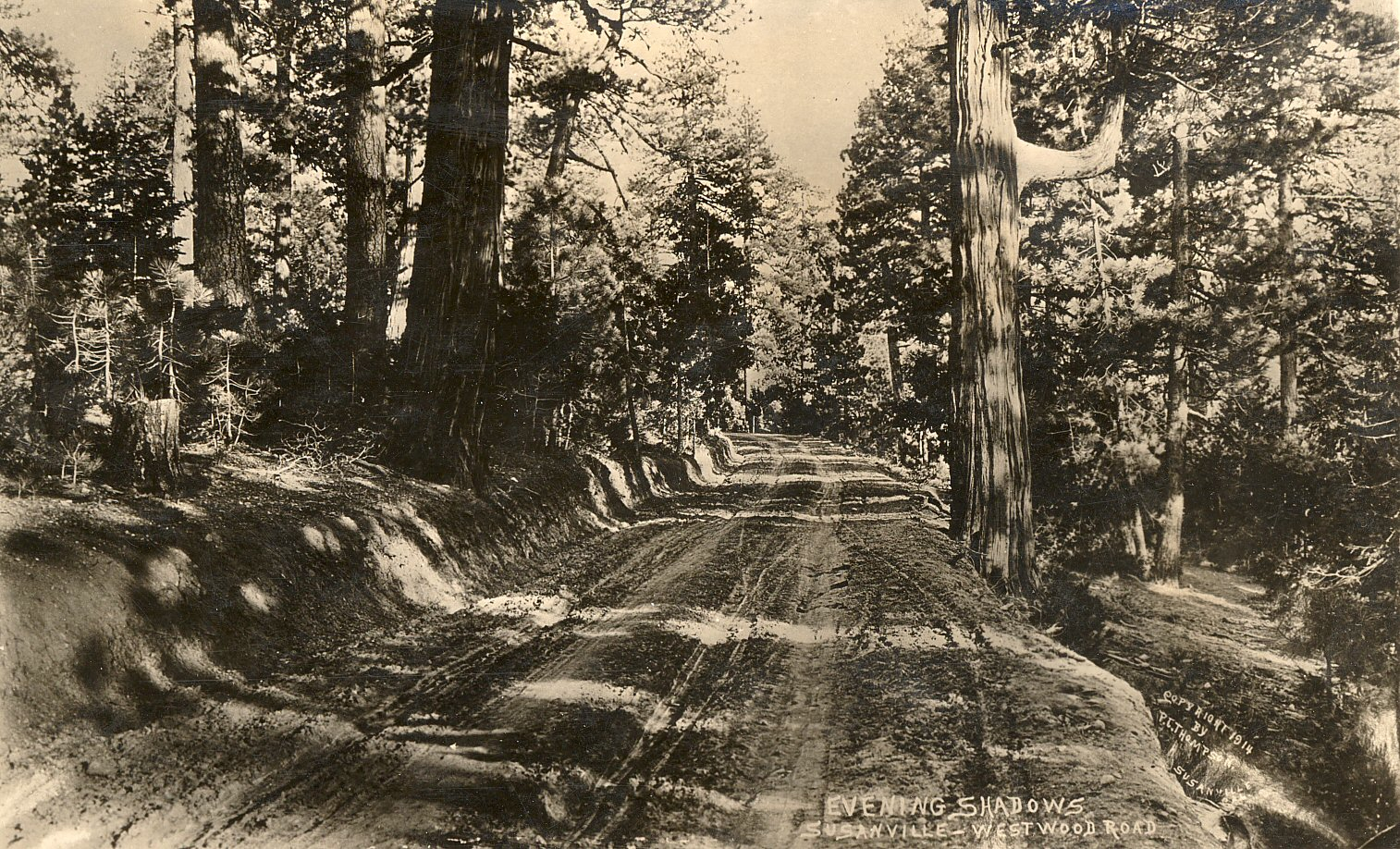
The road over Fredonyer as it appeared in 1914.
The bulk of the machinery was shipped by rail on the Western Pacific to Doyle. Smaller shipments also went by the Western Pacific to Keddie. In either instance, that is still a long haul for all the machinery to build one of the largest electric sawmills. In addition, all the auxiliary items needed to build a company town. This is before paved highways no less, and the truck traffic certainly made its imprint on the roads, though not in a favorable way.
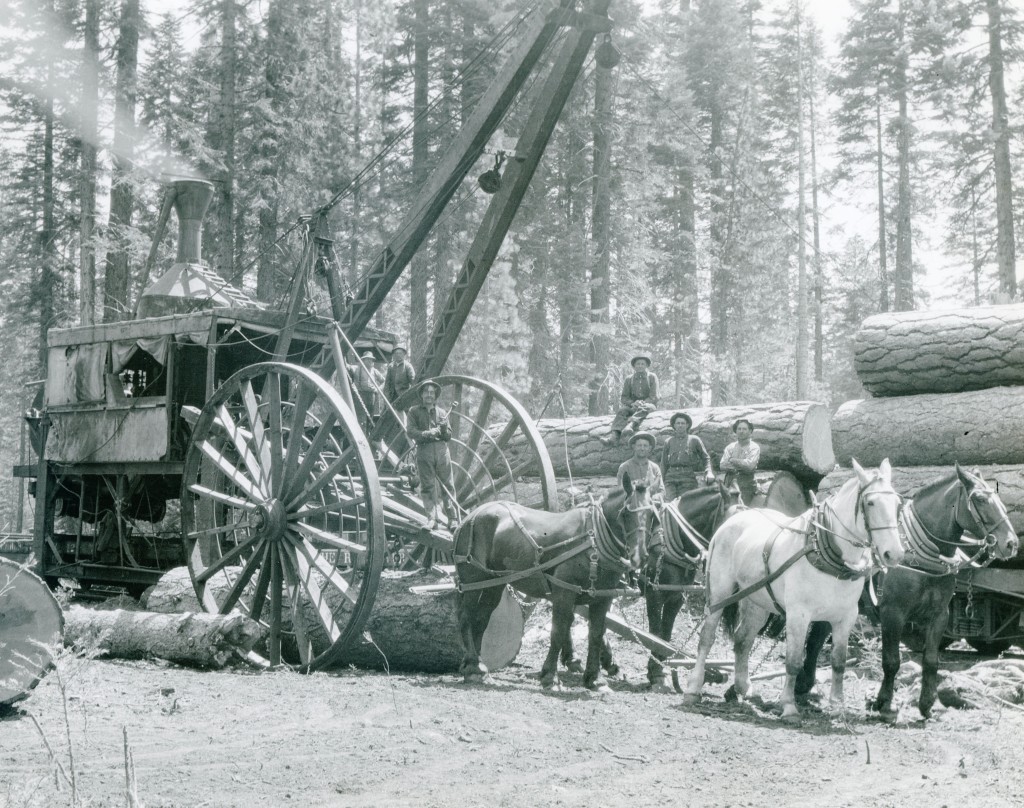
Red River Lumber Company, with Big Wheels and a McGiffert loader in the background. Courtesy of Hank Martinez
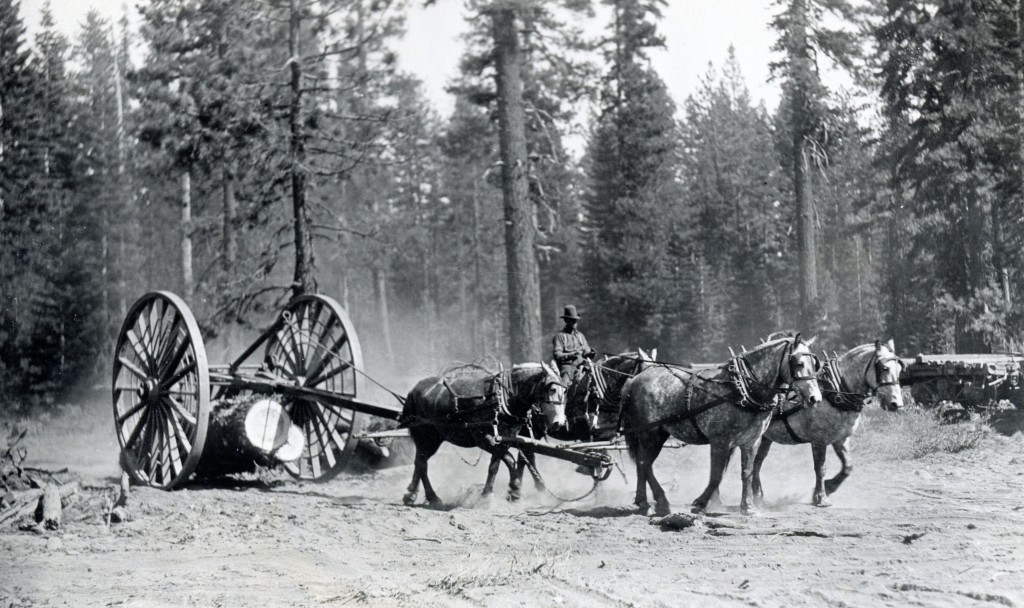
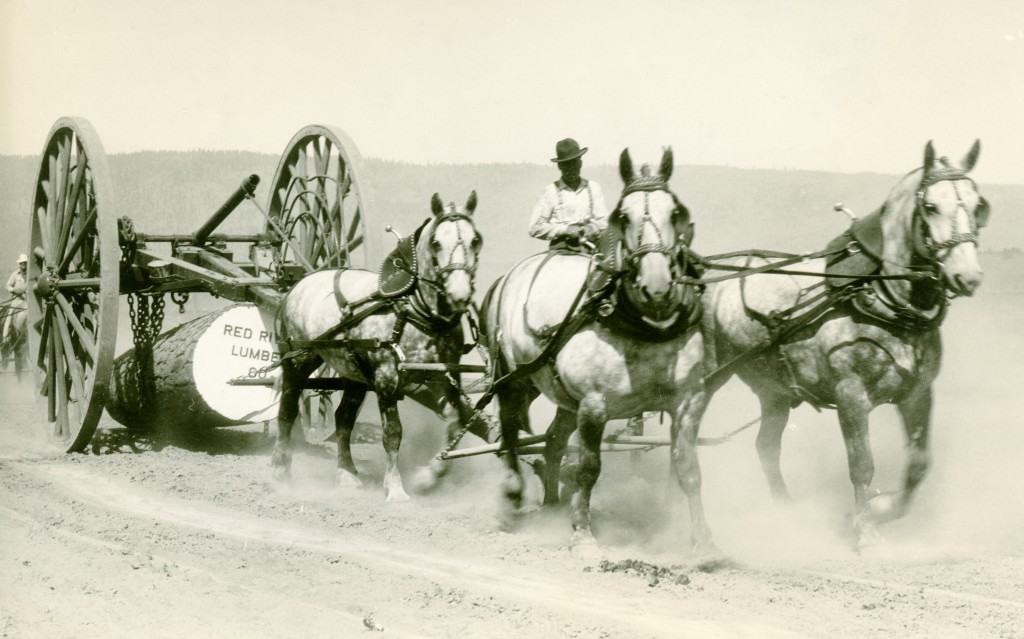
Logging operations of the early 1900s was extremely labor intensive. Motorized equipment was still in the experimental stages. One of the best advancements was the development of the Michigan Big Wheels, which everyone just called them big wheels. The wheels were a simple but efficient way to transport fallen logs to a landing, wherein they were then loaded onto railroad cars. The big wheels in time would become a key component in revolutionizing logging methods.
Horses provided the power to operate the big wheels. The name big wheels stems from their size ten to twelve feet in diameter. It was necessary for that size, in order to straddle a log and navigate moderate terrain. The logs were attached to a twelve foot tongue and with a lever, the driver could not only elevate a portion of a log in the front thereby making it easier to drag, but could loosen or tighten the cable, for braking purposes. One big drawback of big wheels was that it required a great deal of labor. Most big wheel logging camps employed as many as of 150 men. Two thirds of them worked as “swampers.” It was their job to remove brush, tree saplings, rocks and other debris that could injure a horse’s leg.
By the late 1920s, both Fruit Growers Supply Company and the Red River Lumber Company had replaced the big wheels with motorized Caterpillar “cats” Tractors.
he winter of 1923-24, was one of the driest on record in California. That summer another record would be broken–forest fires. It was June, 1924, when the Red River Lumber Company having been in operation for over a decade experienced its first major forest fire. The fire broke out at Chester Flats between Camps 34 and 38 and burned a narrow strip of land, eight miles in length. Red River’s loss was minimal as the fire burned recently logged over land and the only significant damage was 500 cords of wood burned along 1,000 feet of railroad track. Red River considered its biggest loss was to the men fighting the fire which cost the company a $1,000 a day in wages, and it took a week to contain the fire. Continue reading Westwood’s Fire Train→
Jacks Valley, located ten miles north of Susanville, along Highway 139, does not seem like much to the untrained eye. In 1865, John C. Wright located on the abandoned homestead of Thomas Pearson, who had perished in a snowstorm on New Years Day 1865. Wright as known locally was Coyote Jack, and hence the name of Jacks Valley. In 1869, he left for parts unknown. By 1880, this had become a crossroads for travelers as five different roads converged in the valley. Frank Fluery took advantage of the opportunity provided by this unique junction and established a saloon. In 1884, as one of Fluery’s patrons noted: “. . . for ten cents he will give you enough to make you happy to cause you to forget all your trials, troubles and tribulations for a time.” In 1889, Fluery sold to A. J. Conklin who operated the saloon for a number of years. In 1907, Conklin ventured into the lumber business and built a sawmill that had a daily capacity of 15,000 board feet. In 1920, Conklin sold the sawmill to William Johnson. Johnson operated the mill for three years and then sold to the Red River Lumber Company who immediately closed it. In August 1926, a forest fire ravaged the region that encompassed some 20,000 acres. The following year, the Red River Lumber Company established logging Camp 70 to salvage the burnt timber. This was one of that Company’s earliest truck logging camps. While those enterprises have long since faded into oblivion, a cement water trough remains and is still a recognized feature to travelers. In 1913, Thomas Hill and the County of Lassen constructed the water trough. For early motorists, it was a wonderful blessing, a source of water for overheated automobiles making the trip up Antelope Grade. For the next 80 years it was popular stop to drink the water and take a break, though it appears the water line has been disconnected.
Red River operated numerous logging camps from 1913 through 1944 when it sold to Fruit Growers. The camps were assigned numbers, though in no particular order. The majority of the camps were short lived and only had a span of one to maybe three years. One of the more interesting camps was Camp 33, but referred to as Town Camp, as it was located less than a mile west of Westwood. What made it unique was that Red River’s company town of Westwood would experience from time to time a housing shortage for its employees.. On occasion, this camp was used to house mill workers instead of loggers.
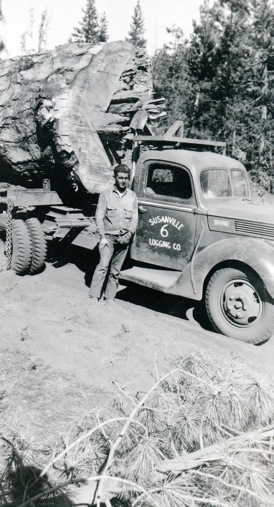
Joe “Tunney” Zunino posing with his one log load- Margaret Purdy
Several people contacted me in November about the above photograph. I had an initially published on March 28, 2019. Lo and behold it was recently posted on social media. It should be noted, that I do not have a Facebook account, etc. There are a lot people who help themselves somewhat generously I might add, and repost them either in newsletters, social media and who knows wherever else.
In this instance, I was a little peeved. The person who did the “lifting” of said picture and reposted it, identified the man in the picture as my father! Far from it. My Dad was connected with the Susanville Logging Company. Before Susanville, it was Purdy Bros LoggingIn 1958, Susanville Logging re-organized and the new owners consisted of Dale Soule, Paul Langslet, James Purdy and Leroy Purdy. The company operated a sawmill on Johnstonville Road and in 1993 when Jeld-Wen Corporation owned it, it was closed down. End of story.
Fruit Growers Supply Company show casing their latest Caterpillar tractors, with the Fairfield Apartments in the backround.
Each of these wars had major impacts, not just isolated to the timber industry.
The development of tractors in World War I was significant. The modifications of the Holt Best Tractors made way for Caterpillar to incorporate these innovations. Within a decade after World War I, tractors basically had replaced horses using Big Wheels.
Horse logging with big wheels, at Fruit Growers Camp B, north of McCoy Flat Reservoir.
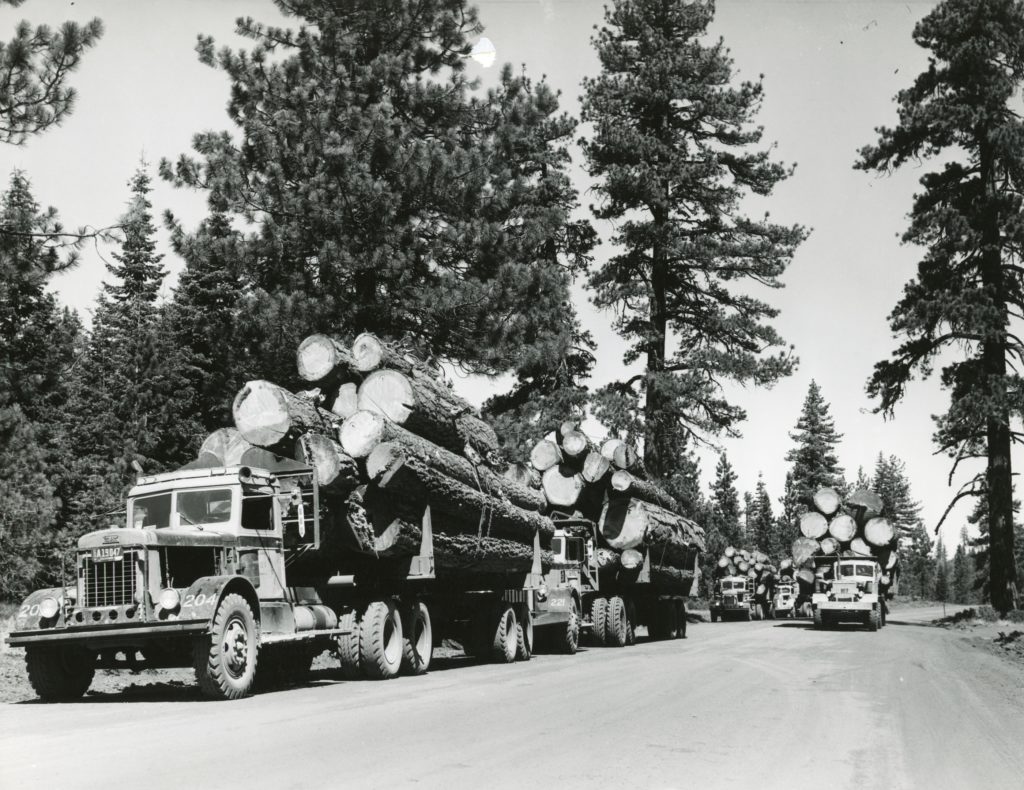
In the 1930s witnessed the introduction of truck logging, albeit on a small scale. This was mainly done by small independent contractors, knowns as gyppos. The technology that made improvements for tractors, was now being done in World War II with large trucks to transport to move goods and logs was one of those commodities. .
Lunch time at Dow Butte, August 21, 1953. Courtesy of Hank Martinez
In the end, eventually, truck logging became more efficient than a railroad logging train. It was a slow integration with reload stations. More about that tomorrow, from a blast from the past column.
When the Lassen County Fair was revived, in 1922, it would go through and still does evolves. Take for instance, logging competitions for decades it was a main stay attraction, but not any more.
In 1923, the first logging exhibition at the Lassen County Fair was held. After all there were three large sawmill operations—Fruit Growers Supply Company, Lassen Lumber & Box Company and Red River Lumber Company. It was certainly a noteworthy event. For many attendees it was the first time they were able to witness the current logging methods of the “big wheels.” A competition was held between the big three companies. The Fruit Growers Supply Company won top honors in this category. It should be noted by 1927, the lumber companies began phasing out the “big wheels” for the motorized Caterpillar traction engines.
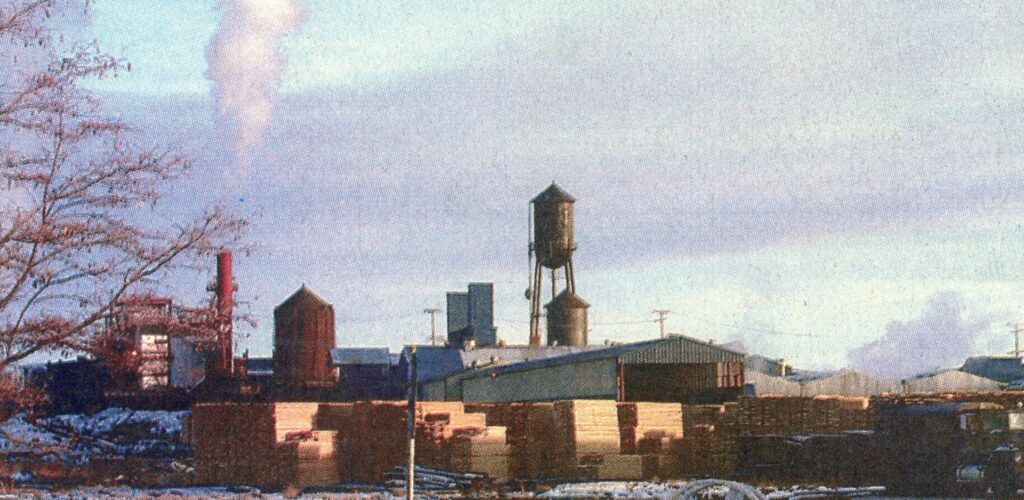
Sierra Pacific Mill—Lassen County Times, December 18, 2003.
On December 11, 2003, Ed Bond, spokesman for the Sierra Pacific Industries announced the Susanville mill would close some time in early 2004. Bond stated a number of issues that led to the closure. One, of course, was a lack of available timber. It was noted that in 1990 the Lassen National Forest sold 108 million board feet of timber and by 2002 that number had dropped to 17.9 million board feet. Those who have an affiliation in this industry, were not surprised by the closure. Actually, many and my self included were amazed that it had not happened years earlier.
The community reaction was all doom and gloom. Fast forward nearly twenty years later, with the closure of the California Correctional Center and the commentary is the same. Guess what, the town has not shriveled up and blown away.
Tim
Note for the record: The mill closed down on May 3, 2004 and portions of the mill dismantled. One of the features that still remain is the water tower, which found a new life as a cell tower.
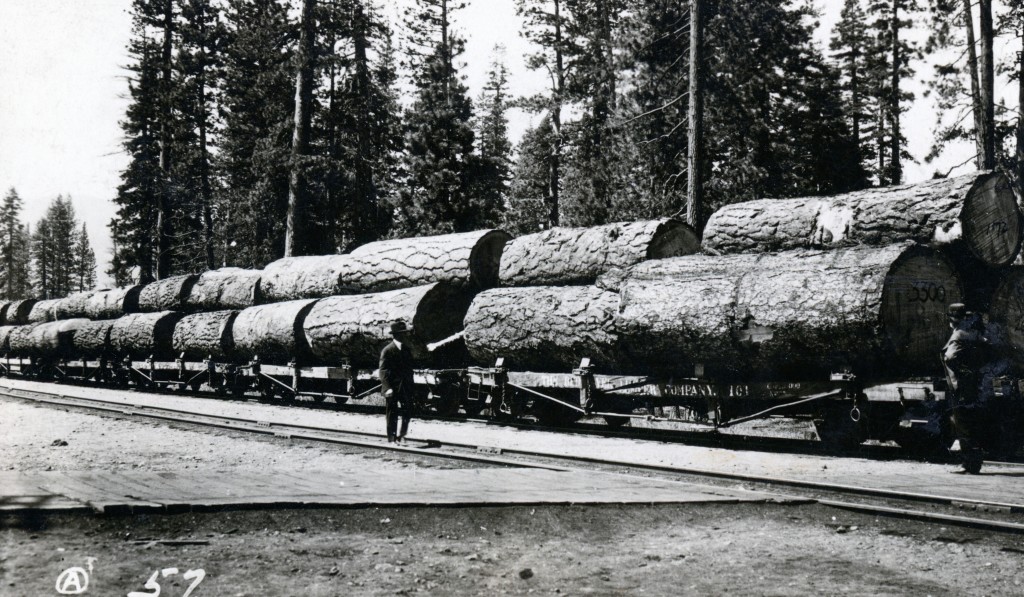
Train load of logs leaving Camp B, FGS Company,1923—Dick & Helen Harrison
For lumber companies back in the day, taking photographic scenes to show case premium logs and/of forest scenes served an unusual purpose that the casual observer would not be aware of. The photographs were used in portfolios to show bondholders, investors and other stakeholders what they were getting for their money.
This particular photograph is very revealing. These are Fruit Growers logs on Red River flat cars. When both Fruit Growers and Red River established their mills, they made agreement with the Southern Pacific Railroad to provide them with rail cars to transport the logs to the mill, saving the companies an expense. Red River found out the hard way that Southern Pacific was not always reliable and eventually purchased their own cars to care of those situation. In this particular instance, Red River was being a good neighbor to Fruit Growers and came to their aid to lend them some cars.