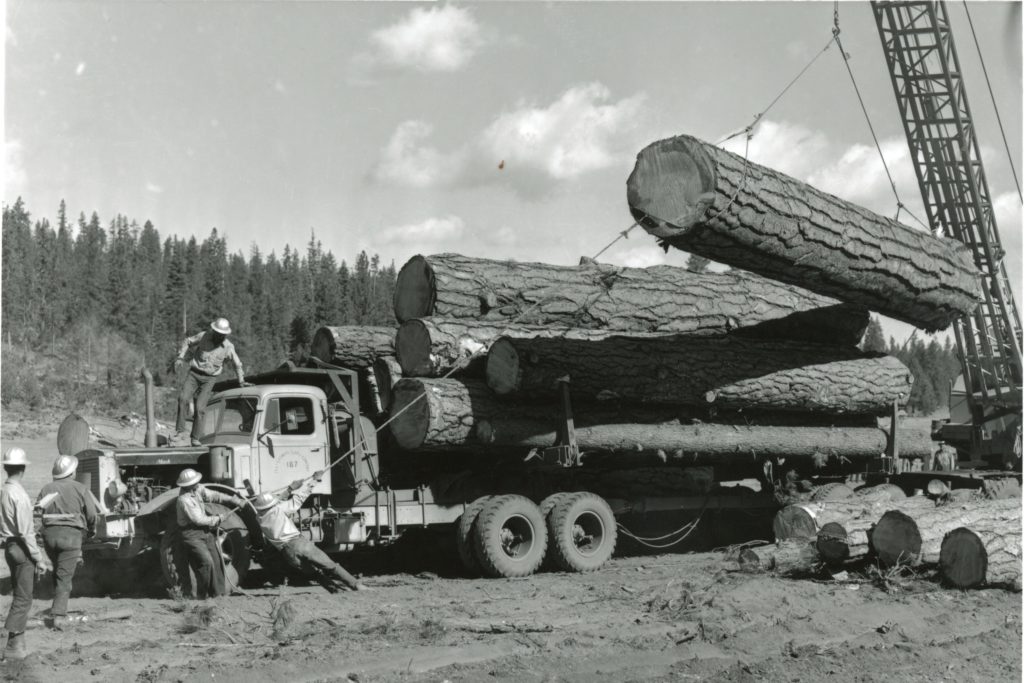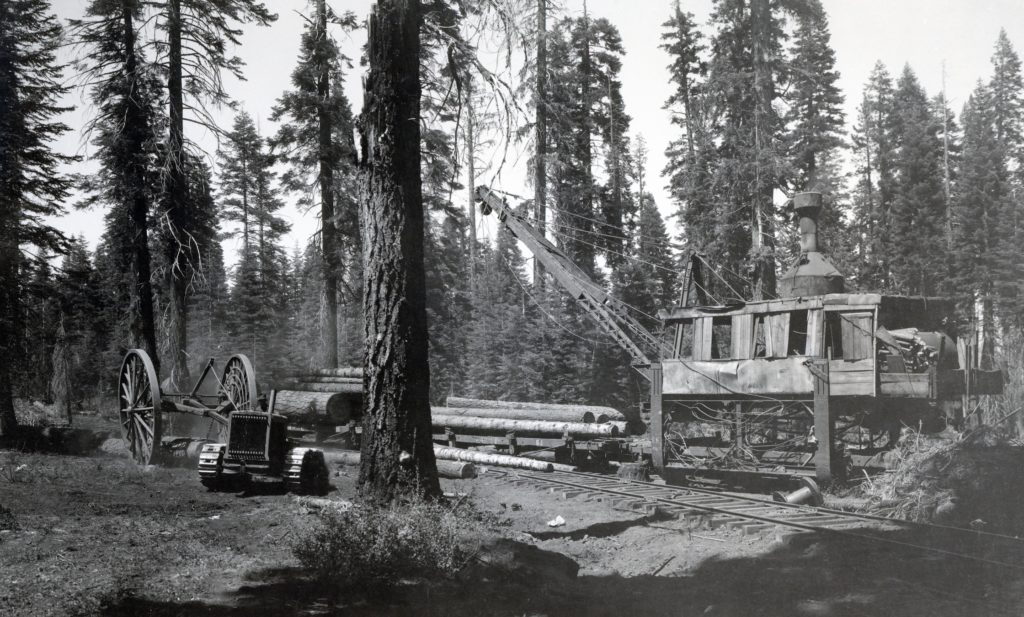
Log landing at Coyote Flat, August 21, 1953. Courtesy of Hank Martinez
It was not long ago when this was a common term issued by the forest service when in the summer months fire risk was high. What it entailed was the suspension of any activities that could spark a fire. First foremost, it applied to logging operations and equally important firewood cutters. On days declared hoot owl went into effect at 1:00 p.m. all such activity was curtailed. If you were a wood cutter while you were no longer able to use your chain saw, you could still have plenty time to load up the wood one had cut. Ditto, for log landings, if there were trucks present, they could be loaded, but all other operations were suspended.
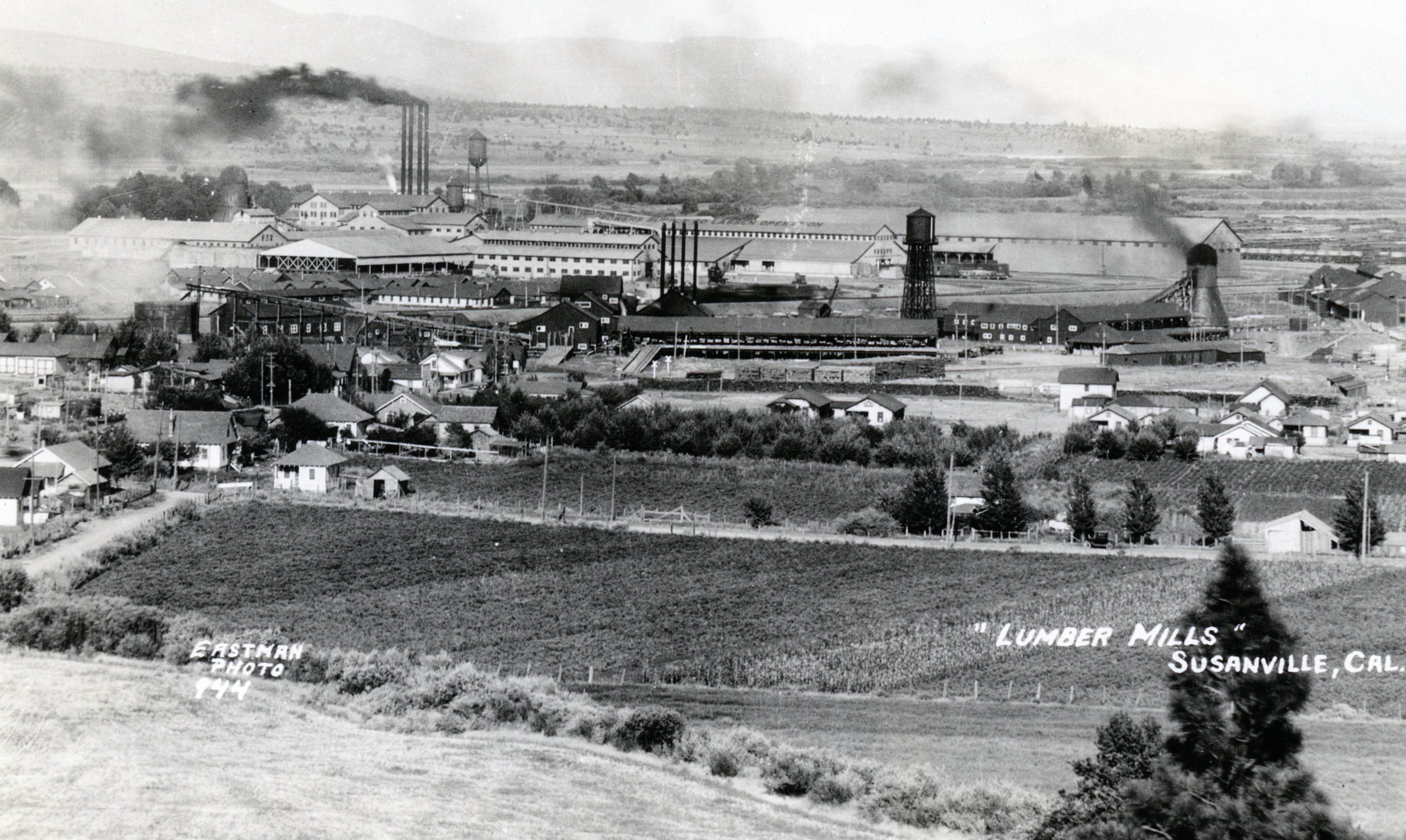
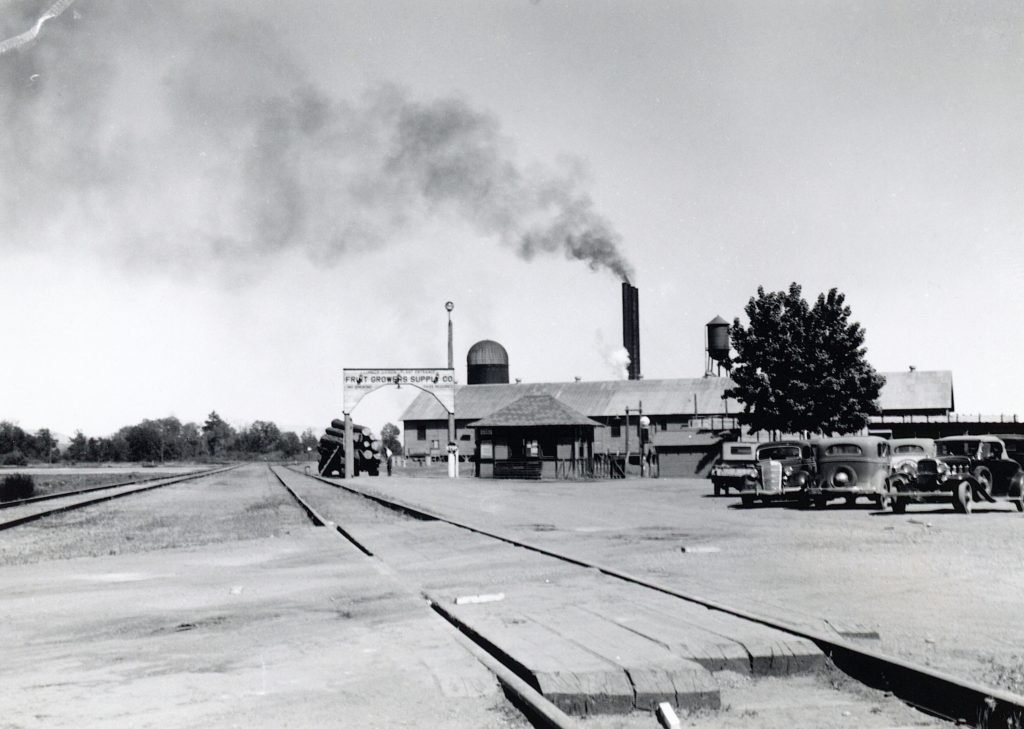
Fruit Growers and Lassen Lumber in their glory days.
Recently, someone wanted to know when the various large lumber mills closed. The first casualty occurred in 1953, when the last of the decked logs were milled at Lassen Lumber & Box Company. The sawmill was dismantled. However, Fruit Growers who bought Lassen Lumber in 1952, sold thirty acres including the box factory to the T&M Sash & Door Factory, operated by A.I. Lucero and Walter Wirth. The building was destroyed by a fire on April. 3, 1966.
Next on the chopping block was Fruit Growers plant in Westwood, which shut down during 1955/56. Fruit Growers had purchased it from the Red River Lumber Company in 1944. Next, in what was kind of an off shoot of Red River was the Paul Bunyan Lumber Company. The Susanville mill closed in 1967, though the company operated another facility in Anderson, Shasta County. One of the shorter lived operations was the Susanville Lumber Company that was established in 1941. In changed ownership several times and then was reincarnated at Coin Lumber. In 1979, it became Susanville Forest Products, a division of Jeld-Wen Corporation. They closed the mill in 1993.
Lastly, was Sierra Pacific Industries. They acquired the mill in 1963 from Fruit Growers Supply Company. Sierra Pacific closed its Susanville mill on May 3, 2004, thus marking an end of era, of a once predominant industry in Lassen County.
McGiffert loader, Camp 28, Red River Lumber Company, 1924—R.S. Pershing
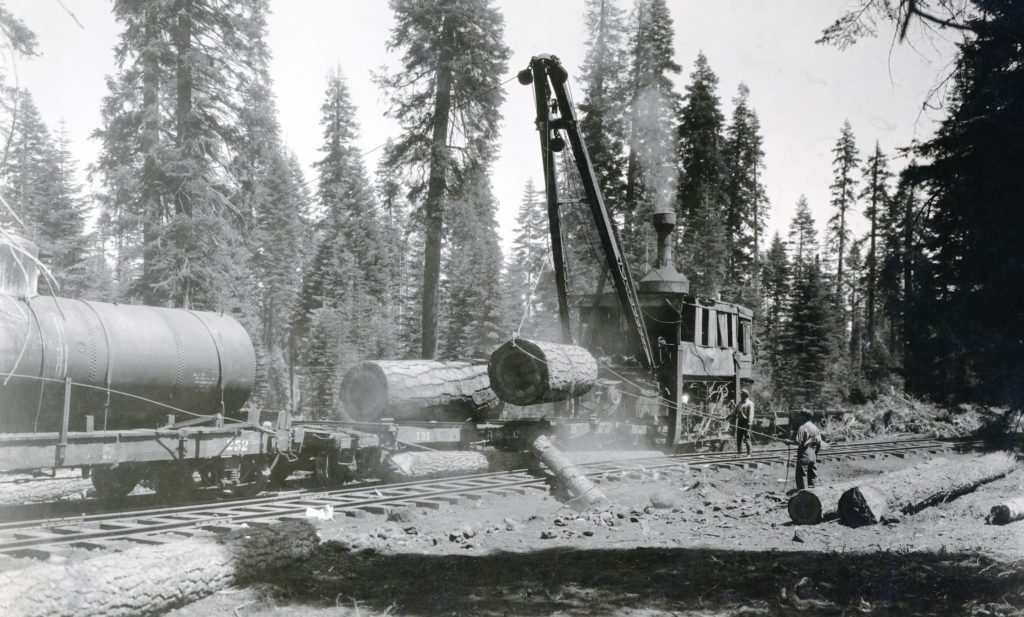
With the advent of railroad logging required the development of supporting equipment. In this particular case, today, a machine to load logs onto flat bed rail cars. Some consider the McGiffert Loader the “Cadallic ” of loaders, which many in the woods just referred to the machine as a “Jammer.” The McGiffert was invented by John R. McGiffert in the early 1900s , and were manufactured by the Clyde Iron Works of Duluth, Minnesota.
The McGiffert while efficient in getting the job done, did not look like much. It had an elevated platform for the boiler and spools. What is interesting it was self propelled wherein its chain-driven axles moved it along the rails. As the McGiffert straddled the tracks, a large, somewhat awkward looking machine. The boiler and spools were mounted on a platform that was elevated over the tracks. The entire machine sat on legs that rested on the ground on either side of the tracks. The McGiffert was self-propelled, as it had a chain-driven drive axles that moved the machine along the rails. The empty log cars were shoved underneath the loader. The log cars would then be rolled through the loader, with logs loaded onto the cars by a boom off of one side of the loader.
McGiffert loader at Camp 28, Red River Lumber Company, 1924–R.S. Pershing
Fruit Growers Supply Company was still using McGifferts into the 1940s on the Susanville Operation, and may have until 1952 when it discontinued railroad logging.
In 1955, Fruit Growers Supply Company announced its closing of the Westwood mill. Over the hill in Susanville, many pondered when Fruit Growers might do the same there. The Susanville mill would receive a brief reprieve.
In 1957 six paper companies were interested in Fruit Growers cutover lands in Lassen County. While California ranked second in the nation for lumber production, there was only one paper/pulp plant in the state. Fruit Growers had debated at one time to convert the Susanville mill into such a facility, but it was just not going to happen.
On November 7, 1962 the beginning of the end was announced with the closure of the Susanville mill. The woods employees were permanently laid off. The mill would remain in operation until the logs on hand were processed. On May 13, 1963 the last log was sawn. Shortly afterwards the remaining employees terminated and the mill closed. There being no buyers it appeared the mill was destined to be dismantled. It did receive a last minute reprieve with negotiations of Crook & Emmerson, but that is another story. On April 30, 1964, Homer Vincent closed Fruit Growers” Susanville office.
After World War I lumber companies began implementing modernization of logging methods. The adaptation of caterpillar tractors proved to be efficient and cost effective. As advances were made on different fronts, one area was lacking—the falling of timber.
An electric saw powered by a D-2 cat. Courtesy of Fruit Growers Supply Company
World War II created all kinds of shortages and labor was one of many. Fruit Growers Supply Company’s 1946 Annual Report provides an interesting glimpse in regards to timber fallers and labor.
”One place in the lumber industry where the use of mechanical equipment has not improved costs is in the falling and limbing of trees in the woods. Until the power saws came along, all of this work was done with hand tools on a contract basis where increased production meant increased earnings to the worker. With the advent of power falling saws, this work changed from a piecework basis to a straight-time basis and as a result costs actually increased. There is no valid reason why power falling saws should not result in lower costs than hand falling and also result in higher earnings to the man on the job. One factor in this change is that skilled help was drawn away from the woods by high wages offered elsewhere and by the military services. Hand fallers are highly skilled, but the substitutes for hand fallers who operated power falling equipment did not require much skill for the job and most of them have not attempted to acquire speed with the power equipment. There has grown up considerable resistance to piecework methods in recent years. Efforts are being made by the industry to get back to a contract basis for this type of work.”
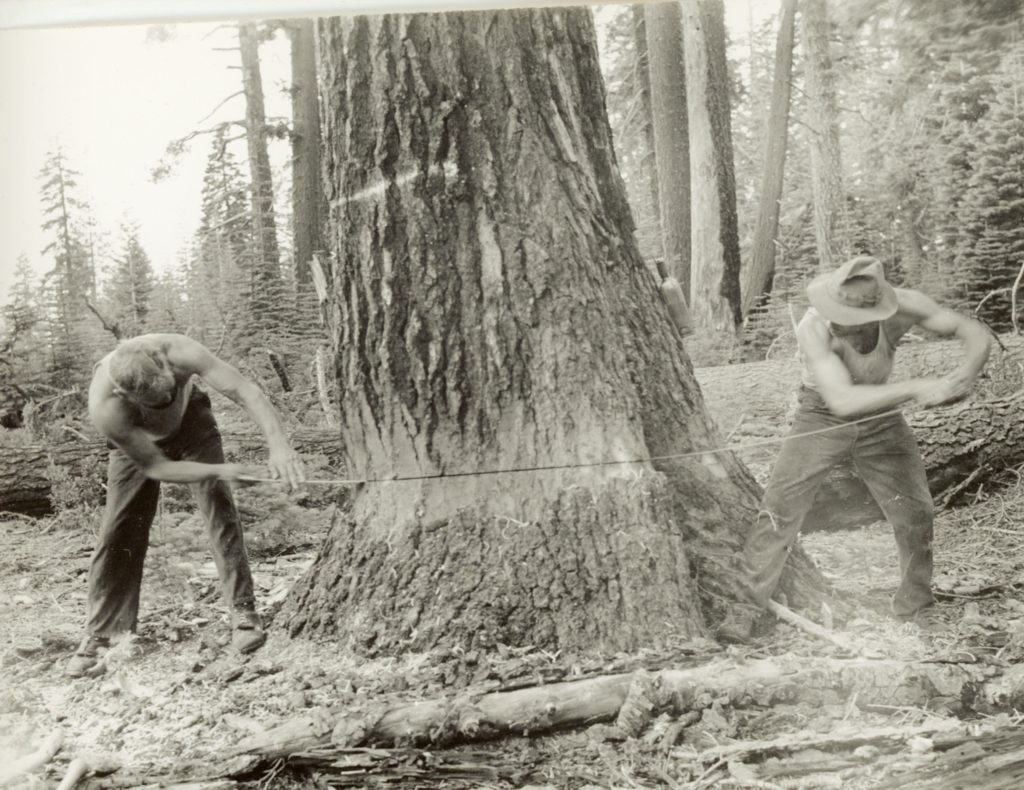
Bucking a log—FGS Co.
For a little bit of clarification about the contract work. Timber fallers for years were paid by the scale of the board feet felled. These men made very good money, considering the size of the trees then. As late as the 1970s, timber fallers were still being paid by the scale.
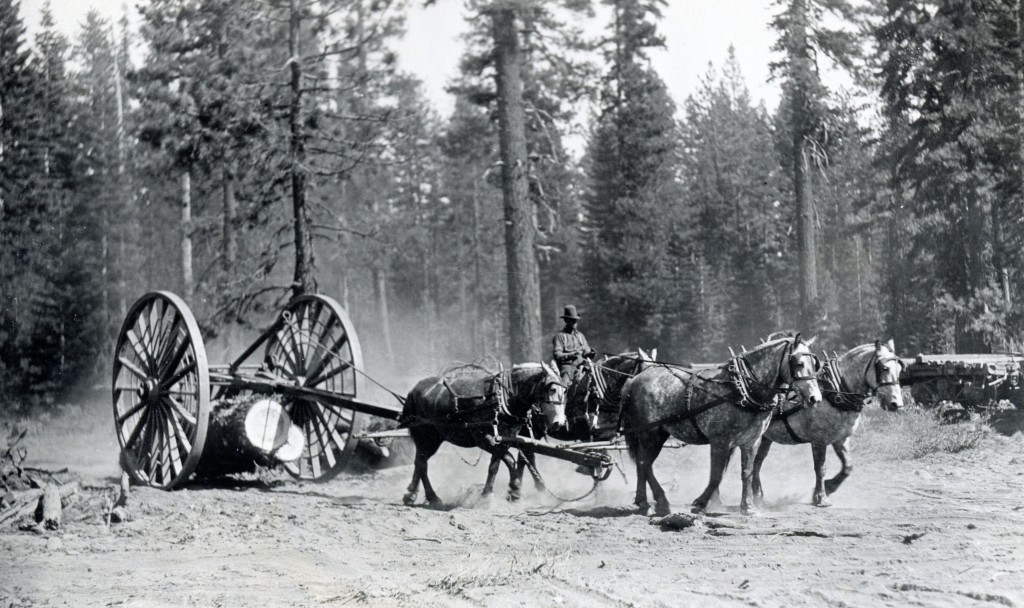
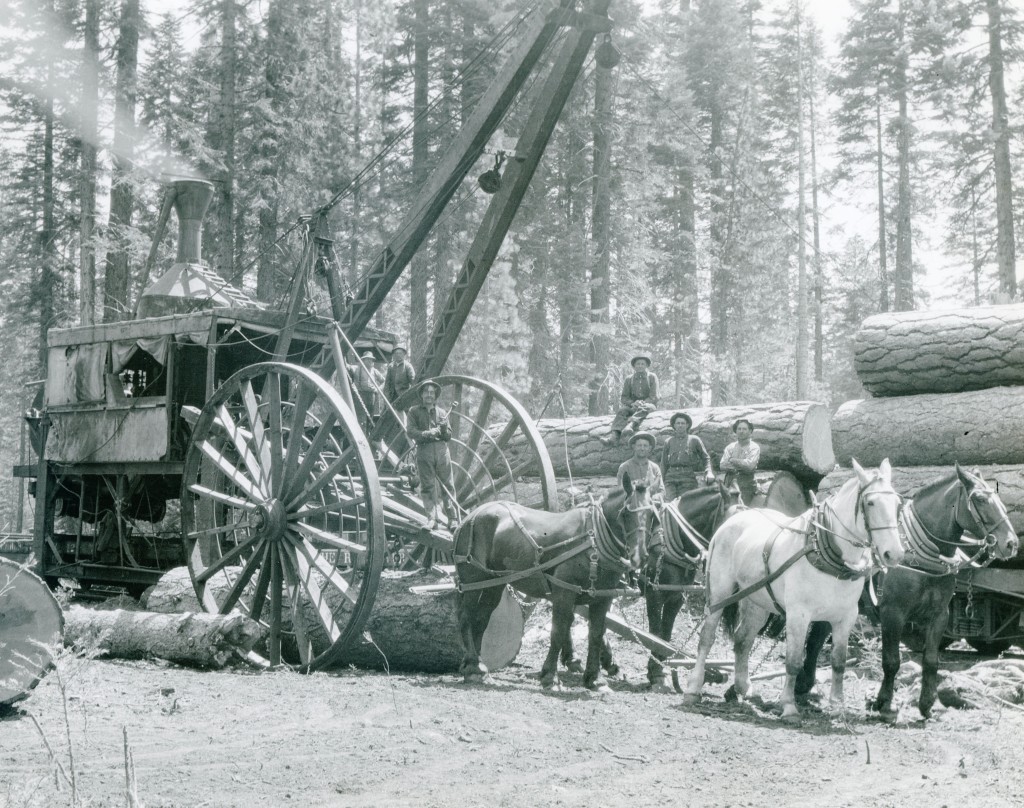
Horse logging with big wheels, at Fruit Growers Camp B, north of McCoy Flat Reservoir.
There were many enjoyable aspects when I researched the logging/sawmill operations of the Fruit Growers Supply Company aka Fruit Growers. For starters they kept well detailed records. Their annual reports are a compelling read, and one just never knows what you can find in them.
Fruit Growers 1947 annual reported highlighted many interesting facts, it being the company’s 40th anniversary. Take for instant, the following:
”The Susanville mill was completed and began cutting timber late in 1921. When cutting started, logging in that area was done with horses. Fifty-two horses were bought locally, 60 in St. Paul and 22 in Iowa. The total of 134 horses had an average cost of $276.67 and the harness for them totaled $13,247.07.
“Four horses would skid with wheels about 2200 feet per load. Modern Diesel D8 tractors bring in about 5,000 feet.”
Timber fallers, Fruit Growers Westwood Operation, 1947
While researching the history of the Fruit Growers Supply Company’s Northern California logging operations I interviewed and corresponded with many former employees. The following account is from Bob Eastman who worked in the woods at the Hilt Operation. He refers that the fallers did piece work. Timber fallers were not company employees. They were contractual and were paid by the scale, i.e. board feet felled. In those days, with large trees, fallers made very good money. The buckers and limbers, however, were company employees.
“Just a bit on the makeup of the woods crews. Now, I’m speaking of the steam age, not the modern gas and diesel operations. Then it still depended on huge outlay of brute force and muscle.
“A team of two fallers, usually the most athletic and youngest, took double bladed axes sharpened to brittle edge and a cross cut saw and some wedges. This team felled the tree in an incredibly short time. After all, they were piece working and the more they cut, the more they got paid. Then two buckers with a long cross cut saw and a few wedges bucked the tree, sawing it into lengths of 16 feet, 32 feet or 40 feet to fit on the sawmill rigs. That was hard work and very dangerous because rhe log could roll—and that was it for the bucker.
”The fallers had a dangerous job too. The ‘widow maker’ could get out at anytime. A falling limb was bad enough and could just as well kill someone unlucky enough to be beneath it as it came crashing down. The main cause of damage though, ‘the widow maker’ was something else. A lot of the trees were old and were dead and the fallers didn’t know it. They were already rotten, especially at the tops. It was these huge pieces of trees that would come crashing down like a bunch of bombs and when they struck earth, zing of horizontally. You didn’t even have to be close by. Anyone even hundreds of feet distant could be struck by these flying things. The irony was that most of the loggers were unmarried and there were no widows to mourn them.”
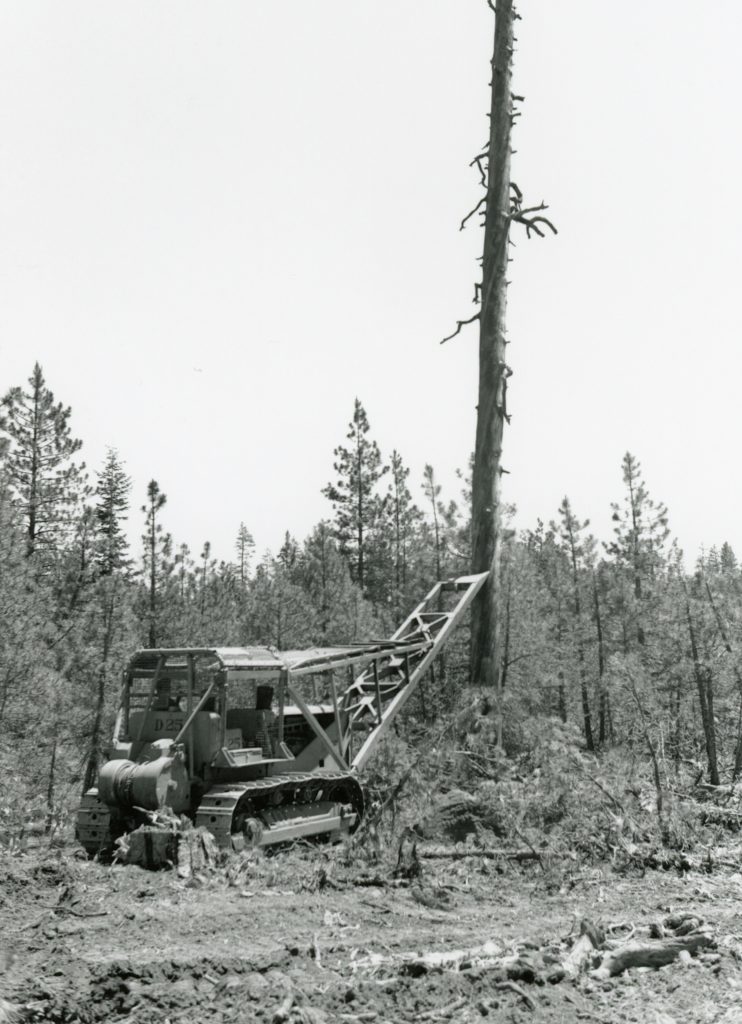
During the 1930s, between bark beetle infestation and a long term drought witnessed a large number of snag (dead) trees on Fruit Growers Lassen Operation. Then came along World War II, which created new challenges due to employee shortages. Yet, it is those kind of conditions where creativity comes to the forefront.
Even after the conclusion of World War II in 1945, there were still labor issues. Since the late 1920s, Fruit Growers, as well many lumber companies turned to machines to do the work more efficiently thus cutting down on labor at the same time.
In 1945, with Fruit Growers acquisition of Westwood from the Red River, did have some perks. The machine shop there employed some very talented people, who over years with creative talents improvised equipment best suited for the company’s needs. Their task to design and modify a caterpillar tractor that could knock down a snag tree—a snag pusher. The major advantage was it eliminated timber fallers from doing the job.
In its first year of operation Fruit Growers reported that 6,929 snags were felled by the snag pusher. How long the snag pusher was used, the record does not indicate.
Camp A, Fruit Growers Supply Company, located just north of McCoy Flat Reservoir, 1921
In the summer of 1920, Fruit Growers started their logging operations near McCoy Flat Reservoir, while their Susanville mill was still under construction. Since logging then, was seasonal in nature, they wanted to make sure they would have a steady supply of logs ready when the new mill would be placed into operation in the spring of 1921.
Camp A was the first of ten railroad logging camps of Fruit Growers Lassen Operation. It opened on July 1, 1920. The operation was comparatively small, only logging 720 acres that season. On April 29, 1921 the first woods crews were dispatched by rail, where they encountered three foot of snow on the ground. The first item of business was to remove the snow from the railroad spurs, so that the timber fallers could start work. Within in a weeks’ time, logs were already being shipped to Susanville. In addition, a second camp, known as Camp B, opened three miles to the north of Camp A. Between the two camps, they housed over 600 men.
In April 1926 a conference of forest service foresters was held in Susanville. It was district forester S.B. Show whose statements caused alarm. Show had been doing extensive studies for a number of years of the nation’s timber resources.
Show noted that the timber resources of the southern states were rapidly being depleted and that, in turn, would put more pressure on the forests on the west coast. When Show was asked how long the forests of Lassen will last, he replied that at the present rate cutting from 25 to 30 years. Show continued that practically nothing is being done to reforest the lands that are being denuded by the timber operations and unless some constructive plan is worked out it is only a question of only a few years when the mountainsides of Lassen County will be bare and the only great natural resources within our boundaries will be depleted.
Show was not all doom and gloom. He stressed the importance of reforestation. He also noted the current tax assessments on timber provide the owners of such lands with little or no incentive to preserve timber for the future. It is interesting to note that later in the year the Lassen County Board of Supervisors reduced the timber assessment tax rate by twenty-five percent.