Currently, I am busy sorting through the archives that have been in storage. Some of these documents I have not reviewed for thirty years. It will be a wide variety of topics from 1921 logging camp prowler to 1952 lawsuit from flood damage from the Highway 395 near Standish. To be honest I am quite overwhelmed by all those boxes. It is kind like a Christmas present, and I never what to expect until I open a box. On a final note I was blessed with a four-drawer legal size file cabinet so the records can be organized and retrieved.
The Shaw Historical Library’s recent Journal “All that Glitters is not Gold,” is now available. It describes mining operations in the High Desert area of NE California, NW Nevada, and SE Oregon. Articles cover the Hayden Hill Mining District, Gerlach gypsum mining, Herbert Hoover’s mining activity in northern Nevada, the High Grade District in Modoc County, Buffalo Salt Works on the Smoke Creek Desert, uranium mining north of Lakeview, and eleven other topics. The book is available for sale at Margie’s Book Nook in Susanville. It can also be ordered by calling the Shaw Library at 541-885-0222.
Tim
On personal note I look forward to purchasing a copy. My family was involved at Hayden Hill for decades. Buffalo Meadows Salt Works in a unique site.
The Grandstand on fire, July 5, 2025[photograph submittedWhere does the time go? It was a year ago, on July 5, 2025 that the wooden grandstand at Susanville’s Memorial Park went up in flames,
It is Thursday, July 2, we are the half way mark of the year. 182 days have passed and there is still 182 days before the end of the year. It is an opportune time, especially with the upcoming holiday weekend to pause and reflect what the first half of the year you might have accomplished, and what you would like do for rest of the year. For me, the first half of 2026 was challenging, so I look forward to smoother times and focus on neglected research projects. On a bright note I have 90%of photographs selected for the 2027 calendar. Yesterday, a subscriber delivered a four drawer legal file cabinet to my new abode. My holiday weekend will consist of unpacking boxes to fill that cabinet.
Camp 38, Red River Lumber Company, 1922. It was located on the east shore of Lake Almanor. Courtesy of R.S. Pershing
The family dynamics of the Red River Lumber Company is fascinating. While founder, T.B. Walker, in his western expansion was meant that his five sons would be in charge. While that was noble, it did not turn out the way he envisioned. Three of brothers, Clinton, Fletcher and Willis would relocate to California, while Gilbert and Archie remained in Minnesota.
Clinton was the first t arrive in California as he assisted his father with the acquisition of the California timberland. It was Clinton’s first hand knowledge of the California timber, that he would be at odds with his brothers. Clinton was early day supporter of control timber burns. In the 1930s, Red River faced a myriad of problems. In a letter, dated August 10, 1935, Clinton wrote his brother, Archie, about his thoughts of the condition of Red River’s California forest. For posterity is the following excerpt:
“It is regrettable that the house of Walker has no forest man. Kenneth covers the nearest but he seems to be absorbed in the performance of log contracts; our annual fire and insect losses are staggering. A systematic annual light burning at the right season of the year would reduce and ultimately eliminate these sources of loss and the cost would be insignificant as compared to the loss and yearly increasing fire hazard conditions in the forests. Burning by means of power burners on or dragged behind tractors could be done very cheaply and the prospective danger of injuring hollow hulled trees could be eliminated by following the burning with a few shovelers. For the entire period of the Walker family timber operation we have centered our attention largely or almost exclusively to lumber operation. Kilne followed the woods and logging and now Willis is attending to the contract writing in log sales matters but little if any thought is be given to Forest matters. I think the Forest bill Introduced in Washington should be followed up and that a competent forest engineer should be working on our forest matters. We are doing nothing but slash down that wonderful forest and letting the fire and beetles burn and eat us down year by year without raising a hand or a voice to afford protection from these annual staggering losses. ”
The Belfast petroglyphs looking towards the sunrise chamber, June 2, 2015
Sunday, is the summer solstice. For some, that means a trek to Belfast at sunrise to catch a glimpse of the sunrise chamber highlighting petroglyphs. While I have conducted a tour in the past, I have not recovered from my recent leg injury.
There is ashes to ashes, for this traditional Memorial Day for me it is cemetery to cemetery. Normally, I go to Diamond Crest, Janesville, Lassen and Susanville cemeteries. At that time I decorate a lot of graves, not just for my family, but for families whose descendants that have moved far away.
Cemeteries have been near and dear to me. It was a cemetery issue, that I at the tender age 13, began my historical research. A family friend, Frank Satica, told me that the World’s First Champion Cowboy was buried at a remote cemetery in Secret Valley. It should be noted when I was a growing up, and being the youngest of four siblings, I was very gullible. What Frank Satica told me, I thought it preposterous. One would think that McKissick’s title would warrant major recognition,, but that was not the case.
I was fortunate as Susanville was still a tight knit community. In the afternoons and weekends I worked part time at Party Port a sporting goods and liquor store. To make a long story short, I asked a long time customer Murray Doyle, an old time Lassen family about the McKissick tale. He said it was true, but to contact Abe Jensen, as he would know more. So I did, From that experience I discovered the town of Amedee, and opened the doors of the local history.
It has been an interesting journey to say the least. A half of a century later another cemetery issue has taken a toll on me.I would rather not go into details, but I am no longer available to any one with cemetery problems.
Awhile back in the comment section was the reference of the Secret Valley Shoe Tree and in 1994 how unknown parties cut it down in act of vandalism. A new reader, and a some what new resident wanted to know more. One can read about it here. If anyone has a photograph of that tree, please do share.
Note: The hilke piler is the featured photograph for May 2026 Calendar. For those that might be interested, my 2027 calendar work file survived the move and it is my desk file drawer waiting for my attention.
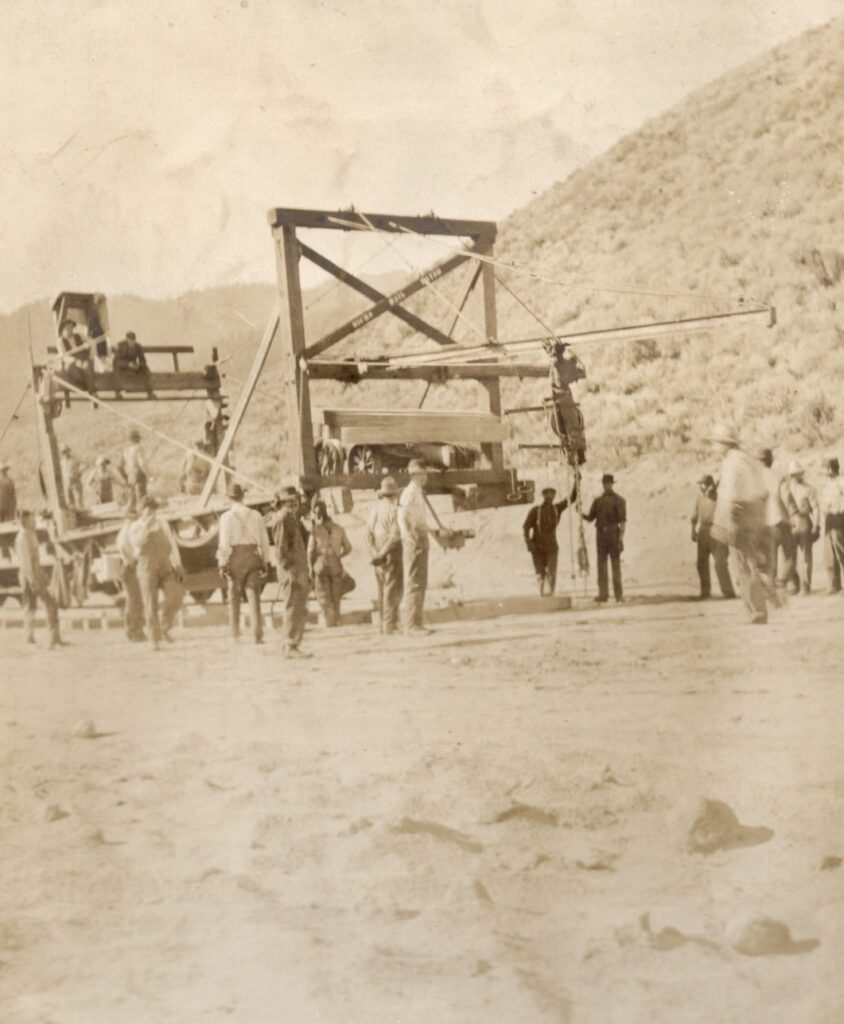
In 1925, Fruit Growers Supply Company at its Lassen (Susanville) operation were always looking at innovative ways for efficiency and reduce labor costs at the same time. That year, they installed a Hilke Lumber Piler, the contraption had been invented in 1915 by Seattleite Henry Hilke. The piler was a very efficient means of stacking lumber outdoors. Not only did it reduce the aisle width for stacking of conventional lumber, but the machine allowed to make higher stacks. While a four man crew was involved, the piler could handle up to 10,000 board feet per hour. As one local observer noted: “To those who had never seen the new stacker in action, it is a most interesting and educational sight.”