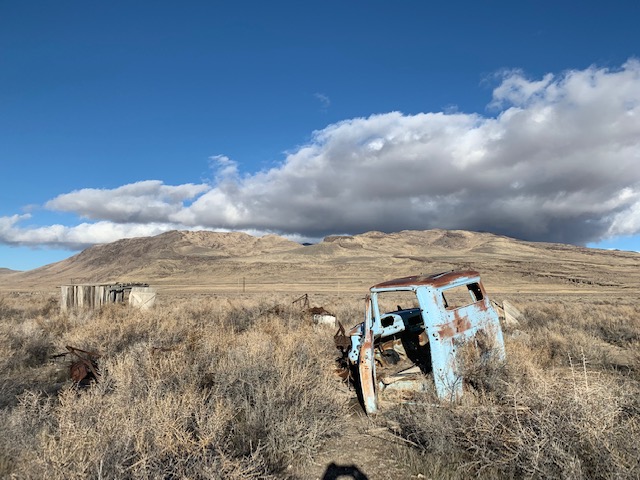
Amedee Mountains, as seen from the former town of Amedee, January 26, 2020
Amedee Mountains has a way of blending with the Skedaddle Mountains. Its best known feature is the archaeological site known as Tommy Tucker Cave. In 1907 gold was discovered on the mountain, causing a miniature gold rush where more prospectors could be found on the mountain, then gold. Whatever the case may be, there was enough activity to form the Hot Springs Mining District.
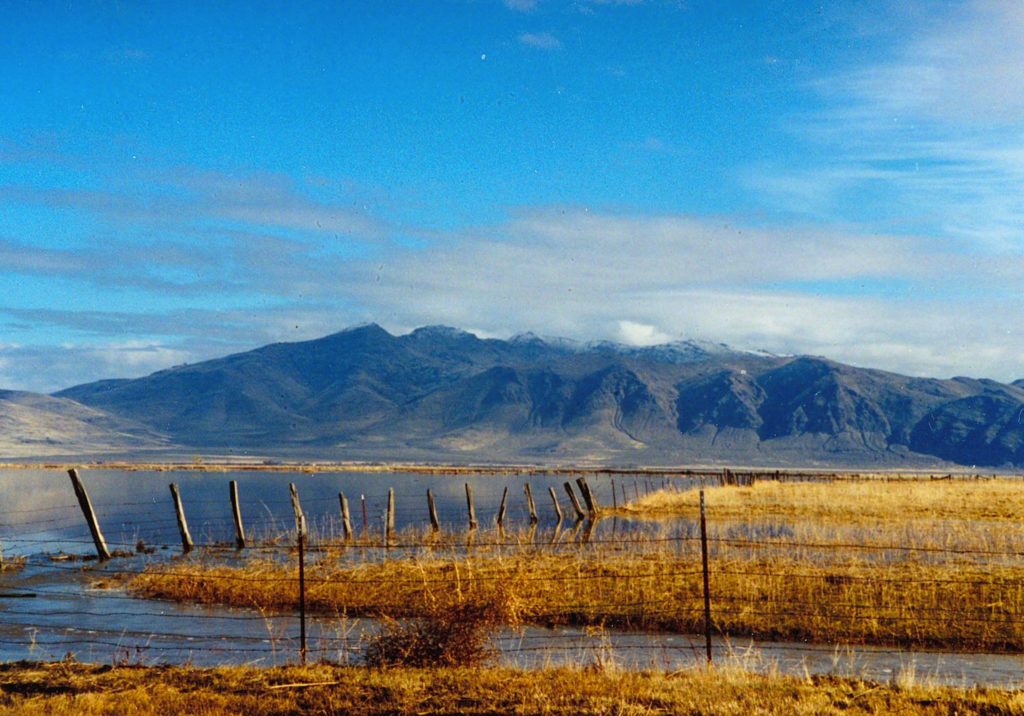
Honey Lake, with Amedee and Skedaddle Mountains in the background, 1997.
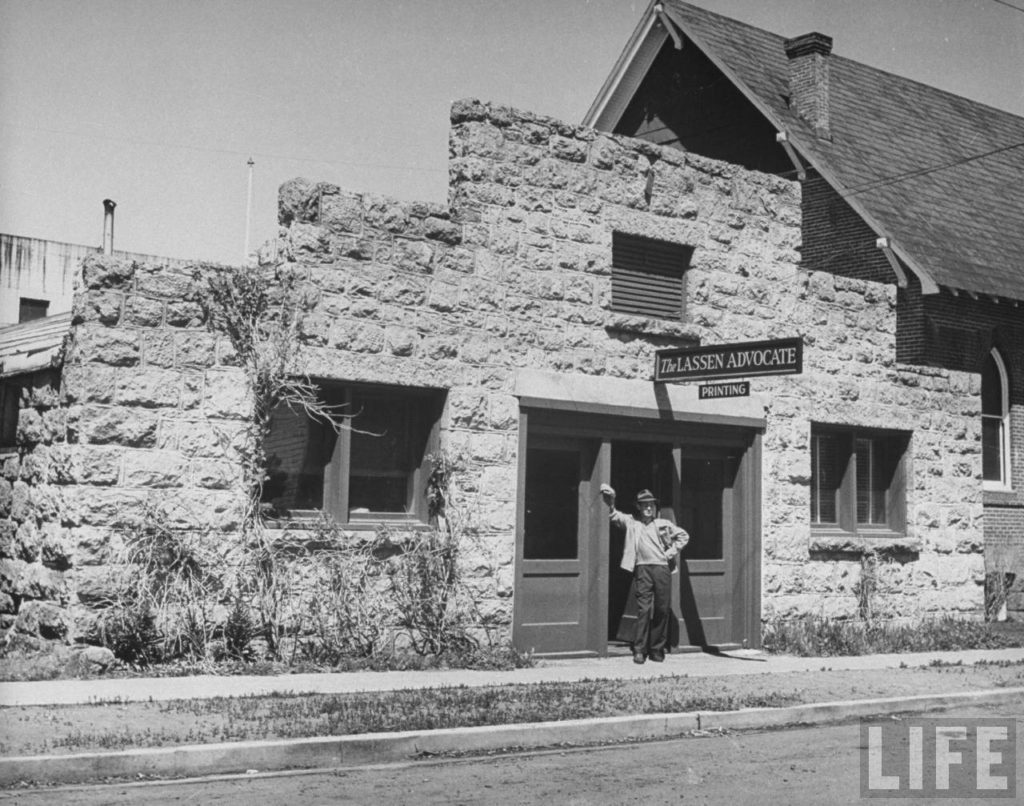
Ted Friend, publisher of the Lassen Advocate, 609 Cottage Street, Susanville, June 1944–Life Magazine
There have only been three structures on this site. Considering that it is one block off Main Street, in the original historic core of the town. In 1914, the first building on the site was moved from up the street. It was the old abandoned Congregational Church. C.E. Emerson who had a three-story hotel, along with his mercantile store was just across the alley, the current site of the Hotel Mt. Lassen. Emerson used this building as a warehouse. In August 1915, it caught fire that destroyed the entire east end of the block including the Emerson Hotel, the Hyer Hotel and the Methodist Church.
Emerson’s loss was only partially insured and was never ever to rebuild the hotel. He did construct a smaller native stone building fronting Main Street, that many people recall the home of Millar Hardware. Across the alley, and next to the Methodist Church a native stone building was built as Emerson’s warehouse. In March 1934, the Emerson Estate sold the warehouse building to the Lassen Advocate newspaper. In January 1963, the Lassen Advocate relocated to 2119 Main Street.
In the early 1960s, the Susanville Methodist Church needed additional space. A 1960 financial bequest by Elizabeth Lytle to the church’s building fund was a major boost. It was decided to purchase the Advocate building and build a second church building to house a Sunday School among other things. It progressed faster than anticipated and the native stone building was demolished in the fall of 1963. The church’s Fellowship Hall was built in 1967 containing a social hall, kitchen and classrooms. A dedication ceremony and the burning of the mortgage took place on May 12, 1978.
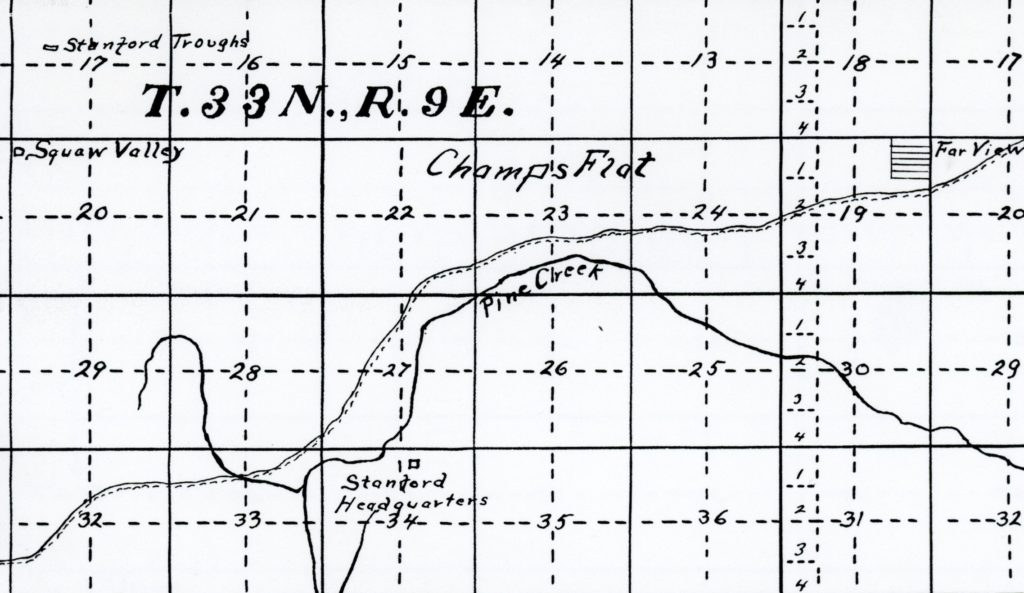
One would not think that Stanford University and Lassen County would be associated in any way, but that was not case. Leland Stanford had many interests. In 1881 he purchased Rancho Bosquejo at Vina, Tehama County. It should be duly noted, that this was Peter Lassen’s original Spanish Land Grant.
On May 26, 1899, Stanford’s widow, Jane, purchased 2,114 acres west of Eagle Lake from Champlin and Boggs for $8,000. This allowed for additional summer pasture for the Vina property. Ten days after the purchase, Jane transferred the title to Stanford University. In February 1924, the University sold its Lassen County Summer Range to J.J. Flemining at $10 an acre.
Spread the word, and encourage a friend to subscribe
It was on April 1, 1864 that Lassen County came into existence. It is interesting to note while Lassen County shares the date with April Fools, it is only fitting that its neighbor, the State of Nevada entered the union on Halloween, 1864. Also, notable on Halloween, Peter Lassen was born that day in 1800 in Denmark. It was on Valentine’s Day 1869, Susanville’s founder, and the first Provisional Governor of the Nevada Territory passed away from pneumonia at the age of 47.
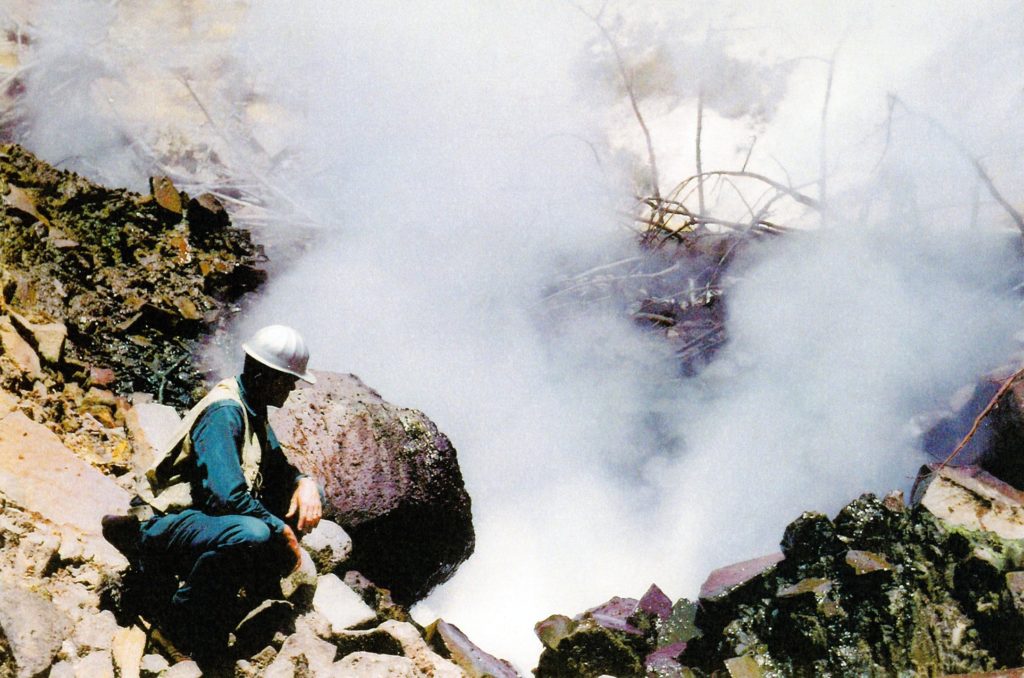
Terminal Geyser, is a odd hydrothermal feature in Lassen Volcanic National Park, located southeast of Boiling Springs Lake and Drakesbad.
In 1874, Dr. H.W. Harkness, who had come to inspect Cinder Cone, also paid Terminal Geyser a visit and wrote, “This geyser is ejecting boiling water to the height of ten feet.” Harkness’ guide informed him that it originally had a height of twenty to twenty-five feet. The guide did not elaborate on what caused the reduction of the geyser’s eruption.
In June 1890, a Chico Enterprise correspondent provided this
observation: “The old geyser above Willow Lake which will be
remembered by many tourists, is now extinct. Every sign of steam, hot water or eruption has gone. This geyser has been in active operation perhaps for hundreds of years. It may be that it will break out with renewed force, or appear in some other place.”
Another visitor to the geyser in July 1897 wrote: “The water in this spring used to spout to a height of 16 feet, but now rises but 2 or 3 feet. It is said somebody rolled a large rock off the mountain into it, spoiling one of the best wonders of that section.”
During the 1920s and 1930s, Clinton Walker, one of the owners of the property, became distressed over visitors throwing rocks into the geyser, disturbing the eruptions. It may be from these various accounts that someone finally applied the name “terminal” to this feature.
Spread the word, and encourage a friend to subscribe
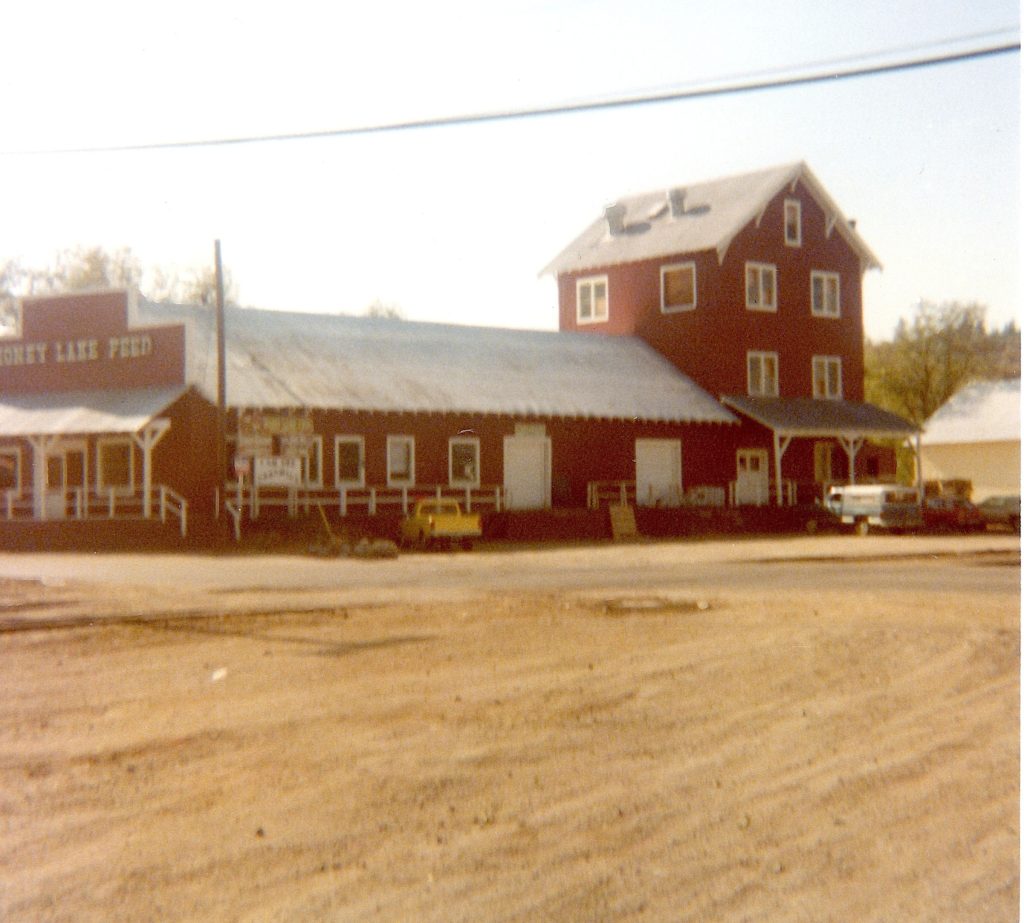
Honey Lake Feed located on Richmond Road, Susanville was the last of locally grown wheat/milled flour which the flour mill portion ceased in the 1940s. The building was destroyed by fire in the early 1980s.
I am pleased to introduce Mile High Mill & Grain Company located on Sunset Ranch near Ravendale. One can now obtain locally organic grown milled flour! The owners Tom and Andrea Traphagan has graciously extended yours truly to tour the facility, in which I will do a follow up later this spring.
In the meantime, you can learn a whole lot more by checking out their website at Mile High Mill
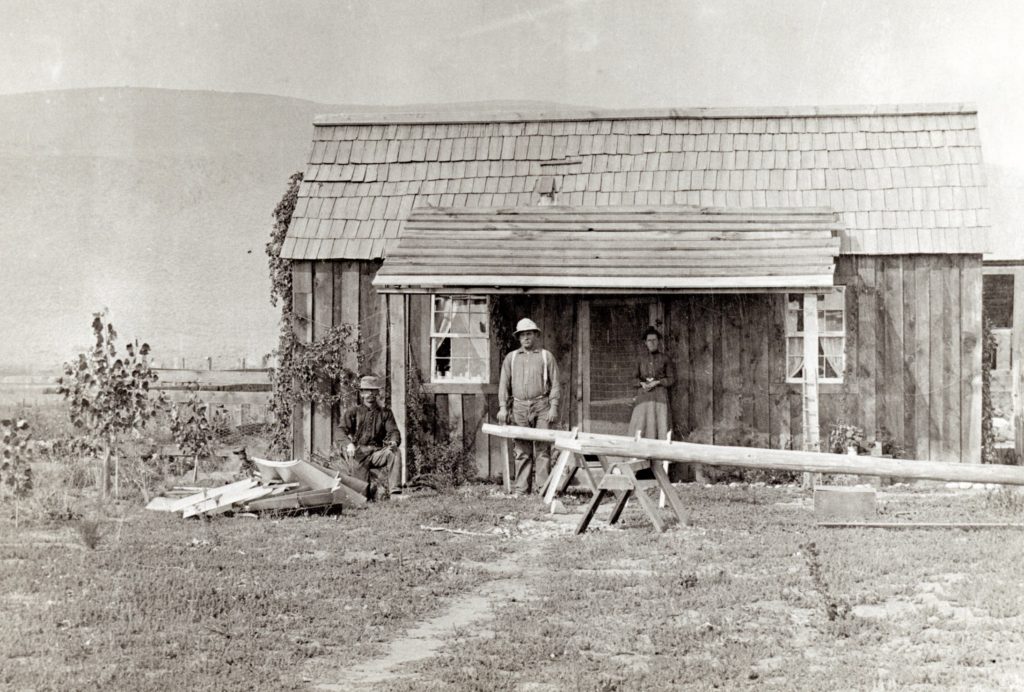
Robert & Mabel Barham homestead near Standish, 1903—Helen Rice
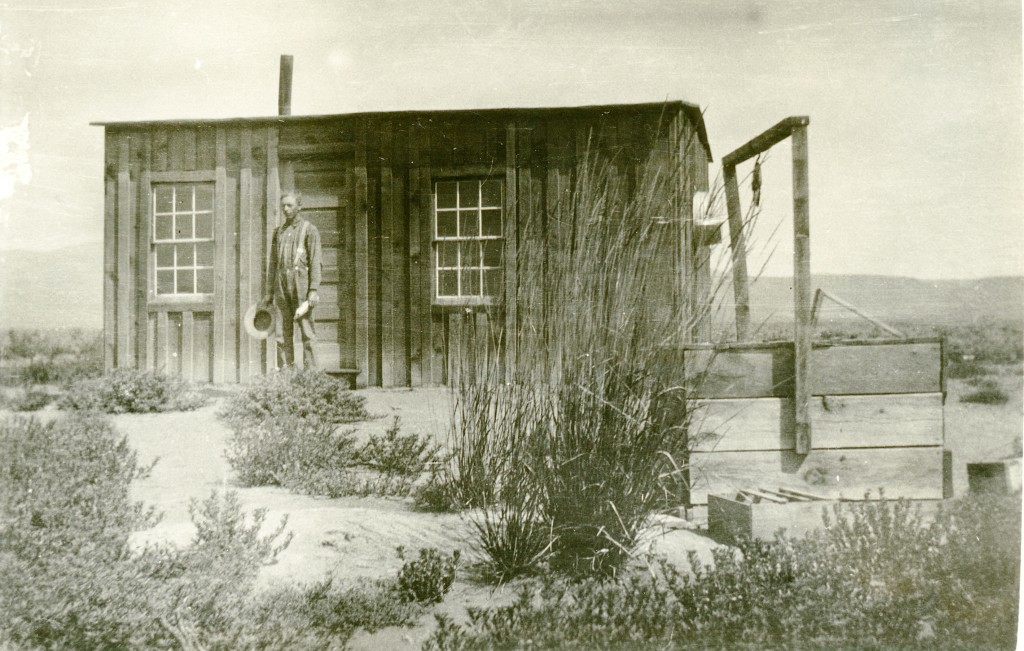
On May 20, 1862 President Lincoln signed the Homestead Act of 1862. It was part of the nation’s westward expansion and made filing on government lands easier. A great deal of the American West was settled in this manner, this region was no exception.
For a small registration fee, one could file on 160 acres of government land. After making improvements, and making it your primary residence one could acquire the title to the land at a cost of $1.25 per acre. By 1934, 270 million acres of government land had been transferred through this act. It remained on the books until it was finally repealed in 1976.
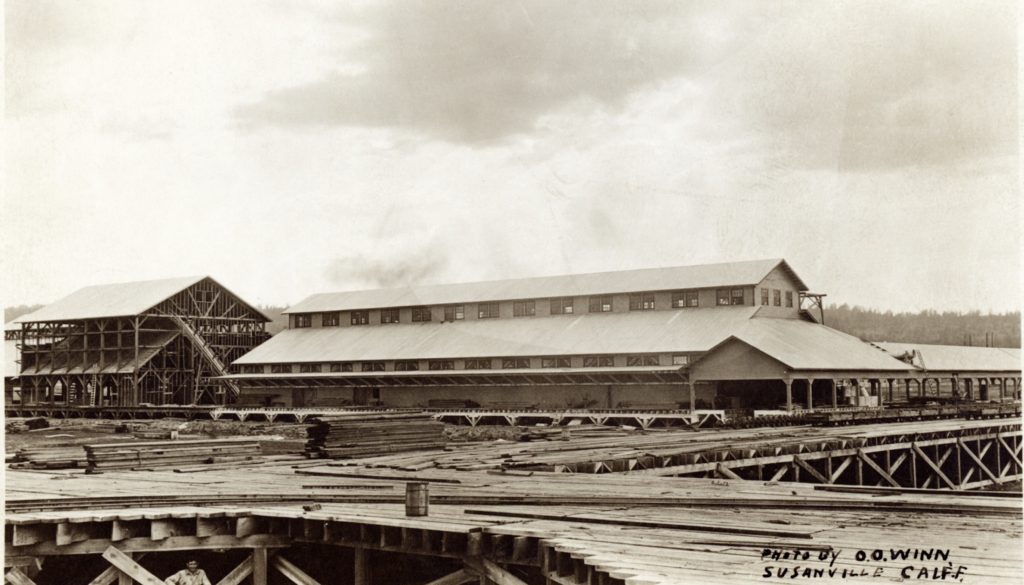
Fruit Growers Susanville Box Factory as it appeared the day it opened on April 9, 1921—Ed Standard
Yesterday, I briefly mentioned that during the Great Depression that some of the grower members wanted to sell the Susanville mill. Some thought the cost was excessive, after all the growers passed a four million dollar bond to finance the construction of the mill and to purchase a billion board feet of timberland in 1919. At that time the growers agreed to assess themselves two cents per box. In addition to the assessment, for every 1,000 board feet of lumber , four dollars was budgeted to pay off the bonds, generating $300,000 annually. In 1934 Fruit Growers paid off the bonds, two years ahead of schedule and its Lassen Operation was debt free!
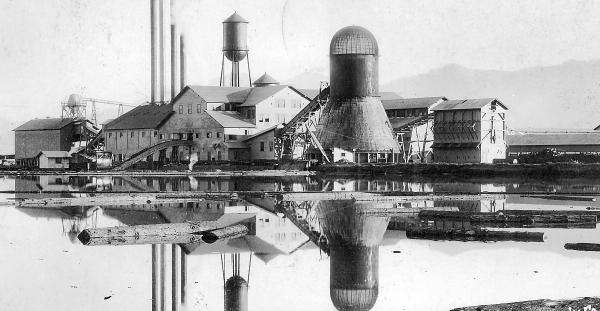
During the Great Depression of the 1930s Fruit Growers like so many sawmill operators on the West Coast had the debate whether to close their mills at Hilt and Susanville. This after all, with the realization that Fruit Growers could buy wooden boxes cheaper than they could manufacture. One other alternative was not just close the Susanville, but sell it.
The final decision was to keep the mills open. It would be costly, but Fruit Growers understood the long-term implications. If they closed the mills, they would lose many valuable employees and would be forced to start over once the economy rebounded. Logging operations at both Hilt and Susanville were suspended that year. At Hilt 1932 witnessed the end of railroad logging there. In addition in 1932, the Susanville mill operations were scaled back to a five-day week, rather than six to avoid layoffs. The decision paid off in the long run and were still able to meet the needs of the grower members.