The Naming of the Madeline Plains

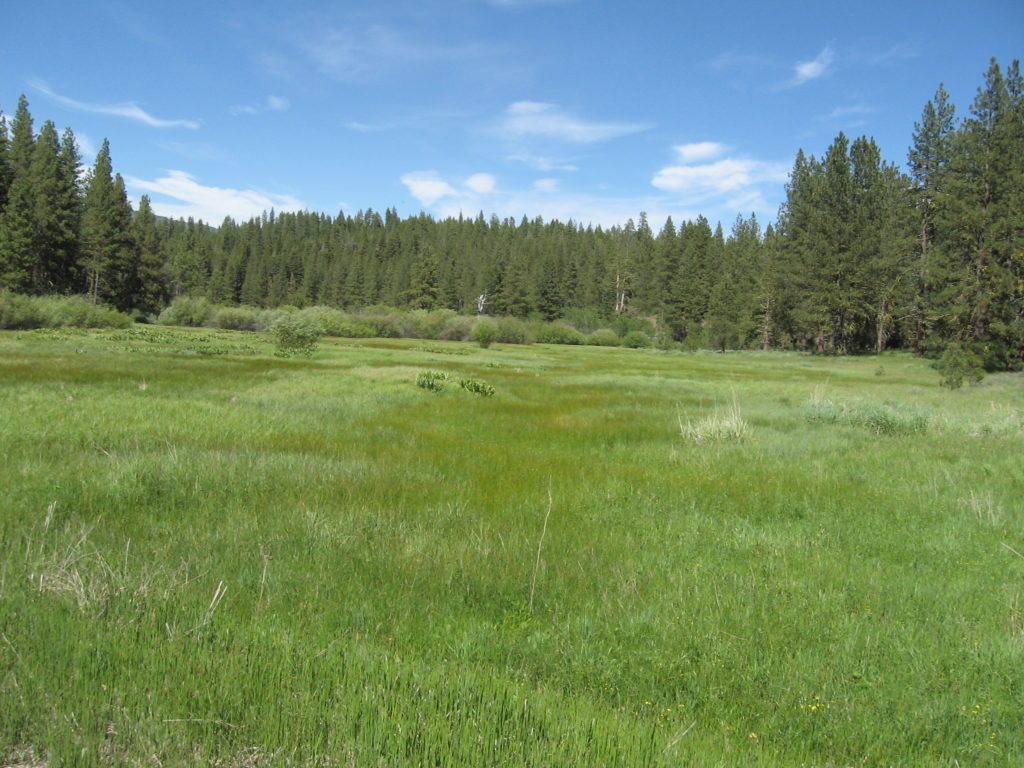
The site of the original McKissick Ranch on the Madeline Plains. It was the first place settled on the plains.

The Madeline Plains in northeastern Lassen County was one of the earliest places named in the county.  In 1853 Congress passed the first Act concerning exploration and surveys for a transcontinental railroad route. Lt. E.G. Beckwith of the Third Artillery was in charge of one of these explorations. Beckwith surveyed Northern California and Western Nevada region in search of a pass over the Sierra Nevada Mountains. In late June 1854, Beckwith entered the Madeline Plains via Smoke Creek Canyon and the east side of Observation Mountain. He named this the Madeline Pass for his daughter Madeline Julia, born January 25, 1853 at New London, Connecticut.  It should also be noted a week later Beckwith named Eagle Lake.

According to folklore attributed the name to an emigrant girl, named Madeline, who was murdered by the Indians in the 1850s. H.T. Risdon who established a sawmill on Bayley Creek in 1912 is credited for that tale.

Finally, it should be noted the Paiute name was Musitzi, though the meaning has been lost through the years. In addition, the Paiute’s territory was for the eastern portion of the Madeline Plains and the western half was the domain of the Pit River.

Become a supporter for just $5 a month to ensure quality history continues. Click here.

Eagle Lake Bass

EL Bass
Guy Talbott with his Eagle Lake bass catch, 1918

Between 1879 to 1956 there were officially twelve different exotic (non-native) species of fish planted in Eagle Lake. Yet, that figure could be higher since local anglers were known to have experimented with their own plantings.

Of all the varieties of species planted in the lake, only one truly flourished—the largemouth (black) bass. In 1901 the Lassen County Fish and Game Protective Association planted 147 bass in the lake that it had received from the California Fish & Game Commission. The following year additional bass were planted in the lake. To allow the bass to prosper the State Game Commission prohibited fishing of the bass for a period of four years. Continue reading Eagle Lake Bass

A Tuesday Tidbit-Dill Pickle Time

This is a little off beat. The above recipe was from June Moller, one of my instructors at Menopause Manor.  She would give those of the second floor of the Lassen County Courthouse a jar at Christmas. They are bit on the spicy side. June’s mother-in-law Hazel was born in Grasshopper Valley and had a post office named for her.

Another tidbit, once upon a time, the county recorder, would record most anything in Official Records. Not only one might stumble across poetry, but recipes, too.

Tim

A Picturesque Scene

Arnold Mill and Susan River

The Arnold Planing Mill along the Susan River near the Richmond Road bridge was one of the most photographed landmarks in the area before it was destroyed by fire in 1914. Of course, enhancing the view was the Susanville Grammar School (later renamed Washington) on the hill above. Then there was the wooden Richmond Road bridge that was replaced in 1915.

Richmond Road Bridge, circa 1910. Courtesy of Lola L. Tanner

Don’t forget to look at the Subscribe feature.

July 4, 1916

July 4, 1916 Parade, Main Street, Susanville.

The Susanville Volunteer Fire Department went all out to put on a two-day grand Fourth of July celebration for 1916. The festivities began at 9:30 a.m. on Monday July 3 with a band concert with the music provided by the Westwood Orchestra. This was followed by horse races, foot races, more band concerts, a boxing match topped off with an outdoor evening dance.

The activities kept coming the next day. There were firemen’s competitions between Alturas, Susanville and Westwood. There were more boxing matches, baseball games, band concerts with a parade that afternoon.

At 8:30 p.m. was the grand fireworks exhibition.  The location and viewing points were unique, no doubt with fire safety in mind. The fireworks display occurred at the intersection of Riverside Drive and Prospect on the bluff above the Susan River. The public was urged to view the fireworks on the opposing bluff where the Susanville Grammar (nee Washington) School. An hour later a Mardi Gras and carnival dance capped the celebrations.

The grammar school, 1915. Courtesy of Royce Houston


Support

Where Are We—Antelope Lake

Antelope Lake, January 26, 2020

Antelope Lake in Plumas County is a popular recreational spot for a number of Honey Lake Valley residents, as well as nearby Nevadans. It is part of the State Water Project of the California Department of Water Resources. The project’s original intent was to provide water to Southern California to augment that of the Colorado River. The State Water Project has 21 dams and over 700 miles of canals, pipelines and tunnels.

Antelope Lake is part of the project. The 113 foot tall earthen dam was constructed in 1964. It has a surface area of 931 acres with a maximum capacity of 47,466 acre feet.

Tim

Quacky Folklore

Hayden Hill School, 1918. B. Dorsey Collection

The following is kind of daffy considering the source. In January 1964, the Lassen County Historical Society published a bulletin on Hayden Hill. Nothing to dramatic, until in a section of tidbits referred to as “Did You Know,” becomes bizarre, which the following appeared.

“When the election for County Seat was held during 1864, Susanville, Janesville and Hayden Hill were the three towns selected at the meeting held April 1. On May 9, 1864, a vote was taken and when the votes were counted it was a close choice. Susanville won over the other two by one vote.”

The author of above, also wrote the early history of Hayden Hill which appeared in the same publication. It is duly noted that gold was discovered at Hayden Hill in 1869, though the mining town was not established until 1870–six years after the county seat election!

Subscribe

Red River Control Burns

Camp 38
Camp 38, Red River Lumber Company, 1922. It was located on the east shore of Lake Almanor. Courtesy of R.S. Pershing

While I have touched upon this topic before, I came across an interesting letter and how Red River was managing its forest. There are a number of institutions that search this site for all kinds of information, natural history being one. As public service, I bring this bit of information to the surface for future researchers.

On August 10, 1935, Clinton Walker wrote to his brother Archie, who resided in Minneapolis. Archie was stable figure in the Red River Lumber Company’s management, since the company had vast holdings there as well.

Clinton was involved in the initial timber acquisitions in California. In 1913, he resigned over a family dispute on the future operations. He came back into the fold during Red River’s financial crisis of the 1930s. Enough background and onwards to Clinton’s commentary.

”It is regrettable that the house of Walker has no forest man. Kenneth [Walker] covers the nearest, but he seems to be absorbed in the performance of log contracts; our annual fire and insect losses are staggering. A systematic annual light burning at the right season of the year would reduce an ultimately eliminate these sources of loss and the cost would be insignificant as compared to the loss and yearly fire hazard conditions in the forests. Burning by means of power burners on or dragged behind tractors could be done very cheaply and the prospective danger of injuring hollow hulled trees could be eliminated by following the burning with a few shovelers. For the entire period of the Walker family timber operation we have centered our attention exclusively to lumber operation. We are doing nothing but slash down that wonderful forest and letting the fire and beetles burn and eat us down year by year without raising a hand to afford protection from these annual staggering losses.”

Support

Exploring Lassen County's Past