Many will consider this rather mundane, yet the daily goings on whether past or present have their cycles, some dull and others dramatic. On the same token, a century ago left remarkable paper trail. In this digital era future historians will not have the luxury of sifting through paper documents.
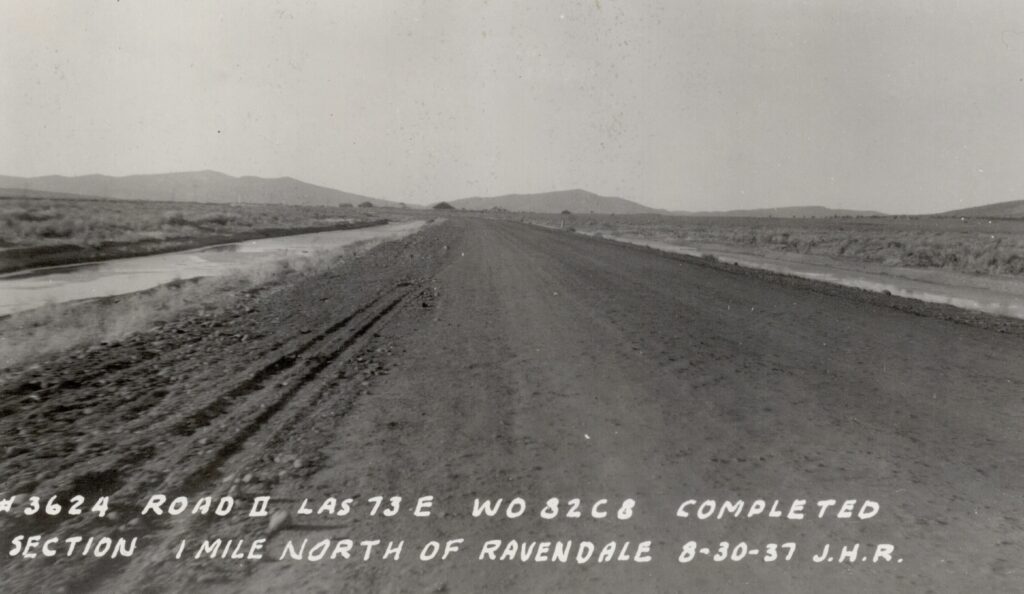
While sorting through records I came this 1937 report from the California Division Highways pertaining of road work on Highway 395 between Termo and Ravendale, photographs included. The cost of widening the shoulders gravel and oil base was $23,100.
In 1897, California approved legislation for the formation of public irrigation districts. It was fairly simple two-step process. The organizers first had get approval of the county board of supervisors. When that was accomplished, the California State Engineer’s Office would review the proposal whether the water source was sufficient and that the project was financially feasible.
In January 1918, W.G. Wilds, A.L. Lincoln, W.D. Grivel, F,M. Dinsmore, H.O. Edwards, Carl Wirth, Peter Anderson, Joseph Gronoski, James Godman, Bruno Wirth and W.H. Evans all of Ravendale petitioned the Lassen County Board of Supervisors for the formation of the Painter Creek Irrigation District. Painter Creek & Flat is a remote location east of Madeline Plains.
On March 4, 1918 the Lassen County Board of Supersviors approved the formation of the Painter Creek Irrigation District. The County Clerk was instructed to notify the California State Engineers Office who had the final say. No doubt that office must have bewildered by the proposal. This agency denied the proposed irrigation district.
Glade is/was located in the southeast portion of the Madeline Plains. Its most prominent landmark is the old Horne Ranch that was established in 1870 and one the first places settled on the “plains.” The name, purported]ly, is from an old Germanic word for open space and there are lot of wide-open spaces on the Madeline Plains. The Glade post office operated from 1908 to 1918. The Glade School operated from 1916 to 1925 at which time it was annexed to Ravendale.
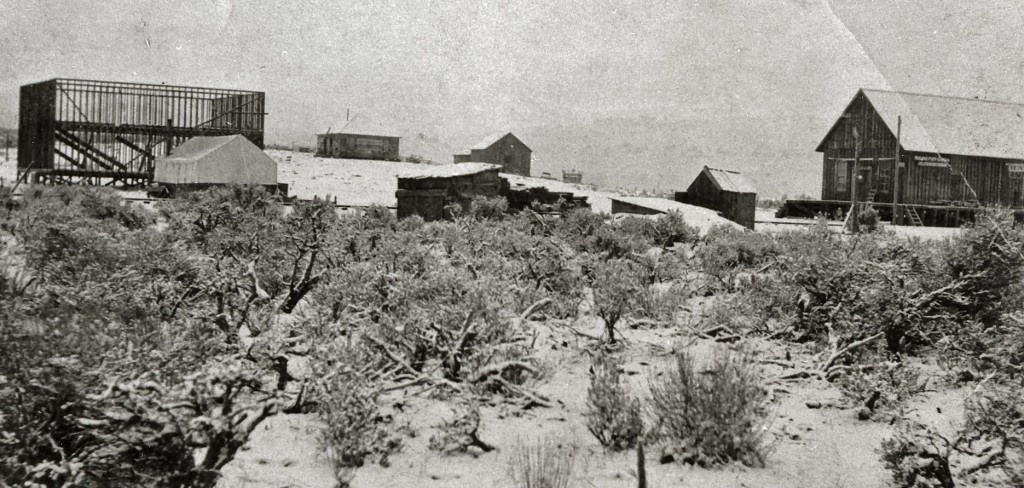
Early day Ravendale. Courtesy of Dorothy Capezzoli
This was an interesting tidbit that appeared in the Lassen Advocate of 4 March 1910. Madeline Matters appeared every week was from the local correspondent for the newspaper. “Dateline, February 28, 1910 –The new station of Ravendale on the eastern side the valley is rapidly being built and rumor has it will be a N-C-O division station. J.H. Williams and G. Horton are there at present writing surveying and plotting the townsite.”
It should be noted that the Ravendale post office was recently establish on February 2, 1910. Williams’s town plot of Ravendale would not be recorded with the County until November 15, 1913. What Williams’ qualifications to survey and plot is not known, but he served as the Justice of Peace for the Madeline Township.
In January 1899, the Nevada-California-Oregon Railway (NCO) after a decade of stalled construction announced its intention to construct northward. Of course, the rumor mill went into overdrive as to whether that route would include Susanville. The NCO stated it was to build onward to the Madeline Plains.
This event coincided with the recently organized Citizens Improvement Club of Susanville. E.V.Spencer and L.C. Stiles were appointed to negotiate with the management of the NCO, or in the instance the canterkous, Erasmus Gest, the general manager. They reported the meeting to be cordial, though the NCO was not going to extend any other assistance than what it had done in the past–nothing. The bottom line if the people of Susanville wanted to construct a feeder line to connect with NCO they would have to do it themselves. It was estimated that to build and equip the line would cost $100,000.
During the remainder of 1899, Spencer worked diligently for a railroad branch from Hot Springs (Wendel) to Susanville. Spencer consulted with the affected property owners along the proposed route to seek right-of-way. Spencer proposed that the line would not stop at Susanville but continue west into the timber region. He said this would create thousands of jobs in the lumber manufacturing business, and that everyone’s investment for the railroad would rapidly pay for itself. But it was a futile attempt. After all, the community could not even raise $450 for a town hall, let alone a $100,000..
It just never ceases amaze me, how some folks settled in an isolated location, when there were prime property to be had. A case example was Frank Eben Horne. When Horne came to California he settled in the Marysville region. By the late 1860s, he relocated to the Smoke Creek Desert, Nevada. In 1870, Horne became one of the first settlers of the Madeline Plains. He kept his Smoke Creek for summer pasture. Horne retired from his ranch in 1905 and turned it over to his sons. Actually, his son Will took over the home place, Arthur took Smoke Creek, and Frank, so the story got an education and moved on.
Will was quite the promoter. In 1914, he came of with a Russian Colony scheme. About three dozen Russian families arrived on the plains. After all, it was noted, if these Russians could make a living at farming in Siberia, than they could be really prosperous on the Madeline Plains. It did not work at well. Noted Madeline Plains historian, Don Garate, wrote the Russians were a lazy bunch.
One of the Horne’s family enterprises was the development of the Buckhorn Reservoir. In the annals of Madeline Plains history it was home to many irrigation/reclamation schemes. On March 28, 1917, Frank L. Horne, William R. Horne, and Arthur T. Horne, along with Raglan Tuttle and Grant M. Lorraine, formed the Horne Development Company–a promotion of a reclamation project. Things did not go as planned and on April 27, 1927, the Farmers & Merchants National Bank of Reno, Nevada, foreclosed on the Horne Development Company for $38,791.11 and became the owners of the Horne Ranch.
Horne Ranch Cemetery, 1985
In the 1990s, the Horne Ranch had a new lease on life when it was incorporated in R.C. Robert’s Spanish Springs development. This and other properties were made available to guests, whether their interest was equestrian pursuits, hunting, etc.
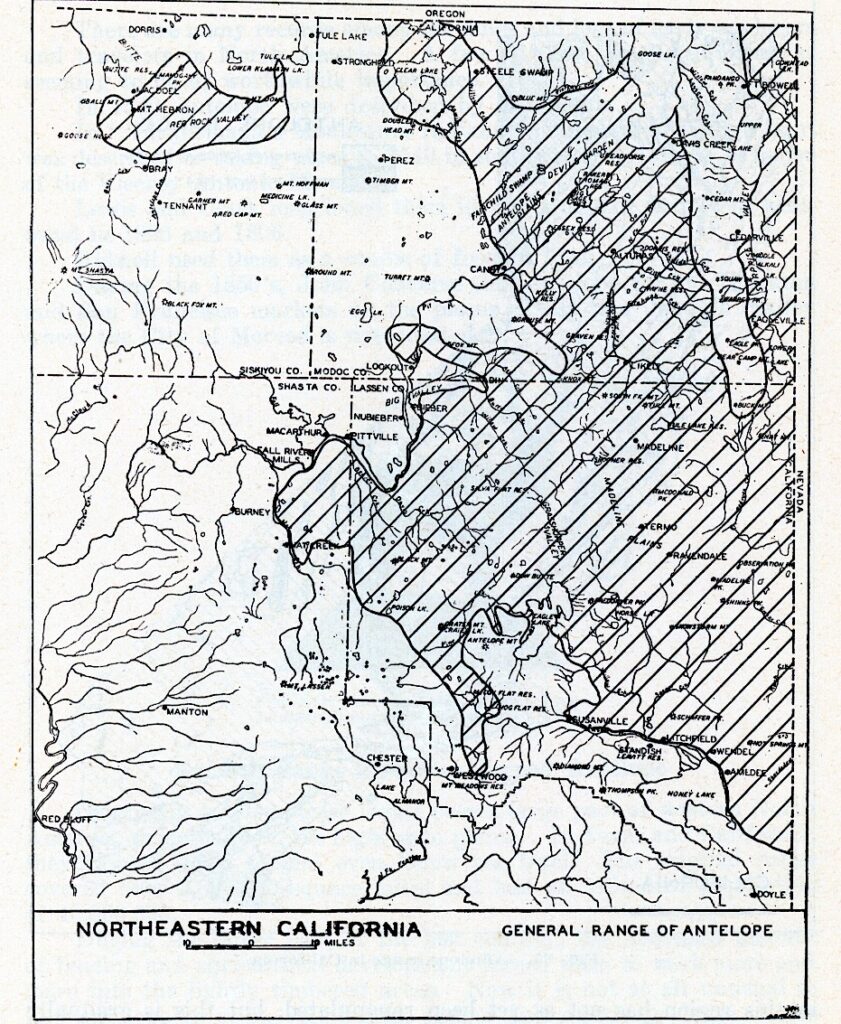
1944 distribution map of Antelope in Northeastern California.
Prior to the 1849 California Gold Rush the pronghorn antelope could be spotted throughout most of California, especially in the Sacramento and San Joaquin Valleys. Fencing and agricultural development in those regions forced them of that habitat. By 1920, some thought the antelope were on the verge of extinction with a population of 13,000 in North America. One of the largest concentrations of antelope were located in Lassen and Modoc Counties. .
A herd of antelope near Secret Valley, 1938.
Antelope are noted for their speed. They are latest mammal in the Western Hemisphere. They are also known for their curiosity. In 1944, Donald C. McLean of the California Fish and Game wrote: “On the Madeline Plains east of Ravendale, four antelope does ran along beside the car for about one-half mile at 42 miles an hour, suddenly put on a burst of speed and tossed directly in front, then raced along just ahead of the car for another one-half mile at about the same speed when they crossed over in front again and stopped about 100 yards from the road. These animals were certainly not particularly frightened. In fact, I think it was curiosity and the joy of a race that prompted them to stay the car for such a distance.”
In McClean’s report he noted that there was 4,504 antelope in Lassen County. The largest concentration was in the Skedaddle Mountain country. In Modoc, the count was 1,167. McClean’s report included a detailed account of census methods. The first two paragraphs are rather informative.
“Formerly antelope were estimated or counted by crews of picked men working from horseback or on foot. About six or seven generally made up a crew, working in twos orthrees in most areas. Occasionally, however, all joined to form one crew in places where large numbers of antelope in a limited area had to be counted one time to avoid the possible duplication that might occur if they were not all counted in one day. Because of soft ground and rocky terrain, most of the counting had to be done on foot. In order to count the two counties, Modoc and Lassen, properly each man of a six-man crew had to walk or ride about 600 miles–about 26 days of effort per man.
“The extensive use of the airplane was started in the late winter of 1941-42. This first airplane census was carried under the Federal Aid in Wildlife Restoration Act as part of Project California 12-R, “Aerial Survey of Big Game in Northeastern California and in the Owens Valley.” James D. Stokes of the Division of Fish and Game was the observer and. A.L. Reese the pilot during the 1941-42 survey. The 1943 and 1944 censuses were made with regular Division of Fish and Game funds, with D.D. McLean as observer and John Allen as pilot. This method is far superior to the old from the standpoint of speed, accuracy and expense.”
I have addressed this issue before, but there was an amusing editorial comment that appeared in the Lassen Advocate of December 23, 1914. One key background of information to make sense, in the fall of 1914, a Russian colony of immigrants of some fifty families had located on the eastern portion of the Madeline Plains.
Herewith: “It would seem that the ‘pesky jack-rabbit” is doing someone good in the world after all. The Russians in the northern part of this county are using the flesh for food, and caps are made of the fur. Recently a number of Reno sportsmen killed 518 rabbits and these were given to poor families in Reno for food.”
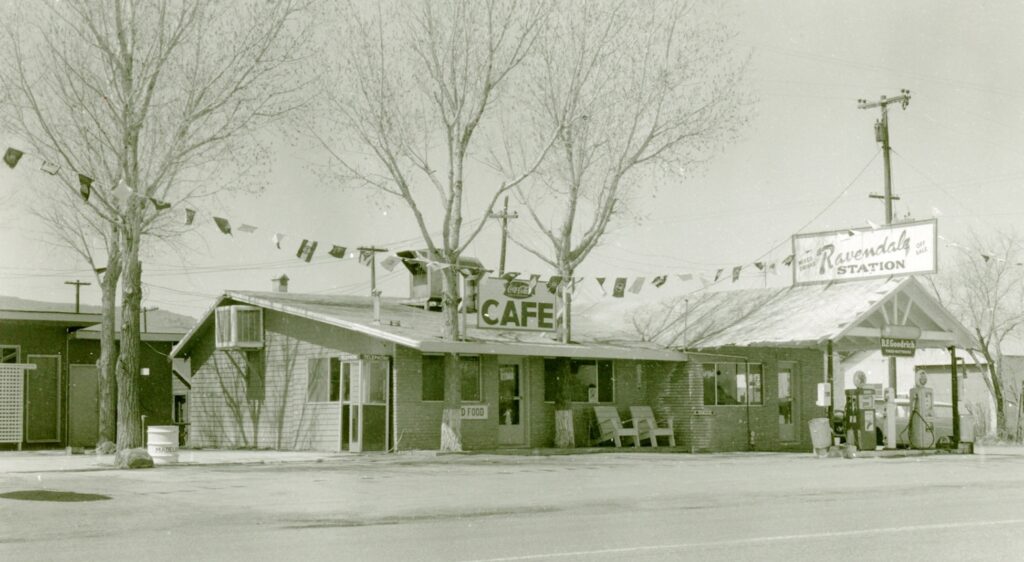
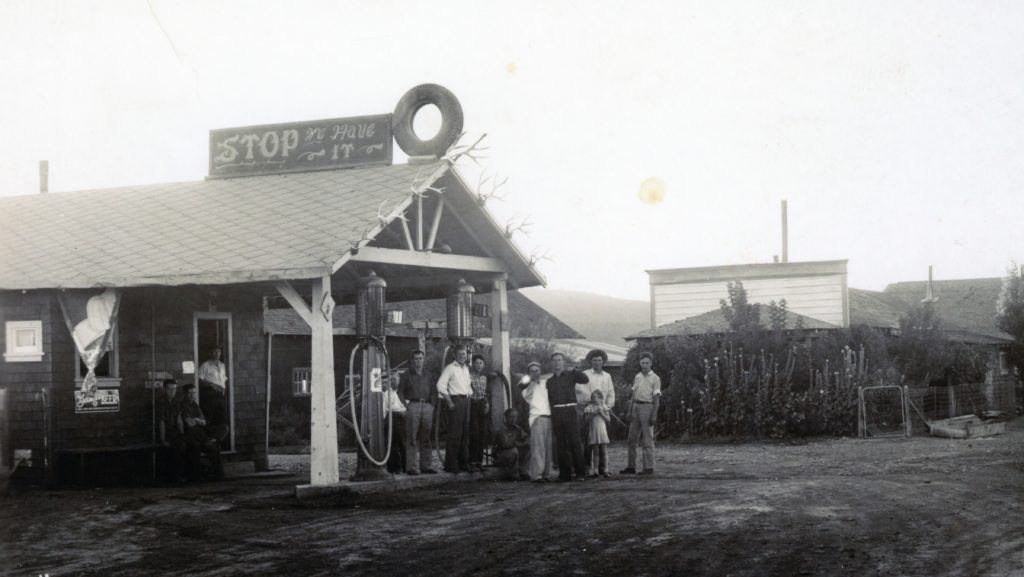
Back in July I did a request post for information about the Ravendale Bar and Restaurant. Armour Edwards built a service station in 1925. Some time after the repeal of Prohibition in 1933, a bar and restaurant was added. Over the years a motel was constructed across the highway.
The Ravendale Garage., circa 1930
This enterprise was a favorite with locals and travelers alike. It 1955 it was named Ravendale Station. The business was a limited partnership between Leo and Martha Burdick and Paul Langslet.
The landmark bar/restaurant burned down in the fall of 1983, either in October or November. The fire was of suspicious origin and one person recalled that when the fire was discovered it was burning at two separate locations. When more information about the history of the establishment becomes available an update will appear.
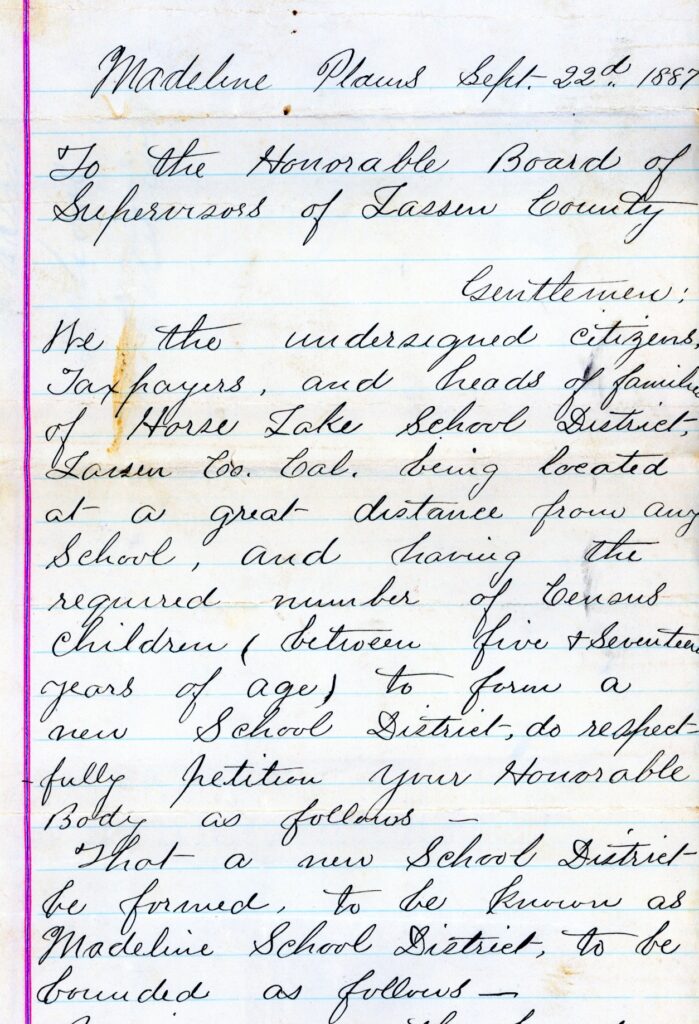
In the fall of 1887 Madeline Plains residents petitioned the Lassen County Superintendent for a new district to be named Madeline. It was signed by thirteen residents who have sixteen children. After all, they cited the nearest school was Horse Lake. In 1888 the petition was granted.
A school house built at the A.W. Pinneo, three miles south of the present day Madeline. Then, in 1902, courtesy of the NCO railroad saw the creation of the town of Madeline. The district hired Ike Metcalf to construct a new school there. In the fall of the 1927, that school was destroyed by fire. The school trustees had planned to construct a new building. But another opportunity arose, and they purchased Cliff cCarter’s house and converted into a school. The Madeline School closed in 1968.