At the March 1926 meeting to the Lassen County Fish & Game Conservation league there were two interesting topics. It should be noted the League was an organization comprised of sportsmen to aid and support the county’s fish and game commission.
The first matter they approved the law to spear bass at Eagle Lake. Even though there was a ban of spear fishing of bass at Eagle Lake, it was ignored and not enforced.
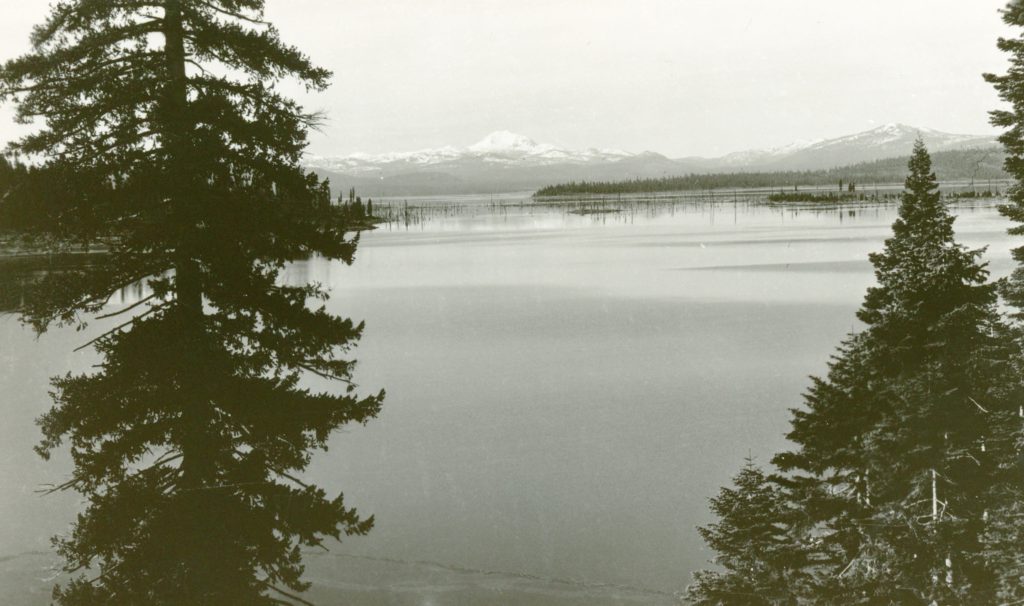
The second issue concerned the Eagle Lake trout and the effects of drought and the Bly Tunnel lowering the lake. The local fish & game commission proposed an egg collection station at Pine Creek and establish a hatchery at nearby Willow Creek. This received enthusiastic support from the league.
The proposal was to intercept the trout during their annual spring run up Pine Creek with nets and fish traps to remove the eggs and then return the trout back to the lake. The commission stated there was a great amount of trout that perished each year with the drying up Pine Creek. With that in mind, the eggs would then be taken to the proposed Willow Creek hatchery and when the fish were sufficiently developed, be planted back into the lake.
These folks were ahead of their time. In 1958, the Wildlife Conservation Board allocated $38,810 for a fish trap/egg collection facility for Pine Creek.
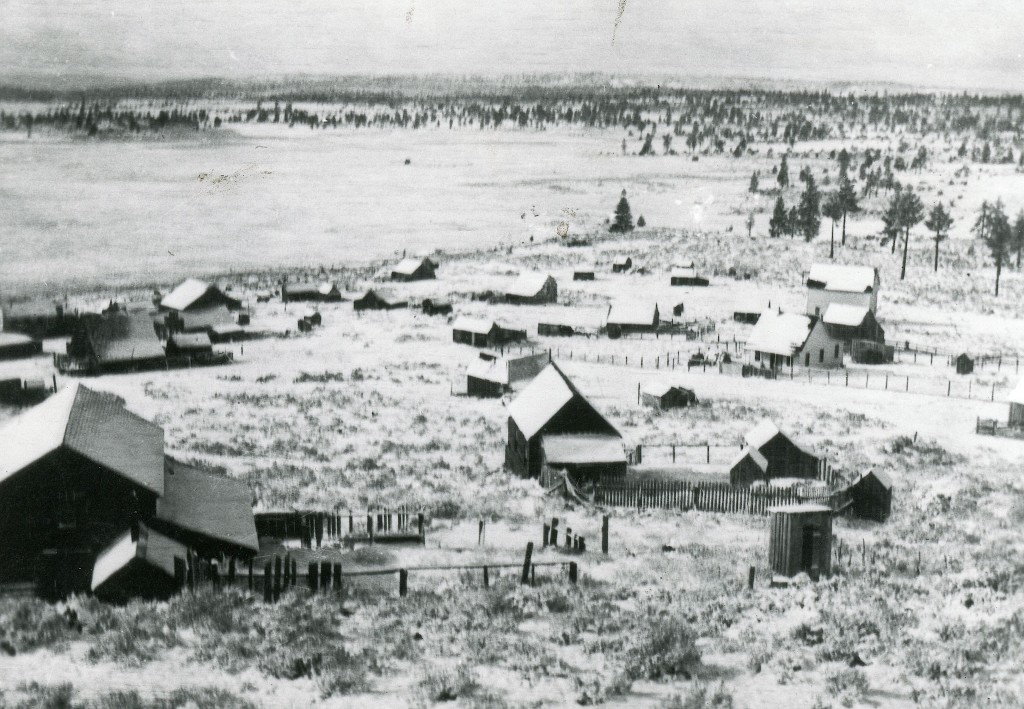
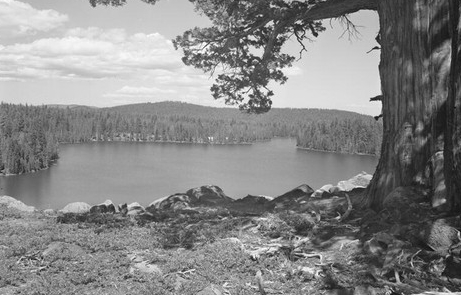
Pine Creek, 1921. Courtesy of Lola L. Tanner
It should be noted the league had a membership fee of one dollar a year. The money raised to provide financial assistance to the fish and game commission.
Honey Lake Gold Mine, 1936. Courtesy of Jere Baker
The following account was provided by Jere Baker and originally appeared in Lassen County at 150.
In 1929 the Honey Lake Valley Gold Mining & Development Co. was incorporated. Two years prior to that event, Hilding Sundberg, a mining man from Oakland, California took possession of an abandoned gold mine called the Badger Group located some six miles southeast of Milford on the Diamond Mountain range at an elevation 6,000 feet. Sundberg began work on the property with a new cross-cut tunnel, reaching a small vein of gold 300 feet in. The property was incorporated in 1929 with Sundberg as the new president and general manager of the new company. A second tunnel was cut 720 feet into the mountain, 500 of which were driven along a ledge of gold ore. Assayed samples taken from tunnel no. 2 showed an average of $55.00 a ton. A third tunnel was started at the mining company’s base camp at the 5,000 foot level. Sundberg took a calculated risk that a horizontal tunnel driven far enough would reach the same vein of gold, whereby the entire body of ore could be mined by gravity at a much lower cost. Continue reading Honey Lake Gold Mine→
Amedee, January, 1916 courtesy of Marie Herring Gould
If anyone is so inclined that they would like to submit something of interest, you are more than welcome. Back in 2016, I included a piece by Jere Baker about the Honey Lake Gold Mine near Milford of the early 1930s. I am going to repost it tomorrow.
Baker’s tome might seem intimidating to some for its depth, his work was an excerpt about the life of his grandfather, C.F. Compton. Maybe you might have a short amusing anecdote to share. I will pass on a amusing one. Way back when, I would visit Alphozene Perry Wood Terril, granddaughter of Ben Leavitt (1835-1915). For those not familiar, Leavitt was an influential person in his time, his lasting legacy of many is the development of the irrigation system for Susan River. Alphozene shared this unique interesting tidbit about her well-known grandfather. On occasion she made his breakfast that consisted of two raw eggs poured into a glass with rock and rye whiskey. That is not the way I would want to start my day.
Sail Rock, Fort Sage Mountain, June 7, 2018
Not sure what to give that special someone, but want to keep the budget balanced too? Why not a gift subscription to tipurdy.org. At five dollars a month it is a bargain. You can decided whether for a month, quarter or even splurge for a year.
The recipient not only receives email notification six days a week, and sometimes seven, of the latest topic, and can always request a topic, too. Many subscribers can attest that it is a great way to start the morning.
In addition, don’t forget the 2022 calendar, and books, too!
Information on subscriptions is found right here. Have a question drop me a line at tim.purdy@icloud.com
In 1914, Red River Lumber Company opened a private high school, that even included night courses for the benefit of the employees. In the fall of 1916, the high school was converted into a public one with an enrollment of forty students. Initially, the grammar and high school shared the same building, but with increasing enrollments it was determined the high school have a building of its own. In the fall of 1918, a new two-story high school was built adjacent to the grammar school. Dedication of the new high school did not occur until March 8, 1919. Red River paid for the construction of the high school, which normally residents of the school district would have passed a bond measure to do so. However, the State of California paid the teacher’s salaries.
Litchfield Depot of the Fernley & Lassen Railroad, 1947. Courtesy of Camilla Moody
More progress has been made about the history of the Litchfield Depot. Bill Shippen, Jim Sweetser and Mike Yoakum were able to provide me with more information to make the search easier.
In October 1915, the Southern Pacific Railroad announced that a depot would be constructed at Litchfield. The company hired J.F. Steinman of Colfax as the contractor. The two-story structure would have living quarters on the second floor. The building’s dimensions 40 feet by 105 feet, with a platform 70 feet long. By Christmas it was in operation. In mid-January 1916, the water tower was completed.
Litchfield Depot, 1920–Lola Tanner
It appears the depot closed sometime between the fall of 1953 and the spring of 1954 and probably torn down in 1956.
The local veterans had a packed day for the 1938 Armistice, known today as Veterans Day. First and foremost was the annual parade from the Memorial Hall to the head of Main Street, were a plaque had been installed commemorating the soldiers of Lassen County who had fallen during the Great War, as it was known at the time, but later became known as World War I.
Following the parade, at noon time, a new flag pole dedication was held at the Lassen Union High School. Later in the afternoon a football game was held at the school between Lassen and Westwood. That evening a banquet was held honoring those who served in World War I. The next evening the Thomas Tucker Post of the American Legion sponsored a Armistice Ball, held at the Cindercone Dance Hall at Standish.
In the spring of 1914, when Lassen Peak came roaring back to life as an active volcano, it brought about a whole new set of issues, that had never been addressed.
In the fall of 1914, Francis M. Garner had a homestead on federal land some twenty miles west of Lassen Peak. Since the eruptions were constant, with no end in sight, Garner began to worry about his home. He feared it could be destroyed by volcanic ash and even worse lava. He wrote to the Government Land Office about his predicament. What Garner wanted to know, if he was forced to abandon his homestead, he wanted to know if an exchange could be made for other government land. If Garner received a reply from the Government Land Office, the contents are not known. On the other hand, while Garner’s homestead was never threatened, he did abandon his homestead.
Native Daughter’s plaque for Fort Janesville site.It was actually built in 1860.
Yesterday, I wrote about the military presence in the region during the 1860s. There is a little follow up about how the locals took matters into their own hands so to speak. Those early day Honey Lakers were an independent lot. They had to. Their numbers so small, and far removed from the gold fields, they had no choice but to be resourceful and make do the best they could with their own resources.
Since military assistance was not reliable, Honey Lakers took matters into their own hands. Captain William Weatherlow usually was the one to form a posse when needed during the conflicts of the Indians and settlers. During the Pyramid Lake Indian War of 1860 the residents of Janesville built their own stockade for protection known as Fort Janesville. In 1864, a local militia was formed known as the Honey Lake Rangers which functioned similar to a National Guard Unit.
Smoke Creek Desert looking towards Sheepshead, fall, 1977
First of all, I want to acknowledge the late J.S. Thompson, who was not only a good friend, but one of his main interests was early Nevada military history that he graciously shared with me.
United States military presence in the Honey Lake Valley was sporadic during the Indian conflicts of the 1860s. Initially, Fort Crook, now Fall River Mills, during the 1850s was the nearest military outpost. In 1858, Fort Crook soldiers had an encounter with Pit River Indians at the northwest corner of Eagle Lake, but never ventured to the Honey Lake Valley.
Relations between the Native Americans and the Anglo settlers had deteriorated by1859. The murder of Edward Clapper and Peter Lassen in the spring of that year in the Black Rock Desert, did not help matters—the Indians rightfully/wrongfully were accused. Between that episode and increased traffic on the Nobles Emigrant Trail, the military made an appearance. During the summer of 1859, a military outpost known as Dragoon Bridge or Willow Creek Station was established along the Nobles Trail where it crosses Willow Creek in the Honey Lake Valley. These troops came from the San Francisco Presidio.
Tensions between the Anglos and the Indians did not improve. On January 13,1860 Dexter Demming was murdered by the Indians in Willow Creek Valley, north of Susanville. It was like a slow burning fuse that would ignite into the Pyramid Lake War of 1860. After Demming’s death the Honey Lakers petitioned California Governor Milton Lathom for military assistance. By the time their letter was received in Sacramento, Lathrom was out of office, he only served five days as governor!
Not all was a loss. In the summer of 1860 the San Francisco Presidio sent troops to the Honey Lake Valley and established Soldiers Bridge along the Susan River near present day Litchfield.
Susan River, near the Soldier Bridge military site. November 19, 2015
In 1861, the area had no military presence. Things changed quickly with the mining discoveries of the Humboldt in Nevada and the quickest route was via the Nobles Emigrant Trail. This prompted military officials to establish a permanent military outpost at Smoke Creek near the California/Nevada border. The troops, it should be noted came from Fort Churchill, Nevada.
For whatever reasons a mobile military unit named Camp Johns established a base camp near Susanville in June 1864. They did a reconnaissance of the area to Modoc and Northwestern Nevada. The troops came from Fort Churchill and returned there in August. They were replaced with a new set of soldiers with the same mission, and the camp was renamed Susan. It lasted briefly, and the soldiers returned to Fort Churchill in October.
That was the end of actual physical military presence of the region until the establishment of the Sierra Army Depot in 1942. However, there were Camp McGarry and Fort aka Camp Sage that I will write about in future posts.