Sunkist Lodge, Eagle Lake

The water carnival at the Sunkist Lodge, 1921. Courtesy of Ed Standard

In 1921. Fruit Growers Supply Company built a cabin at the south shore of Eagle Lake. They named it Sunkist Lodge. It was built for the recreational needs of its employees. Even though Fruit Growers closed its Susanville operations in 1964, employees of Fruit Growers who worked at Burney, Hilt and Los Angeles still vacationed there.

Another view. Courtesy of Ed Standard

In 1921 and again in 1922, Fruit Growers sponsored a water carnival at Sunkist Lodge. This was a water competition between the three big mills—Fruit Growers, Lassen Lumber & Box Company and Red River Lumber Company. The event attracted large crowds of over a thousand in attendance. For the overflow camping, a new site was located and dubbed the Circus Grounds.

In 2019, Fruit Growers sold its Lassen Operation holdings to Sierra Pacific Industries. In 2021, Sierra Pacific has placed this parcel for sale.

Never miss a story click here to subscribe.

It Was Just A Matter of Time

Susanville Depot, 1970.

In December 1955, the Southern Pacific Railroad track between Susanville and Westwood experienced severe damage from unusual winter flooding in the Susan River Canyon. Earlier that year, Fruit Growers Supply Company announced it was closing the sawmill at Westwood. With the closure of the mill, freight traffic from Westwood would be minimal, so the Southern Pacific decided it was not worth the cost to make the repairs and closed down that segment of the line between Westwood and Susanville.

Two decades later, witnessed the slow decline of lumber shipments by rail with Susanville’s two remaining sawmills, Coin Lumber and Sierra Pacific Industries. It was just a matter of time when the railroad would shutter the Susanville Depot. That day came on October 12, 1979.

Depot 78
Susanville Depot, September 1978.

Subscribe and support this site for as little as five dollars a month.


Preparing for Winter – Log Decks

Red River's winter log deck near Camp 16
Red River’s winter log deck near Camp 16

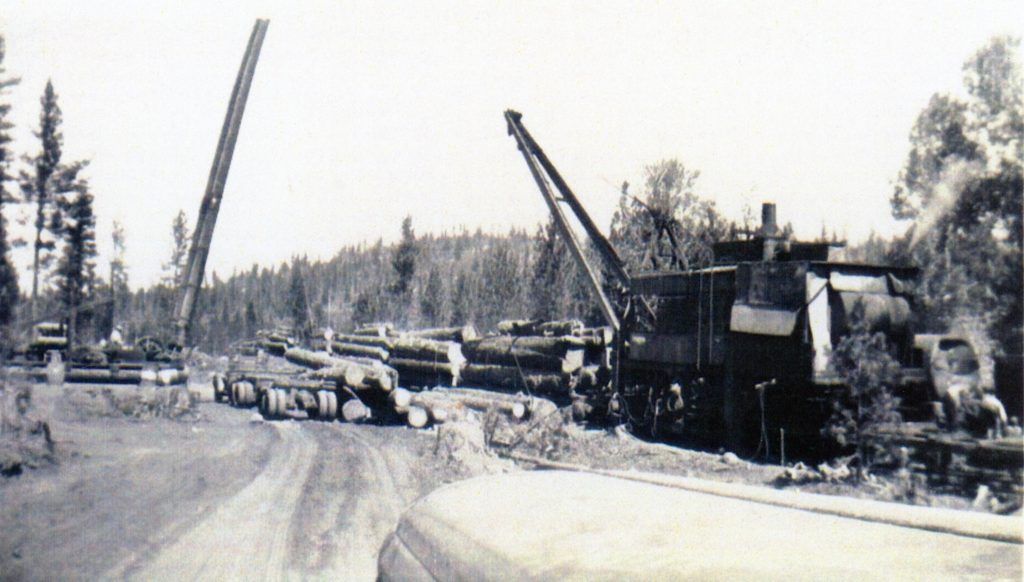
The two largest mills, Fruit Growers and Red River maintained two type of winter log decks. Usually, normal logging operations ceased in November. Yet, to keep the mills operating throughout the winter, required to have a substantial amount of harvested timber. There was the log deck at millpond, and then a second one out in the woods.  The latter was not brought into the mill until spring, since the winter mill supply was nearly exhausted. The log decks in the woods provide enough logs during the transition, since it would take some time when the logging camps opened in the spring, to provide a steady supply to the mill.

It should be noted the decked logs in the woods, were protected with heavy snows, thus preventing checking or blue stain.

Never miss a story, click here.

A Familiar Landmark

The old Jakobs homestead, Willow Creek Valley—Photograph by Darwin Solus

Those who frequently travel Highway 139 through Willow Creek Valley, just north of Susanville will easily recognize this landmark.  Since the photograph was taken, the roof has collapsed. There was a time, that seasoned residents may recall there were two structures there.

In 1869, Adam Jakobs settled there. In 1898, he sold to Fall River Mills rancher, Frederick Knoch for $2,500. Knoch moved there with his wife, Helena, and their two youngest daughters, Mary and Lillie. According to family lore, Mary had a romantic interest with one of the McArthurs and her parents objected, hence the move. Mary eventually married, Willow Creek Valley, neighbor Edward Murrer. Next Lillie married Susanville rancher John “Fritz” Brockman. In 1902, with both daughters married, Knoch  sold the place, and returned to Fall River Mills.

In the 1920s, Jessie Collier was the last person to reside there, and the buildings since abandoned, with only one standing.

Support

The Almanor Post Office

Plumas Pines
The Almanor Post Office was located inside the Plumas Pines Resort

In 1932 Adelaide and Fred Smith established the Plumas Pines Resort on the west shore of Lake Almanor, located between the Lake Almanor and the relocated Prattville Cemetery. On July 15, 1932, Adelaide became the postmaster of the newly created Almanor Post Office. The post office was seasonal in nature, only open during the summer, i.e. May 1 to September 30.. It should be noted the Chester Post Office originally was a seasonal post office.

In September 1951, Adelaide Smith informed the postal authorities and the public that she would retire as the Almanor Postmaster effective September 30. It should be noted that her husband Fred had passed away in 1946, but she kept the resort running. In the spring of 1950, she sold the Plumas Pines Resort to V.Y. Briggs.

Of a final footnote, the following year on June 16, 1952, the Canyon Dam Post Office opened with Emmett W. Bishop, serving as first postmaster.

Donate

A Different Kind of Party

This 1931 gathering was held at the home of Blanche & Ike Knoch, frequent hosts of such events. Courtesy of Hank Martinez
This 1931 gathering was held at the home of Blanche & Ike Knoch, frequent hosts of such events. Be sure to click on the photograph for a larger image. Courtesy of Hank Martinez

Back in the 1920s and 1930s certain segments of Susanville’s Society entertained in a variety of formats. While there were numerous card groups to pass the time, others craved something a bit more exciting. These, of course, were costume parties and the themes as varied as the host/hostess.

It is interesting to note that these “freak parties,” as they were called, were quite popular during prohibition and less so afterwards. Whether alcohol refreshments were served, is anyone’s guess, but Susanville residents enjoyed their libations during prohibition.

Who knows if we experience a roaring 2020’s, may be there will be a resurgence of some form of freak parties.

It is never too late, subscribe today and enjoy tomorrow with daily notifications.

Honey Lake, 1868

Honey Lake, 1984
Honey Lake, February 1984. To the right is the Hartson Sand Ridge. Photograph courtesy of Bob Sorvaag

Yesterday, we explored what was originally thought of as a strange phenomenon when Honey Lake went dry in 1859. A decade later the residents were puzzled by the high water of Honey Lake. In 1868 Honey Lake had reached its highest level ever witnessed. There, of course, a lot of speculation causing the lake to be so high, just as there was when it went dry. Many believed that the lake now contained springs, thus, why the lake was ten feet higher than known, flooding a lot of adjacent farmlands. There was even speculation that if the lake level continued to rise, that a channel be constructed to drain the lake into nearby Pyramid Lake. In the course of time, the lake level subsided and in 1887 it went dry.

Donate

Honey Lake, 1859

Honey Lake, 1938

A strange thing happened in the fall of 1859 that took the residents of the Honey Lake Valley by surprise—Honey Lake went dry. For the Anglo residents this had never happened before. In addition, in 1856 two people drowned in the lake. This led to all kinds of theories as to how this could have happened.

Personally, I enjoy newspaper writers of the past for their wit. On October 29, 1859, Oroville’s Butte Democrat newspaper entered in the discussion and wrote: “Some of the papers are endeavoring to account for the sudden disappearance of the waters of Honey Lake. One editor suggests that they have sunk into vast fissures of the earth, caused by an earthquake. This theory might be objected to on the ground that if such fissures had been created, water would more probably arise therefrom than descend. Our deliberate opinion, formed after the most mature reflection and consultation of the most learned authorities upon the subject, is, that the waters which constituted what was formerly Honey Lake, have been drunk by the “Guyas Custas.” We shall prepare a paper upon this subject, to be deposited in the archives of some Historical or Geological Society.”

Donate

Westwood’s Hotel Saville

Hotel Saville
Hotel Saville, Westwood, circa 1914

This was a real misnomer, for it was not a hotel, but a boarding house in Westwood. Built in 1913, it was one of the first rooming houses constructed there for Red River’s employees. It was a substantial structure with 250 rooms. Initially it housed Spaniards, though in time many of them relocated across the millpond to Old Town. It was destroyed by fire on March 30, 1918.

Tim

Scotts, Lassen County

Scotts
Scotts, courtesy of the Nevada Historical Society

Scott’s was a little known Western Pacific Station in Long Valley. It was located about three miles south of Constantia. It was so named for Charles and Franceska Scott who located there in 1901, from Fish Springs, Nevada. With the railroad station, they decided to open a general store and even established the Scotts Post Office. The post office only operated from 1912 to 1916. In 1918, they sold their 3,160-acre ranch to Antonio Saralegui.

Support this site and Subscribe today!
Exploring Lassen County's Past