It Only Took 40 Years

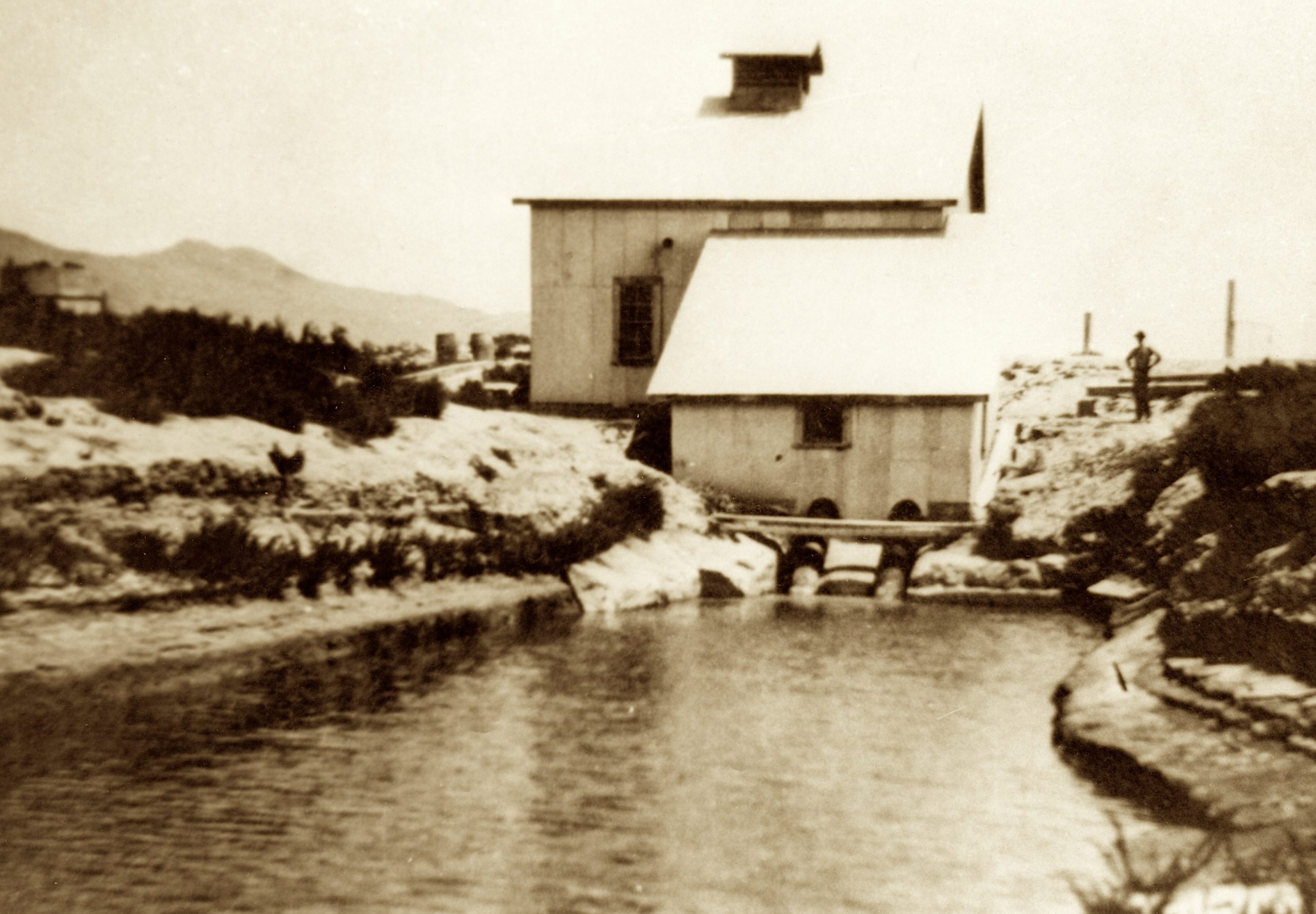
Bly Tunnel, 1922

Before we explore how long it took to close the Bly Tunnel, I hope whoever reads this, closely examine the above photograph. The tunnel was in its early stages of construction. If one looks closely, you can see the lake level has already dropped, though it would be another two years before water flowed through the tunnel.

By the late 1960s, no one really paid that much attention to the abandoned Bly Tunnel at Eagle Lake. By 1970, the level of lake kept rising, threatening some lake shore improvements. In November 1971, D. Dean Bibles, District Manager of the Susanville Bureau of Land Management (BLM) announced that it would take action to revoke the Bly Tunnel right-of-way which was on BLM lands. Bibles noted that there were would be public hearings on the process. He noted there were some that wanted to keep the tunnel open to stabilize the lake level. There was the other camp, that wanted to permanently seal the tunnel to allow the lake level fluctuate naturally.

On February 6, 1973, BLM gained control of the Bly Tunnel for lack of non-use and water rights. The following year, BLM declared the tunnel a safety hazard. At that time, the BLM had the tailing piles used to make a temporary plug of the inlet, which greatly reduced water flow into the tunnel.

In 1981, Murrer Ranch filed a quiet title action over the granted right-of-way for a canal for distribute the water from the tunnel. After all, this is was first water connection from the tunnel. The following year, Murrer’s neighbor, Barron Ranch also filed a quiet title action, thus rendering project as done. In 1986, BLM had a permanent concrete plug constructed at the inlet.

The outlet as it appeared in 2012. Courtesy of Barbara White

However, water still flowed through the tunnel. In 2011, a valve inside the tunnel to regulate flow was finally shut and the water stopped flowing. While the tunnel was originally somewhat functional for a period of eleven years, it took BLM forty years to close it.

Subscribe

The End of the Line

Wendel Depot. Courtesy of Aldah Riesenman

On September 1, 1929 the Nevada-California-Oregon Railroad’s existence came to an end, when it finally ceased to exist and was entirely absorbed by the Southern Pacific. Its demise was slow, and for its owners it must have been a strange process. Its decline dated back to 1914, the last year the railroad made a profit. What was started like a death knell came in 1917, when the NCO sold its trackage rights from Hackstaff (now Herlong) to Reno to the Western Pacific Railroad. Without its connection to Reno, it became a very isolated feeder line to the Southern Pacific Railroad.

In 1925, the Moran family, owners of the NCO, reached an agreement with the Southern Pacific to sell the line. It was a slow process. It would take nearly a year before the Southern Pacific acquired the trackage rights. In 1927, starting at Wendel, the Southern Pacific began to broad gauge the NCO’s narrow gauge line north. One would have thought NCO would have dissolved, but NCO was a peculiar outfit. What really gets confusing is its financial statement. In 1928 the NCO showed an operating revenue of $510,478.37 and a net expenses, including taxes, of $848,262,25.

Support

Juniper School, Lassen County

This was the third school district established in Big Valley, on the Lassen County side. The other two were Providence and Pleasant Butte. The Juniper School served the residents of the southern end of Big Valley. The district was established on November 5, 1877. On November 1, 1884, the voters of the district had two measures before them. One was for a school site and the other for a bond measure for $400 to construct the school. The bond measures were rejected and no site was determined. On April 14, 1888, an election was held to issue a $500 school bond measure and it was approved by all twelve voters. On August 27, 1889, Charles M. Kenyon donated one acre of land for the school and it was constructed.  In 1924, the school closed for two years, for lack of students.  Again in 1937-38, the school closed due to the decrease of students. It operated during 1939-40 with Reva Snell as the school’s last instructor.  It then closed for a final time and annexed to the Bieber School District.  The abandoned schoolhouse was sold on June 8, 1942, to Mike Roufs who tore it down and used the lumber to expand his mechanic shop in Bieber.

Support

Honey Lake Goes Dry

Honey Lake, June 26, 2021—Larry Plaster

On August 29, 1903 it was reported that Honey Lake had entirely dried up. Since the Anglo settlement of the valley in the 1850s, it was an unusual occurrence. It should be noted that area received abundant winter precipitation. The years from 1907 to 1916 was an extremely wet cycle. In 1911, Litchfield founder, B.F. Gibson proclaimed the lake was so high that it might be necessary in the future to build a canal at the east end of the valley to Astor Pass. and the excess water would then flow to Pyramid Lake at that point. It would not be necessary as beginning in 1917 the region would experience a twenty-year drought in which Honey Lake remained dry all those years.

Tim

Today’s Botany Lesson

Suaeda calceoliformis or Suaede depressa

The Honey Lake Paiute were known as the Wadatkut, i.e. “wada eaters” for the eating of the seeds of Suaede depressa. Its common name is seepweed. It likes alkaline moist soil, which certain segments near Honey Lake thrives, especially near Amedee. When the seeds begin to ripen in August the plant takes on a pinkish hue. I have seen this plant all the time, but never knew its name or its significance.

Tim

A Lake Almanor Pest—Pelicans

Eagle Lake Pelicans, circa 1920—Wyn Wachhorst

Avid fishermen detest pelicans as a natural predator to fish. If ever want to see these birds in action visit the Pine Creek estuary at Eagle Lake during spawning season of the trout there.

Chester resident Nels Olsen went from dairy farmer to innkeeper due to the transformation of Big Meadows to Lake Almanor. On April 15, 1929, Olsen penned this opinion on the pelican problem.

“For the past two weeks pelicans have been gathering in the waters between Lake Almanor and Last Chance where the streams are now alive with trout and there is no escape for the fish in these small streams as in the lake for the pelicans form a solid body as they move up stream and scoop up every fish in their path. For many years the pelicans have been a serious menace to the fish in these parts and at the present time the situation is becoming very alarming as they are destroying millions more fish each year than the fish commission is able to supply. The pelican is not a game bird. He is good for nothing He is a worse menace to our waters than a coyote is to our land. He should be killed whenever possible.”

Support

Susanville’s Winchester Hill

Winchester Hill, 1918—Belle Dorsey

Linguistics, especially local terminology, changes over time, with not only an older generation passing on, succeeded by a new one, mixed with new arrivals making for a blended community. Some local designations  retain their original names, others abandoned.

Susanville’s Winchester Hill is a perfect example. This steep hill is located on Mill Street between South Gay and Weatherlow Streets.  It was so named for George and Fannie Winchester who in the fall of 1914 built a house at 205 South Gay Street, on the south east corner of Gay and Mill. It was also one of the first houses built in the Brashear Tract subdivision, that had a deed stipulation that all homes constructed must at a least cost a thousand dollars.

Donate

Doyle’s First Forest Fire Threat

Doyle, July 10, 2021—Noah Berger, Associated Press

It was in mid-August 1926 when a fire on the Plumas National Forest broke out. High winds sent embers and a spot fire erupted in the Last Chance area. As the winds fanned the flames, the fire came over the crest of the Diamond Mountain Range between Milford and Doyle. The fire rapidly spread past Bird Flat (Herlong Junction) on its way to Doyle. After burning through four ranches, it appeared that fire threatened Doyle. Then a strange thing happened. The wind abruptly changed direction blowing the flames back to the area it burnt and it slowly extinguished itself. Bert Downing lost a barn with 150 tons of hay and several other buildings, but his house was saved. However, H.W. Sutton, John Wagner and Paul Zurfluh were not as fortunate and lost there homes. Another causality was the Lucerne Schoolhouse, but it had closed the year before due to a lack of students.

Lucerne School, 1916. D.M. Durst Collection

Support

The Mighty McGiffert Loader

McGiffert loader, Camp 28, Red River Lumber Company, 1924—R.S. Pershing

With the advent of railroad logging required the development of supporting equipment. In this particular case, today, a machine to load logs onto flat bed rail cars. Some consider the McGiffert Loader the “Cadallic ” of loaders, which many in the woods just referred to the machine as a “Jammer.”  The McGiffert was invented by John R. McGiffert in the early 1900s , and were manufactured by the Clyde Iron Works of Duluth, Minnesota.

The McGiffert while efficient in getting the job done, did not look like much.  It had an elevated platform for the boiler and spools. What is interesting it was self propelled wherein its chain-driven axles moved it  along the rails. As the McGiffert straddled the tracks, a large, somewhat awkward looking machine. The boiler and spools were mounted on a platform that was elevated over the tracks. The entire machine sat on legs that rested on the ground on either side of the tracks. The McGiffert was self-propelled, as it had a chain-driven drive axles that moved the machine along the rails. The empty log cars were shoved underneath the loader. The log cars would then be rolled through the loader, with logs loaded onto the cars by a boom off of one side of the loader.

McGiffert loader at Camp 28, Red River Lumber Company, 1924–R.S. Pershing

Fruit Growers Supply Company was still using McGifferts into the 1940s on the Susanville Operation, and may have until 1952 when it discontinued railroad logging.

Support

From Dairymen to Innkeepers

Olsen Dairy, Chester 1914.

In 1859, Peter Olsen located along the north bank of the Feather River, which would later become the community of Chester. Olsen like a handful of others, of what then was known as Big Meadows were dairymen. Over the years, he acquired some 1,100 acres. Upon his death in 1892, his three sons, George, Nels and Edgar took over the operation. Time changes. In the early 1900s, Great Western Power Company began buying all the properties in Big Meadows to transform it into Lake Almanor. The Olsen’s sold all but 110 acres, which was above the 4500 contour line.

Olsen’s Hotel, Chester. Courtesy of Margaret A. Purdy

The dairy operation would slowly be phased out, so it was time to change occupations. The family became innkeepers. In 1913 construction began on their hotel. In early May 1914, the doors were open to the public, and timing could not have been better. By the end of the month, Lassen Peak began erupting, bringing throngs of people to see it. Olsen’s was one of the few nearby lodging establishments and business was off to a booming start.

For many years the hotel was operated by Nels and Eula Olsen. In 1948, it was time to retire and they sold the hotel to Earl McKenzie. McKenzie leased it for a time, and it finally shuttered. As to the building’s final demise, I do not know.

Subscribe!

Exploring Lassen County's Past