Tag Archives: Westwood

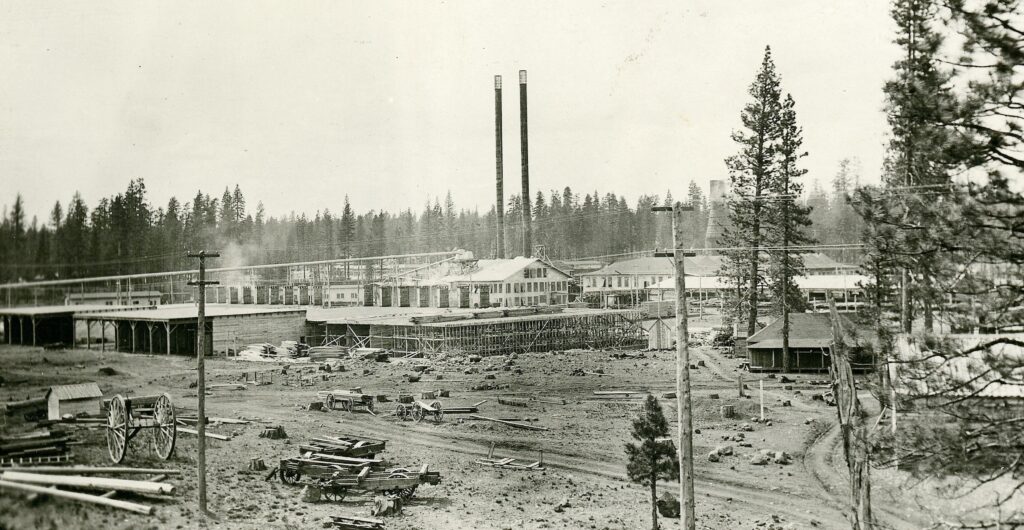
Red River Lumber Company’s Mill B

Mill A, Westwood, 1914–Leona F. Byars

Truth be known in the beginning Red River Lumber Company had three sawmills at Westwood. The first was a portable circular sawmill powered by an old hay threshing machine engine. This mill was assembled  in September 1912 and sawed its first piece of lumber on October 1. This mill would provide lumber for construction of Mill B. Mill B would in turn supply lumber for Mill A, the permanent one.

Mill B had a 40,000 board feet daily capacity. The mill was pushed to its limits and it became around the clock operation. Of that output, common grade lumber was utilized to build the town and highest-grade lumber was stored awaiting shipment for when the railroad arrived.

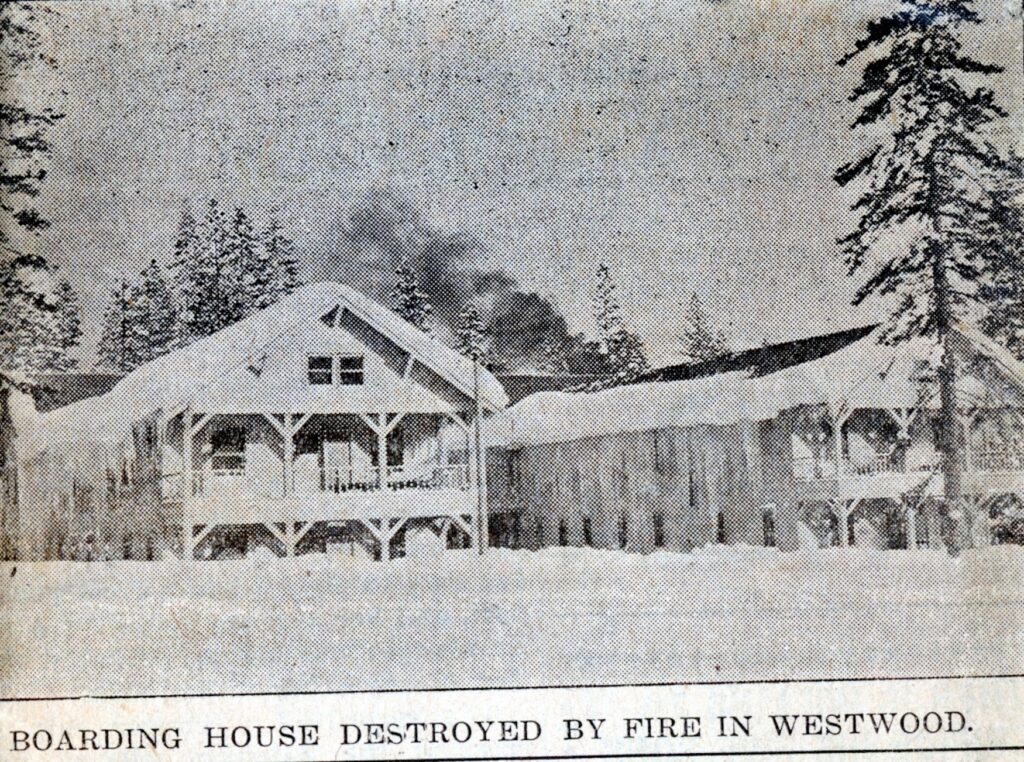
There are discrepancies as to when Mill A was placed into operation. Some accounts have that the first board produced occurred as early as May 1, 1914 and others as August 1. Interestingly, both Mill B (temporary) and Mill A (permanent) were running at the same time. The record is not clear what Red River’s plans were for Mill B. Unfortunately, the issue was resolved when on September 8, 1914, it was destroyed by fire. The fire had originated when sparks ignited the nearby sawdust pile. The fire was fanned by strong winds, which quickly spread to the temporary mill and destroyed it. All efforts were made to contain the fire to the mill, which they succeeded thereby saving the nearby planing mill and lumberyard. While the mill was equipped with automatic sprinklers they malfunctioned during the fire. After the fire, it was discovered there was a piece of wood inside the pipe blocking the flow of water.

Support by subscribing.

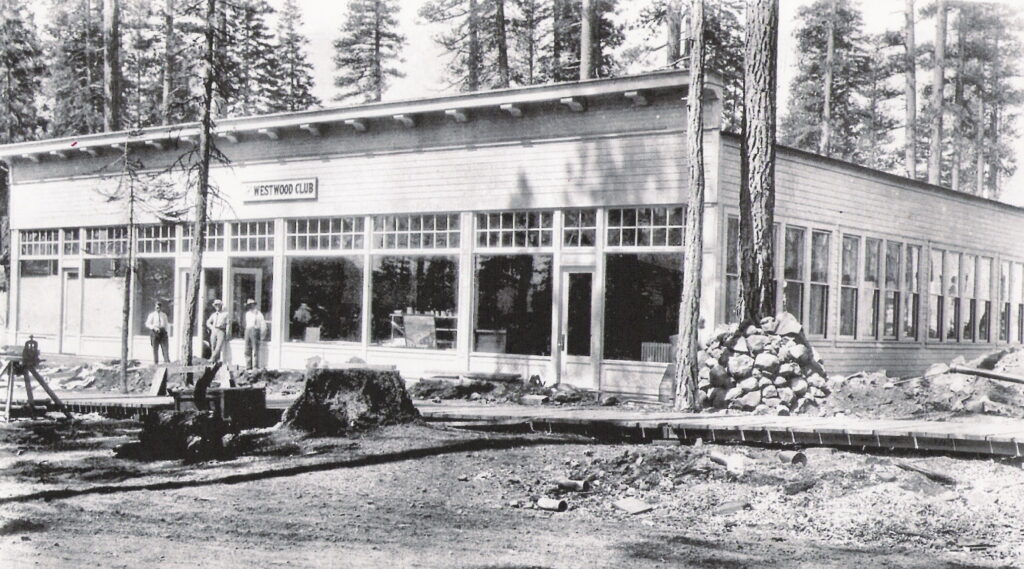
Westwood Club Employees Strike

The Westwood Club was one of the first buildings constructed in that community and it was a major social hub—Westwood Museum

In 1935, with the creation of the National Labor Relations Board brought about the collective bargaining between employers and unions, which had a ripple effect in organized labor. During the late 1930s, unions big and small sprung up everywhere. Many a business even with a handful of employees became subject to union membership with a community’s union providing an umbrella for
these workers to join.

H.S. Anderson Company, who leased the Westwood Club, knew the
situation very well. On March 13, 1940, the Bartenders and Culinary
Workers Union No. 654-A went on strike, protesting the firing of
fry-cook Bill Knighton. They desired a closed shop with H.S. Anderson as their working agreement was set to expire in April. When the union signs were removed from inside the Club, this caused a general exodus of the patrons. Four waitresses—Margaret Miller, Vivian Buffo, Donna Weber, Ramson Bingham—for a brief time formed a picket line outside the Club, until the manager of the Westwood Club announced it was closed, for how long no one knew. The displaced customers found relief at Pland-Evans lunch counter on Ash Street, while the Westwood Rotary Club moved their meetings to Tunison’s at Goodrich.

A month later negotiators were brought in with little success. It
took several more weeks before a compromise was reached. On May 4,1940, the eight-week strike ended, the longest in Westwood’ history, with a Union Shop Agreement that affected the thirty workers at the Westwood Club.

Support by subscribing.

A Made-To-Order Town

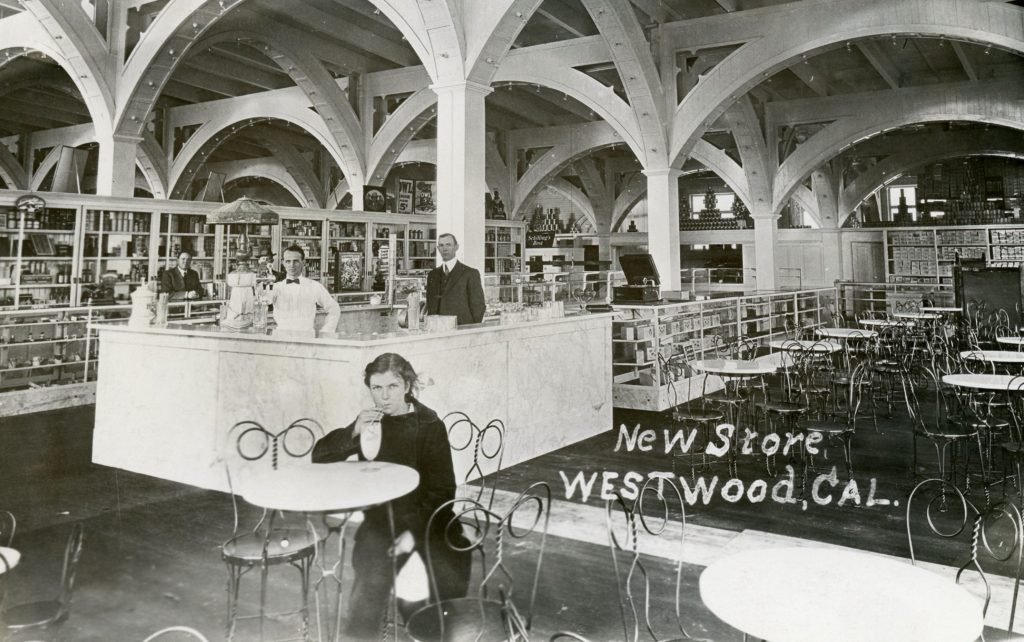
The soda fountain in the Big Store. Westwood, circa 1917

Awhile back I wrote about Frona Colburn’s’ 1922 book The Kingship of Mount Lassen. As promised from her book, is her account of Westwood.

”Like a trip on the magic carpet is the transformation wrought at Westwood, a model town in Plumas County, set in the heart of a virgin pine forest skirting the southern base of Lassen Peak. All about one clean, sweet smell of newly cut pines, and the whole atmosphere is one of humming activity among an intelligent and contented populace. The five thousand inhabitants live in modern homes in a natural forest park. An eye for the beautiful has left the big white pines standing wherever possible, even along the graded streets, and the approach roadways leading into and out of town.

“It was the author’s good fortune to arrive at Westwood at noon, hot, thirsty and covered with volcanic dust. Imagine the surprise and joy of finding an up-to-the-minute department store—large, airy and cool—where a delicious crushed pineapple ice cream soda all but saved one’s life.  And the price, fifteen cents! This drink was served with all the daintiness of a metropolitan soda fountain, by a chap in white coat and apron spotlessly clean, and with manners to correspond.

Westwood has just ‘growed up’ in the heart of the woods, sixty miles from Nowhere, and is the last word in a logging camp. What gave it impetus? The constructive imagination of its founders.

Westwood, 1915. Courtesy of Leona F. Byars

“It is the pride and glory of the Walker family to have a nearly a perfect plant as it is possible to create and this desire includes evrything connected with the industry of lumbering. The whole atmosphere of Westwood is one of work. No loafers are permitted to stay long enough to breed dissensions. Every person bears his or her share of the work to be done, consequently there are no paupers and no destitution. Nor is there a shack in the town.

”Westwood baseball teams are not only natty in appearance but they can and play ball. Like the neatly-uniformed band they are an inspiration to all the surrounding countryside. Westwood musicians are in demand wherever good music has an appreciative hearing. The men at the head of the Red River Lumber Company not only know how to live themselves, but are willing that others may share in benefits derived from an intelligent, constructive attitude toward a big problem—that of pioneering in and out-of-the-way neck of the woods. The situation at Westwood would have delighted the soul of Peter Lassen, who was something of a sawmill man himself, and had a true woodsman’s love of trees.

“The Red River Lumber Company gives the following as their attitude toward the industry:

”It is our hope, by forestry practice, to so conserve the trees spite of our cutting (the largest of its kind) the actual amount of timber will never grow less but will remain forever a permanent thing of beauty, a field of labor and a source of supply.”

Donate

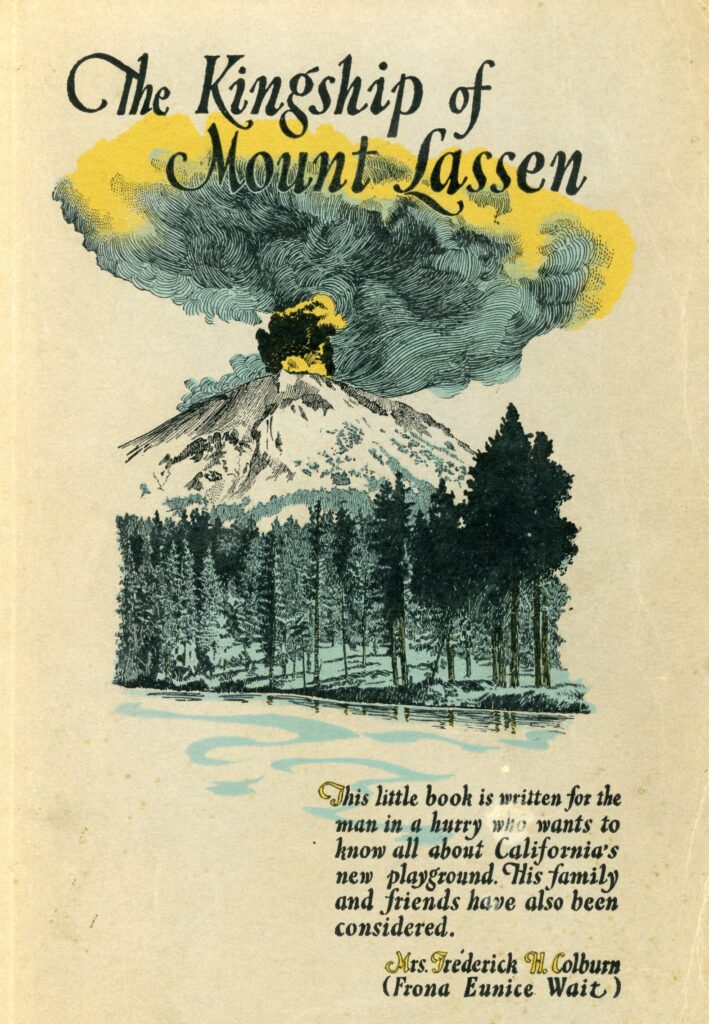
The Kingship of Mount Lassen

Cover of Mrs. Colburn’s book

This is Mrs. Frederick Coburn’s (nee Frona Eunice Wait)1922 book about Lassen Volcanic National Park, which she dubbed as “California’s Newest Playground.” It is a somewhat whimsical account about the Lassen Peak region, while interspersed with some dubious historical claims, it is an interesting read nevertheless.

While writing about Peter Lassen she raises the age old question, “Who killed  Lassen?” She includes some interesting citations on that topic. In 1917, she was also a participant at the new Lassen Monument dedication that she provides an interesting account of that event, not found elsewhere.

Towards the end of the book, she provides her experience as a visitor to Westwood. That excerpt will appear in a week or so.

Tim

Northern Counties Utility Company

Birch Street, Westwood. Courtesy of Hank Martinez

In 1945, when Fruit Growers Supply Company took over the town of Westwood from the Red River Lumber Company it presented all kinds of problems. It should be noted for the record, Fruit Growers did not want Westwood or its mill, but it was packaged deal to obtain Burney Tract which contained a billion board feet of timber.

Westwood provided all kinds of challenges for Fruit Growers. What worked for Red River, did not for Fruit Growers. To provide water, telephone and electrical service to the community Fruit Growers formed the Northern Counties Utility Company. It was necessary for the company to avoid the involvement with its lumber and timber operations.  The residents were not happy with any change, and in the past their utility cost were included in the rent. Fruit Growers did not initially charge a separate utility bill. This, of course, was an accounting nightmare for Fruit Growers. In 1945, the utility company lost $35,549.65. Fruit Growers covered the loss from revenues from rental properties, but it was still a out-of-pocket loss for Fruit Growers. In 1956, when Fruit Growers sold Westwoof it was no longer their problem.

Subscribe

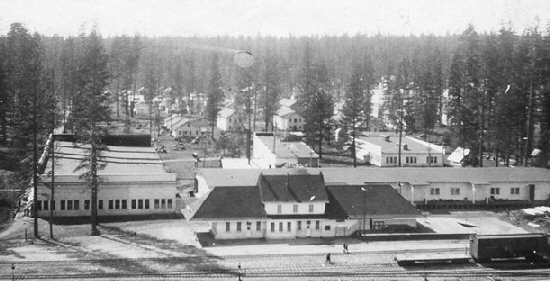
Westwood Depot No more—End of an Era

Westwood Depot, circa 1918—David B. Martin

In the summer of 1955, Fruit Growers Supply Company announced it would close their mill at Westwood. Another important event happened that year when in  December the region experienced severe flooding, causing tremendous damage to the railroad tracks between Susanville and Westwood. The Southern Pacific deemed it too costly to make the repairs to that section of the railroad with the pending mill closure.

However, with all this bad news,  Westwood Depot had some salvation. It should be noted, the depot was utilized by the Western Pacific on its Highline route between Keddie and Klamath Falls. Oregon. Thus, the Westwood Depot remained opened, how long was any one’s guess.

Westwood Depot closure notice—David B. Martin

In the spring of 1971, it was announced that the Westwood Depot would close on April 15, 1971. Just by happenstance, two Lassen College students, Roy Lopez and David Martin, paid a visit to the depot late that afternoon of the final day. One of the duo’s first encounter was to witness the Southern Pacific’s trainmaster from Redding to remove the station’s clock. The remainder of time was spent visiting with the Depot’s agent, J.C. Hoxie. When Hoxie escorted them out, the door was locked for good from the public.

On a follow up, the Southern Pacific transferred Hoxie to Wendel. The depot stood vacant for several years and was finally dismantled in either 1975 or 1976, as I have conflicting data. If anyone has more information on that event, please let me know, so I can update this post.

Subscribe

Changing Westwood’s Image

Westwood
Westwood. Courtesy of Hank Martinez

By the fall of 1940, the day of reckoning was at hand as to the future of Red River Lumber Company’s Westwood Operation. . A decision had to be made. The responsibility fell on Ted Walker, the General Manager, to provide options for everyone in the family to consider. Some of his suggestions would no doubt seem radical to his grandfather, T.B.Walker, Red River’s founder. Ted wanted to get away from the company town image, and heaven forbid actually spruce up the town by painting the houses. Ted suggested they even allow the opening of the cocktail lounges, so Westwood would look like any other American community.

Clinton Walker agreed to the house-painting program on one condition that there was an appropriate increase in the rents to
offset the cost. In summation, Ted wrote: “In general, I believe we
will be far better off to get away from the idea of a closed, one man
company town as much and as quickly as is practicable. There was, no doubt, merit to the closed town idea at the time operations were
started. It was then practicable, legally, geographically and politically to control mercantile, labor and moral conditions to a substantial degree. None of these things can safely be controlled today. Practically all the benefits of a closed town set-up have been
eliminated by changing times, and all that remains is the unfavorable
reaction and publicity connected with an archaic and obsolete policy
and philosophy. “

Actually, it should be noted, the transformation of the company began in the the mid-1930s in which operations such as the Big Store were leased to concessionaires.

Donate

Mill Closures

Fruit Growers and Lassen Lumber in their glory days.

Recently, someone wanted to know when the various large lumber mills closed. The first casualty occurred in 1953, when the last of the decked logs were milled at Lassen Lumber & Box Company. The sawmill was dismantled. However, Fruit Growers who bought Lassen Lumber in 1952, sold thirty acres including the box factory to the T&M Sash & Door Factory, operated by A.I. Lucero and Walter Wirth. The building was destroyed by a fire on April. 3, 1966.

Next on the chopping block was Fruit Growers plant in Westwood, which shut down during 1955/56. Fruit Growers had purchased it from the Red River Lumber Company in 1944. Next, in what was kind of an off shoot of Red River was the Paul Bunyan Lumber Company. The Susanville mill closed in 1967, though the company operated another facility in Anderson, Shasta County. One of the shorter lived operations was the Susanville Lumber Company that was established in 1941. In changed ownership several times and then was reincarnated at Coin Lumber. In 1979, it became Susanville Forest Products, a division of Jeld-Wen Corporation. They closed the mill in 1993.

Lastly, was Sierra Pacific Industries. They acquired the mill in 1963 from Fruit Growers Supply Company. Sierra Pacific closed its Susanville mill on May 3, 2004, thus marking an end of era, of a once predominant industry in Lassen County.

Support

Susan River Fish Kill

Richmond Road Bridge, circa 1910. Courtesy of Lola L. Tanner

One of the stranger side effects of the national prohibition had to do with a one time fish kill in the Susan River. There was the issue what do with the confiscated alcohol usually referred to as jackass brandy or “dago red” wine. In the summer of 1923, Lassen County Sheriff Carter seized 500 gallons of red wine at Westwood. He did not have ample room to store the evidence. He asked the District Attorney’s. Office for approval to dispose of it, which was granted. Carter instructed his deputy sheriff A.C. Hunsinger to bring a truck to the jail to dispose of the wine and it was poured into the Susan River. However, the wine killed some of the fish in the river. Game Warden W.J. “Spade” Lee was not pleased. He asked the Sheriff to find an alternative way to dispose of confiscated wine in the future.

Donate