Tag Archives: Fruit Growers Supply Company

Why the Fruit Growers Name?

A Fruit Growers Craveneer box, which resembles the standard wooden box—-FGSCo.

When one asks, I try to do the best to answer. A person thought Fruit Growers Supply Company was an odd name for a timber company. Fruit Growers is not a timber company per se, just a facet of its many  duties. Fruit Growers only got into that line by accident.

First, some very brief background. In 1893, the Southern California citrus growers formed a marketing co-operative later to be known as the California Fruit Growers Exchange. The growers co-op proved to be a success. In 1906, discussions were held of forming a second co-operative—this one to purchase agriculture supplies such as fertilizers, sprays, tissue wraps, etc. Another component was the need for wooden boxes for the shipment of citrus. It should be duly the nation’s fruit and vegetables were shipped in wooden boxes and the conversion to cardboard did not occur until after World War II. At first, it was discussed to have two co-ops, one to handle supplies and the other for boxes. It was finally agreed that one co-op could do it all. In 1907, the growers organized the Fruit Growers Supply
Company.

In the same year, due to multiple circumstances,  the price for wooden boxes nearly doubled to 23 cents a box. To make long story short Fruit Growers found some sawmills in far Northern California that could provide them with boxes for a reasonable price. These mills needed financial aid and Fruit Growers lent them money. One of these mills was the Northern California Lumber Company located at Hilt, Siskiyou County near the Oregon border. In 1910, the company defaulted on their loan and Fruit Growers took over the mill and thus its entrance into the timber industry. It is interesting to note the growers self financed the operation by a special assessment of three cents a box for a period of five years. The growers needed six million boxes annually, so that assessment raised a lot of money.

Donate

Fruit Growers Supply Company Trivia

horse logging
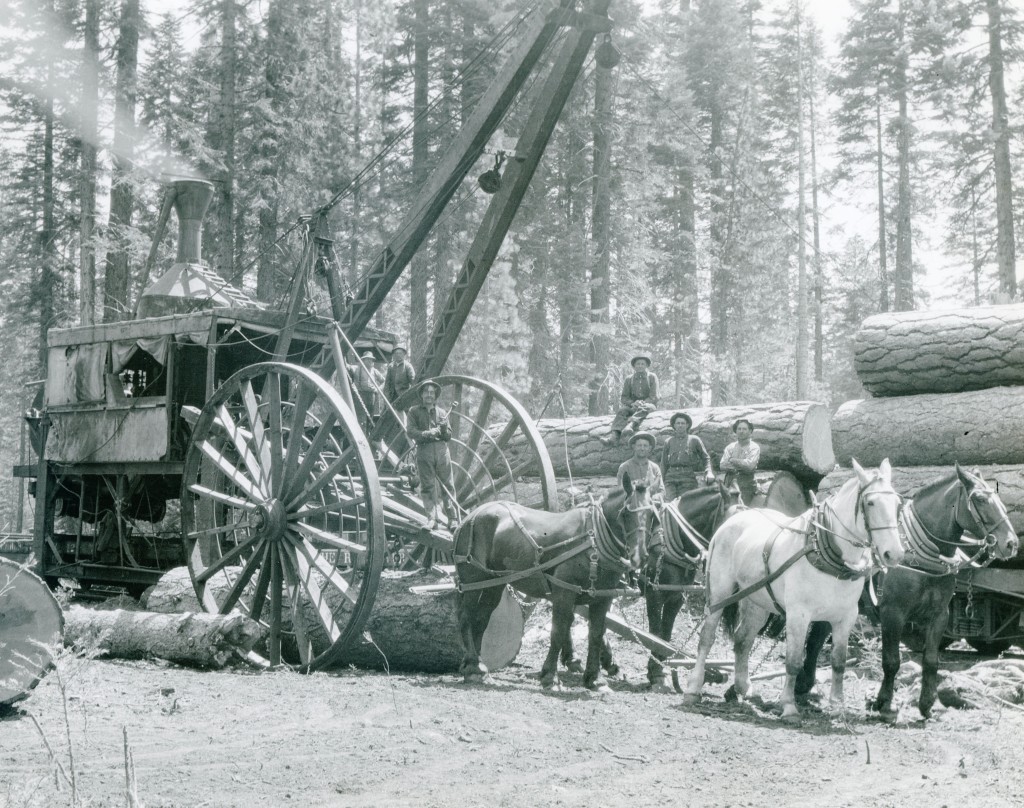
Horse logging with big wheels, at Fruit Growers Camp B, north of McCoy Flat Reservoir.

There were many enjoyable aspects when I researched the logging/sawmill operations of the Fruit Growers Supply Company aka Fruit Growers. For starters they kept well detailed records. Their annual reports are a compelling read, and one just never knows what you can find in them.

Fruit Growers 1947 annual reported highlighted many interesting facts, it being the company’s 40th anniversary.  Take for instant, the following:

”The Susanville mill was completed and began cutting timber late in 1921. When cutting started, logging in that area was done with horses. Fifty-two horses were bought locally, 60 in St. Paul and 22 in Iowa. The total of 134 horses had an average cost of $276.67 and the harness for them totaled $13,247.07.

“Four horses would skid with wheels about 2200 feet per load. Modern Diesel D8 tractors bring in about 5,000 feet.”

Subscribe

Fruit Growers Departs from Northern California

Burney, circa 1940

Since 1907, Fruit Growers Supply Company has had a presence in Northern California. It first began at Hilt in Siskiyou County. In 1919, it expanded to Susanville. In 1944, another expansion of the purchase of Westwood and equally important the Burney Tract in Shasta County. After the closure of Hilt in 1972, Fruit Growers was no longer operating any sawmills, the company owned some 400,000 acres of timberland in Northern California. In 2019, Fruit Growers began to liquidate, the first to go was the Burney Tract which was sold to Sierra Pacific Industries.

The water carnival at the Sunkist Lodge, Eagle Lake, 1921. Courtesy of Ed Standard

The next to go was the Lassen Tract. In 2020, it was also sold  Sierra Pacific Industries.

Fruit Growers Mill at Hilt, 1919

Hilt, was of course, Fruit Growers first acquisition and it would be the last sold, which occurred in 2021. It was purchased by a firm known as New Forest based out of Sydney, Australia.  Fruit Growers has focused on purchasing timberland in Oregon and Washington.

Support

Camp Poison Lake

A McGiffert Loader at Camp Poison Lake—Gordon Thelander

This was a short-lived railroad logging camp, located near Poison Lake. It was established in 1944 by the Red River Lumber Company and then taken over by the Fruit Growers Supply Company. There is a scant information about it. Since this was World War II, and the timber industry deemed “essential” coverage by news outlets were censored. In July 1946, the camp at Poison Lake was closed, as well as Camp Bunyan to the north at Halls Flat. The rails from the Poison Lake line were removed to build a twelve-mile extension of the Harvey line that started at Halls Flat and went eastward.

Tim

How Bits of History Are Saved

The FGS Burner under construction at the Susanville Plant, 1920–Ed Standard

The tossing of old documents takes on many forms. Believe me I witnessed a lot over the years and became an expert “dumpster diver.”

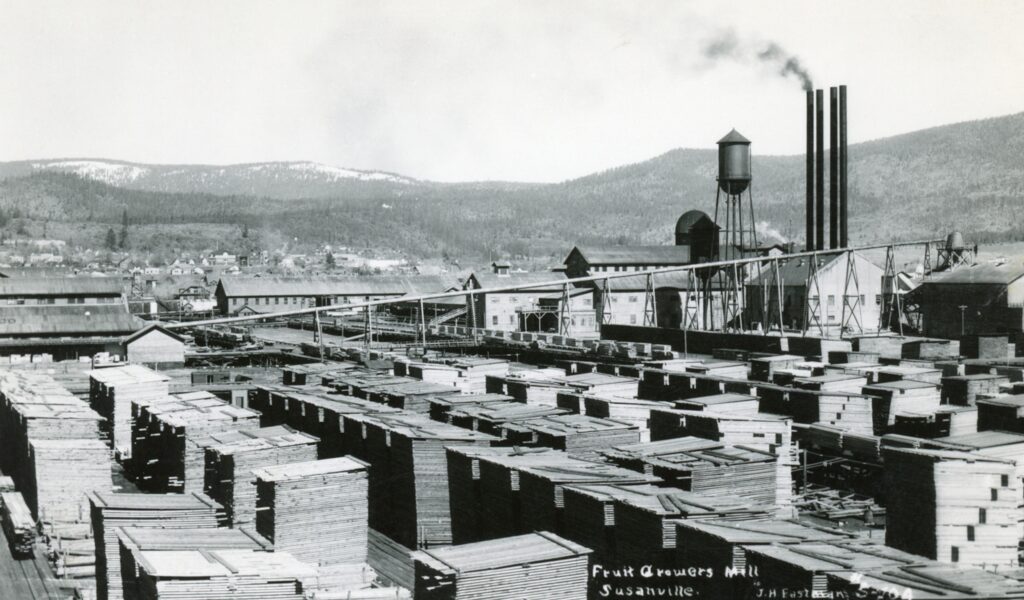
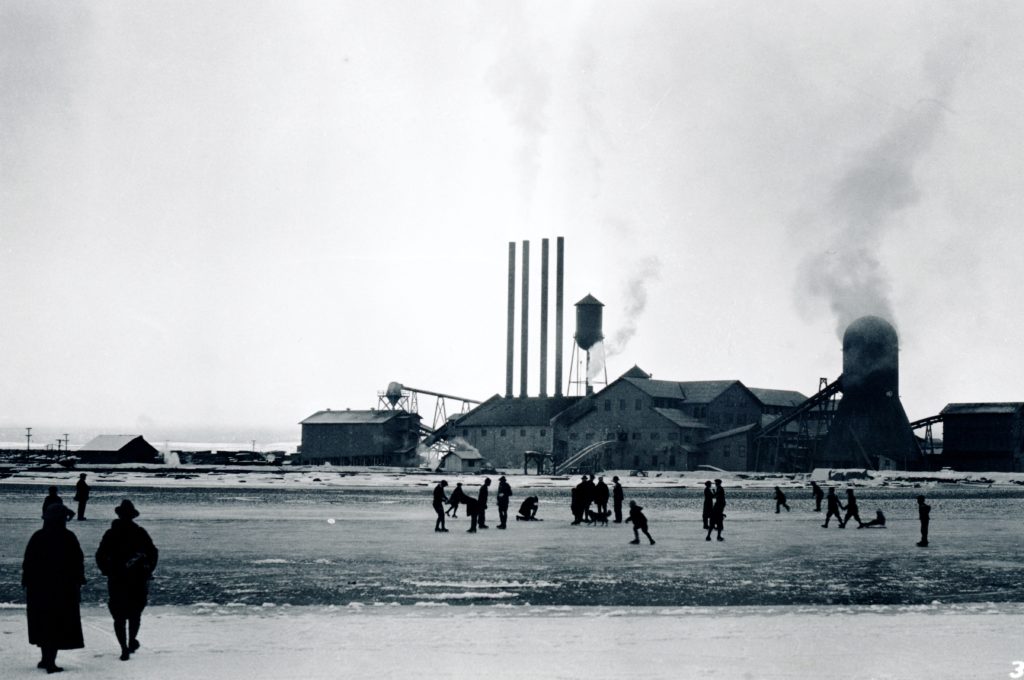
Recently, Susanville native, Edward Standard (1930-2021) passed away. Sometimes, what was intentionally destined to be destroyed gets a last minute reprieve. Ed was working for Fruit Growers Supply Company at the time the mill was being closed in Susanville back in 1964. He was assigned the task to take a number of records from the office to be disposed in the company’s burner. He carried out most of his duty, except for one packet. What he saved was about 600 commercial negatives of O.O. Winn who photographed the construction of the mill in 1920-21. He never said anything about it.

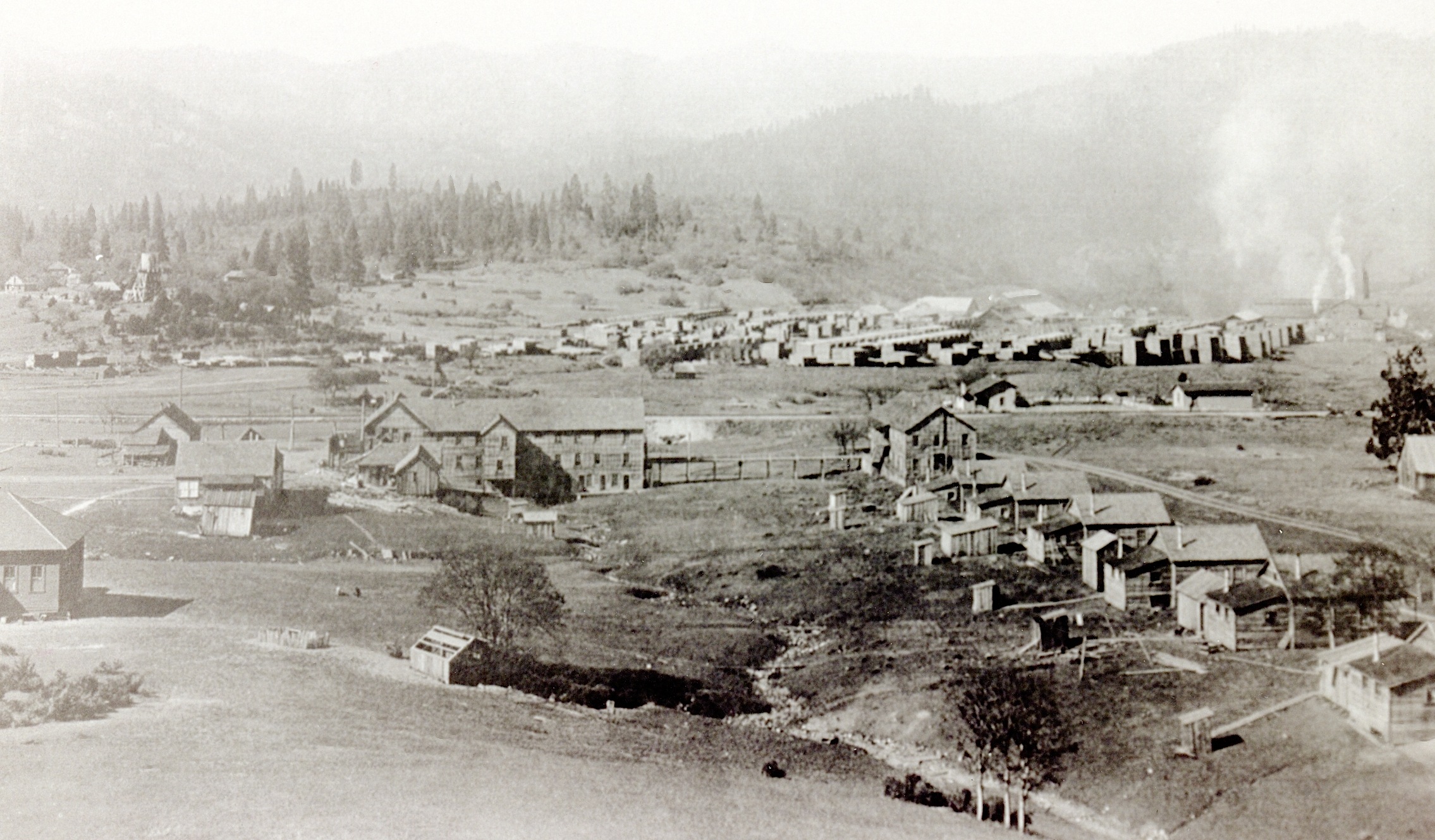
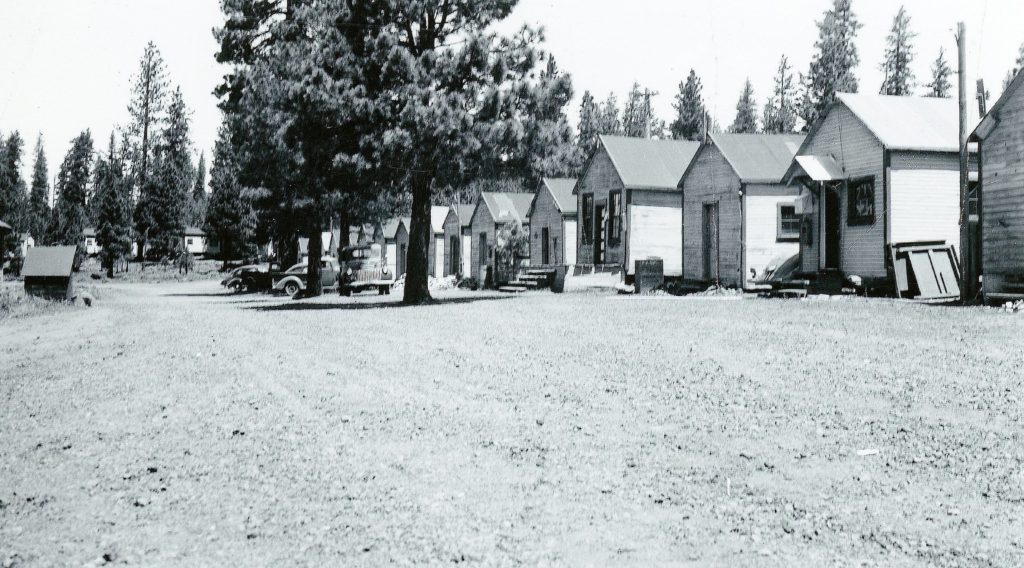
Construction of Fruit Growers housing, 1920–Ed Standard

Fast forward to the fall of 1998. It was common knowledge that I was working on the logging operations of Fruit Growers. In September I had an opportunity to go to Cornwall, England to meet my grandfather John Tanner’s only living first cousin. While I was away brought the negatives by and placed them between the screen and front door. It was quite the surprise when I returned home.

Tim

Timber Fallers of Yore

Timber fallers, Fruit Growers Westwood Operation, 1947

While researching the history of the Fruit Growers Supply Company’s Northern California logging operations I interviewed and corresponded with many former employees. The following account is from Bob Eastman who worked in the woods at the Hilt Operation. He refers that the fallers did piece work. Timber fallers were not company employees. They were contractual and were paid by the scale, i.e.  board feet felled. In those days, with large trees, fallers made very good money. The buckers and limbers, however, were company employees.

“Just a bit on the makeup of the woods crews. Now, I’m speaking of the steam age, not the modern gas and diesel operations. Then it still depended on huge outlay of brute force and muscle.

“A team of two fallers, usually the most athletic and youngest, took double bladed axes sharpened to brittle edge and a cross cut saw and some wedges. This team felled the tree in an incredibly short time. After all, they were piece working and the more they cut, the more they got paid. Then two buckers with a long cross cut saw and a few wedges bucked the tree, sawing it into lengths of 16 feet, 32 feet or 40 feet to fit on the sawmill rigs. That was hard work and very dangerous because rhe log could roll—and that was it for the bucker.

”The fallers had a dangerous job too. The ‘widow maker’ could get out at anytime. A falling limb was bad enough and could just as well kill someone unlucky enough to be beneath it as it came crashing down. The main cause of damage though, ‘the widow maker’ was something else. A lot of the trees were old and were dead and the fallers didn’t know it. They were already rotten, especially at the tops. It was these huge pieces of trees that would come crashing down like a bunch of bombs and when they struck earth, zing of horizontally. You didn’t even have to be close by. Anyone even hundreds of feet distant could be struck by these flying things. The irony was that most of the loggers were unmarried and there were no widows to mourn them.”

Support

Fruit Growers’ Snag Pusher

The snag pusher, 1947—FGSCo.

During the 1930s, between bark beetle infestation and a long term drought witnessed a large number of snag (dead) trees on Fruit Growers Lassen Operation. Then came along World War II, which created new challenges due to employee shortages. Yet, it is those kind of conditions where creativity comes to the forefront.

Even after the conclusion of World War II in 1945, there were still labor issues. Since the late 1920s, Fruit Growers, as well many lumber companies turned to machines to do the work more efficiently thus cutting down on labor at the same time.

In 1945, with Fruit Growers acquisition of Westwood from the Red River, did have some perks. The machine shop there employed some very talented people, who over years with creative talents improvised equipment best suited for the company’s needs. Their task to design and modify a caterpillar tractor that could knock down a snag tree—a snag pusher. The major advantage was it eliminated timber fallers from doing the job.

In its first year of operation Fruit Growers reported that 6,929 snags were felled by the snag pusher. How long the snag pusher was used, the record does not indicate.

Subscribe

Lesser Known Fruit Growers Logging Camps

Camp E395
Camp E, Fruit Growers Supply Company. Courtesy of Lola L. Tanner

Fruit Growers Supply Company had a total of eleven railroad logging camps on its Lassen Operation, west of Eagle Lake.. Technically, the longest operating, Camp 10, which closed in 1952, should have been named Camp 11. Then again, Fruit Growers had given consideration of a Camp 11, further north of Camp 10.

Anyhow,  there were  three camps that were quite small and operated for only one logging season during the 1920s. The first was Camp E at Merrill Flat. It was followed by tiny and peculiar Camp Y. Then there was Camp 9, which from most accounts only housed timber fallers, which was located on the Eagle Lake side of Antelope Mountain. Unlike the other camps that had portable wooden buildings these camps had canvas-wooden tents.

Donate

Sunkist Lodge, Eagle Lake

The water carnival at the Sunkist Lodge, 1921. Courtesy of Ed Standard

In 1921. Fruit Growers Supply Company built a cabin at the south shore of Eagle Lake. They named it Sunkist Lodge. It was built for the recreational needs of its employees. Even though Fruit Growers closed its Susanville operations in 1964, employees of Fruit Growers who worked at Burney, Hilt and Los Angeles still vacationed there.

Another view. Courtesy of Ed Standard

In 1921 and again in 1922, Fruit Growers sponsored a water carnival at Sunkist Lodge. This was a water competition between the three big mills—Fruit Growers, Lassen Lumber & Box Company and Red River Lumber Company. The event attracted large crowds of over a thousand in attendance. For the overflow camping, a new site was located and dubbed the Circus Grounds.

In 2019, Fruit Growers sold its Lassen Operation holdings to Sierra Pacific Industries. In 2021, Sierra Pacific has placed this parcel for sale.

Never miss a story click here to subscribe.

It Was Just A Matter of Time

Susanville Depot, 1970.

In December 1955, the Southern Pacific Railroad track between Susanville and Westwood experienced severe damage from unusual winter flooding in the Susan River Canyon. Earlier that year, Fruit Growers Supply Company announced it was closing the sawmill at Westwood. With the closure of the mill, freight traffic from Westwood would be minimal, so the Southern Pacific decided it was not worth the cost to make the repairs and closed down that segment of the line between Westwood and Susanville.

Two decades later, witnessed the slow decline of lumber shipments by rail with Susanville’s two remaining sawmills, Coin Lumber and Sierra Pacific Industries. It was just a matter of time when the railroad would shutter the Susanville Depot. That day came on October 12, 1979.

Depot 78
Susanville Depot, September 1978.

Subscribe and support this site for as little as five dollars a month.