Support

Support

In January 1920, LeRoy Pollock purchased the Diamond Mountain Inn, a 22-room two story hotel, along with 140 acres at Janesville from J.B. and Katherine Rice for $6,000. The Inn, was originally just known as the Janesville Hotel and was built in 1872 by Dennis Tanner. While the transaction was noteworthy, one of residents would later become well-known in the art world, Jackson Pollock. Continue reading Jackson Pollock

In February, I inaugurated a book-of-the-month, that featured Sagebrush Reflections. After all proceeds from book sales not only help support operations, but help finance future publications, in this case the stories behind the brands of the Pioneer.
Sixty Years of Siffords at Drakesbad is Roy Sifford’s memoirs of the six decades the family operated the famed resort inside Lassen Volcanic National Park. How the family acquired it in 1900, happened by accident. Roy’s father, Alexander Sifford was a school teacher by day, and a bank accountant by night In June 1900, he was just worn out. Friends suggested that he should, “Go to Drakes to camp, drink those hot and soda waters and it will help you.” And he did. So impressed by his experience, he convinced the 70-year old E.R. Drake to sale the springs and the rustic lodge. On June 20, 1900 the Siffords took possession and would remain at the helm until 1959 when Lassen Park took over Drakesbad. Of course, a lot things transpired over the years, it was in 1914, it was officially named Drakesbad, and in 1938, the original lodge was destroyed by the heavy snows, and a new one built.
Click here to order.

For those that have never been there, this is a hidden gem inside Lassen Volcanic National Park. It was Susanville resident, Alexander Sifford (1861-1957) who was key figure into transforming the place into a resort. However, in 1874, Thomas Malgin first settled in the upper end of the Warner Valley, and built a bath house to take advantage of Hot Springs Creek. Malgin focused more on raising sheep, than operating a remote tourist attraction.
Malgin was succeeded by Edward Drake, who in 1890 built the first lodge. His operation was simply known as Drake’s Spring. In June 1900, Susanville school teacher Alex Sifford arrived with his family as friends suggested the springs might help his ailments. Sifford was so taken away, that he negotiated to buy the place from Drake for $6,000. In 1914, for marketing purposes, the name was changed to Drakesbad. The Sifford family continued with operations until the 1950s when the last of their holdings was sold to Lassen Volcanic National Park. You can learn more by reading Roy Sifford’s memoirs Sixty Years of Siffords: Darkesbad directly from this site.

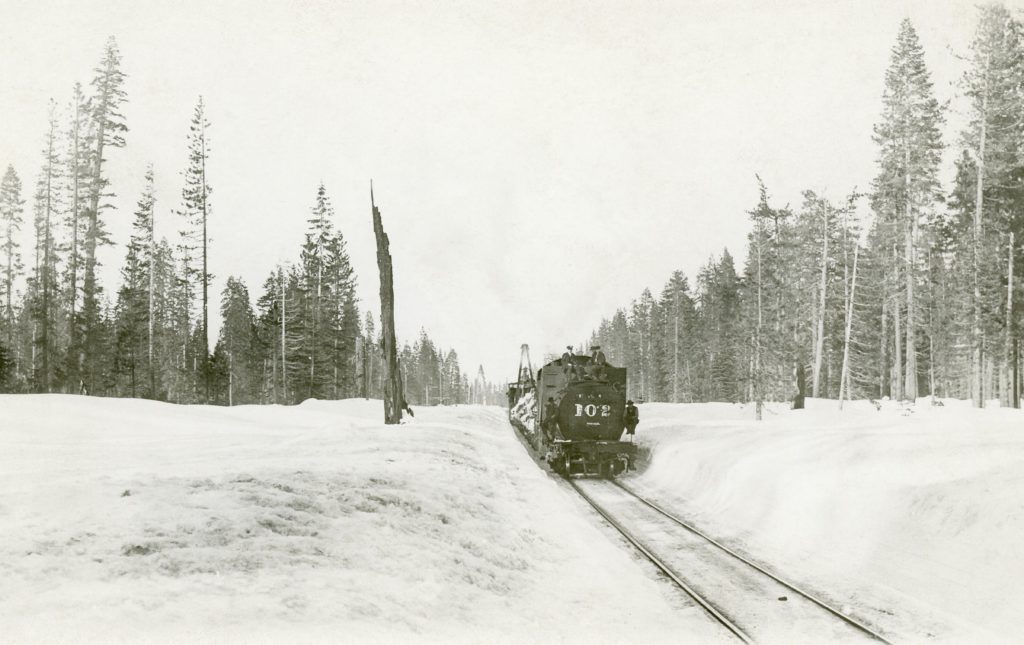
Camp Harvey was a railroad logging camp during the 1940s of the Red River Lumber Company and later Fruit Growers Supply Company and located approximately 20 miles east of Poison Lake.
The cookhouses in logging camps always operated at a loss. However, a cookhouse could make or a break a camp—poor food resulted in an exodus of loggers. In 1948, Fruit Growers raised the price of a meal to one dollar at Camps Harvey and Stanford, and the complaints were loud and clear. Fruit Growers instead of losing 36 cents per meal, they only lost 8 cents.
In 1949, Fruit Growers leased the cookhouses and commissaries at those two camps to H.S. Anderson Company for one dollar. Fruit Growers thought maybe an outside company could handle the operations for more efficiently. They would never find an answer.
By the end of May the cookhouse crews represented by Local 769 of the Bartenders and Culinary Workers Union walked off the job in a wage and hour dispute. Logging came to standstill. The two camps with a population of nearly 500 became ghost towns, with Robert Simons and Harry Beal remaining as caretakers. After the weeks went on and no end to the strike Fruit Growers closed down the camps permanently. In addition, they abandoned that railroad logging line.

In 1925, Great Western Power Company announced its plans to enlarge Lake Almanor. The raising of the dam would flood a large portion of Chester Flats, thus flooding a number of roads, and also Red River Lumber Company logging railroad network. Controversy arose when Great Western informed the Plumas County Board of Supervisors that the road across Chester Flats would be re-routed to follow the high water contour. The residents of Chester and Westwood were furious, for such a proposal would add an additional seven miles between the two communities. They wanted a causeway in which the current route would remain the same. Great Western balked at the idea. After all, a causeway would cost Great Western $220,00, while to re-route the road would only cost $50,000. To make a long story short the opponents bypassed the Plumas County Board of Supervisors and had the State Highway Department intervene. In 1926, an agreement was made between the State and Great Western that a causeway would be constructed.
The old English proverb necessity is the mother invention was widely adopted locally. For years Fruit Growers searched for an effective way to reduce grass around its millsite for fire protection. In 1937, someone came up with the brilliant idea to bring in a band sheep to graze the mill property. Problem solved and they called the new addition to their workforce “Lassen Lawnmowers.”

On the front page of the Lassen County Times of November 8, 1978, there was a bit of irony one of the falling a large sugar pine tree, which running next to it a story of the Westwood Cemetery dispute involving logging.
On November 6, 1978 Ernest Cluck felled the 432 foot sugar pine tree that contained 16,000 plus board feet. It was part of timber sale that Beaty & Associates sold to Sierra Pacific of Susanville, though article failed to mention where the tree was located.