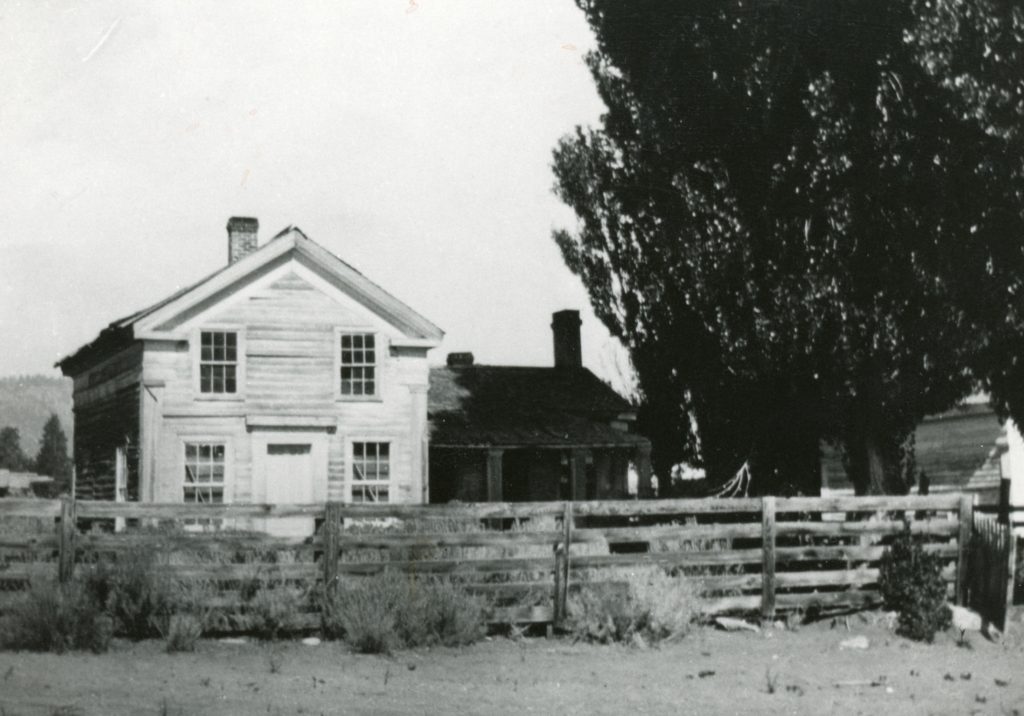
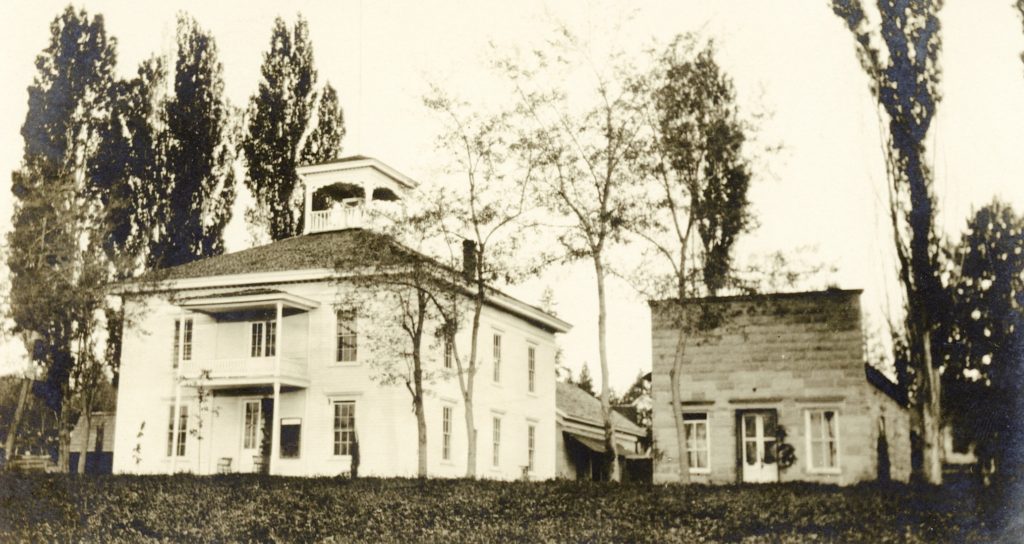
Amedee during its heydays in the early 1890s. Courtesy of Grant and Lena Trumbull
The following is part of a Amedee letter dated, September 15, 1896: “The raft built by Torrey & Harwood has had quite an experience lately. Their first trip was made about the 4th and they brought over some 40 cords of wood from Milford in six hours, but it took them a week to return as they met contrary winds every day driving them back to the Amedee shore. They finally made the trip and returned with 40 cords of wood for the railroad company and have again returned. We wish them success, for we need plenty of wood have always experienced difficulty in getting it here.“ Tim
During the late 1800s, there were a handful of individuals that each spring would go to Eagle Lake to harvest wagon loads of that lake’s famed trout, to bring back to Susanville to sale.
Susanville resident Med Arnold (1885-1967) provided an unusual account. Med recalled an outing, either in 1895 or 1896, for their fishing expedition, they bypassed Eagle Lake and ventured to Pine Creek, near present day Bogard Rest Stop. It was in May and in several places they had to shovel through snow drifts. Med stated, “We found literally thousands of those fine, big Eagle Lake trout all over the meadow. We scooped them out of the water with pitch forks. It was estimated that we caught around 800 pounds of fish. Upon arriving home the next day, we stopped in front of Hi Skadan’s livery stable (607 Main Street) and gave them nearly all way—two or three per person.”
What has puzzled me about these accounts, how did they keep the fish from spoiling?
Look east on North Street from Weatherlow during the 1938 flood. Courtesy of Betty Barry Deal
The history of this street, is a bit odd, when compared to the city’s oldest avenues. The name is a bit of a paradox, the street runs in a east-west direction. Folklore has it, it was so named “North” because it was the most northernmost street. However, when one examines the original town plat of1863, that is not the case. Willow Street which is one block north of North Street, was initially the most northerly street at that time. In addition, when North Street was laid out, it ended at Weatherlow Street. In 1910 it was extended to connect with Hall Street.
The year 1889 was a pivotal one in the region, especially with a frenzy of reclamation projects. On the Susan River watershed, Hog and McCloy Flat Reservoirs were built. A dam to store the spring run-off of Secret Creek to create Ward Lake. In Long Valley a dam along that creek would create Lake Greeno. Further north, a proposed dam on Red Rock Creek to create Dodge Reservoir.
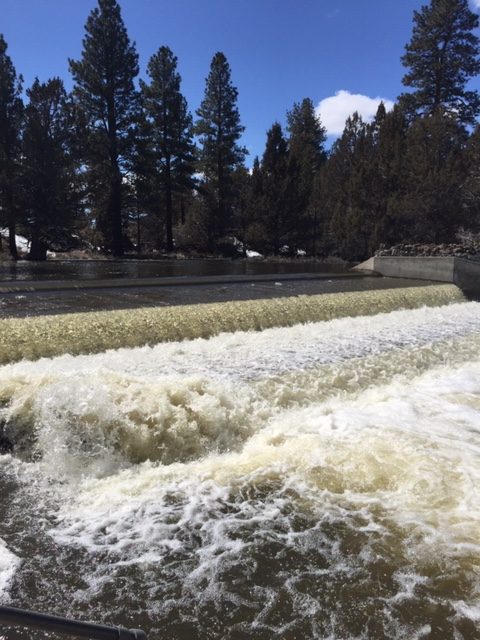
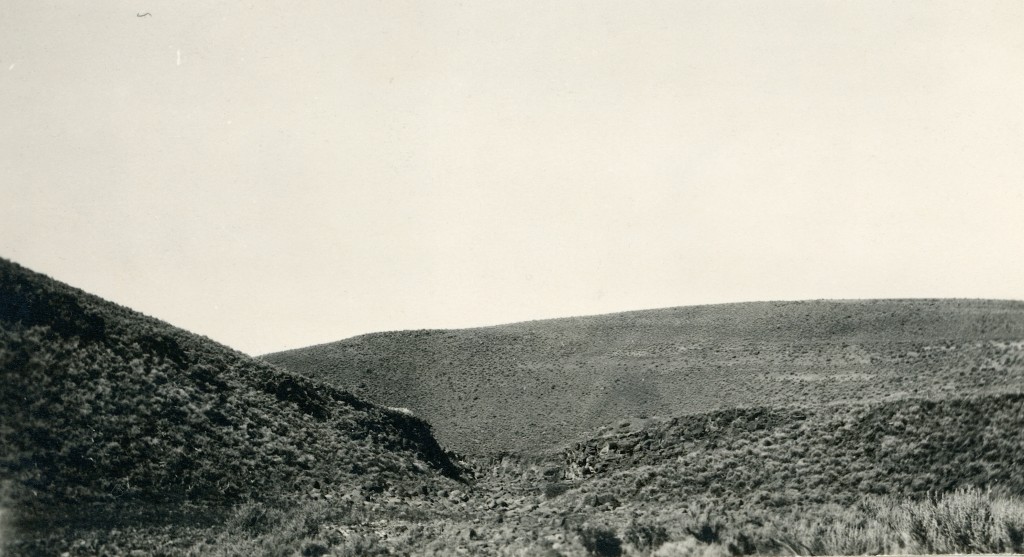
Then there was the dam on Skedaddle Creek that straddled the California-Nevada border. Today, it is an impressive historical site, but not in the way the developers wanted. On May 25, 1889, William A. Clark filed a claim to all the water of Skedaddle Creek to irrigate the sagebrush lands of eastern Honey Lake Valley. To accomplish this, Clark proposed to dam the creek at the “narrows.” The dam would span the canyon some two hundred feet and be 126 feet in height. To fund the project, Clark formed the Honey Lake Water Company, and it was incorporated on June 17, 1889. It was estimated that the dam would cost $30,000. Construction of the dam began in October 1889, and it was anticipated that the dam would be complete by the following spring. In November, Company Engineer, Alexander Center, reported that construction had progressed better than expected and that the dam’s height would be raised an additional fourteen feet. It was during that month of November that one of the severest winters on record began. The November and December snows made work difficult and by January work came to a complete halt. Blizzards blanketed the countryside and then followed bitter cold temperatures that sent the thermometer to –30 degrees. Snowstorms continued and by the end of January it was estimated that on the higher slopes of Skedaddle, the snow depths surpassed ten feet! (Normal annual precipitation at the dam site is 7 inches a year, in 1889-90 it received 22 inches). Continue reading Skedaddle Dam→
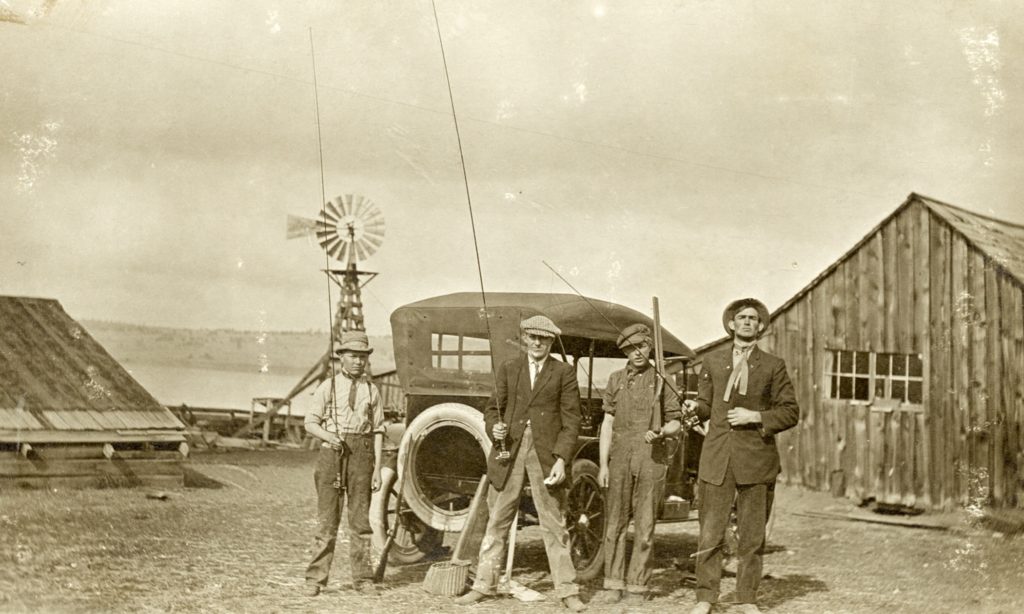
A group of bass fishermen at the McClelland Ranch, 1914.
This well known place on the north shore of Eagle Lake, happens to be first place settled there. On January4, 1870, Levi Button, a thirty-three old New Yorker, filed a land claim there for 160 acres. Button’s main activity was prospecting and trapping. Button only remained there for a couple of years. Various individuals would lay claim to Button’s abandoned homestead, but it was not until the early 1880s when Adolph Schuler made a real go of it. After making numerous improvements he secured a federal land patent for the property. At first, it seemed he would quickly fade away when on July 11, 1884, he sold out to James D. Byers for $1,000. Byers had an extensive livestock operation in the Honey Lake Valley and could utilize the Eagle Lake property for summer range. Schuler remained on the premises working for Byers. In 1902, Byers passed away and left a major portion of his estate to his nephew’s family, the McClellands, including the Eagle Lake property. It is still owned by the McClelland family.
In 1870, Frank Eben Horne settled in the eastern section of the Madeline Plains, and became one of the first settlers of that region. Horne retired from the ranch in 1905, and moved to Auburn, Califoria. He had turned over the ranch to his sons, and due to some poor judgement lost the ranch in 1927.
There is a very small cemetery on the property, and for whatever unknown reason I neglected to transcribe the headstones. I will have to put that on my todo list this summer.
Before there was the town of Doyle, the place was best known as a stage stop named Willow Ranch. The J.M. Stienberger operated Willow Ranch from 1879 to 1898 when they sold and moved to Reno.
The Lassen Advocate newspaper of October 17, 1889 published this description of Willow Ranch: “For the many years that the traveling public were wont to go between Susanville and Reno by stage, the foregoing title was a talisman to them for they knew, by experience or report—that a good meal and entertaining host and hostess, would make their stay there one to be remembered with pleasure. Mr. and Mrs. Stienberger did not, originally, perhaps to expect to combine a wayside inn with their farming enterprise, but as people who know of the pleasure of stopping with them insisted on being entertained whether or not they finally decided to do their best to entertain all who came, and well have they succeeded.
”Of course since the NCO Railroad has been completed northward from their place there has not been so much travel by teams, but still there is some.
”It’s not many years since their house stood by the roadside without foilage or green shrub to cheer and enliven the weary traveler, but now the dwelling lot is a graced by a front line of cork elm, maple and a variety of shade trees to lend an air of neatness and comfort to the whole place. This season, they have with the profits from their house and farm, built and added to their former house on such an extensive and substantial scale that they may now feel that in the years to come they may enjoy as comfortable and convenient a home as anyone in the county.”
Lassen County Courthouse and Hall of Records, 1908–David Zoller
On June 18, 1864, the County of Lassen purchased Block 22, in Susanville for $100 from Isaac Roop. It was the only block on the south side of Main Street that was not subdivided into lots. It should be noted that many lots on Main Street sold for more than $100. In many ways it was a fair price. It did contain a stipulation that should the county no longer use it for a courthouse that the property would revert to Roop or his heirs. This was not unusual, as a number of school properties such as Lake and Willow Creek contained such stipulations, but when those properties were no longer used for their original purpose the stipulation was ignored. However, in the late 1970s Lassen County acquired property on North Mesa Street, in Susanville, as a possible new County complex site. When the courthouse stipulation was revealed it brought about some palace intrigue, especially since heirs of Roop still resided in the community. However, the Mesa Street proposal would be abandoned, thus ending that debate. The county could have challenged that stipulation and would have won, because Roop never owned the property in the first place. More about that later.
In March 1926 work began on the construction of a American Legion Memorial Building in Susanville, located across from Lassen Union High School. On Sunday April 18, 1926 a cornerstone ceremony was held. The stone made of native granite was carved with the American Legion emblem and bore the inscription sponsored by the Thomas Tucker Post No. 204. It was a simple ceremony. A time capsule was placed that included copies of both local newspapers, names of the Lassen County Board of Supervisors, and of course, a list of members of the local Legion and. Auxiliary posts.
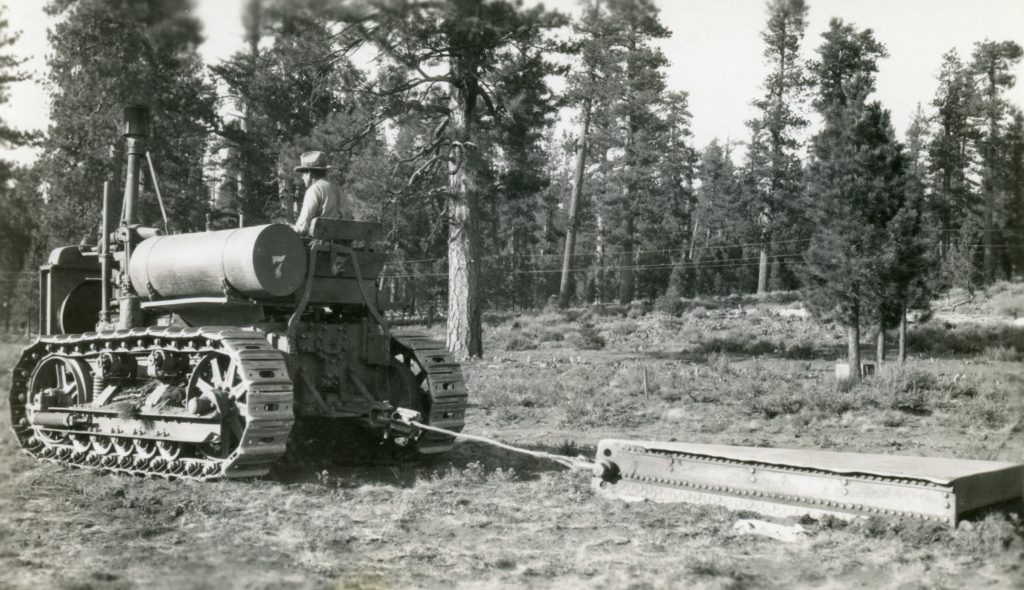
Fire trail V-drag plow, 1929. Courtesy of Fruit Growers Supply Company
No doubt this winter there are many fire officials having discussions about last year’s horrendous fires. During the winter of 1924-25 Fruit Growers Supply Company officials plotted out a new course of fire prevention after a brutal forest fire season.
In 1925 Fruit Growers adopted a new method, building a series of fire lanes. The fire lanes were 100 feet wide and completely void of vegetation, each encircling 100-acre sections of timber. They were formed by a specialV-drag hooked to a 60-Caterpillar tractor which could clear up to six miles of fire lines a day. The lanes not only served as firebreaks, but provided quick access in an emergency.
During the fire season, two crews of eight to ten men worked as fire prevention team. It was their job to build fire lines, oversee brush and slash piling, remove dead snags and maintain the company’s private telephone lines. Telephone “boxes” were attached throughout the forest, allowing for daily monitoring between the logging camps and the mill. The telephone system was also used to report fire or an accident when medical aid was needed.
By the end of 1932, the 178 miles of fire lanes constructed over 26,000 acres had proved very effective. Even though three of the. seven years it took to build them were critical fire years, only 53 acres burned. From 1925 to1940, prevention cost $40,373.54, fire fighting only $7,546.65. During World War II the construction of fire lanes was abandoned.