Some readers knew my father Leroy W. Purdy, who was quite the character in his own right. For nearly fifteen years, he, along with his brother James, operated Purdy Brothers Logging. While today is Father’s Day, I think of dear old Dad often. While I spent a lot of time with him, and asked lots of questions, there are times when something arises that I wish I could ask him. While sorting through my parent’s house last year, I found the above photograph. I wish I knew the story behind this episode, I am sure it was an amusing and entertaining one.
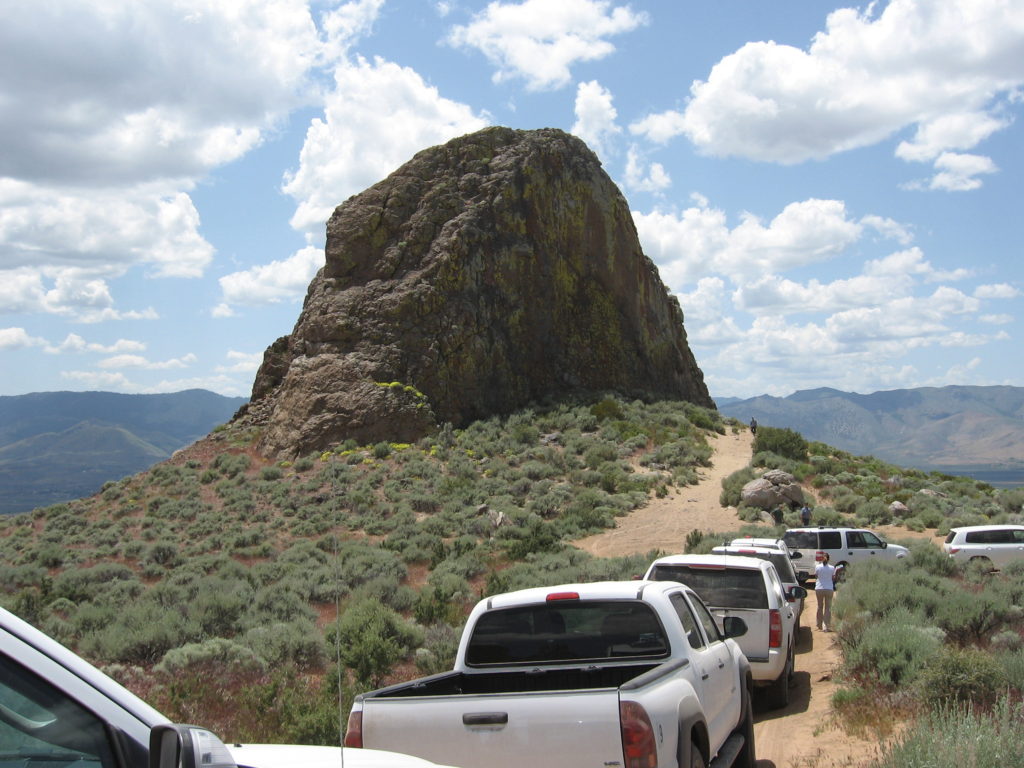
This is one of many fascinating features to be found at BLM’s Fort Sage OHV near Doyle. It is quite possible that we could include this in a forthcoming tour. If you are interested, let me know. For those wondering about Fort Sage, it never existed, more on that later.
Located at the southern end of the Smoke Creek Desert, it was a tiny outpost on the Western Pacific Railroad that for a brief time even had its own post office that operated from 1911-1916.. Some of the old buildings remain in a dilapidated state, the railroad had abandoned it years ago. The most striking feature is the huge gravel pit the railroad used for its ballast.
It makes for an interesting stop, just to view the shear expanse of the Smoke Creek Desert and ponder where you might head to. If you continue along the main road, the next stop is the abandoned Bonham Ranch. Continue further, you can take a left turn on Smoke Creek Road and make an entire loop of the country, as it will take to near Viewland on Highway 395.
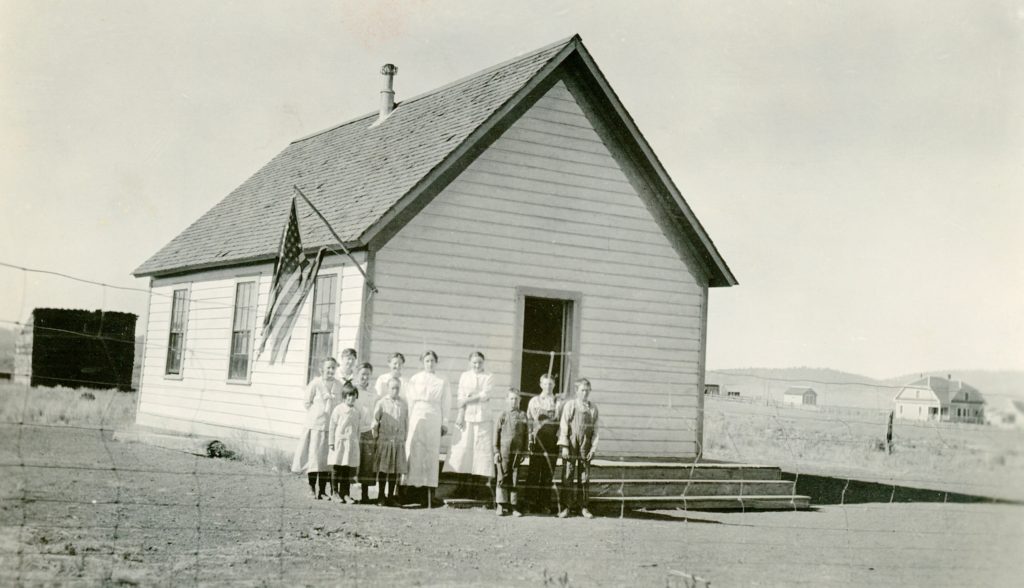
Ash Valley is one of those hidden gems tucked away between the communities of Adin and Madeline. When it was settled in the early 1870s the majority of its population consisted of old bachelors. Changes were on the horizon, new settlers with families began to arrive. In 1876, the Lassen County Board of Supervisors approved the Ash Valley School District, there being some fifteen plus school age children there. Shortly thereafter the residents built a school house.
World War I had a major impact on the rural areas of Lassen County and this was readily apparent in Ash Valley, as the school closed its doors in 1919 for a luck of students. It would go through several openings and closures over the next twenty years. In 1938, John Bath and Martha Bath were the last students to graduate. In 1941, the school closed for good.
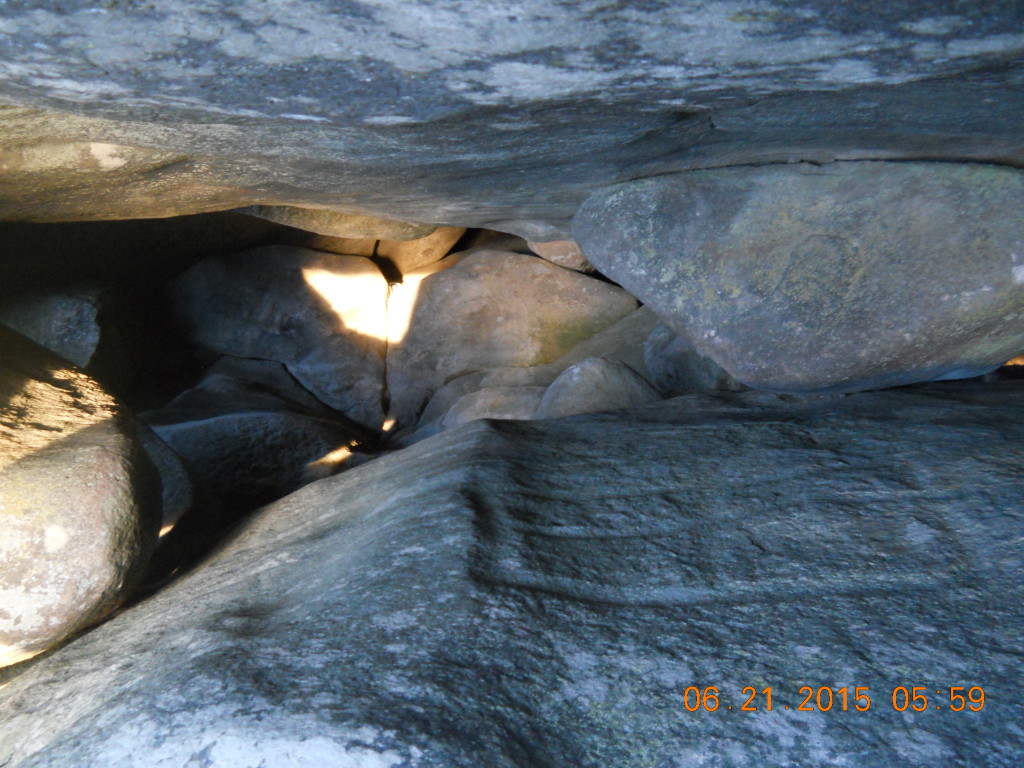
Were you aware that the Belfast petroglyph site also serves as ancient observatory? This event only occurs on the morning of the summer solstice when the sun enters a chamber highlighting a variety of glyphs, among other things. It is quite the sight to see.
The sunrise chamber.
This is an early morning excursion and I mean early as we gather at 5 a.m. to make the trek. In preparation attendees receive in advance John Rudolph’s paper, “An Ancient Solar Observatory.” If there is enough interest we can make the trip again this year. Please let me know. One final note the solstice occurs on Thursday, June 21.
On Wednesday, June 20, I will send an email with all the details. However, if it is overcast there is no sense in going.
Note: There is a $5.00 fee for non-subscribers.
Never miss a story, click here to subscribe and support.
In Susanville’s early years as an incorporated city, it was remarkable what the council did. One of their actions, I still support today, and that is the prohibition of fireworks. The first time they banned fireworks was in 1906, following the aftermath of the San Francisco earthquake and fire. It was also a nod to the insurance companies who suffered tremendous loss from that event. It was their belief, as well as many other communities, that this preventive measure would reduce the risk of fires.
In 1912, the City once again banned fireworks. The Lassen Advocate applauded the city and wrote: 21 June 1912 – “No Fireworks on the Fourth. We desire to congratulate our Board of Town Trustees on their action in placing the ban on all kinds of fireworks on July 2, 3, and 4. This action has been taken by large and progressive cities for years past, and we are greatly pleased to note that the smaller places are falling into line. Fireworks do no good and may do a world of harm. Fires may be started that will blot out blocks of cities or towns; little boys and girls all over the United States have lost fingers, hands eyes and in many instances, their lives from the dangerous pinwheel and firecrackers. Let them yell all they will, let them spend their money for ice cream, candy—anything on earth but the fireworks.”
Butte Lake, circa 1920. Roy Sifford, of Drakesbad fame wrote: “The sign of the Manitou which means the sign of God. The shadows in the water made a long arrows which the Indians thought that was a sign of the Great Spirit (Manitou) or God gave them. Courtesy of the Sifford Collection.
The search for water is an interesting chapter in Lassen County history. However, who would have thought that an civil engineer proposed to tap Butte Lake, in remote Lassen County for irrigation in the Honey Lake Valley. It was 1916, an William Wales of the Honey Lake Valley Irrigation District saw Butte’s for its potentional, especially since no one had filed claim to its water. Wales proposed a canal would be constructed from Butte Creek to Poison Lake, and then onto Pine Creek. From there the water would flow naturally into Eagle Lake. At that point a tunnel would be constructed to convey water into Willow Creek, and from there would flow naturally into the Honey Lake Valley. Due to litigation in the early 1920s the project was abandoned.
There are a wide variety of outdoor enthusiasts in our neck of the woods. For some, they would identify the site rather easily, and for others will be clueless.
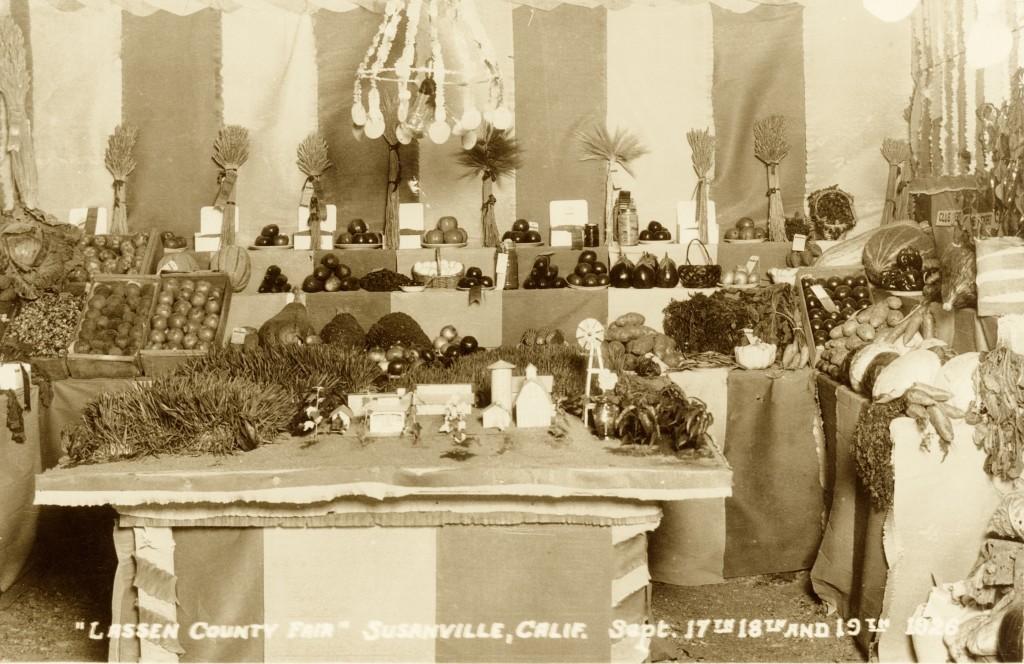
With the impending arrival of the Fernley & Lassen Railroad in the early 1910s, there were a lot of promotional materials produced to extol the virtues of the region. In a 1909, Sunset booklet, it noted that Susanville could be a major player in celery production. They cited one case of Frederick Borgwardt, a Susanville resident, who planted a small plot of thirty by fifty feet with choice variety of celery, from which he gathered eight hundred bunches. When you consider that this plot could be contained a hundred and thirty-five times in an acre, and that the celery sold at five cents a bunch right in Susanville, the profit may be readily seen.
As a friendly reminder, tomorrow is the beginning of Susanville’s Farmer’s Market for the season. Hope to see you there!
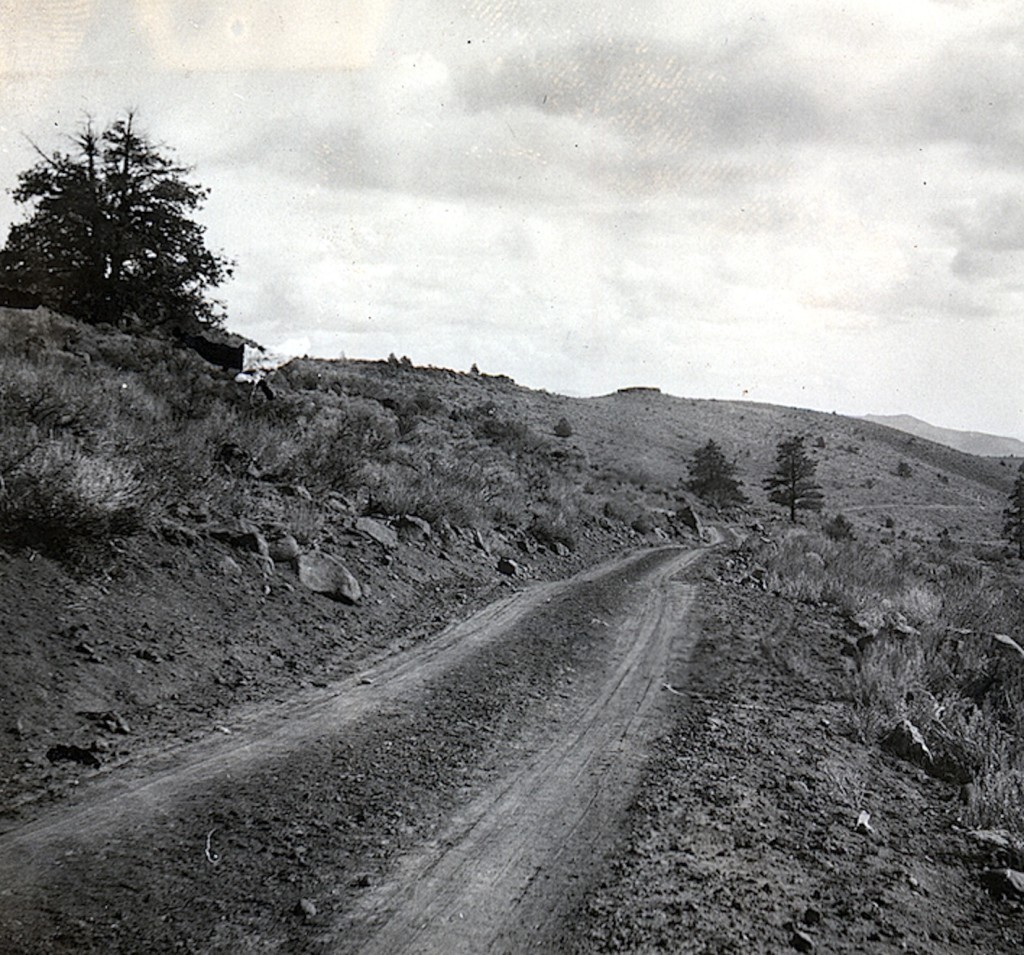
Rice Canyon Road, 1920. Courtesy of Lola L. Tanner
Today, I am out for a little adventure to Rice Canyon and Fort Sage Mountain, and all points inbetween. Many folks may not realize that the route through Rice Canyon, was the main road north leaving Honey Lake Valley. All the equipment and machinery used in the construction of the Bly Tunnel at Eagle Lake came this route. It was not until 1947, when the current Antelope Grade on what would eventually become Highway 139 was completed. By the way, it was named for Ed Rice who settled near there in 1857. The best known resident back in the day was the family of Charlie Piute whose family cemetery is located near there.