Donate!

Donate!

Leonard Clark was one of those interesting Never Sweats who went on to live a very colorful life. Clark was born in 1907 in British Columbia, but was raised in the Honey Lake Valley, as his mother was a member of the pioneer Brubeck-Grass-Litch families of the same place. After he graduated from Lassen High School in 1925, he was struck with wanderlust. By the early 1930s he had explored Asia extensively and wrote his first book, A Wanderer Until I Die. The book published in 1937, as one review began, “Aviator, soldier of fortune, mountain climber this young American has adventure in his blood. From tiger and python hunting in China, treasure hunting in Malaysia . . .” The following year he married Jean Wingfield, daughter of Nevada tycoon George Wingfield.
Because of his vast knowledge and contacts in China and Mongolia, during the early stages of World War II, he was recruited by the American OSS, the forerunner of today’s CIA to conduct espionage and guerrilla warfare in those two countries. After the war, he continued with his adventures and now focused on South America. In 1952, his most popular book, The Rivers Ran East was published, which is his account for the search of the legendary Seven Cities of Cibola in the Peruvian Andes. It was also in South America where he met his demise. On May 4, 1957, Clark drowned in the Caroni River, Venezuela while on a diamond mine expedition.
Subscribe!

The desert homesteaders of eastern Lassen County encountered numerous problems in their quest to make their land there productive. One unassuming predator they had to deal with was the rabbit. In 1920, the residents of the Madeline Plains requested aid from their Congressman, John E. Raker, to help them with this particular problem. A study sent to Raker reported: “As soon as the crops are up and making good progress the rabbits begin work on them. The heaviest damage is done during August. One rancher reported losing 100 acres of wheat last summer. They take this crop in preference to oats and rye. It was reported that 70 tons of rabbit meat [to make tamales] had been shipped last season to the San Francisco market. It appears that the animals cannot be killed fast enough in this region to furnish relief to the ranches.”
Subscribe!

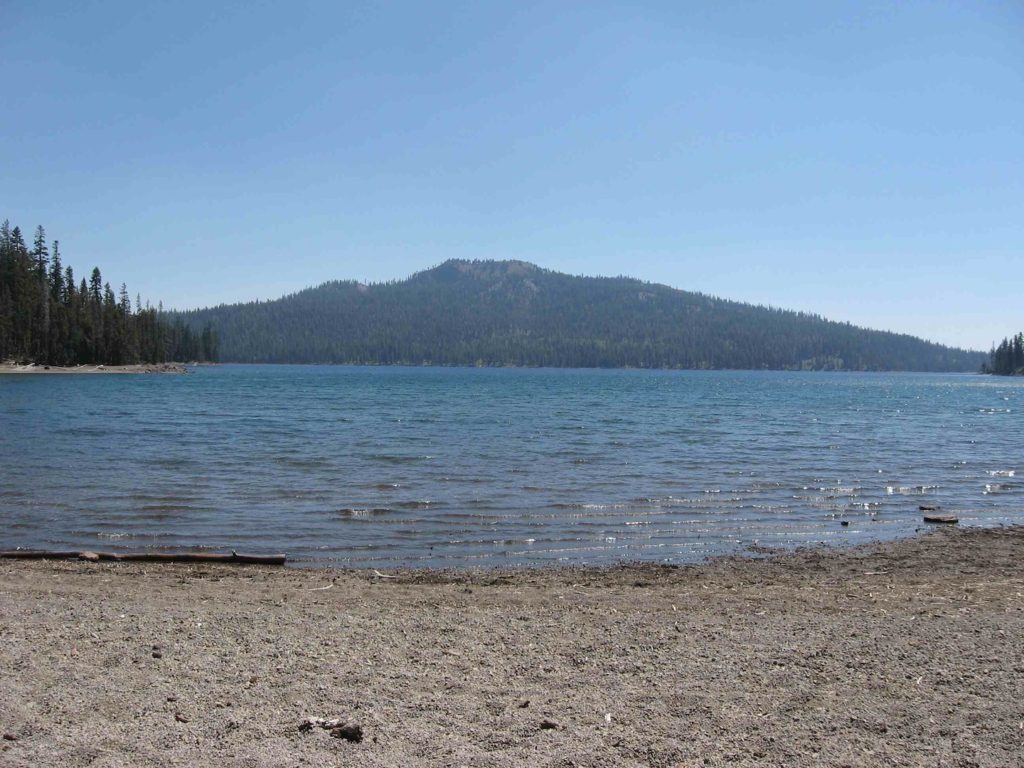
It is officially known as the Lassen County Youth Camp, but its location on the east shore of Eagle Lake and just north of Chico State Biological Field Station, it received the unofficial lake moniker. On November 6, 1962, the County of Lassen received a land patent from the Bureau of Land Management to establish the camp. By 1965, various fund raising drives began and work was done with volunteer labor. In 1974 a restroom and shower facility was completed. It should be noted that a portion of that money came from left over funds from the Save Our Center campaign, which was the result when the state had intentions to close down the California Correctional Center at Susanville. In 1976, the kitchen and dining hall was constructed.
Subscribe!

In spring of 1863, Dr. John Briceland of Cow Creek, Shasta County had a problem. The stream which his flour mill was located had begun to erode the foundation. He made an agreement with P.W. Cunningham and Fred Johnson to relocate the mill, or rather the equipment. For their efforts they received one-half ownership. They found a new location for their enterprise at Johnstonville in the Honey Lake Valley. The mill was located along the Susan River, which was needed for power. They built two small reservoirs and at night they would dam the river and fill the ponds. The two ponds held enough water to power the mill until the next night.
During the late 1860s through the early 1870s, mill changed hands numerous times. In 1875, William H. Hall and Henry Snyder took possession and would operate it for thirty plus years. In 1907, Snyder sold his interest in the mill to Hall, as he desired to retire and move to a warmer climate. Shortly thereafter the mill closed and would remain idle for nearly a decade. In 1919, it was sold to M.A. Taylor of Oakland who dismantled it and took the machinery to the San Francisco Bay area. It should be noted that Standish resident, Sam Alexander purchased some of the lumber that he used to build a barn at his place. Finally, for the record the mill was located at the site of the Gables.
Subscribe!

“Real estate in Honey Lake Valley for the past week has been decidedly shaky, and when things are to get settled down to a firm and reliable basis it is hard to determine. Since last Friday night there have been no doubt at least 50 shocks of earthquakes felt in the valley. Today something like a dozen have been felt here in town. One at seven o’clock this morning was quite lively. The shocks seem to be more frequent and harder around Janesville. It is a well established fact that below Buntingville, crossing the Epley Ranch, is a place that “sounds hollow” when being crossed and at intervals rumbling sounds are heard traveling along this place. The sounds seem to come from the mountains to the west and travel toward the lake. Horses when plowing over this place have become frightened at the sounds beneath their feet. This has been repeated for years. The occurrence of so many earthquakes in this locality seems remarkable and how ad when they will cease seems to be a hard conundrum to answer just now.
“Not the earthquakes alone but the weather is phenomenal. Yesterday the thermometer reached 68 degrees in the shade, while for a week or more there has been no frosts at night. Last night and today we had quite heavy showers of rain and the snow is fast disappearing from the mountains.”
Subscribe!

On March 1, 2015, I began doing the daily postings. It was not until April after I became a bit more proficient with the daily posts, that the subscription feature appeared. I do thank all of you who subscribe for your support. Finally, I just signed another three year contract with the server, so I plan to be around for some time.

Donate!

Subscribe!

Subscribe!