Eagle Lake, 1893

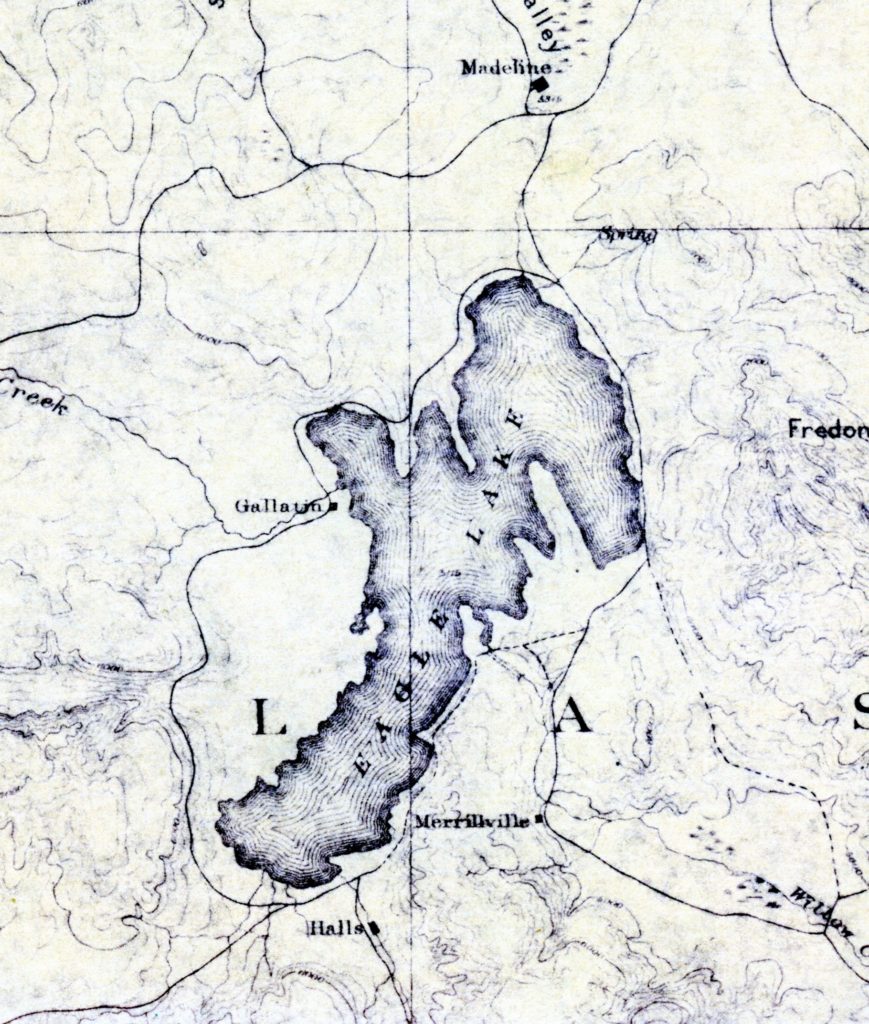
A 1893 topographical map of Eagle Lake

Some might be interested in this map of Eagle Lake. No doubt, there might be a few folks, who think that the cartographer had gone mad. I can rest assure you that was not the case. In the modern era, the Gallatin name has always been synonymous with the south shore of the lake. As one can see from the map, the south shore was referred to as Halls in the late 1800s. It was so designated as Wright P. Hall, a Susanville resident and well known Lassen County public figure, owned Papoose Meadows since 1876. Albert Gallatin’s, ranch manager Byron Bell had a sheep camp near what is known today’s as Spaldings. Prior to this, there had no designation for that locale. In 1914, things suddenly changed. Malvena Gallatin had a built summer home at the south end of the Lake. It was in 1914, the first Spalding subdivision was plotted on the west side of the lake.

Another interesting note, is Madeline located in Grasshopper Valley. The first Madeline was established in 1870s as a stage stop to accommodate travelers to Hayden Hill and other points north. The Madeline we know today on the Madeline Plains came into existence 1902 with the arrival of the NCO Railroad, which was formally known as Van Loans.
Spread the word, and encourage a friend to subscribe

Mixie Flat, Nevada

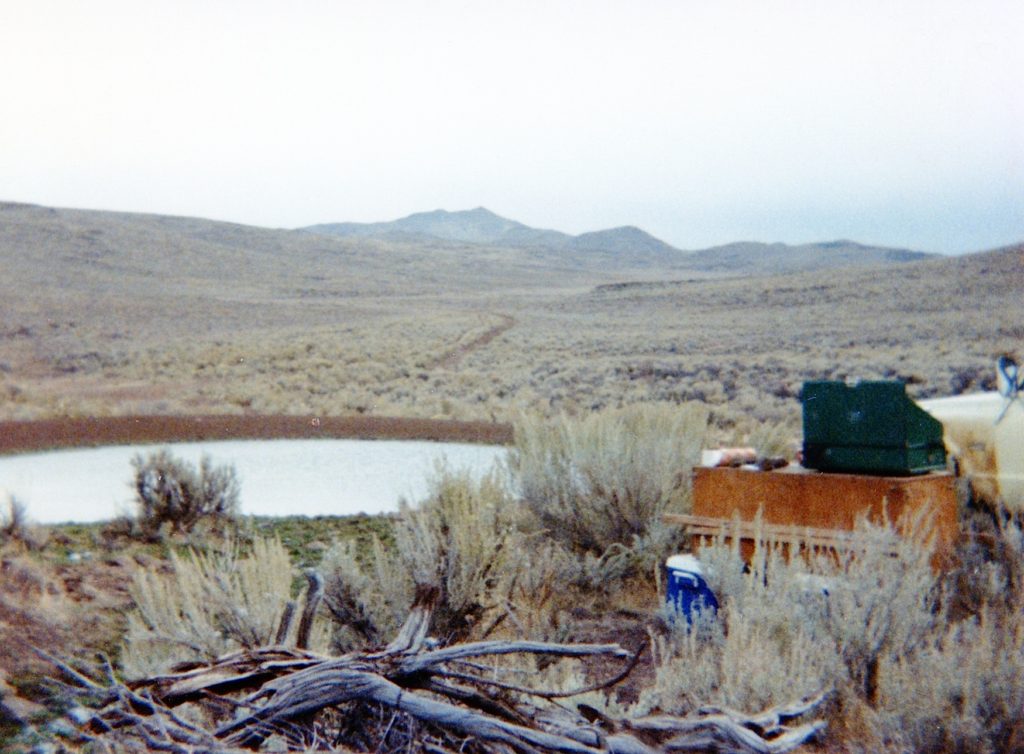
Indian Springs, Mixie Flat, October 1985

Last month, this obscure location was in the news about two travelers, who for reasons unknown, perished near there—no foul play was involved according to officials of both the Lassen and Washoe County Sheriff’s Departments.

Mixie Flat is in northern Washoe County, Nevada, just north of the Smoke Creek Desert and just east of the California-Nevada border. It is also the headwaters of the east branch of Smoke Creek.  While I do not know much about the history, I have some interesting memories camping there in 1985–the kind that you never forget. If one wants a truly memorable lifetime experience, depart Mixie Flat from the east and descend down Parsnip Wash to Buffalo Creek at your own peril.

Support

Gyppo Loggers

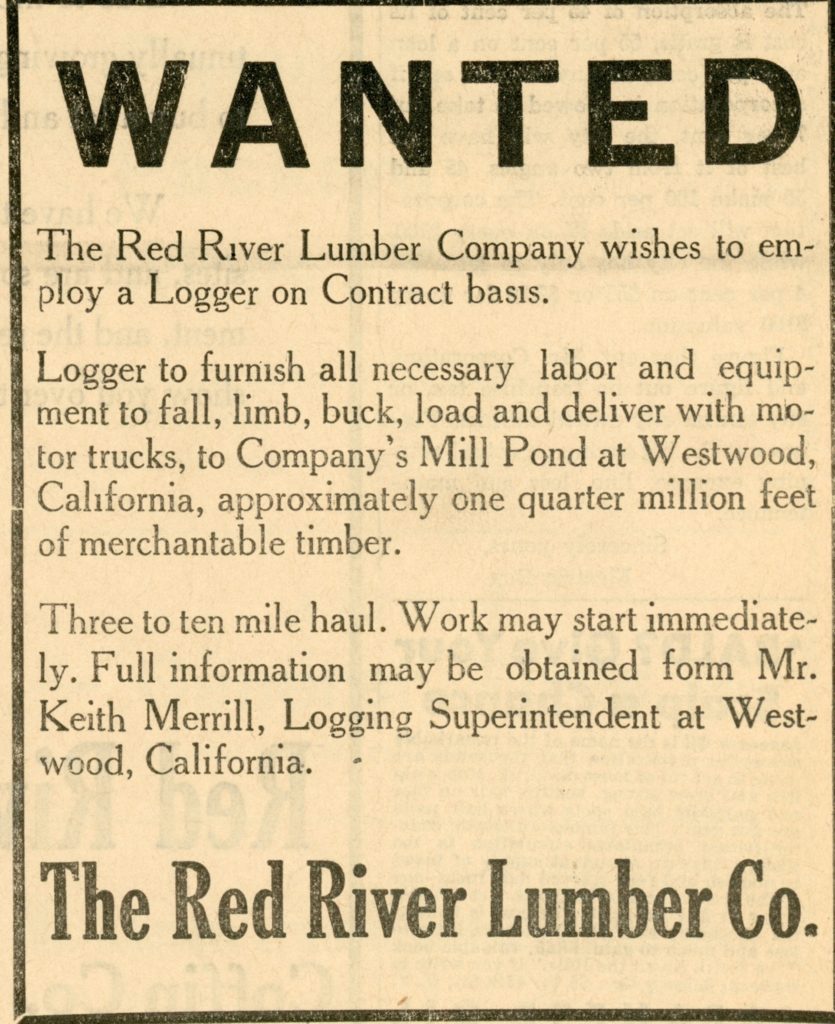
A Red River Lumber Company Ad—-Lassen Mail, October 7, 1935

This is one aspect of logging operations that I have never addressed. It is by the way, a term near and dear to me, as my father was a gyppo logger.

The term originated during World War I from the Industrial
Workers of the World (IWW) one of the earliest unions to attempt to organize loggers and sawmill workers. Just exactly how word was coined is not known. The IWW referred to the gypos as strike breakers. Basically, a gyppo logger could be an individual or small company who worked as a independent contractor to log certain tracks for large companies such as Fruit Growers Supply, Red River Lumber Company among others.

Spread the word, and encourage a friend to subscribe

The Lucero Mortuary

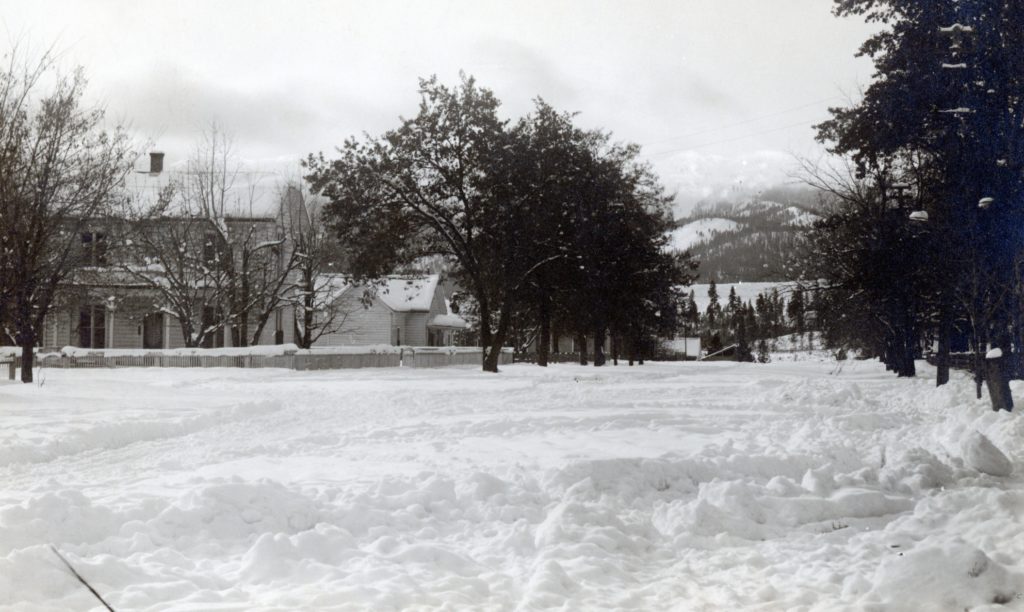
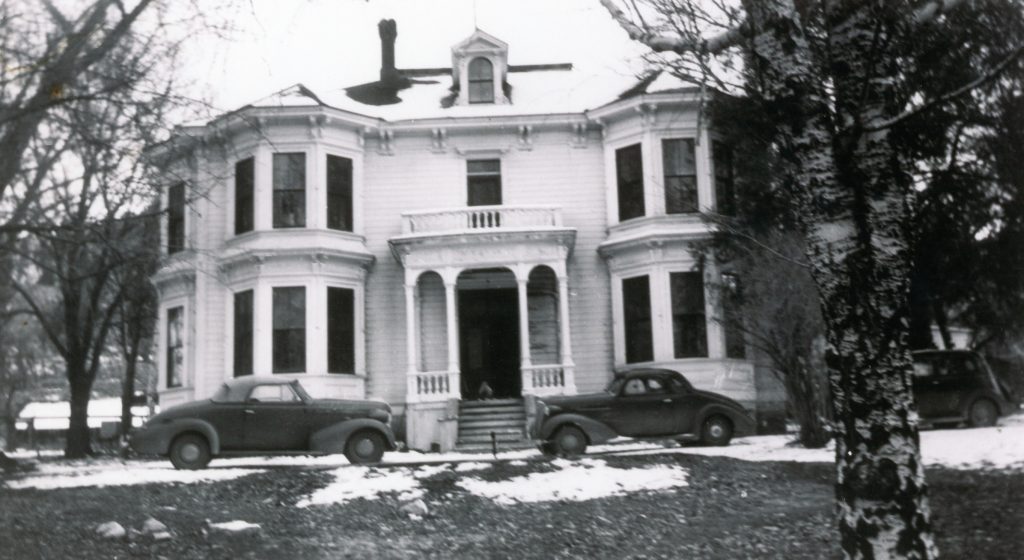
The McDow residence at the intersection of Lassen and Cottage Streets, January 1911.

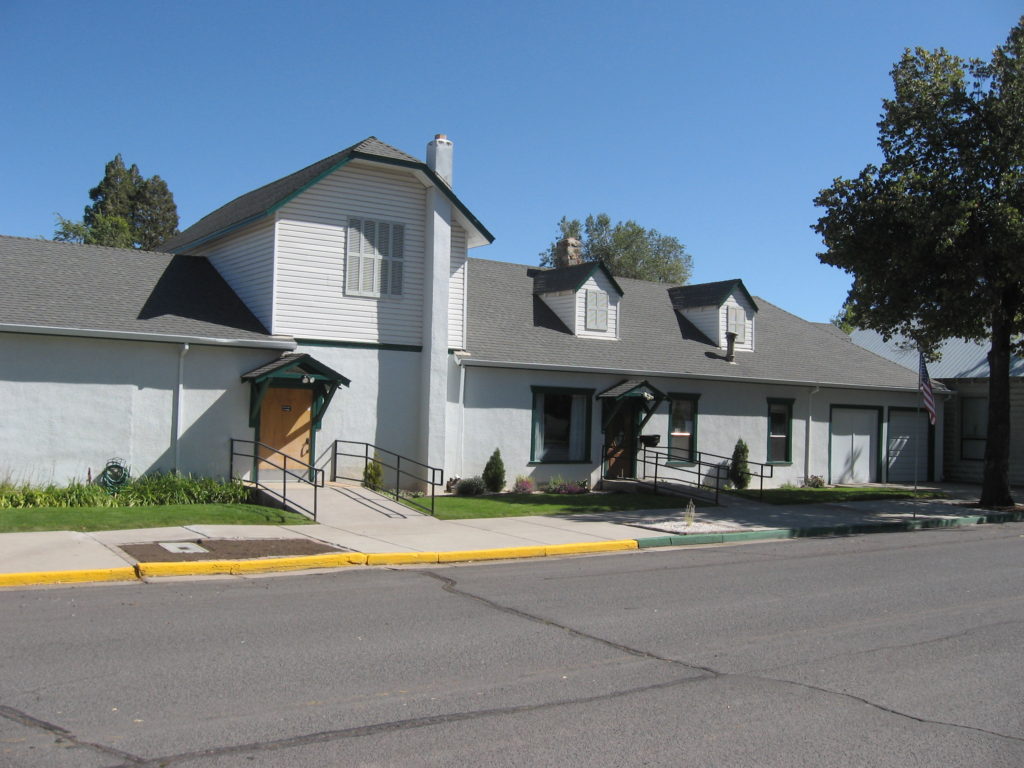
Seasoned residents will recall Carlos Lucero and his mortuary located on South Lassen Street, which is now Walton’s Mortuary. In November, 1935 Lucero purchased the George McDow residence and proceeded to renovate it into a mortuary to compete with the town’s other mortuary—Edenholm & Morrill. Lucero hired A.K. Philbrook to operate it, who had been in the local undertaking business since the early 1900s.

Fast forward to the spring of 1938 when Edenholm & Morrill took over the premises. They, too, made extensive improvements including the use of knotty pine in the interior, that was quite popular then. Within ten years, Lucero would again own it and this time operate mortuary for several decades.

It is now known as Walton’s Mortuary, 145 South Lassen Street, Susanvillr. September 21, 2019

Subscribe

Bieber’s New Jail

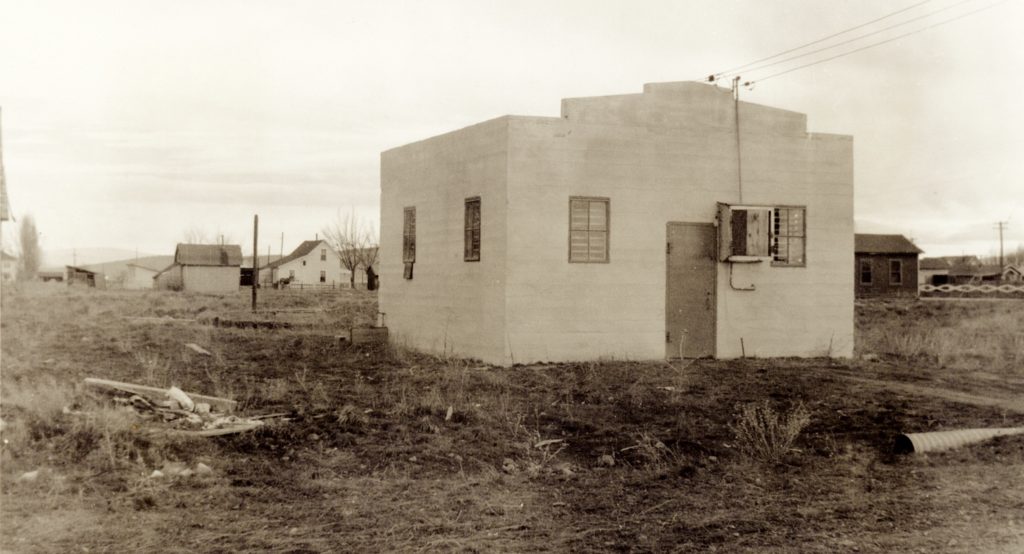
Bieber Jail, 1947

On Saturday, August 8, 1931, Lassen County purchasing agent, E.F. Koken drove to Bieber to sign and award a contract to build a jail for that community. The concrete structure contained three cells and a storage room. W.A. Zimmerman built the structure at a cost of $1,935.50.

These were exciting times for Bieber being the focal point where the Great Northern and Western Pacific Railroads were in the midst of constructing their respective extensions to connect the two railroads. Besides the new jail, construction began on a $10,000 grammar school. In addition, Pacific Gas & Electric was constructing a transmission line from Fall River Mills to Big Valley.

Support

Lake School, Lassen County

Lake School
Lake School, 1886

One of the original six school districts established in 1864, that was located in the northwest segment of Honey Lake, near what would become Buntingville. In 1877, the District constructed a two-story schoolhouse with the assistance of the Independent Order of Good Templars. The second story was used as a hall for that organization. In 1934 the second story was removed as part of a WPA project. Francis Wilbur, a local carpenter was hired to do the work at a cost of $1,740.

In 1953, a ballot referendum was held to consolidate the Janesville, Lake, and Missouri Bend schools. The Lake District voters opposed it. In 1971, the school closed and annexed to Janesville. In 1975, the Janesville District declared the Lake School as surplus property and it was deeded to George and Jane Bailey. The schoolhouse has since been converted into a private residence.

Lake School as a private residence, February 7, 2016.

Spread the word, and encourage a friend to subscribe

The Chateau

In the 1920s witnessed the construction of State Highway 36 between Red Bluff and Susanville. This allowed entrepreneurs opportunities to take advantage of the motoring public’s needs. This was readily apparent between Susanville and Westwood that within a short time frame four roadhouses were established.

The first one, “The Chateau“ was operated by Bill and Julia Nolan just a short distance west of Devil’s Corral. The initial operation was modest with a gas station and a small store selling snacks. Business was good and by 1929, a restaurant was added. Another unique draw was Julia Nolan offered her abilities as a fortune teller.

By the early 1930s, the Nolan’s sold their enterprise and it would change ownership on a rather frequent basis. It also became known as “Deerhaven.” The big snow of 1952 severely damaged the building and it closed for good.

Support

Eagle’s Peak Ski Resort Revisited

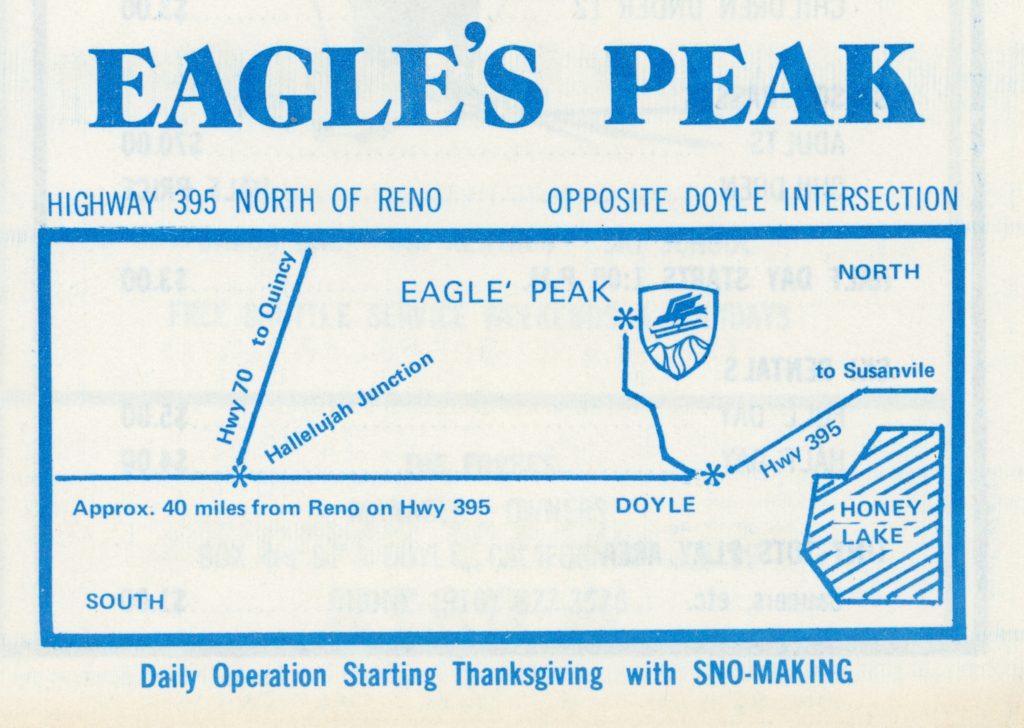
A portion of the resort’s brochure.

Note: This originally appeared on June 28, 2019. There are several new subscribers who would be quite interested on this topic. Also, unfortunately I have not located any additional information.

This short-lived ski resort was the brain child of Ernest “Ernie” Forbes, an Austrian skier. Forbes established Eagle’s Peak in 1971, in one of the more peculiar places, near Doyle. As the late Paul Herman informed me that Forbes always wanted his own ski hill. In a 1972 interview Forbes stated “Started a dream that is becoming more and more a reality everday.” He designed the entire operation with the first slope for beginner and intermediate skiers that according to Forbes to accommodate 150-200 skiers at a time. Of course, Forbes offered skiing lessons, since he had been a ski instructor at various resorts in the west. Other amenities included a snack bar, ski rentals and even a free shuttle service on weekends and holidays. Of course, Forbes had grandiose plans of a modern lodge, advanced ski runs and so forth, none ever materialized. Records are rather sketchy but it remained in operation until the early 1980s.

Support


Christie Furniture Update

Lassen College 1970-71 yearbook ad—-Jim Chapman

According to Claude Wemple, who by the way was related to the Christie family, that after Jim Christie’s death in 1936, the furniture store was sold to Frank Stewart, It was Stewart who moved the store to the Main Street location from Weatherlow Street. Stewart later sold to the store to Madge Dolio, who in turn sold to Carlomagno.

Tim

Latasca Shidler & The Monastery

The White House, 1947—-Eslie Cann

On Monday morning, January 7, 1929, Latasca O. Shidler was killed instantly when his car collided with a Western Pacific passenger train at Constantia. Such traffic events were common then.

The 39-year-old Shidler had previously worked as a mechanic for the Western Pacific. However, at the time of his death, he was employed as a ranch hand for the Galeppi family at Constantia. One newspaper report cited that Shidler resided in the old Monastery, which in reality was the White House at Constantia. For whatever reasons, members of the Galeppi had no desire to reside in the 17-room house. After Shidler’s death, an elderly Indian couple by the name of Purdy, resided as caretakers in the house. With their passing by the end of the 1930s, the house was never occupied again.

Support

Exploring Lassen County's Past