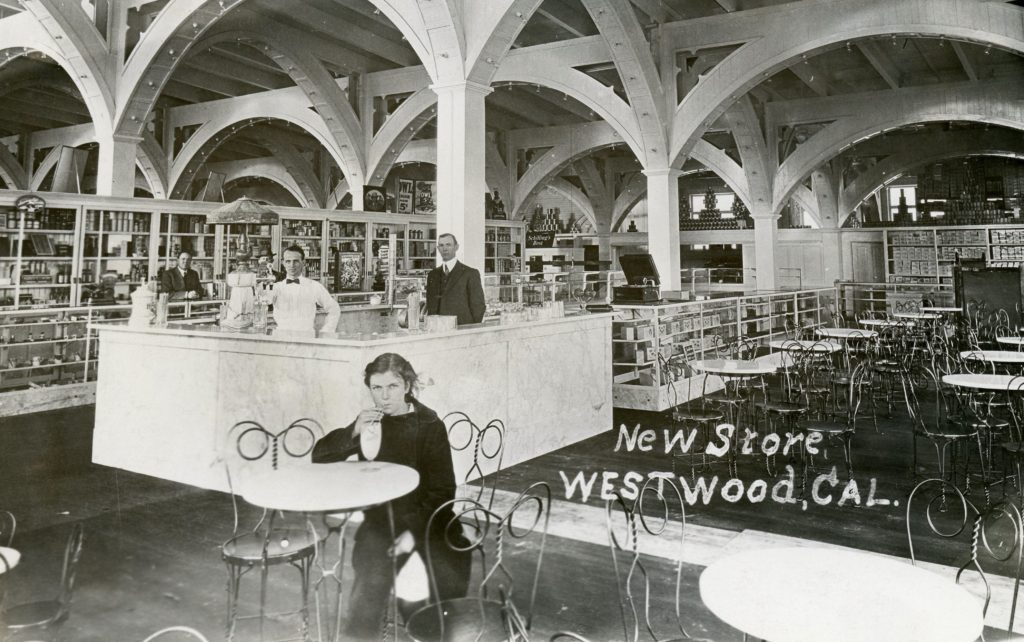
On December 24, 1914 was a major event in Westwood when the town’s Big Store opened for business. The Plumas National provided the following description of the event. :“A complete butcher shop, a drug store, grocery department, men’s furnishings, women’s goods, hardware and shoe departments are all under special heads, each of whom is a specialist in his line. Nineteen men are employed in the store at the present time.”
The soda fountain in the Big Store.
In February 1916, the Big Store got even bigger with another forty-foot addition. The facility could boast 73,125 square feet of retail space, with an additional 8,800 square feet utilized for offices and other purposes. It was the largest department store north of Sacramento.
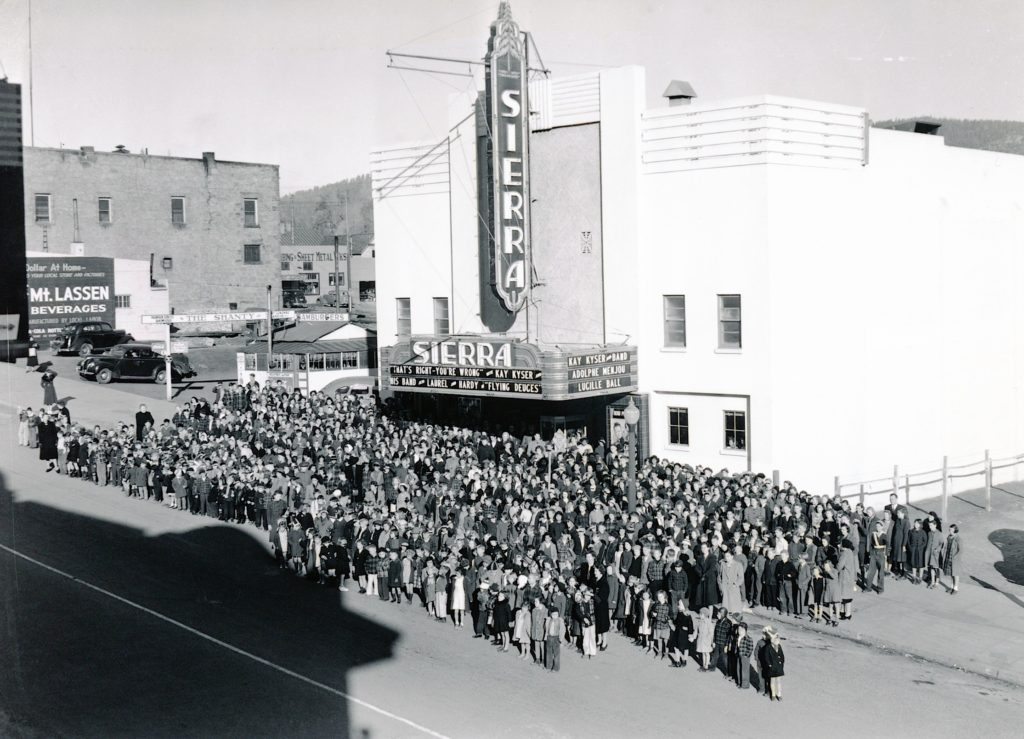
A year or two after the newly constructed Sierra Theater opened its doors in 1935, an annual Christmas event transpired. It was a special “Kiddies Day at the Matinee.” It was opportunity for all the school children of Susanville to have a special morning showing of movies, and given Christmas treats, as well. Various groups and businesses supported the event. This custom carried on for several decades.
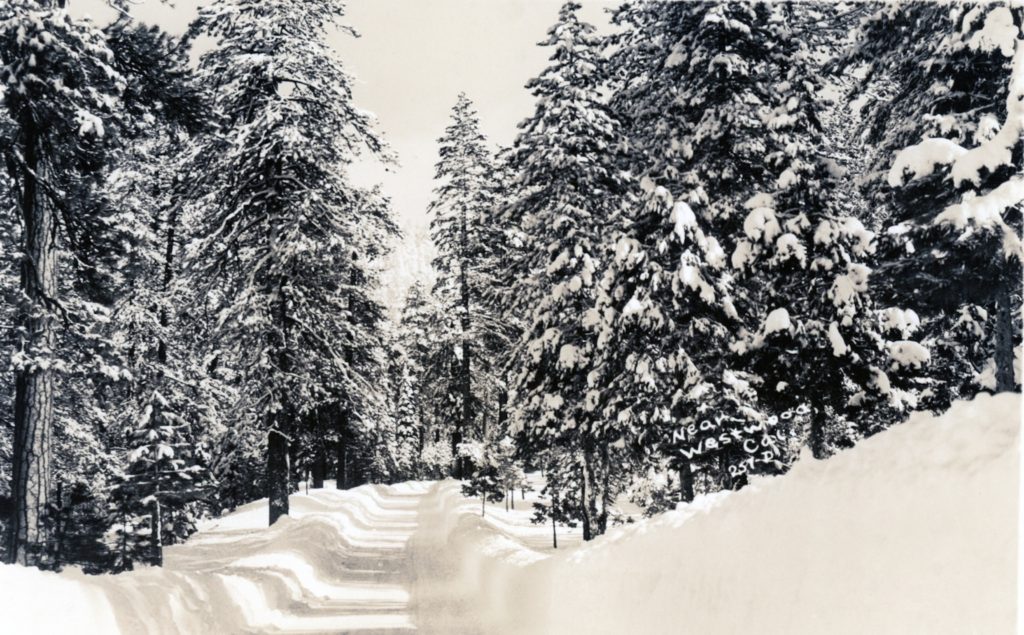
The road has been plowed, but what do you do if there is an oncoming vehicle?
The caption states taken “near Westwood,” but when it was taken remains unknown. When winter snows arrived on the east slope of the Sierra, travel across the mountains came to an abrupt halt. It was that natural barrier why east slope residents since the 1850s sought for their own self governance.
What is intriguing about this photograph is the road is plowed. In the late 1910s when Westwood was established, there was a competition with that community and those in Susanville to see who would be first to cross over Fredonyer in the spring. In addition, no doubt with a ting of spring fever, the two communities led a joint effort to clear each other’s side of the mountain of the snow.
When Highway 36 was completed between Susanville and Red Bluff in the late 1920s, when winter arrived the California Highway Department closed the highway. After intense lobbying, in 1929 the state agreed to plow the road for snow removal, thought initially it was sporadic.
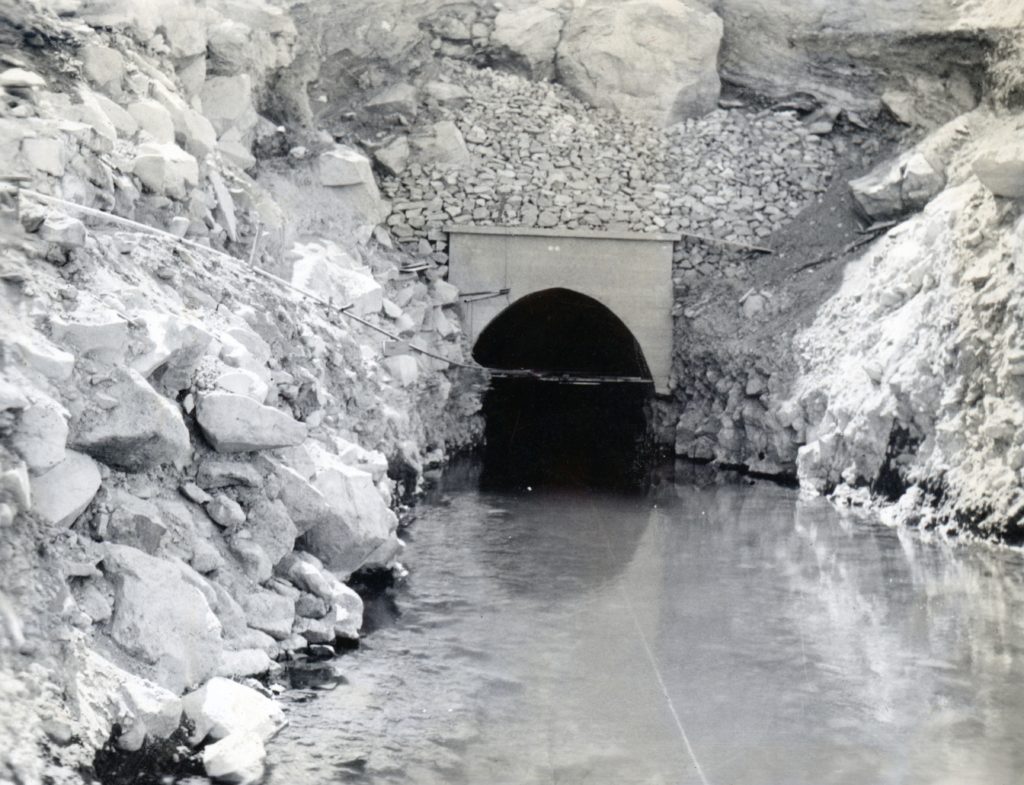
Bly tunnel inlet, July 1924. Courtesy of Wyn Wachhorst
In 1934, the California Department of Fish & Game introduced two varieties of fish into Eagle Lake. The first was a spiny ray fish, though exactly which specie it did not identify. They thought they would be successful because of their breeding habits. However, due to the lake’s high alkaline content the fish were almost immediately killed when planted in the lake.
The other experiment was with coho salmon. It was a substantial planting of 250,000 of coho. A problem occurred sometime between the initial planting and the spring of 1935. Unknown parties had removed the fish screen at Bly Tunnel. Instinctively, a large population of the salmon migrated through the tunnel, just as they would like a regular stream to reach the ocean. Fish and Game officials were furious to say they least. They stated there would be no more fish plantings until the problem was fixed.
While the fish screen was reinstalled, Fish and Game were hesitant of future plantings due to the high alkalinety of the water.
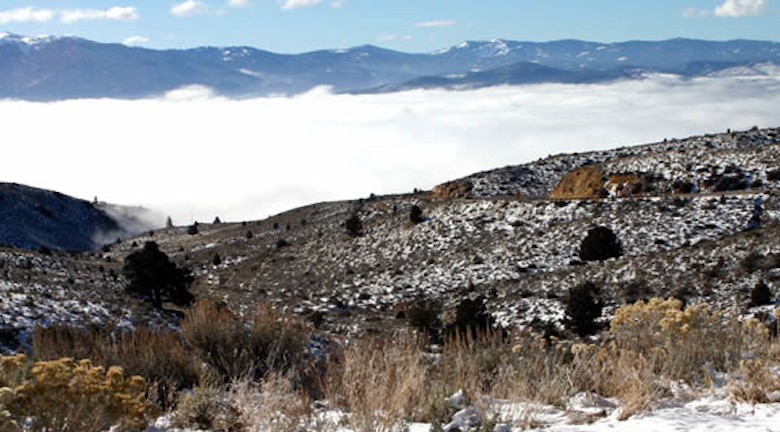
The latest storms residual moisture and lack of wind is the perfect combination for a pogonip, also known as a freezing fog. . A true pogonip is when the fog freezes coating everything with ice crystals. The name is from the Native American community when translated means white death, due to the number of Indians who would contract pneumonia from this weather condition.
There are varying types of pogonips. The most common form is when the high pressure holds down the cloud inversion. Thus, in many instances, one only has to travel a few hundred feet above the valley floor to bask in the sunshine. The pogonip season usually runs through December and January. The longest recorded duration, locally, lasted for six weeks in the winter of 1859-60.
On a final note, the National Weather Service states that there is a storm front headed our way tomorrow. There should be enough winds to break up the inversion, and may be we will see a little sun shine in the afternoon.
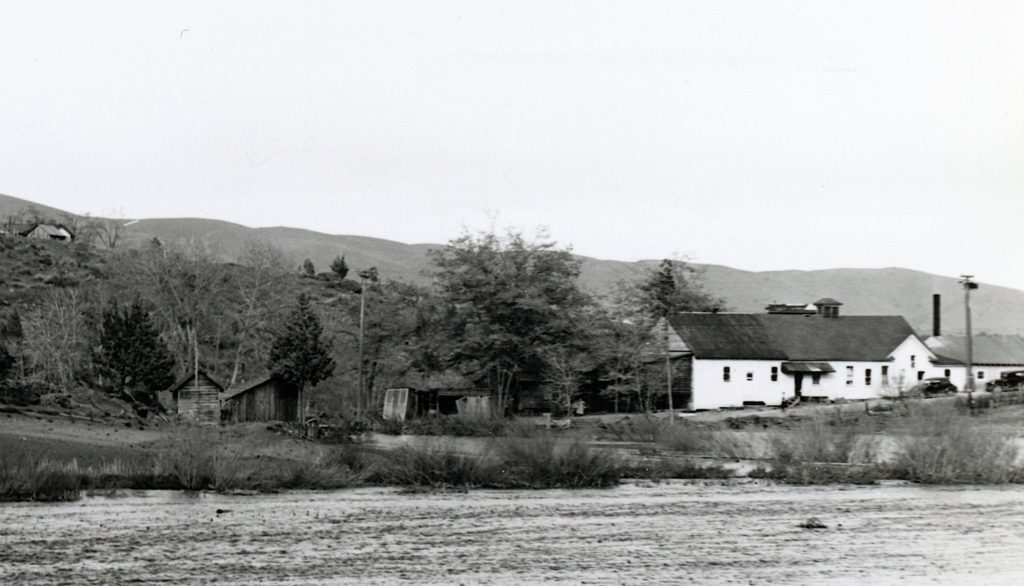
Model Laundry, 435 N. Roop Street, April 1938–Betty B. Deal
A lot of people have been curious about stone and cement work at the intersection of Roop and Cherry Terrace in Susanville. It was the original home of the Susanville Creamery. Then it was transformed into Model Laundry which remained there until 1950, when it relocated into their new building on the northeast corner of Main and North Spring Street. You can learn more about the original post at Roop Street Remnants. However, the original post did not include a picture of the building, hence this update.
435 Roop Street and the remains of Model Laundry., September 3, 2018
Grant Smith’s tunnel works, Eagle Lake, 1922–Courtesy of Lola L. Tanner
Without archives, we would not have records about our past. Some readers might find this a bit mundane. Since we are approaching the end of year, some focus on tidying things in the record department.
In 1996, a colleague of mine and dear friend, Francis, better know as “Fritz” Riddell desired to assemble all collections of the Baxter Creek and Tule Irrigation Districts, i.e., Bly Tunnel and have them deposited with California State Archives. Riddell’s father, Harry, was hired as an engineer in the late 1920s to see if he could find a remedy to the problems of Bly Tunnel. He had all of his father’s records. In my possession were the district records by two of their attorneys, Hardin “Finn” Barry, and J.A. “Gus” Pardee. There was a third piece, the County of Lassen, which the Planning Department had stored boxes of the irrigation districts records. The County was agreeable and mission accomplished.
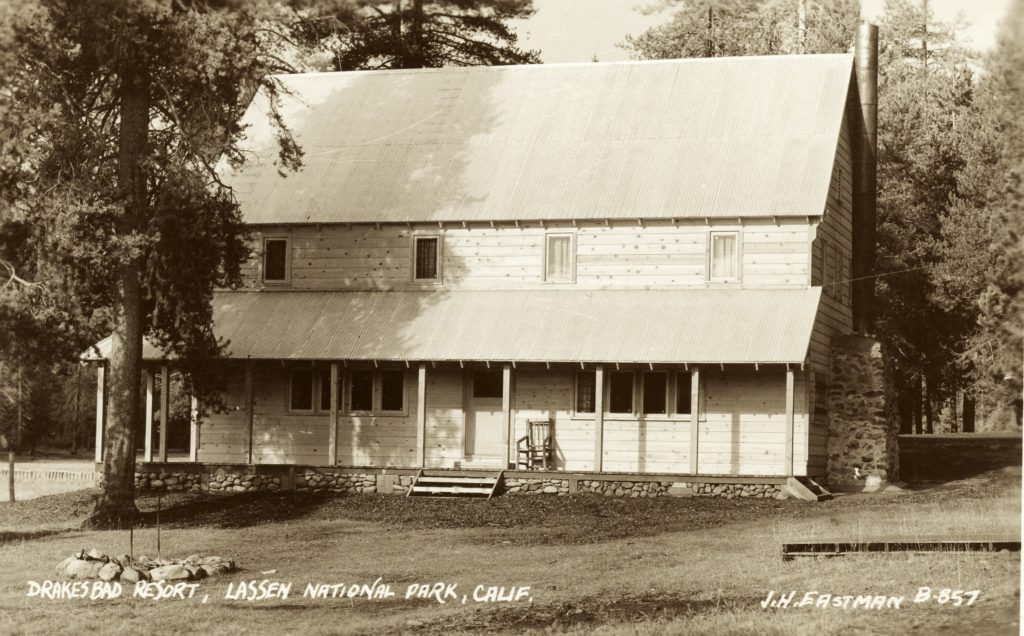
Drakesbad, 1939
During the early 1990s, I came into possession of the Sifford papers. This material primarily generated by Alex Sifford and his son, Roy. In 1900, Alex Sifford purchased what was known as Drakes Springs, and later transformed into Drakesbad resort located in Lassen Volcanic National Park, that was created sixteen years later. They, too, needed a permanent home. In May 2021, they are now part of the archives of Lassen Volcanic National Park.
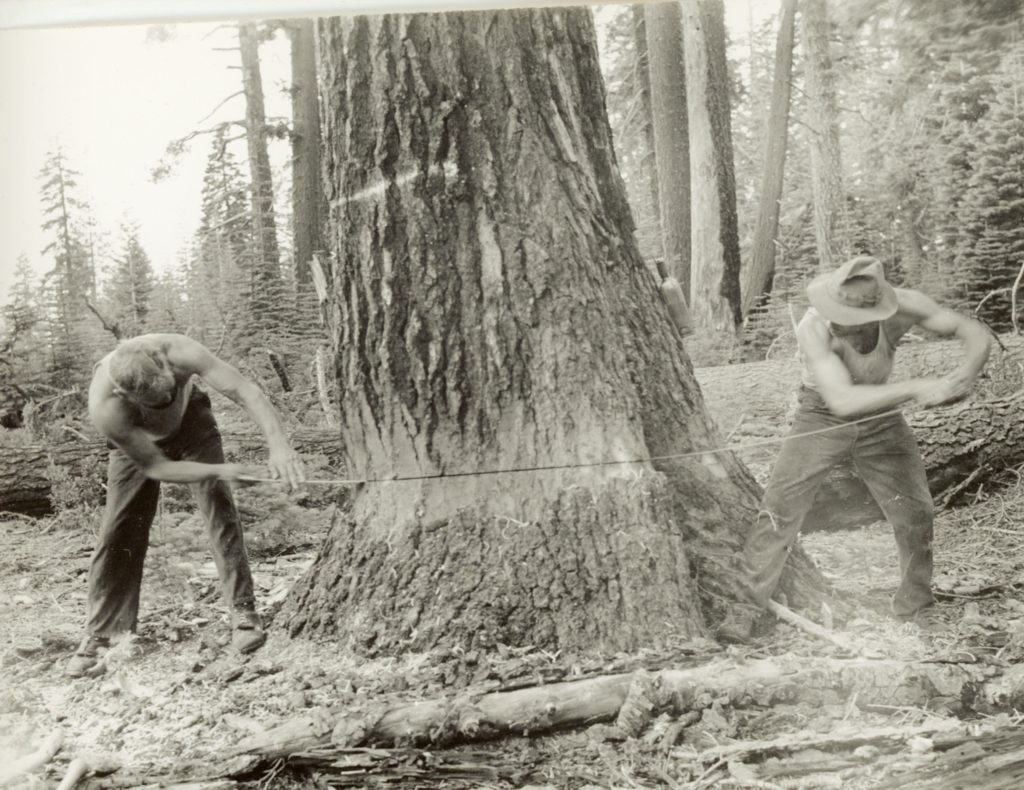
Timber fallers, Fruit Growers Westwood Operation, 1947
While researching the history of the Fruit Growers Supply Company’s Northern California logging operations I interviewed and corresponded with many former employees. The following account is from Bob Eastman who worked in the woods at the Hilt Operation. He refers that the fallers did piece work. Timber fallers were not company employees. They were contractual and were paid by the scale, i.e. board feet felled. In those days, with large trees, fallers made very good money. The buckers and limbers, however, were company employees.
“Just a bit on the makeup of the woods crews. Now, I’m speaking of the steam age, not the modern gas and diesel operations. Then it still depended on huge outlay of brute force and muscle.
“A team of two fallers, usually the most athletic and youngest, took double bladed axes sharpened to brittle edge and a cross cut saw and some wedges. This team felled the tree in an incredibly short time. After all, they were piece working and the more they cut, the more they got paid. Then two buckers with a long cross cut saw and a few wedges bucked the tree, sawing it into lengths of 16 feet, 32 feet or 40 feet to fit on the sawmill rigs. That was hard work and very dangerous because rhe log could roll—and that was it for the bucker.
”The fallers had a dangerous job too. The ‘widow maker’ could get out at anytime. A falling limb was bad enough and could just as well kill someone unlucky enough to be beneath it as it came crashing down. The main cause of damage though, ‘the widow maker’ was something else. A lot of the trees were old and were dead and the fallers didn’t know it. They were already rotten, especially at the tops. It was these huge pieces of trees that would come crashing down like a bunch of bombs and when they struck earth, zing of horizontally. You didn’t even have to be close by. Anyone even hundreds of feet distant could be struck by these flying things. The irony was that most of the loggers were unmarried and there were no widows to mourn them.”
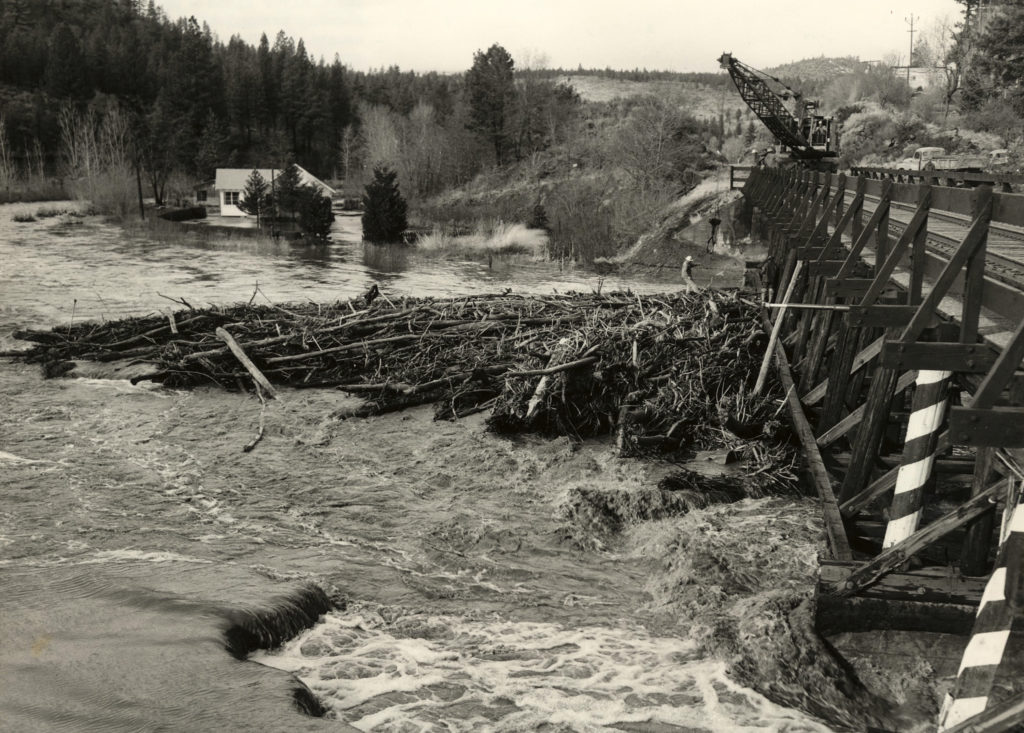
Southern Pacific’s railroad trestle at South Lassen Street, December 1955.
The floods of December 1955, locally and throughout California was a notable event to say the least. It began with warm rains on December 15th and by December 20th, 4.41 inches had fallen in Susanville. The snow elevation remained high, and on December 20th there was 21 inches of snow on Fredonyer summit. The rain continued turning the Susan River into a raging menace. Conditions worsened as the river brought assorted debris with the floodwaters. The debris became a major obstruction when it collided with the Southern Pacific’s railroad trestle at Susanville’s Lassen Street. On December 23rd Marvin D. Coltran, a member of Southern Pacific’s bridge gang fell into the water there. Efforts were made to reach him, but the river’s swift current swept him away.
Riverside Drive, Susanville, December 1955
Relief from the rains arrived in the form of snow on December 28, when four inches fell in Susanville. In December 13.03 inches of rainfall was recorded in Susanville.