In 1955, Fruit Growers Supply Company announced its closing of the Westwood mill. Over the hill in Susanville, many pondered when Fruit Growers might do the same there. The Susanville mill would receive a brief reprieve.
In 1957 six paper companies were interested in Fruit Growers cutover lands in Lassen County. While California ranked second in the nation for lumber production, there was only one paper/pulp plant in the state. Fruit Growers had debated at one time to convert the Susanville mill into such a facility, but it was just not going to happen.
On November 7, 1962 the beginning of the end was announced with the closure of the Susanville mill. The woods employees were permanently laid off. The mill would remain in operation until the logs on hand were processed. On May 13, 1963 the last log was sawn. Shortly afterwards the remaining employees terminated and the mill closed. There being no buyers it appeared the mill was destined to be dismantled. It did receive a last minute reprieve with negotiations of Crook & Emmerson, but that is another story. On April 30, 1964, Homer Vincent closed Fruit Growers” Susanville office.
After World War I lumber companies began implementing modernization of logging methods. The adaptation of caterpillar tractors proved to be efficient and cost effective. As advances were made on different fronts, one area was lacking—the falling of timber.
An electric saw powered by a D-2 cat. Courtesy of Fruit Growers Supply Company
World War II created all kinds of shortages and labor was one of many. Fruit Growers Supply Company’s 1946 Annual Report provides an interesting glimpse in regards to timber fallers and labor.
”One place in the lumber industry where the use of mechanical equipment has not improved costs is in the falling and limbing of trees in the woods. Until the power saws came along, all of this work was done with hand tools on a contract basis where increased production meant increased earnings to the worker. With the advent of power falling saws, this work changed from a piecework basis to a straight-time basis and as a result costs actually increased. There is no valid reason why power falling saws should not result in lower costs than hand falling and also result in higher earnings to the man on the job. One factor in this change is that skilled help was drawn away from the woods by high wages offered elsewhere and by the military services. Hand fallers are highly skilled, but the substitutes for hand fallers who operated power falling equipment did not require much skill for the job and most of them have not attempted to acquire speed with the power equipment. There has grown up considerable resistance to piecework methods in recent years. Efforts are being made by the industry to get back to a contract basis for this type of work.”
Bucking a log—FGS Co.
For a little bit of clarification about the contract work. Timber fallers for years were paid by the scale of the board feet felled. These men made very good money, considering the size of the trees then. As late as the 1970s, timber fallers were still being paid by the scale.
When Honey Lake is full, it has found many uses such as boating, fishing and ice-skating to name a few. One of the more unusual usages of the lake was baptisms. On Sunday, March 8, 1914 the Janesville Baptist Church held services at the Lakeview School. After the services, the congregation went to the shores of Honey Lake, where the Rev. L.D. Howard baptized several new candidates into the flock. Unfortunately, I have not been able to find a record as to who they were.
In 1919, Honey Lake went dry and would remain so until the winter of 1937-38. So baptisms as the lake was no longer an option. On April 2, 1932, the Rev. Bond of the Seventh Day Adventist Church o Susanville found an alternative—the Wendel Hot Springs—which thirteen members were baptized there.
This Susanville landmark, which is more a less a replica of the original structure built by the Roop Brothers in 1854 was never intended to be a fortress. Its purpose was that as a trading post along the Nobles Emigrant Trail. It was in 1863, the abandoned trading post was were Honey Lakers barricaded themselves in a conflict with Plumas County officials dubbed the Sagebrush War. That is another story. Thus, the appellation of fort was added to the structure. It has also been known as Fort Defiance.
In May 1974, Northern California Congressman Harold T. (Bizz) Johnson announced that Roop’s Fort and Trading Post had been entered into the National Register of Historic Places.
This originally appeared back in 2019. A recent post about the occupants of the Knoch Building, a reader thought I neglected the B&B, a popular place back in the day. Without further adieu here it is.
1935 Advertisement for B.B. Liquor Store
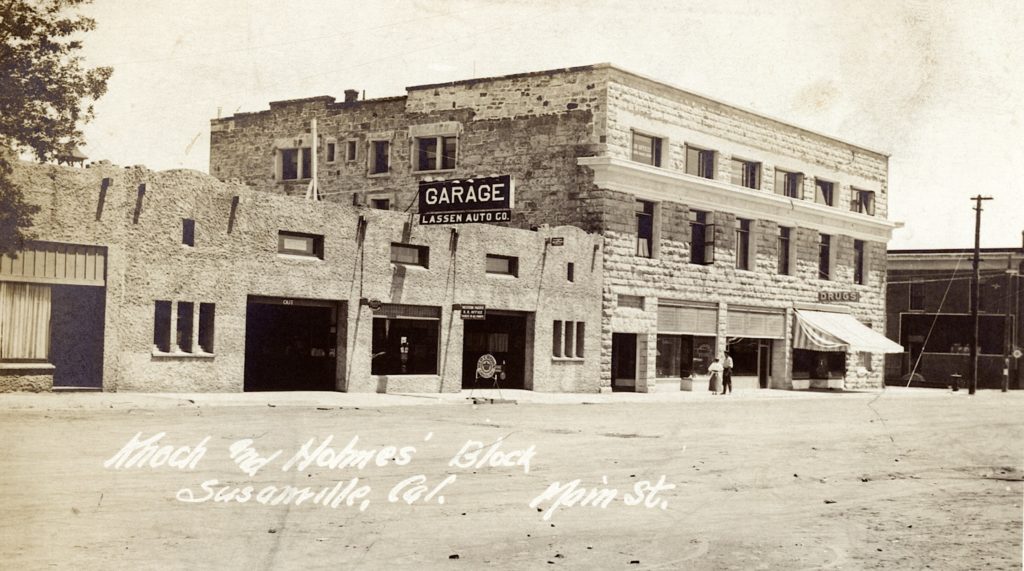
Seasoned residents will remember with fond memories of the B&B, a fine restaurant and bar located in the Knoch building. Before it became the B&B it as the B.B. Liquor Store. The B.B. stood for Brouillard’s Beverages, after the owner, E.H. Brouillard.
Some may recall in the banquet room, there was a rather large canvas mural 6’ x 20’ of Mount Lassen. It was painted by J.E. Lane, and the mural still exist, it being in storage. It should be noted that two other works of Lane have graced the walls of the Lassen County Courthouse since 1917. One is of Susanville as it appeared in 1864. The other is of Warner Valley, with Lassen Peak in the background. Why the County Board of Supervisors selected the latter has always confused me. First Warner Valley is in Plumas County. And, secondly, Lassen Peak is in Shasta County.
Lassen County Courthouse and Hall of Records, 1907. Courtesy of Gil Morrill
When the Lassen County Courthouse was constructed in 1867, in certain ways it was a multi-purpose facility. It would be awhile before any houses of worship would be built in Susanville. The County allowed the courthouse to be used for religious gatherings charging $3.00 a day.
The original courthouse did not have a second story balcony. It was constructed in 1892 by L.D. Arnold and George Harrison for $150.
I was going to include some other tid-bits, but my wrist recovery decided otherwise.
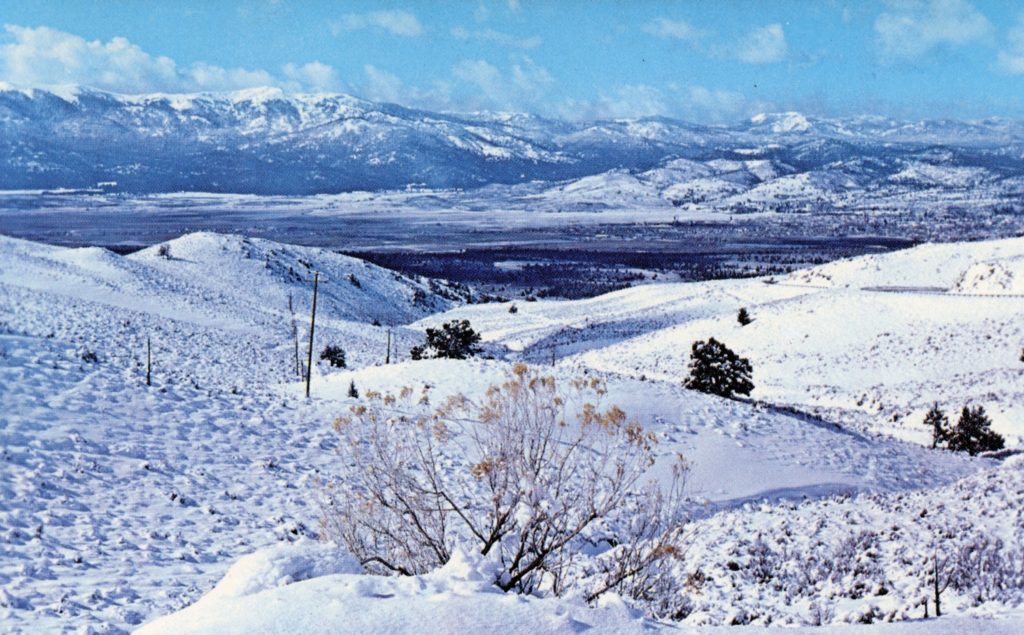
A view of Diamond Mountain from Antelope Grade, January 1975
Exactly who and when mountain was named, is not clear. By the early 1860s it was referred to Diamond Mountain. There are pockets of crystal quartz that can be found along the range, hence “diamond.”
In February 1910, Lassen County historian and retired school teacher, Asa M. Fairfield wanted to name the highest point on Diamond, Mount Roop. It went over like the proverbial “lead balloon.” Fairfield’s quest to have a feature named for Isaac Roop did not end. Fairfield consider Roop the father of Lassen County, while Peter Lassen received all the name recognition.
In 1921, Fairfield petitioned the United States Board of Geographical Names to rename Worley Mountain, to the west of Susanville. In 1922, the Board agreed and changed the name from Worley to Roop Mountain.
Susanville Peak, 1947. Courtesy of Fred Lendman
Personally, Susanville Peak would have been more fitting to the name designation. In Susanville’s historic core, one cannot see Roop/Worley Mountain. Yet, Susanville Peak is highly visible throughout the community. I still refer to Worley by its given name because when I was growing up that is what everyone referred to it as.
In 1913 the United States Government Land Office (GLO) intervened. California was on a major verge to overhaul water rights, yet that was of little concern to the GLO. At issue, at least with the GLO, was the State’s law was vague and failed to state whether water from a lake with no outlet could be appropriated. Until that issue was resolved, the GLO had no choice but to revoke Standish Water Company’s rights-of-way of its canals across federal lands. In essence the Company was forced to cease and desist, thereby forfieting revenue from water sales to recover its initial investment. This issue with the State was not to be resolved in a timely manner. In November 1914, the voters of California were presented with an initiative to overhaul the State’s water right system. It was approved and the Department of Water Resources was created. This new agency had complete control over the issuance of water appropriations, which previously was done at the county level. It was necessary reform, since the counties recorded water right claims but had no authority to determine concerning multiple applicants over a single water source. Continue reading Standish Water Company – Part II→
Standish Water Company’s pumping plant. C.R. Caudle collection
When Honey Lake is full it is an impressive body of water. There have been those over the years who thought it could be put towards a beneficial use. In 1878, Captain Charles Merrill came up with the first proposal to use water from the lake to irrigate the sagebrush lands on the lake’s eastern shore. Others, too, looked at lake’s potential for irrigation, but nothing materialized.
In the Standish district, two families who were joined by marriage—Hartson and Holmes—made plans to utilize the lake’s water for irrigation. In 1909, they formed the Standish Water Company. The Company was successful in attracting investors, one of whom was Carl Caudle. Caudle was a civil engineer, who had a homestead at Stacy on the east side of Honey Lake. Not only was Caudle instrumental in designing the project, he also invested $22,000.
In April 1910, construction began on a pumping plant on the east shore of Honey Lake, about two miles south of Amedee. A 150 horsepower Fairbanks Morse engine with a 24-inch centrifugal pump powered the pump house. Eleven miles of canals were constructed in an effort to irrigate 4,000 acres.
On October 4, 1910, on one of those beautiful falls days the region is noted for, set the mood for the inauguration of the pumping plant. During the morning people began arriving from around the Honey Lake Valley to partake in the festivities. Of course, the customary local dignitaries were on hand to provide their accolades. Shortly after noon, the visitors were instructed to assemble along the banks of the main canal to anxiously watch awaited event of pumping water into the main canal. At one o’clock the whistle blew from the engine house, and within moments water burst through the pipes to fill the canal.
On the surface it appeared the Company was off to a successful start. In addition, Mother Nature contributed to their efforts, when a snowstorm in January 1911 dumped eight feet of snow there! Actually, the weather gods for the next several years were very kind to the east shore residents by providing higher than normal precipitation.
In the Company’s first year 1,000 acres had been planted with sugar beets, with a successful harvest. The following year was a success, too. This changed in 1913, in one of those bureaucratic snafus. The Standish Water Company sold water to individuals who were homesteading on federal lands. Once those individuals met the government’s requirements they could acquire the land for a nominal fee. Disputes occurred, usually from neighbors. In this particular instant, Thomas Philbin contested John Ramsey’s request for a final proof for his 160 acre homestead. The United States Government Land Office (GLO) investigated Philbin’s claim, which they dismissed. However, when it was learned Ramsey’s source of water supply was Honey Lake, it raised a concern.
The grave of Jeremiah Wood at the Susanville Cemetery. March 17, 2016
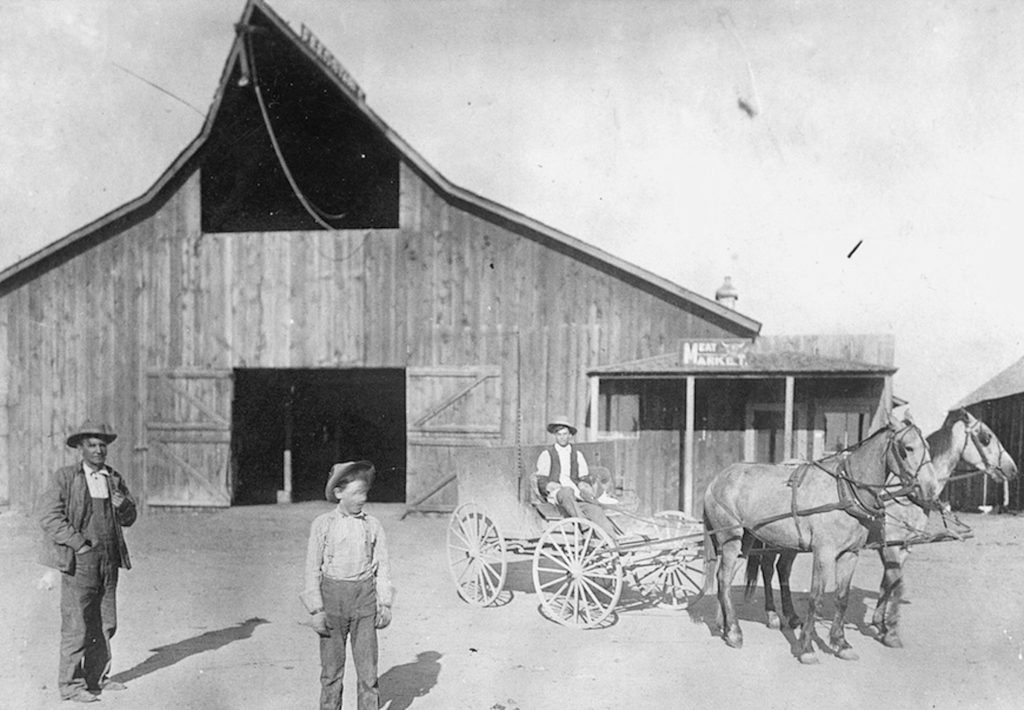
Jeremiah Wood (1819-1889) was a true ‘49er arriving in California in that infamous year and spent most of his life mining in Nevada County. In the meantime, two of his sons, John and Denis came to Susanville in1872 and opened up a meat market/butcher business. In 1887, Jeremiah came to Susanville to spend his final years with his son Denis, who by the way expanded operations into ranching, and six generations later the family carries on the tradition. This is remarkable, after all the old saying goes the first generation makes it, the second uses it and the third loses it. Only 13 percent of family owned businesses make it past the third generation. On a final note, the Wood Ranch still uses the brand that Denis created back in 1875, the DX.
Jeremiah Wood was married to Anne Clifford and they had six children—five sons and one daughter. Denis was the eldest and after moving to Susanville spent the rest of his life there, and his descendants, too. John Clifford Wood, who spent some time in Susanville moved around to various points and was buried in San Francisco. Katie Wood married J.J O’Neill and spent most of her life in Nevada City, Thomas spent most of his life in Pacific Grove. James Hyatt was the only to migrate further away and spent most of his life The Dalles, Oregon. Jeremiah Vincent, the youngest, died in 1888 in Susanville at the age of 22.