Tag Archives: Westwood

Early History of Mountain Meadows, Lassen County

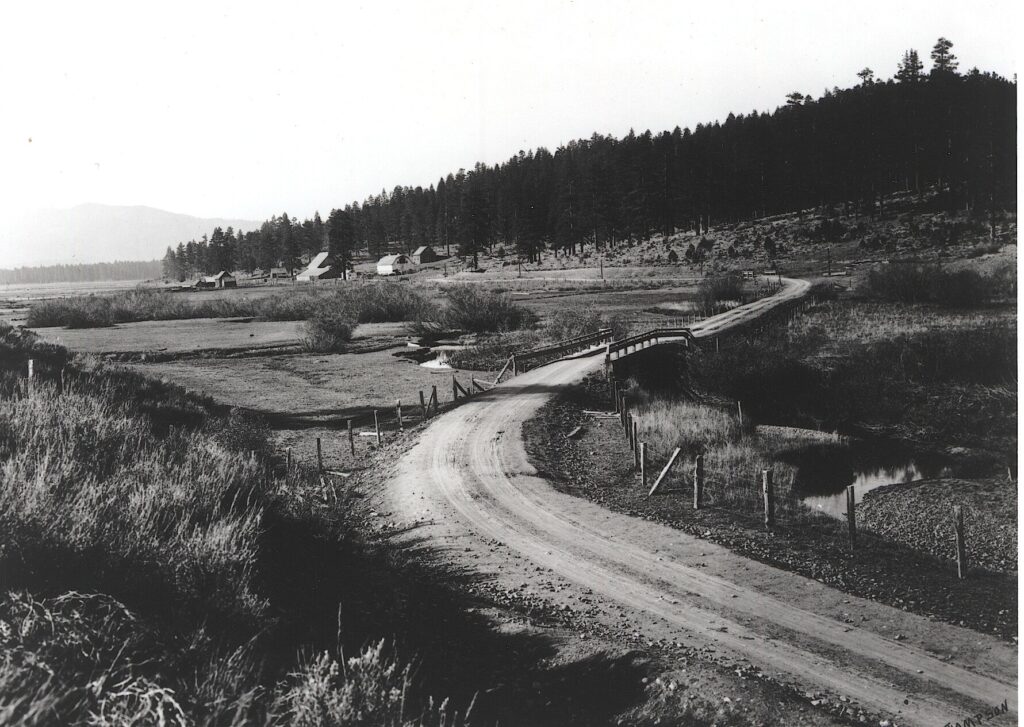
Goodrich Creek, Mountain Meadows, 1914-Minnesota Historical Society

Mountain Meadows located in the western section of Lassen County comprises some 12,000 acres.  Prior to the establishment of Westwood in 1912, its hub of activity was at Coppervale. More about that in a minute.

In 1860, Dr. Atlas Fredonyer became the first settler. He remained there for two years and William B. Long briefly settled on his claim. In the early 1860s copper was discovered in the vicinity. When Carlton C. Goodrich petitioned for a post office he suggested the name of Coppervale. It was granted and the Coppervale Post Office opened for business on May 24, 1864 with Goodrich as first postmaster.

In 1885, L.M. McKenney’s Directory of Northern California provided the following description of Coppervale: “A small town with a post office situated midway between Prattville and Susanville. sixteen miles from the latter place. It has a try-weekly stage route each way between these two points. Mountain Meadows, in which the town is located, has an area of 12,000 acres, principally devoted to stock raising and dairying.”

In 1886, Goodrich passed away. He owned 7,650 acres there. He had put up on the market in 1885, but it was not until 1909 his estate sold it to John Crouch. Crouch would later sell it to the Red River Lumber Company where that Company established the town of Westwood.

In 1888, the Mountain Meadows School District was organized. A school house was built in 1892. In 1902 the school was closed for a lack of students.

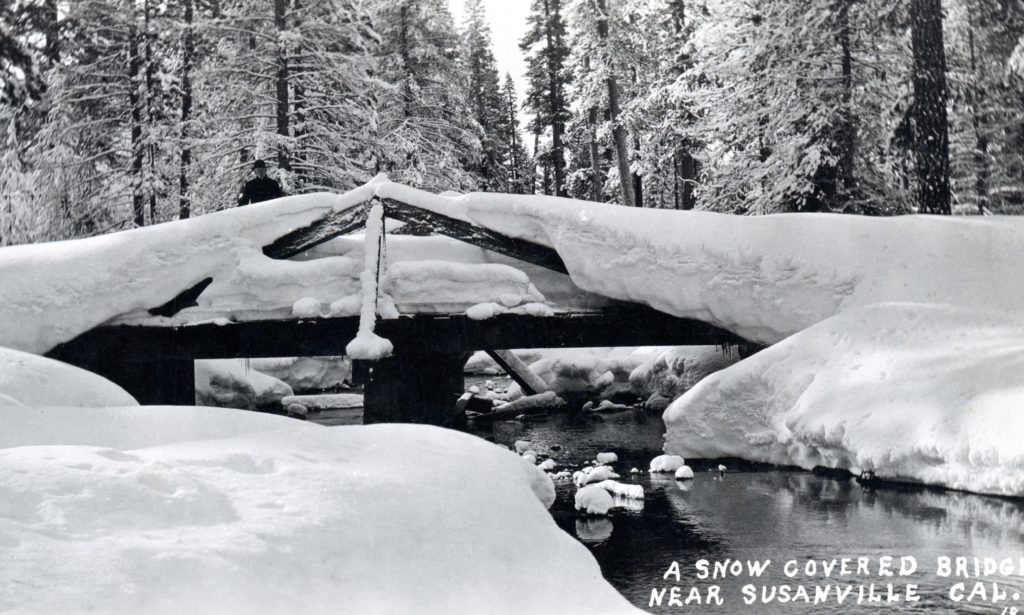
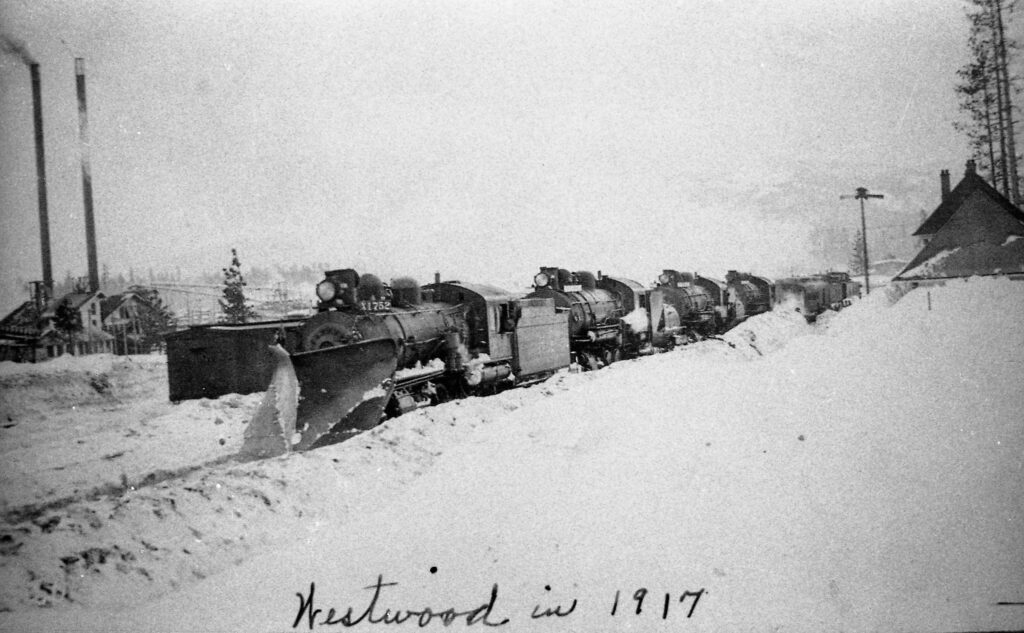
A primary reason the region did fully develop in the late 1800s was the weather. Mountain Meadows is susceptible to heavy winter snows. A number of the ranchers who located there wintered at Red Bluff.

To Support, Please Donate or Subscribe 

A Fruit Growers Relic

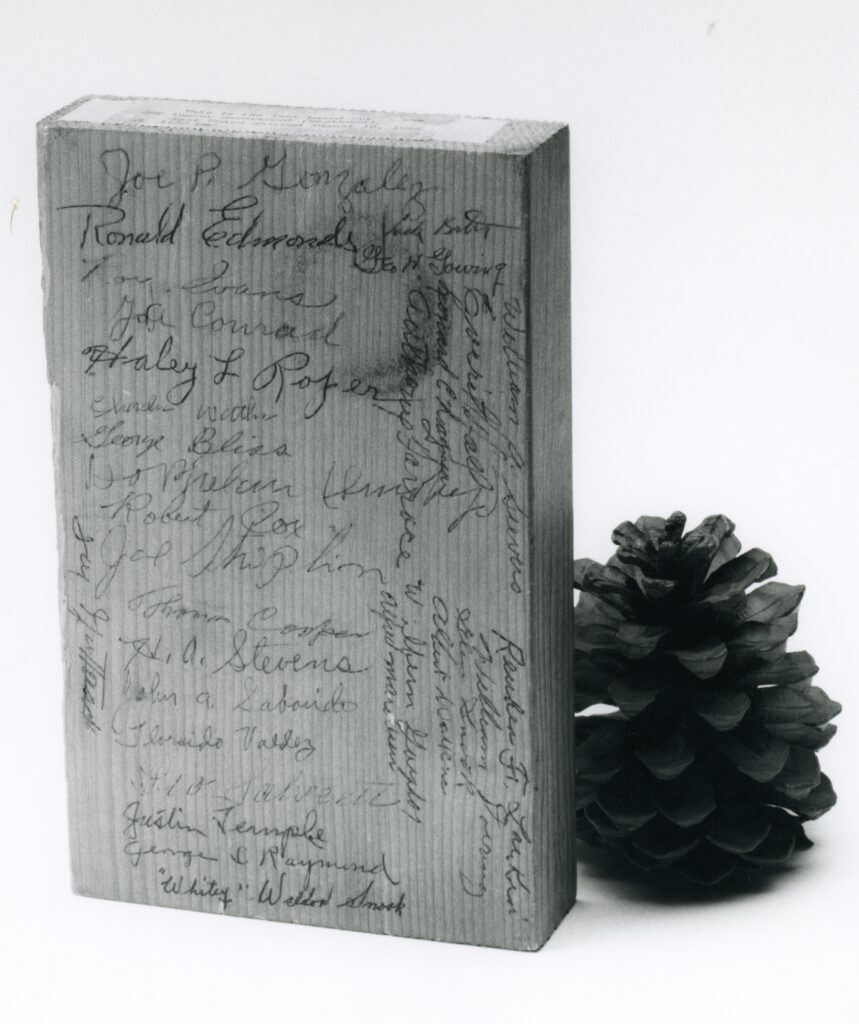
The last board milled at Westwood and signed by those last workers.

In January 1999, a relic of Westwood’s past was found in the old Community Center at Hilt. It was a piece of vertical grain Douglas Fir 5 1/2 inches wide, 9 inches high and 1 1/2 inches thick. It was the last board cut in the dry lumber department at Westwood in 1956, signed by the last workers. The board was put on display at Fruit Growers headquarters, then located at Sherman Oaks. Since Fruit Growers has moved from location there is not telling as what became of it.

The board was signed by Joe P. Gonzalez, Ronald Edmonds, Roy Evans, J.A. Conrad, Haley L. Roper, Charlie Watkins, George Bliss, D.O. “Smokey” Phelan, Robert Cox, Joe Stripling, Thomas Cooper, H.A. Stevens, John A. Saborido, Florida Valdez, Tio Salveltti, Justin Temple, George C. Raymond, “Whitey” Weldon Snook, Jack Bates, Geo. H. Gowing, Reuben F. Larkin, William Doeering, Glen Snook, Albert Watkins, Wilbern Taylor, Alfred Mardesen, Jay Guttered, William A. Sievers, Everett Hall, Leonard F. Lagnear and Anthony Farrace.

Tim

Red River’s Great Purge

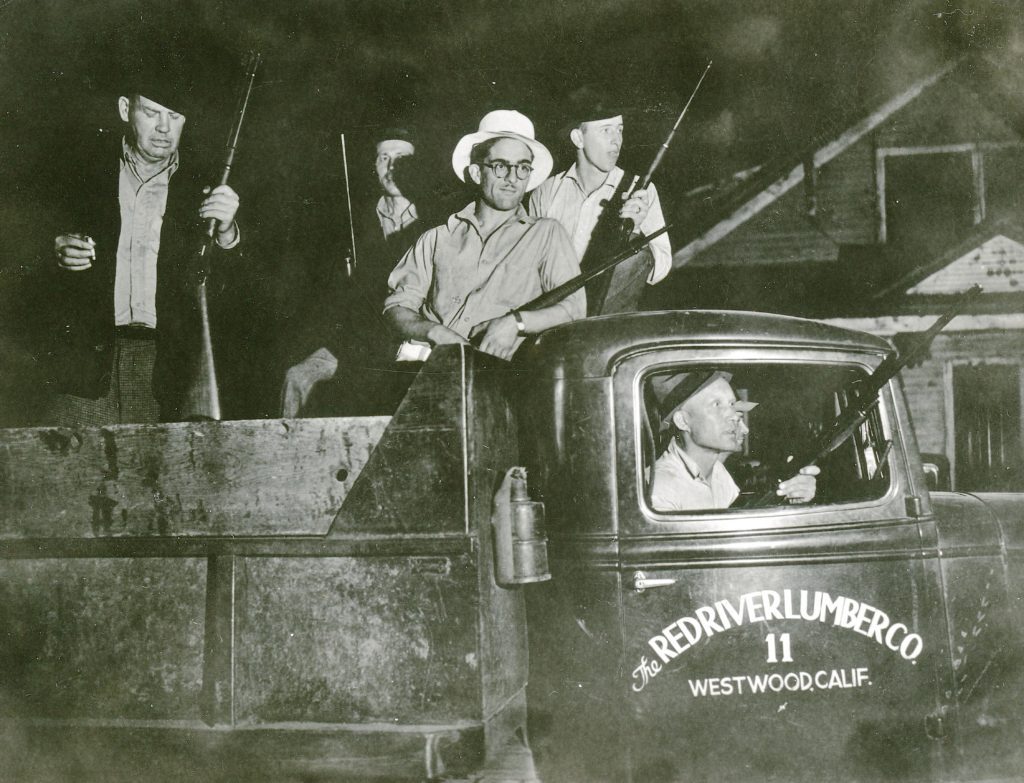
Purge Nite. Courtesy of Frank W. Davis

Red River Lumber Company’s labor problems in Westwood during the 1930s is a perfect case study on how to do everything wrong. There was, of course the great purge of in which nearly 400 men, women and children were forced out of their homes in Westwood on July 13, 1938 over a labor dispute. By the end of that historic day the California Highway Patrol, with the National Guard on standby placed a blockade on the community, sealing it from the outside world until things could stabilize.

I do not think we will encounter anything like this. Yes, it was a scary time during the strike of 1938 at Westwood.

According to historian Gerald Rose about the historical significance of the Red River purge he wrote, “Not until the 1941 deportation of Japanese-Americans was there a larger forced migration of United States citizens.” 

Tim

701 Nevada Street, Susanville

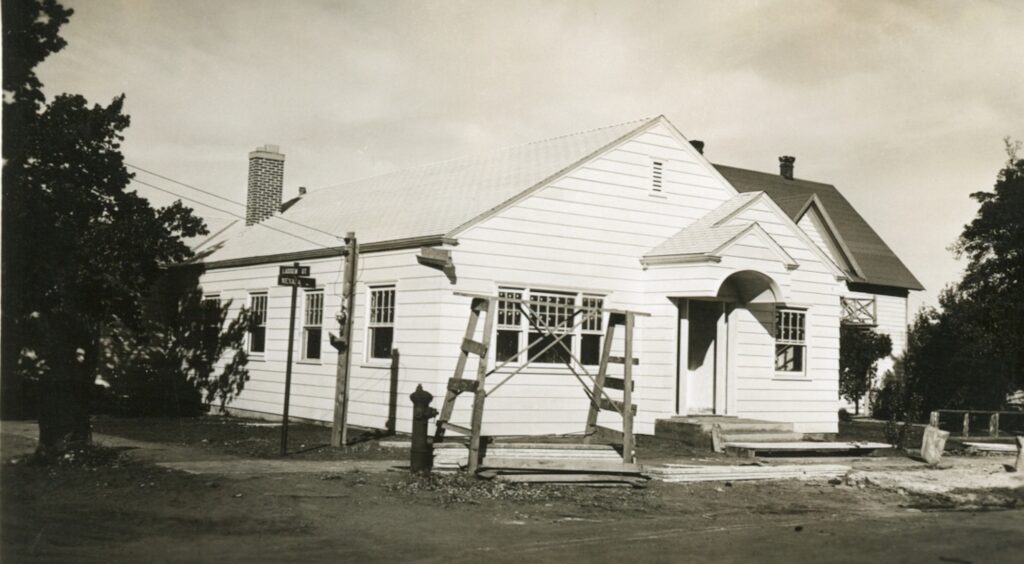
701 Nevada Street, Susanville, October 7, 1939–H. Frodsham photograph

In 1912, the Great Western Power Company was in the midst of the construction of Nevis Dam to create Lake Almanor. The company hired Dr. Fred J. Davis to provide medical care for the construction workers. In September 1913, Red River Lumber Company hired Dr. Davis to provide medical care to its newly constructed company town of Westwood.  Dr. Davis would remain in charge of the Westwood Hospital until 1939. Dr. Davis, along with son, Dr. Fred J. Davis, Jr., moved to Susanville to open their private practice.  At 701 Nevada Street, Susanville they had an office constructed. In 1965 Dr. Davis Sr. retired. In 1974, Dr. Fred J. Davis Jr. retired and he sold the office to Dr. Jay Beams. In 2022. Beams closed the office, which now sits vacant.

Tim

Fruit Growers Departs Westwood

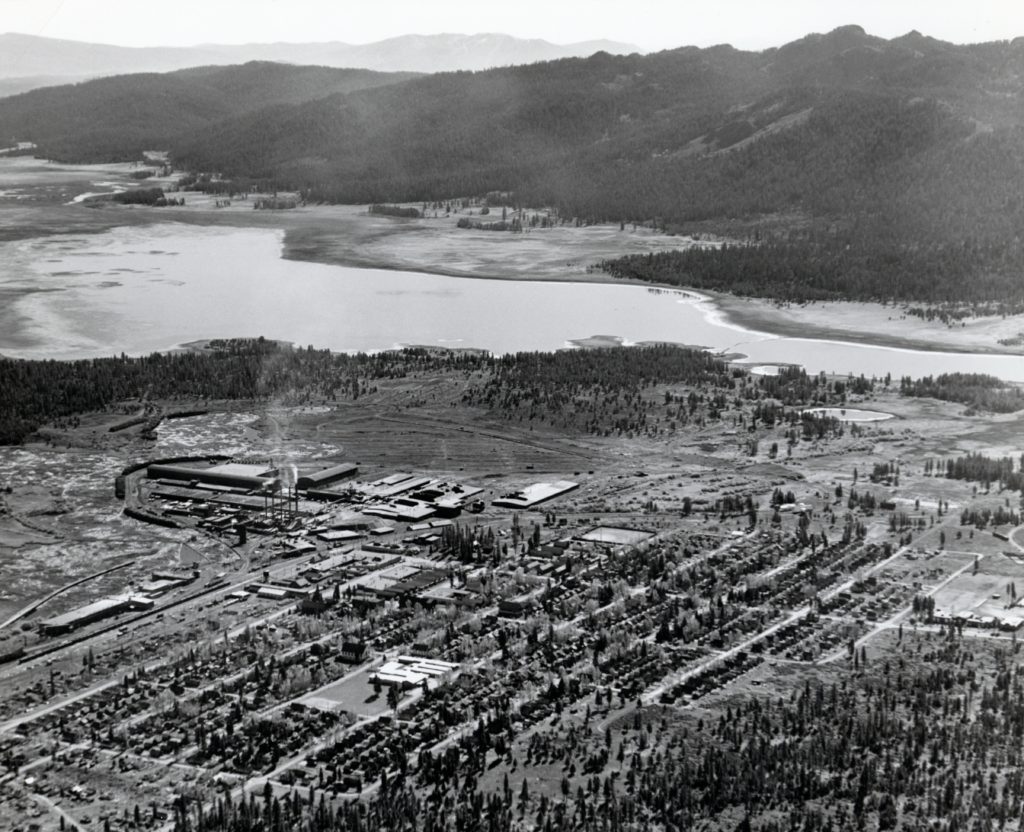
A view of Westwood with Keddie Ridge in the background, 1955.

Truth be known when Red River put its mill plant and town on the market in the early 1940s, no one wanted it. Some of the factors were an aging mill facility and majority of the tributary timber depleted. There was also the major headache of operating a town. It was not until Red River sweetened the proposition with the Burney Tract that contained an estimated one billion board feet of timber that made it more attractive. Reluctantly, Fruit Growers Supply Company succumbed and made the purchase.

Major changes were on the horizon and the universal adoption of the cardboard box changed the way Fruit Growers business operations in the future. On August 25, 1955 Fruit Growers announced it would  shut down the Westwood plant. Since it appeared there was not market for the mill, Fruit Growers sold everything the following year to a liquidator Wershow and Weiz of Los Angeles. For Fruit Growers one of its greatest relief it no longer had the complicated burden of maintaining a town.

Support

The Fate of the Westwood Hospital

Westwood Hospital, February 14, 1938–H. Frodsham photograph

The Westwood Hospital remained opened even after Fruit Growers closed the mill. The new owners Wershow & Weisz did not want to operate the aging facility. They offered to give it to Lassen County along with $5,300, the cost they estimated to make the improvements to the building required to meet fire regulations. Lassen County was not interested. The county stated if the Westwood residents could form a special tax district for the hospital.  On June 24, 1958 the few remaining patients were transferred to Chester and Susanville.

Missing in action during the final days of the hospital’s fate was long-time physician Dr. Herman Levin, who was away on vacation in Chicago. Levin,it should be noted, maintained an office in the hospital. M.H. Poster, resident representative of Wershow & Weisz, stated that if Dr. Levin wishes to continue with his office there, it is available to him. If not, Poster stated: “Otherwise the doors will be locked and it will be boarded up.” When Levin returned, he kept is office and it was business as usual in the hospital, except it could only handle emergency care patients until the person could be transferred by ambulance to a neighboring hospital. On April 9, 1972, the community held a retirement party for Dr. Levin.

Support

Westwood Rod & Gun Club

Westwood Rod & Gun Club building, September 30, 1928–H. Frodsham photograph

On March 13, 1922, the organizational meeting of the Westwood Rod & Gun Club was held. The principal players were George Peltier, Fletcher Walker, Ted Walker, Dr. F.J. Davis, Herb Smith, Rev. R.G. Green, R.H. Browne, Charlie Gardner and Bud Morrison, with Peltier serving as first president. Besides working on formalities of by-laws and such, the first objective was to build a clubhouse at Lake Almanor. At that time, Lake Almanor was only half the size that it is now. This, of course, influenced their decision as to the location. The site chosen was Bunnell’s point, close to the proximity presently known as the tip of the Lake Almanor peninsula.  By April construction began on the two-story clubhouse. By September the club boated a membership of 57. In addition, to the clubhouse Dr. Davis, George Peltier and Fletcher Walker had small cabins built next to it. Tents were also provided to the members, along with duck blinds at the lake. The clubhouse which featured an outside dance floor, became a scene of merriment, as numerous social gatherings were held there.

In 1925, the club received word that Great Western Power had plans to heighten the dam at Lake Almanor, doubling its size. A discussion ensued among members about moving the clubhouse. It was finally agreed to move it near Big Springs, thus making is more accessible by being only six miles from Westwood. Of course, before they could do that, they would need permission from the Red River Lumber Company to locate there, since the property in question was company owned. This was not a problem, as Fletcher Walker was Red River’s General Manager of Westwood and active member in the organization and gave his blessing. Equally important, they could use the barge Red River leased from Great Western Power to float over the clubhouse and existing cabins.

By 1940, changes were on the horizon  and the Westwood Rod & Gun Club days would be soon numbered. with the sale of the Red River to the Fruit Growers Supply Company. In1945, the club disbanded, and the clubhouse became the property of Red River. In 1947, Red River began subdividing its lakeshore property at Lake Almanor and one of the first pieces was at Big Springs. There 125 lots that were plotted. In May 1947, W.W. Davis of San Diego purchased the clubhouse. Davis remodeled the building into apartments. It was torn down in October 2010.

Subscribe


The Westwood Airports

Mr. & Mrs. H. Frodsham in front of Bud Coffee’s airplane at Westwood, August 5, 1920–H. Frodsham photograph

Today, Westwood has no airport. It did, however, at one time had two different airports. The first one which really consisted of a crude landing strip. By the late 1910s, the first landing field was located about a mile south of the Goodrich Ranch, or the current bridge that crosses Goodrich Creek. Interest in flying slowly gained momentum.  In June 1928 the Westwood Auto Club spent $100 to clear the landing field of brush and fill in holes to make two 2,200 foot runways. Thus, the Westwood Airport was created—a first in Lassen County. By the late 1930s the landing field slowly declined in use, since the Red River Lumber Company was in a transitory period. In 1944, Red River sold its Westwood operation, thus more changes on the horizon.  In 1946, Lassen County bought forty-two acres at $2.50 acre from Red River to provide a landing strip to the west of Westwood. It was subsequently closed. In July 1982, the Lassen County Board of Supervisors discussed re-opening the airstrip, but it never got off the ground.

Tim

Frodsham Photographs

Fifth Street, Westwood, 1923

Recently, I have been in receipt of some photographs taken Harold Frodsham (1879-1958). Frodsham came to Westwood in the spring of 1920, while working for General Electric. Red River Lumber Company was retrofitting its powerhouse and building its Hamilton Branch hydro plant. Red River hired Frodsham originally as its efficiency expert, and was later transferred to various management positions,  Frodsham did among other things was a lot of photography work for Red River at Westwood.

In the near future, these will be featured along with stories about the scenes in particular such as the Westwood Rod & Gun Club.

Tim

A Westwood Independent Business

Taylor’s Advertisement, Westwood Independent, 1918

While many are aware of when Red River Lumber Company’s mill town of Westwood first came into operation in 1913, it was a true company town. All the housing was owned by company, and about 99 percent of businesses were too. There are exceptions to the rule.  There were some tasks the company did not want to undertake, such as the mortuary. Of course, that business needed Red River’s approval to operate. The featured illustration provides another example.

In. 1918, WesleyTaylor advertised in the Westwood Independent his services as insurance agent and notary public. How long he remained in business there is not clear. However, in 1920 with the formation of the Westwood National Bank, that institution provided notary services. It should be noted since Westwood was initially a company town, there is little public documentation of the coming and goings of the town’s residents.

Tim

Ad from Westwood Independent April 2, 1918