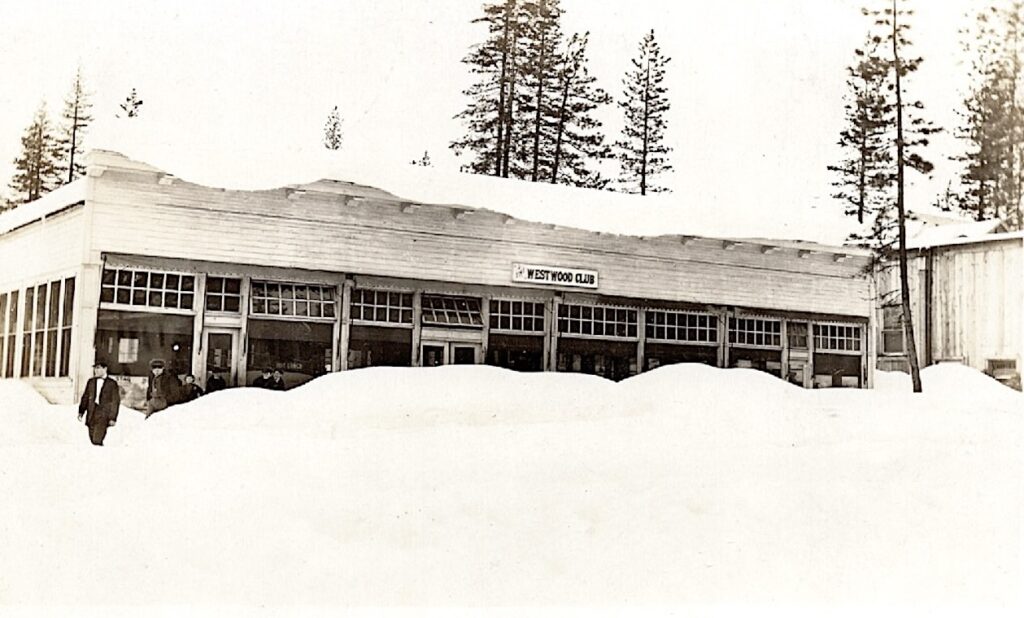
Company town’s such as Red River Lumber Company’s Westwood, in a rural setting had its challenges. To prevent labor turnovers, recreational outlets needed to be provided. However, this one amenity was not a cure all. In the 1920s, with affordable automobiles and improved highways laborers had an upper-hand in mobility. One of Red River’s earliest endeavors in its newly constructed town of Westwood, was aptly the named the Westwood Club. This institution included a restaurant, lunch counter, soda fountain, cigar and newsstand, a barbershop, reading room and a billiard room. While many enjoyed the Club, it did prevent Red River’s high turnover rate with employees, or with management. If there was a bright aspect, that due to high volume of high traffic in and out of Westwood assisted in the construction of Highway 36 between Red Bluff and Susanville. It would also be catalyst to establish Highway 32 to Chico. The Westwood Club was destroyed by fire on March 31, 1944, the cause was never determined.
The grave of Charles Gardner, Westwood Cemetery, 2013.
In August 2013, I conducted a Westwood Cemetery Tour. Since Westwood began as a company town of the Red River Lumber everyone worked together in a common goal.
With that in mind, in every operation, everyone plays an important role, as one cannot exist without the other. But before you can build a mill, first you need timber. That is where Charles Gardner, along with brother Irvine, better known as “Ippy.” The Gardner brothers, along with E.G. Scammon were part of the early California timber cruisers working under T.B. and Clinton Walker to not only examine timberlands, but also had the tedious jobs of going to a variety of county courthouses to examine land titles, so see who owned what parcel, values, taxes, etc. In a relatively short time frame of just over a decade Red River owned nearly 800,000 acres timberland in California making it the third largest landowner in California, only behind the railroads, who received their land for free from the government. Even after the Red River assembled its timberland, there was still plenty of work for the timber cruisers to do. Chief among them, was to plot out every year which sections of land that would be logged.
As it was in the past, timber is still part of Red River’s heritage, as certain heirs of T.B. Walker have retained their share of the timberland. It is now operating under Red River Forests, which is managed by Beaty & Associates.
One never knows for sure where your final resting place may be. In one instant, there was a disinternment of a grave of a girl who died in 1924 in Susanville. She was buried in the Susanville Cemetery and nearly 70 years later her family had the remains moved to a cemetery in Oroville.
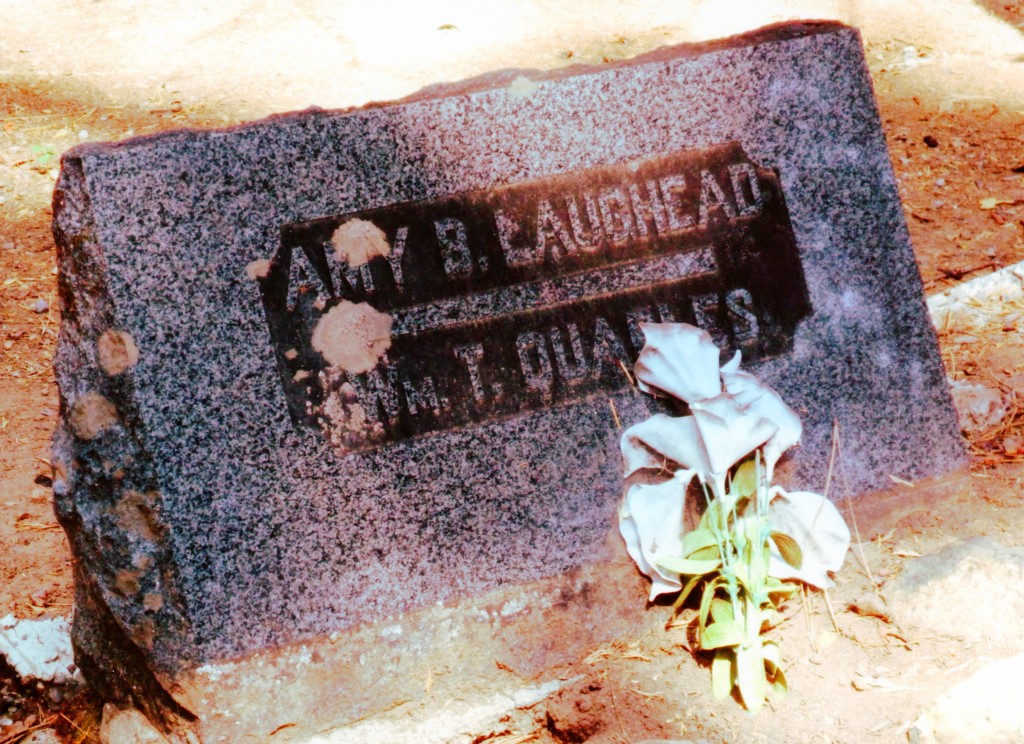
Then there is the case of Amy Laughead. She was a first cousin to Red River Lumber Company’s founder, Thomas Barlow Walker. Her claim to fame, is that of her son, William B. Laughead, who developed the famous Paul Bunyan caricature that later became the trademark for Red River. Amy is a perfect example of you just never know where your final resting place might be. She died in February 1939 at Westwood and was buried in Sacramento. Seven months later, her son had her remains disinterred and brought to the Westwood Cemetery. When he died in 1958 he was buried in the plot in Sacramento where his mother was originally interred.
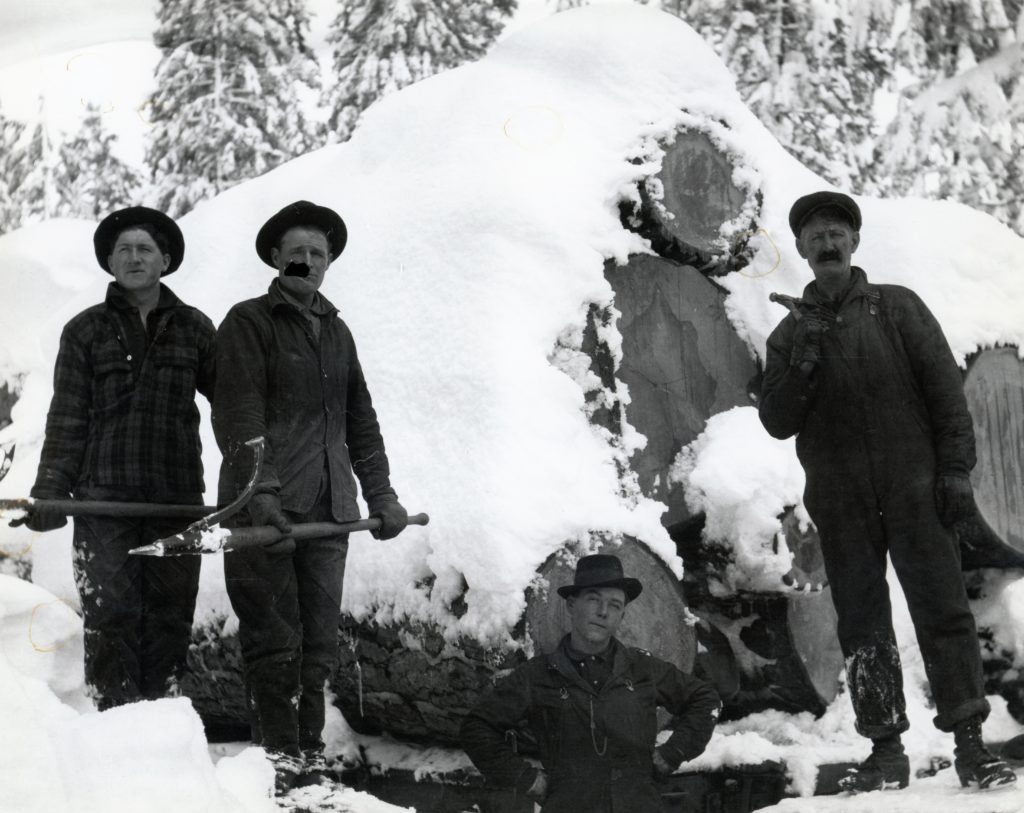
A winter logging crew, 1916. Courtesy of Hank Martinez
When T.B. Walker, founder of the Red River Lumber Company, made his westward expansion from Minnesota, it was the set the foundation for his five sons to operate it. Things happened and it did not quite had the desired results he had imagined. Family partnerships are fraught with their own set of obstacles, the Walker sons was a perfect example.
The earliest dispute was selection of the site of Westwood. T.B. attempted to be referee, but to no avail. There was a fallout when son Clinton objected, that he would he leave the company. Fletcher, another son, if site had chosen to be Westwood, Fletcher won out, he would became the resident manager of the Westwood.
It was Fletcher’s goal to operate Red River year round, much to the chagrin of his father. On February 25, 1915, T.B. wrote to Fletcher criticizing him for running the mill during winter storms, and that he should just shut it down. T.B. commented: “I have never expected that we could run all year in the mountains of California. I had in mind when I was securing the millsite where you built, that this would likely be about a nine or ten month’s milling job.”
A steam donkey being pulled through Westwood, 1916.
Fletcher questioned his father’s judgment on the ease of operating a winter mill in Minnesota, and remarked, “I never discovered that it was an easy operation to get through four months of cold and snow.”
The following year T.B. again requested Fletcher to shut down the logging operations in the winter as it was just plain too costly. Fletcher agreed the winter operations operated at a loss. However, his justification was that outfits such as McCloud River Lumber Company that called it “quits” in the sawmill operation on November first, placed Red River at an advantage by having a ready supply of lumber. In summation, Fletcher wrote, “In place of our figuring from this end on closing down, we have been figuring carefully the pros and cons of taking advantage of the bulging market to produce a bunch of timber of lumber this summer and make a real killing.”
Fletcher suspended winter logging during World War I. In 1920, Red River resumed winter logging briefly, only terminate it finally in 1924.
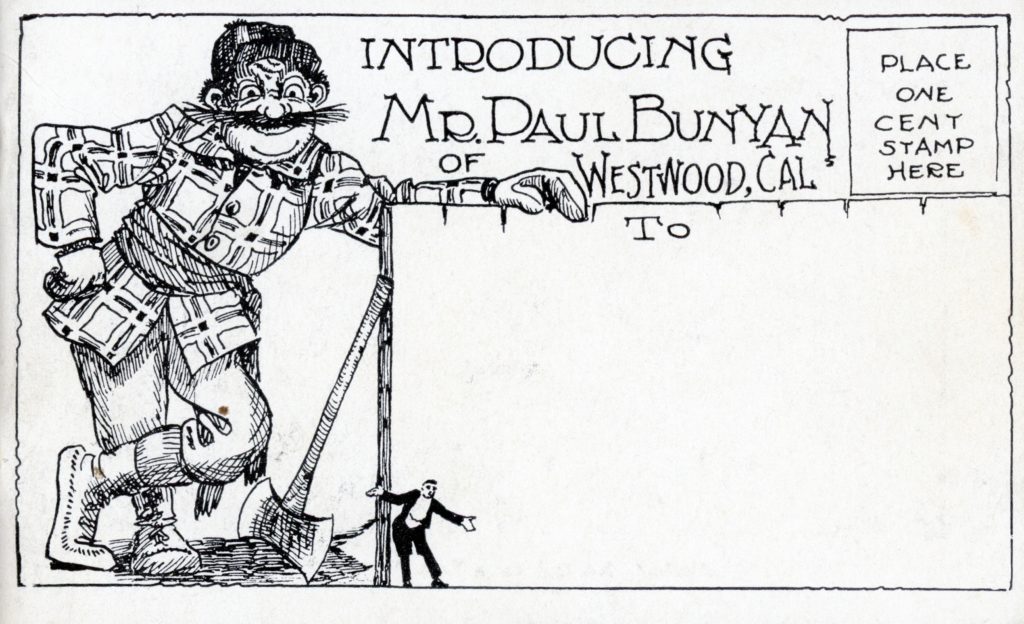
Since today is the Paul Bunyan Festival in Westwood, here is the origin of the town’s mascot.
During Red River Lumber Company’s expansion to California, they had number of hurdles to overcome. Since they would be using a different species of pine, than what they had previously used in Minnesota, they had to monumental task to educate their customers. Part of the duty fell to Archie Walker in Minneapolis, and he contacted his cousin, W.B. “Bill” Laughead, who was doing some free-lance advertising work to assist him. At this time, Paul Bunyan was a little known folklore, associated with loggers. The two came up with the idea of Paul Bunyan, and prior to this no one had rendered a drawing of the mythical logger. Continue reading Introducing Paul Bunyan→
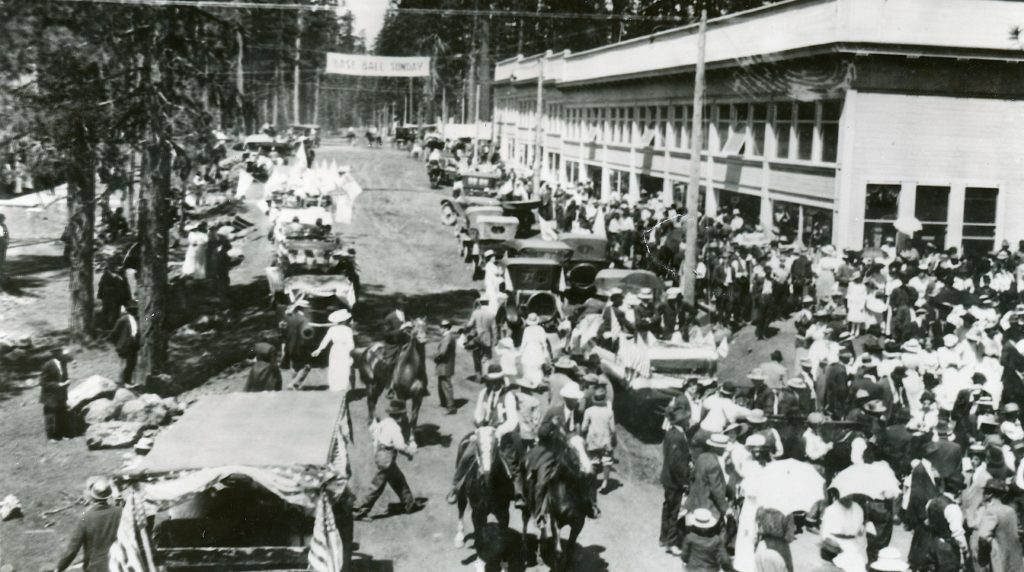
4th of July 1915 celebration at Westwood. Courtesy of the Nevada Historical Society.
In the spring of 1914 Red River Lumber Company announced that it would hold a grand 4th of July celebration to welcome visitors to its new town. Red River officials stated its main purpose was to establish and maintain the “friendliest” relations with Susanville. On the other hand it evolved in a two-day event featuring a baseball tournament.
The Fernley & Lassen offered a special excursion train that consisted of eight passenger cars. It was sold out and the fare was $1.50 round trip. As soon as the train arrived around 10:00 a.m. a procession was formed and marched through the principal streets of Westwood. It ended at open air pavilion where entertainment and necessary orators speaking. It was followed by barbecue. The next event were scheduled baseball games. The evening consisted of a firework display and a dance. It was successful event and repeated in 1915. In 1916, Susanville reciprocated and was the host of the grand 4th July celebration.
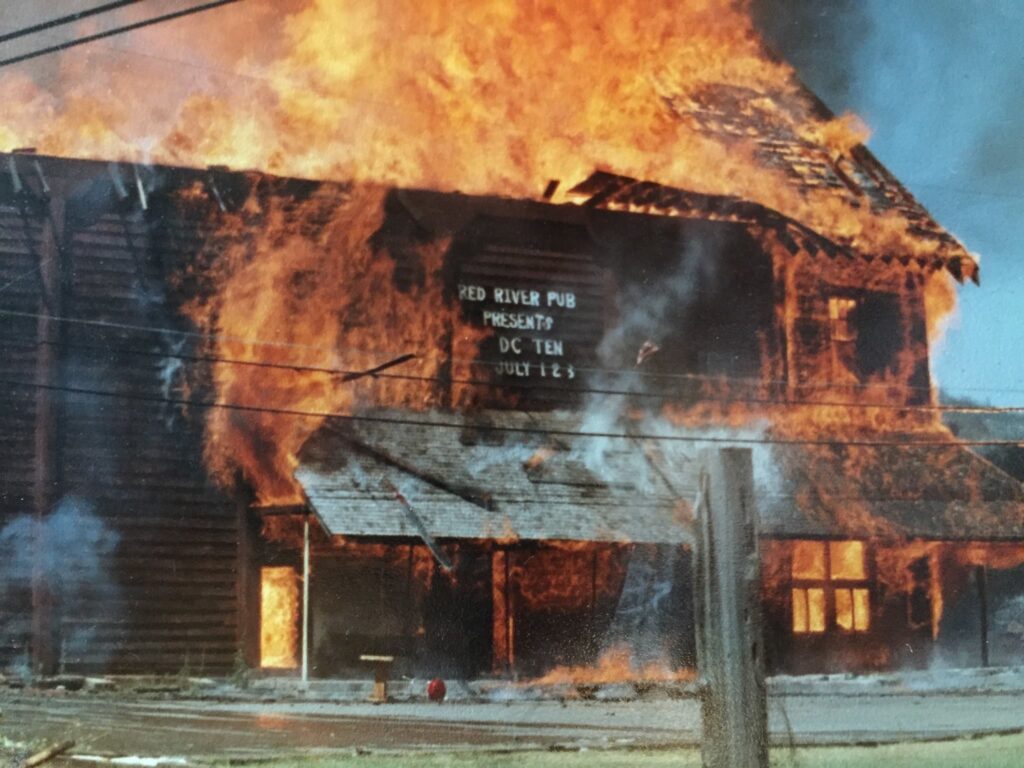
The Red River Pub fire, 1982-Courtesy of David Zoller
After the closure of the mill at Westwood in 1956, a lot businesses fell on hard times. One of the victims was the majestic Westwood Theater. Several attempts were made to revive it, but to no avail. By 1980, it took on a new life as the home of the Red River Pub. On July 12, 1982, it was one of the most spectacular fires in modern Westwood history. when the old theater caught fire. Due to the intense heat of the blaze, aid from a forest service air tanker dropped retardant to combat the fire and to keep it contained.
Westwood Theater. Courtesy of David Zoller
If you have memories of the pub or fire, that you would like to share, please do so.
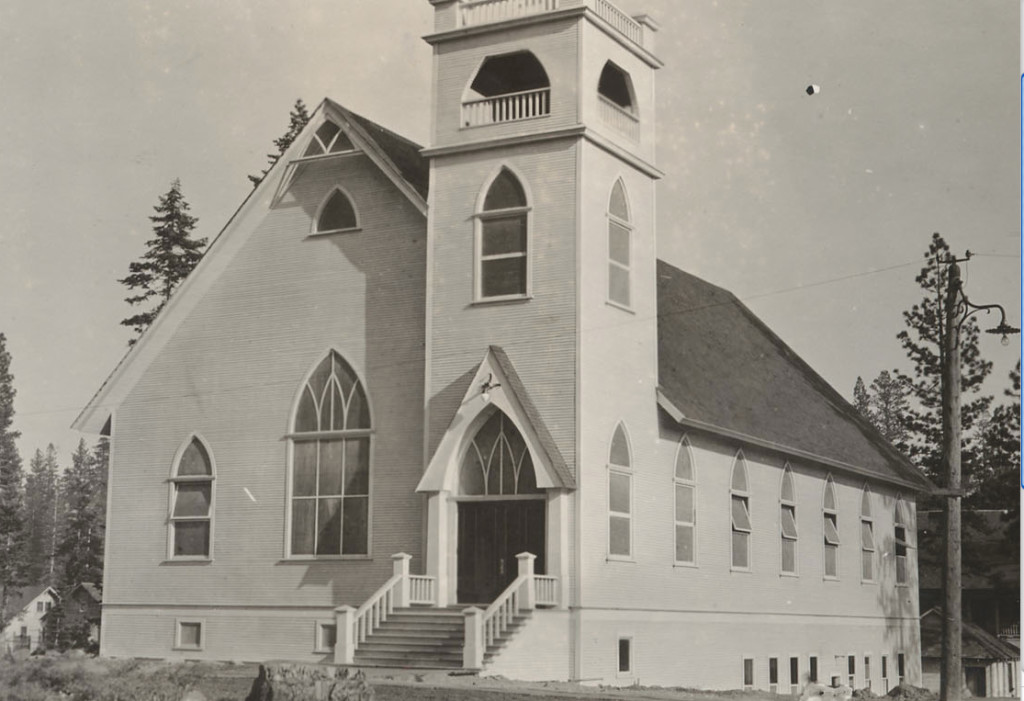
When the Red River Lumber Company started their construction of Westwood in 1913, there was a lot of thought that went into it. A neglected matter was a church. In the spring of 1917, Fletcher Walker, Resident Manager, brought up the topic that Westwood was in need of a house of worship with his father, T.B. (Red River’s founder, who resided in Minnesota) and wrote: “We have come to a time when it seems inadvisable to put off further the building of a working church. The Sunday school had 255 last Sunday and the condition of the school in one of the old cook houses is such that the congestion prevents efficient work.”
Fletcher informed his father that a committee had organized to solicit donations. The committee discussed plans for a building, not only its seating capacity but that it should have a full basement to provide for a library, kitchen/dining rooms, and other rooms for sociable functions such as Y.M.C.A. meetings. After considerable debate it was determined that ideally the church should seat 600 churchgoers.
Once the committee agreed to the building’s size, they were able to calculate the cost. They estimated a price tag of $8,700—with lumber the most expensive item at $4,000. Fletcher thought Red River should donate the lumber to such a worthy cause. To finance the remaining balance, the committee had already secured $3,000 in pledges.
In conclusion Fletcher wrote, “We could have the Red River Lumber Co. build the church and direct the work along lines that were best for the Company, keeping in mind that we are against the I.W.W. and politicians as well as the Assessor, etc. That the labor market is a laborer’s market and that we must make Westwood attractive if we are to keep a crew without paying excessive wages. So from my viewpoint I think we should go ahead and build it and let the people use their money on the extra running connected with it.”
By the summer of 1917 the project moved forward with Red River donating the lumber and labor. The site selected was at 500 Cedar Street, which the Rev. R.G. Green described as a rock pile strewn with empty beer and whiskey bottles. By November 1917 the new church was completed.
Initially, it was a church with no name. Since it would serve the needs of variety denominations it was named The People’s Church. On Sunday May 19, 1918 dedication ceremonies were held with Dr. John Wilson, District Superintendent of the California-Nevada Methodist Conference officiating.
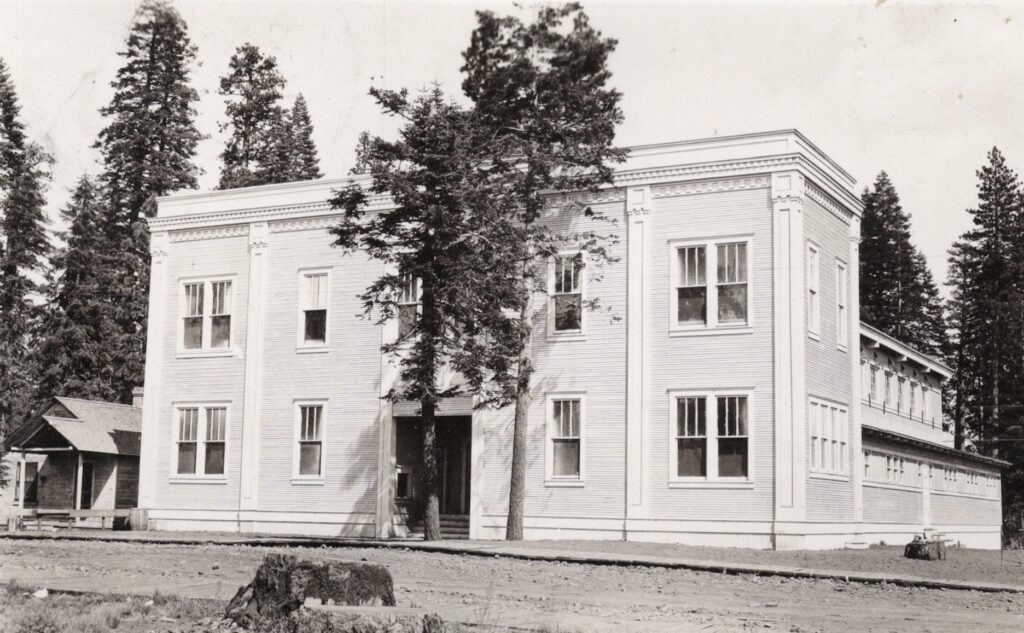
One of Red River Lumber Company’s early public buildings in Westwood was the auditorium located at northeast corner of Birch and Fourth Streets. It was in December 1917 when Red River unveiled the plans for a multi-purpose building. This much needed facility would house a fully equipped gymnasium, lodge rooms to accommodate its growing fraternal organizations, Billiard rooms and other spaces devoted for readings and meetings. The goal was have it completed by the spring of 1918, but Red River noted it could be delayed for a number of reasons due to the impacts created to meet the needs associated with World War I.
The Auditorium was put on hold, much to dismay of the residents. In January 1920, Garfield Oates, Red River’s resident engineer, announced that the plans for the Auditorium were being modified and construction would begin shortly. On May 29, 1920, the highly anticipated opening of the $30,000 Auditorium was held–by far the most expensive public building built in Westwood to date.
On the first floor was its most notable feature being a large dance floor measuring 48 by 96 feet. In the Auditorium’s later years the dance floor was converted into roller staking rink. By the early 1970s, the building was its showing its age. In 1973 the Lassen County Assessor deemed to building of no value. By the late 1970s the building was demolished. Many Westwood residents could not remember a year, but it has been gone by 1980, when the shuttered nearby Westwood Theater re-opened as the Red River Pub.
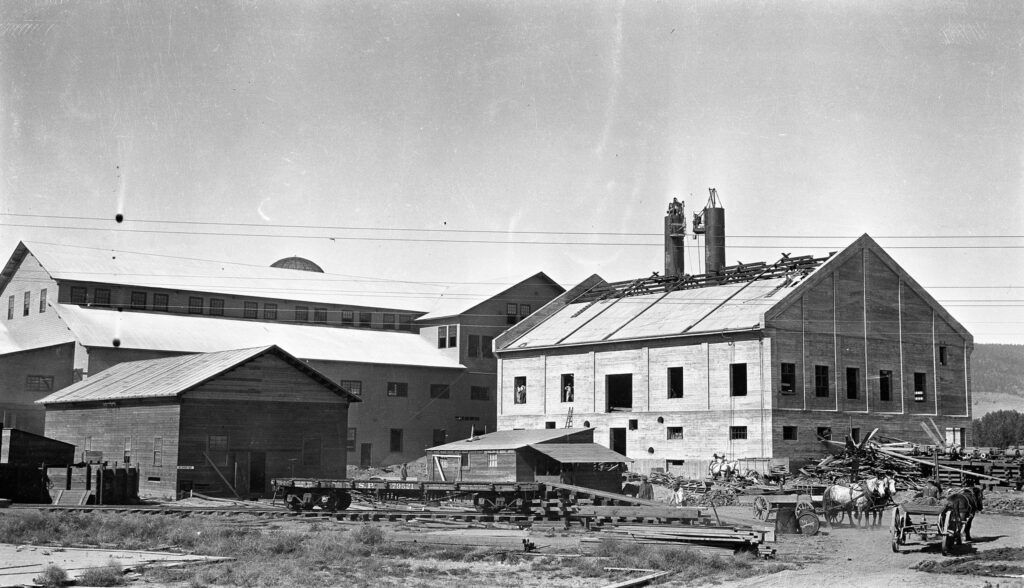
Fruit Growers Powerhouse under construction, 1920 – Courtesy of Ed Standard
In 1910, a partnership was formed between Abel Bunnell, L.R. Cady and J.E. Pardee known as the Lassen Electric Company. It should be noted, in 1901, electrical service were offered to Susanville residents. The anticipated growth with the imminent arrival of the railroad meant a larger more reliable electric plant was needed. A solution was found at Bunnell Springs, six miles west of Susanville The springs could provide sufficient hydro power. A plant was constructed at Bunnell Ranch and placed into operation on June 11, 1910. It had a capacity of 150 kilowatts, twice the capacity of the old system. In 1920, the Lassen Electric was sold to the Red River Lumber Company. This was done to meet the demands of the fast growing community. Red River, after all, had its own extra power to supply Susanville. In the summer of 1920, Red River spent $100,000 to build the transmission lines from Westwood to Susanville. In 1924, Lassen Electric reached an agreement for Fruit Growers and Lassen Lumber Box to provide for back up power.