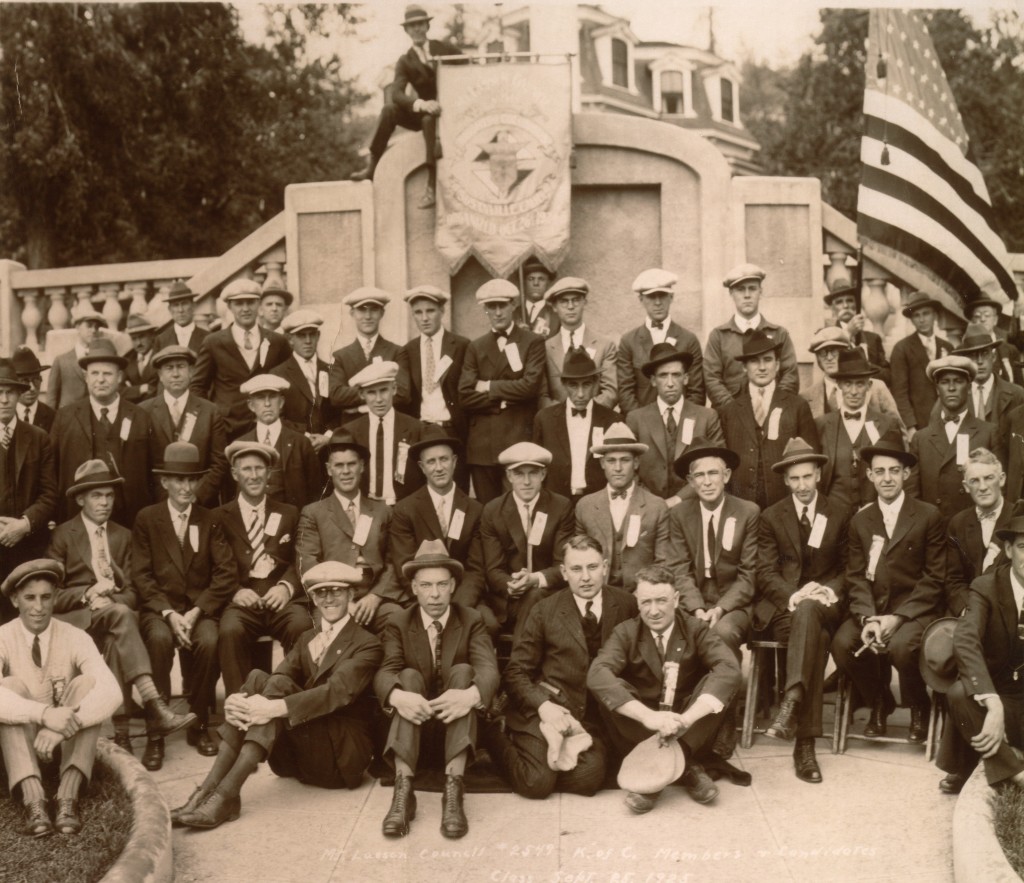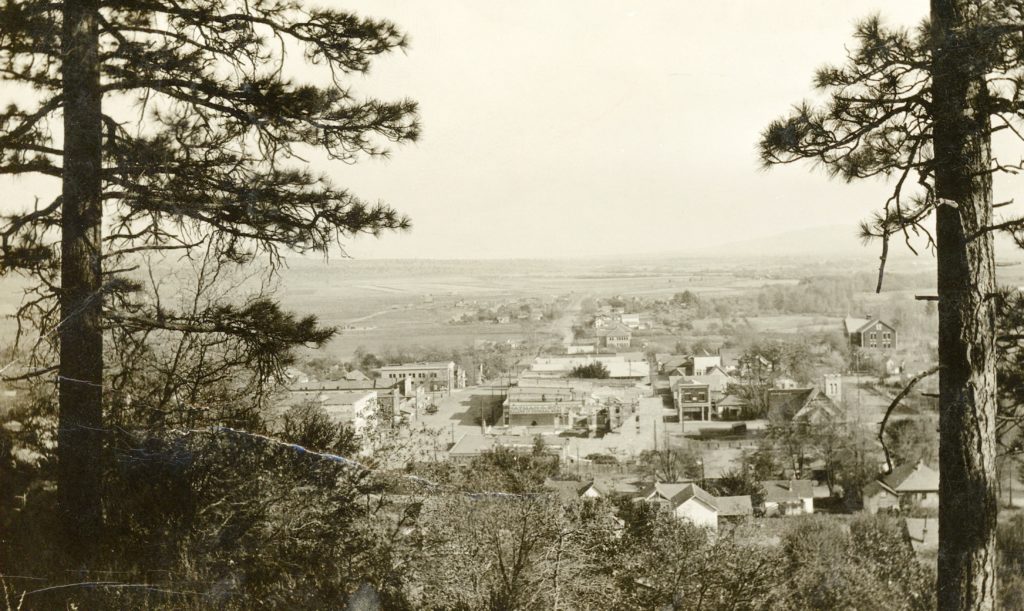
Susanville’s first catholic organization the Knights of Columbus was formed in the same year as the Susanville Elk’s Lodge and the Susanville Country Club. It was busy period in the town’s history. Continue reading Susanville – Knights of Columbus

Susanville’s first catholic organization the Knights of Columbus was formed in the same year as the Susanville Elk’s Lodge and the Susanville Country Club. It was busy period in the town’s history. Continue reading Susanville – Knights of Columbus

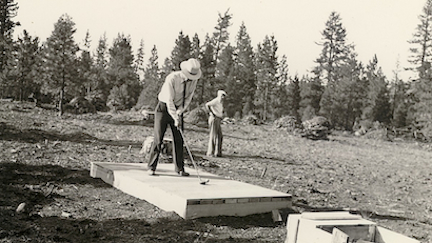
On March 9, 1940 the Church of the Latter Day Saints held groundbreaking ceremonies on corner of Ash and Fifth Streets, in Westwood. This was the last house of worship to be constructed under Red River Lumber Company’s tenure at Westwood.
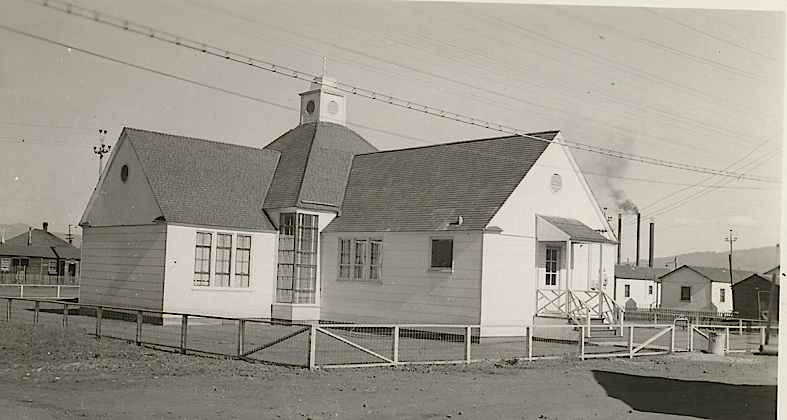
The church was designed Caldwell and Richards, Los Angeles architects. After World War I, the LDS Church began to implement standardized plans. This particular church was the first to use this particular layout. The $9,000 church was built by volunteer labor and completed in four months.
In 1986, its congregation had grown, wherein they bought property in nearby Clear Creek and built a new church. In 1991, their old our church was acquired by Our Lady of Snows Catholic Church which they converted into a parish hall. However, with their new Lake Almanor church, it will be just a matter of time when this is placed on the market, and only time will dictate its fate.

From time to time, someone will approach me about buried treasures. Some stories have been embellished over the years, especially that of Harry Gordier’s gold and the Holden Dick Mine.
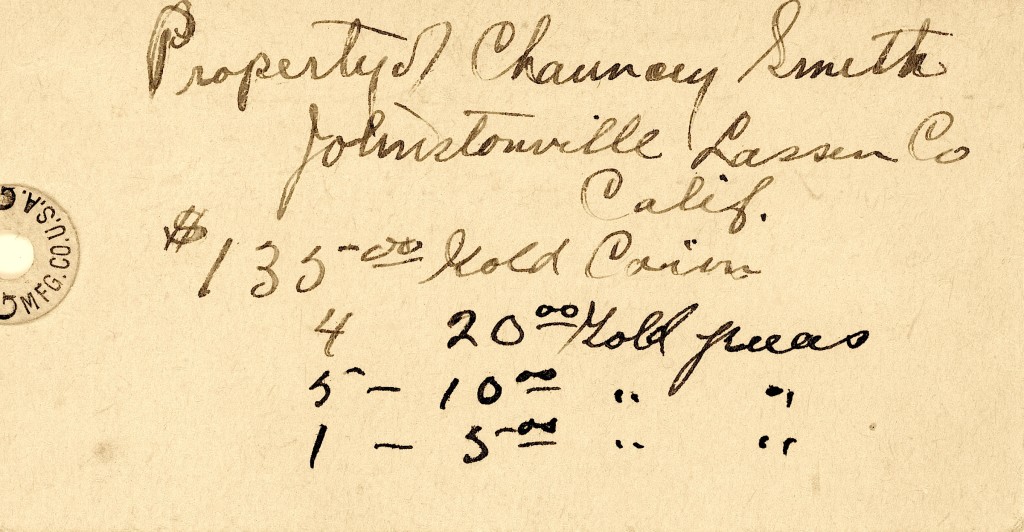
Then there are the lesser known tales, which are actually true,and not folklore. In the book Untold Stories, I relate the story of Chauncey Smith, since only a portion of his hidden cache of money was ever found. There is, of course, the great Westwood bank robbery, that to this day the money has never been recovered. In August, 1926 a portion of Red River’s monthly payroll shipment consisting of $45,000 never made it Westwood from the Reno bank. One theory was the money was stashed along the mountainside between Doyle and Milford. In June 1927, Red River thought they had found thief, in one A.A. Bruce who formerly worked for the railway express offices in Reno and Westwood. Bruce was arrested and his Reno home searched. However, when a preliminary hearing was held in Susanville, Bruce was released from custody as there was insufficient evidence to charge him with the crime. No one was ever charged, and the money never found.

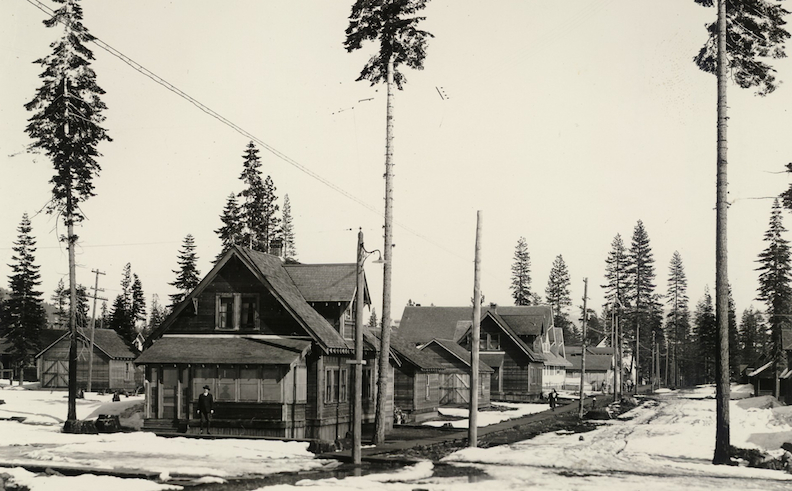
Company towns as a rule were a drab affair and Westwood was of no exception. After all paint cost money, and it was not a necessary expense.
In the 1930s, the Red River Lumber Company was in a major financial crisis. When 1940 arrived, and not a moment to soon, discussion of modernization of the lumber plant was in earnest. It was not only their plans to make substantial upgrades to the plant, but the town, too. These improvements were necessary if they wanted to sell its operation, though not all family members of Red River’s Board of Directors were in agreement. However, the majority wanted to sell Westwood and get out from under it, so they were willing to figure out to make the improvements under the financial duress they were under.
The unpainted residential district did not help matters in making the place look nice for prospective buyers. It needed sprucing up. One item discussed was to paint the houses. Clinton Walker, a family board member, was against the proposal unless the rents were raised to cover the costs.
While, the concept was shot down, it was also discussed to sale the houses and lots to employees for cash, the value would be the equivalent of four years rent. There would be one deed restriction, that the houses could only be used for residential purposes. Should someone attempt a business in a home the company would have the right to repossess it.

Just as Red River Lumber Company’s large manufacturing plant, its millpond was larger than average. Actually it was huge, it had a surface area of nearly 320 acres, though some segments were not used too much, certain areas being to shallow. In contrast, McCloud’s millpond was only eight acres and Fruit Growers was 20 acres.
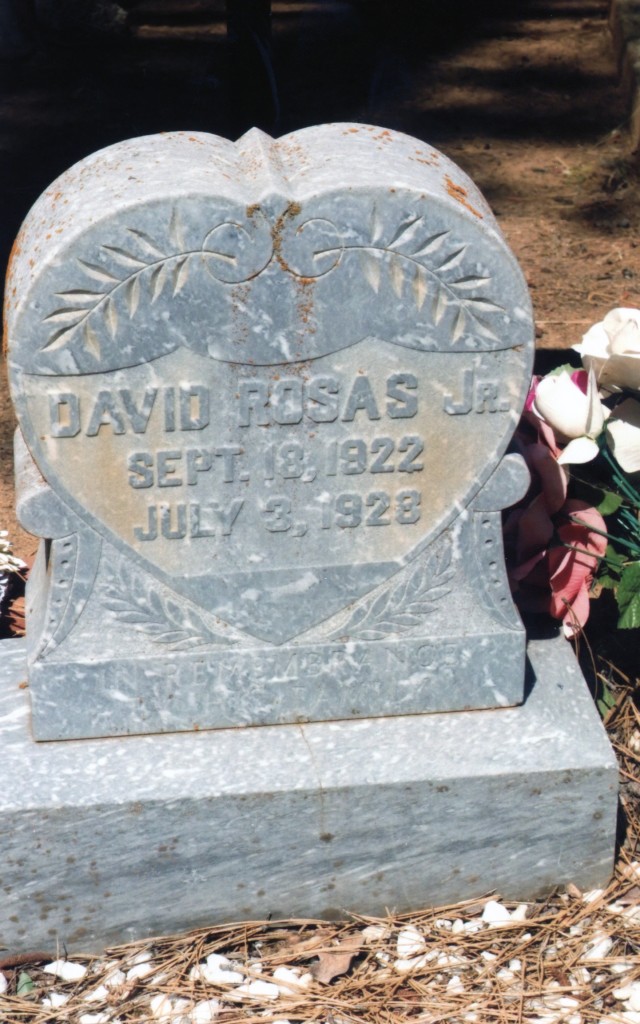
This odd man made lake could be hazardous to one’s health. During the early years, swimming was common, as well as fishing. Of course, small children were attracted to the water, and that is the story of seven-year-old David Rosas of Old Town. Several of his companions were playing in the water on July 4, 1928, when David ventured out too far, and the depth of the water changed dramatically. He, nor his companions knew how to swim. His friends went to get help, and when help arrived it was too late. The grieving family buried him later that day.

A reader wrote : “Hi. Tim! I know there are much more positive aspects about the history of Westwood that people would find interesting. It seems to me that using “Westwood Rumor Mill” and “Westwood’s Deportation of Immigrants” as the titles puts negative thoughts about our town in the reader’s mind right from the get go. Have you posted any other articles about Westwood that can show me that I have jumped to the wrong conclusion here? I sincerely hope so, as I truly enjoy your other work. You are an amazing historian! Hoping to hear from you.”
Continue reading A Westwood Reader Laments

For those who have have been enjoying skiing at Coppervale this season, you need to thank Bert and Mary Bain who established it.
First a little background. Back in the 1930s several road houses were established along highway 36 between Susanville and Westwood. They initially started out simple first with a gas station and restaurant, and later expanding. You can find a complete account of these in Red River: End of an Era.
At the same time, skiing, and more particularly ski jumping was all the rage throughout Northern California, where numerous professional events were staged. In 1934, the Paul Bunyan Ski Club even sponsored one which they built a ski jump on Fredonyer. In the spring of 1935, Bert and Mary Bain purchased The Meadows. First they expanded operations with an enlarged restaurant, but added a bar and dance floor. To attract amateur skiers, Bain had a ski jump constructed across the highway from The Meadows. Bain recruited noted skiers Sid Knudson and Phil Brown to design and build a small jump for his guests, and thus the Coppervale Ski Hill was born.

In August 2013, I conducted a Westwood Cemetery Tour. Since Westwood began as a company town of the Red River Lumber everyone worked together in a common goal.
With that in mind, in every operation, everyone plays an important role, as one cannot exist without the other. But before you can build a mill, you first need timber. That is where Charles Gardner, along with brother Irvine, better known as “Ippy.” The Gardner brothers, along with E.G. Scammon were part of the early California timber cruisers working under T.B. and Clinton Walker to not only examine timberlands, but also had the tedious jobs of going to a variety of county courthouses to examine land titles, so see who owned what parcel, values, taxes, etc. In a relatively short time frame of just over a decade Red River owned nearly 800,000 acres timberland in California making it the third largest landowner in California, only behind the railroads, who received their land for free from the government. Even after the Red River assembled its timberland, there was still plenty of work for the timber cruisers to do. Chief among them, was to plot out every year which sections of land that would be logged. As it was in the past, timber is still part of Red River’s heritage, now operating under Red River Forests, which is managed by Beaty & Associates.

Yesterday’s photograph featured the dynamiting of the Westwood millpond and the freeze of 1949. There was a side affect of that freeze. The freeze reduced California’s citrus crop, and in turn reduced the need of wooden boxes and Fruit Growers box factories in Susanville and Westwood were temporarily closed. In May when the Westwood box factory re-opened, it was only with one shift. Continue reading Westwood’s Rumor Mill

In January 1949, the temperatures plummeted to nearly thirty degrees below zero. The millpond froze. When Red River designed the facility, they placed piping from the powerhouse that forced steam air directly into the millpond near the sawmill. This system was no match for Mother Nature. To keep the mill operating it was necessary to use dynamite to blast loose the logs in the millpond. Continue reading Westwood’s Frozen Millpond