Well, can you believe it, it has been one year to the date that the old barn at the east entrance to Susanville was destroyed by a fire. It was built in 1920/21 for the Fruit Growers Supply Company, who were in the midst of constructing their new sawmill/box factory nearby. Continue reading That old barn→
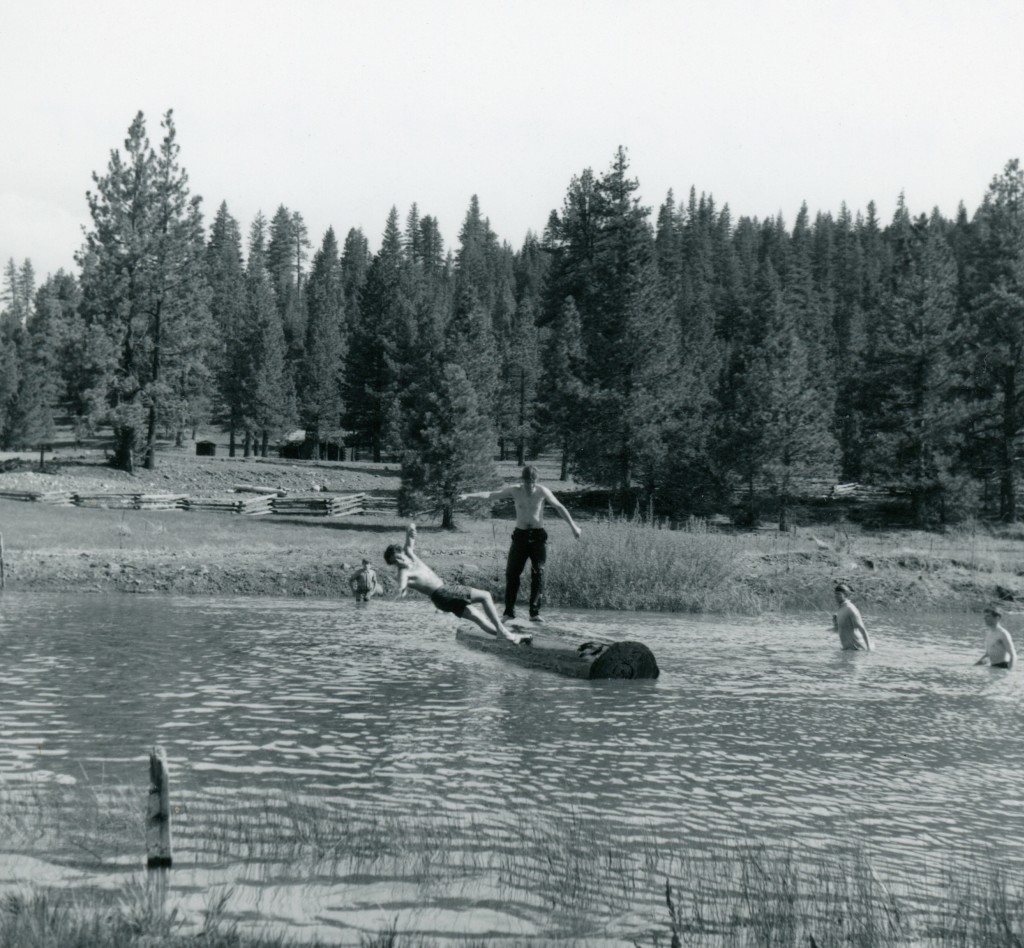
Paul Bunyan Days at Willard Creek, April 1970. Featured is the log rolling contest-student still standing is Howard Hanns and the student falling is Marshall Benedict. Photograph courtesy of D.B. Martin
This topic is certainly a work in progress, after all it does take a lot of research time to put together these daily posts.
Lassen College’s forestry department began in 1938, though now its major emphasis is on fire science, than forestry. It was in this era of the late 1930s and early 1940s that the forestry students developed a small winter recreational area known as Willard Hill. For several decades it was a very popular spot for sledding, etc.
Back to the topic at hand, Paul Bunyan Days. Any one out there who can shed more light on this? If so, please contact me.
It is never too late, subscribe today and enjoy tomorrow with daily notifications. You can also surprise someone with a gift subscription
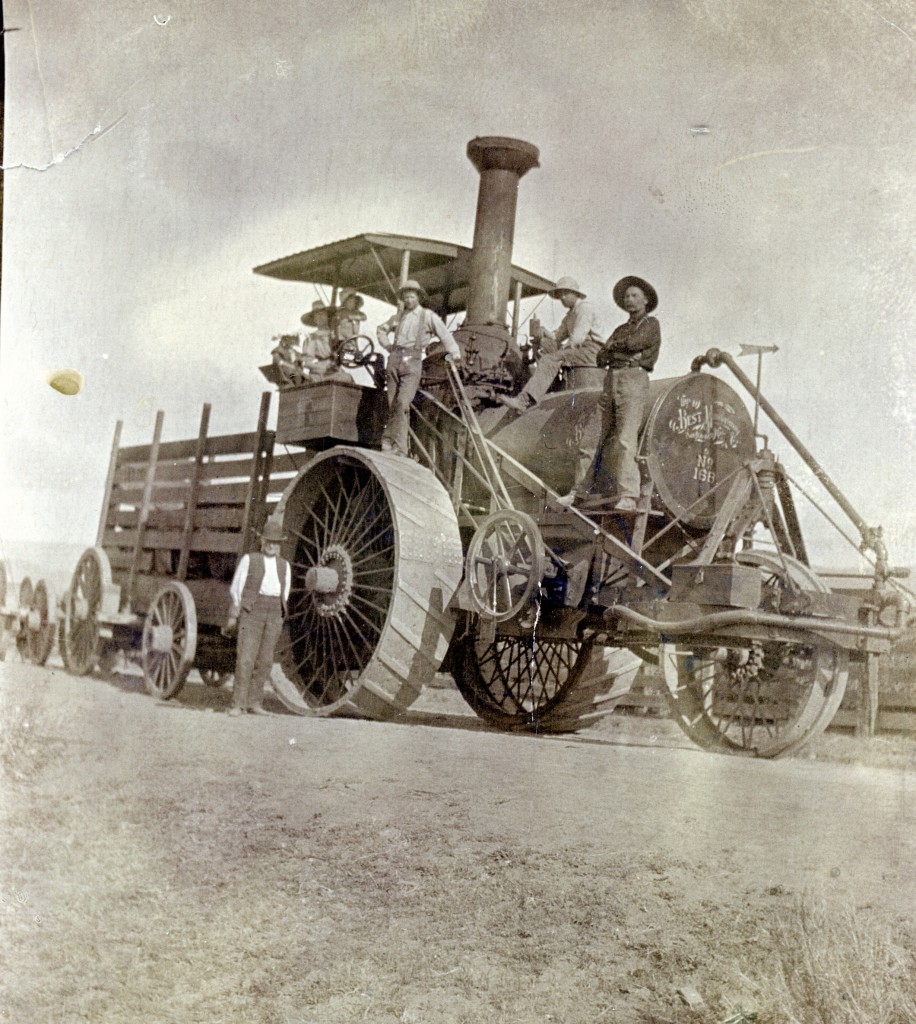
Harrison’s “mighty beast.” Courtesy of Lola L. Tanner
1907 was a a most interesting one in certain circles. There was a national financial crisis, but California and Nevada were experiencing a building boom. For the Golden State it was still in the midst of rebuilding the San Francisco Bay region from the previous year’s earthquake. For the Silver State, a mining bonanza it had not experienced since the discovery of the Comstock. These two episodes created a lumber shortage. Lassen County’s timber resources had basically remained untapped due to the lack of a railroad infrastructure to develop it. Continue reading Harrison’s Traction Engine→
Wingfield’s Meadowbrook Ranch circa 1911. Courtesy of Fred and Alyce Bangham
On May 23, 1910, Nevada millionaire, George Wingfield purchased the 320-acre Clinton DeForest ranch at the base of Diamond Mountain to construct a summer home. This, of course, was unheard by the local populace.
No time was wasted and construction of the $25,000 home, complete with at that time, modern electric and plumbing fixtures. The house, was the project of Wingfield’s wife, Maude.
Besides the house, there was guest house, a greenhouse, blacksmith shop and two fish ponds, along with a wildlife preserve. In due time, Wingfield enlarged the holdings by another 1,300 acres. In one acquisition he purchased the timber holdings of the Lassen Mill & Lumber Company. Included was a tugboat used on Honey Lake. Wingfield which he converted the boat into a pleasure vessel and even had a special boathouse constructed on the shoreline of Honey Lake.
The landscaped grounds of Meadowbrook Ranch. Courtesy of Alphozene Terrill
On July 24, 1923, the Wingfields sold the property to the Lassen Mill & Lumber Company for an undisclosed amount. The latter’s sole interest was for the timber estimated at 20 million board feet. The following year the property was converted into the Susanville Country Club, but that is another story for another time.
Never miss a story, click here, and also support this site too.
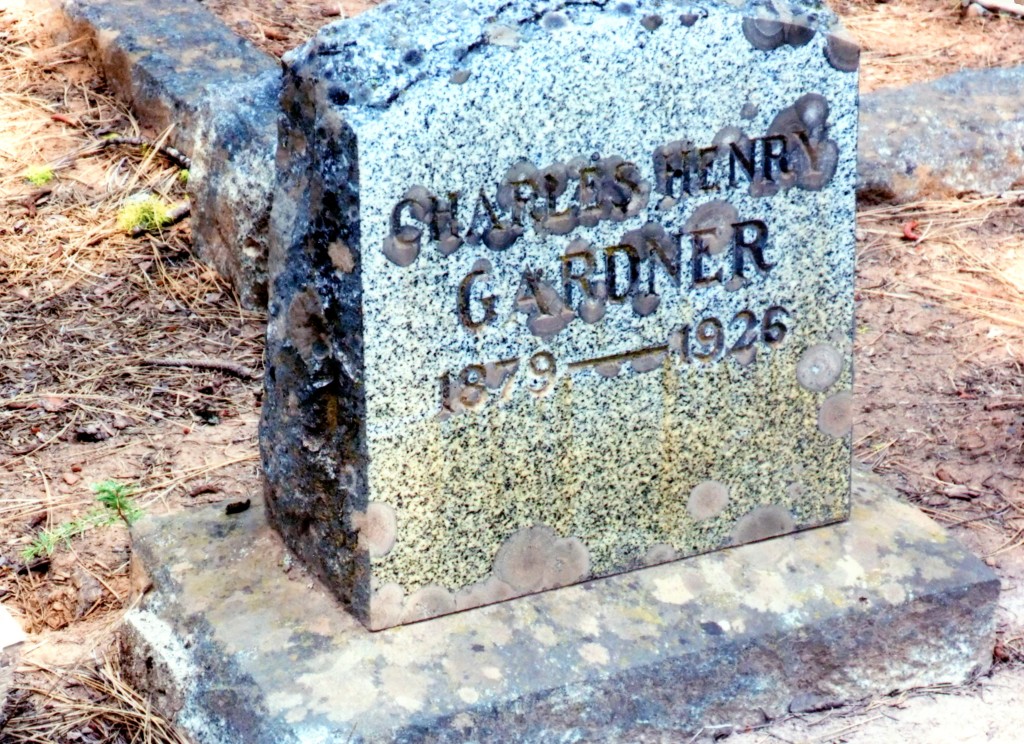
The grave of Charles Gardner, Westwood Cemetery, 2013.
In August 2013, I conducted a Westwood Cemetery Tour. Since Westwood began as a company town of the Red River Lumber everyone worked together in a common goal.
With that in mind, in every operation, everyone plays an important role, as one cannot exist without the other. But before you can build a mill, you first need timber. That is where Charles Gardner, along with brother Irvine, better known as “Ippy.” The Gardner brothers, along with E.G. Scammon were part of the early California timber cruisers working under T.B. and Clinton Walker to not only examine timberlands, but also had the tedious jobs of going to a variety of county courthouses to examine land titles, so see who owned what parcel, values, taxes, etc. In a relatively short time frame of just over a decade Red River owned nearly 800,000 acres timberland in California making it the third largest landowner in California, only behind the railroads, who received their land for free from the government. Even after the Red River assembled its timberland, there was still plenty of work for the timber cruisers to do. Chief among them, was to plot out every year which sections of land that would be logged. As it was in the past, timber is still part of Red River’s heritage, now operating under Red River Forests, which is managed by Beaty & Associates.
First of all, coming from a family logging heritage, its still hard to fathom, that lumber mills no longer exist in Lassen County.
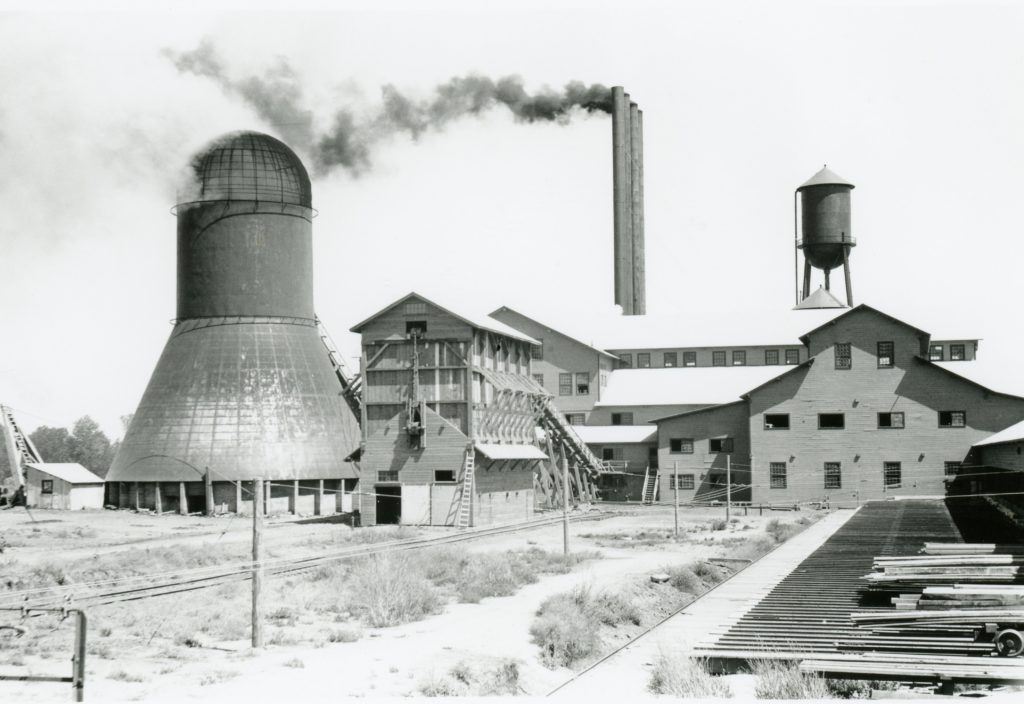
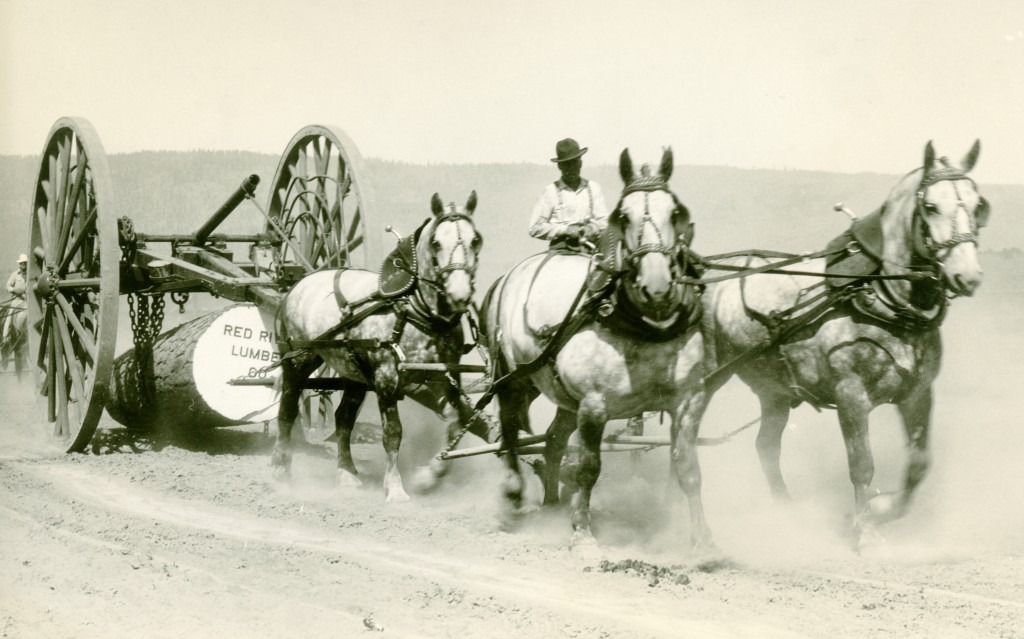
The two largest mills, Fruit Growers and Red River maintained two type of winter log decks. Usually, normal logging operations ceased in November. Yet, to keep the mills operating throughout the winter, required to have a substantial amount of harvested timber. There was the log deck at millpond, and then a second one out in the woods. The latter was not brought into the mill until spring, since the winter supply was nearly exhausted. The log decks in the woods provide enough ample supply during the transition, since it would take some time when the logging camps opened in the spring, to provide a steady supply to the mill.
The Southern Pacific Roundhouse, Susanville, 1947. G. Dunscomb Collection
Yes, I must confess my ignorance on this topic. This railroad’s roundhouse is unique in the sense it was isolated. It was not something a person would drive by, and it went relatively unnoticed unless you worked for the railroad or was involved with the nearby lumber mills.
Equally, puzzling is the rarity of photographs of trains along the Fernley & Lassen line. What makes that peculiar when one takes into consideration the large amount of tonnage shipped. During its existence, I would safely estimate some three billion board feet of manufactured lumber was shipped across these rails, that with the exception of the rails left at the Susanville Depot are all gone.
If anyone has information that they would like to share about the roundhouse, it would be greatly appeciated.
It is never too late, subscribe today and enjoy tomorrow with daily notifications. You can also surprise someone with a gift subscription.
As its name implies it was a real junction. The railroad constructed a spur to the south to Westwood. The Southern Pacific’s real goal was to extend the line north to Klamath Falls, Oregon. It was after all, the Red River Lumber Company’s intent to build several mills, the next one scheduled for near Lookout. By 1917, the Southern Pacific was anxious to extend the line north, but Red River was not ready. The mammoth mill at Westwood was more than it could handle. In the meantime, the Southern Pacific was nervous that its competitor the Western Pacific might extend a branch to Westwood and siphon off traffic, since Southern Pacific’s five-year all inclusive freight deal with Red River was about to expire.
Then came along World War I and that changed everyone’s plan. When the war ended, the nation went into a severe recession, so expansion was off the table for many. Red River kept adding more divisions to its lumber manufacturing plant. In the meantime, the Southern Pacific focused on the troubled Nevada-California-Oregon Railroad, as an alternative route north of Oregon, which it eventually did.
The site, it should be noted, also served as a junction for the railroad logging operations of the Fruit Growers Supply Company and the Lassen Lumber & Box Company.
It is never too late, subscribe today and enjoy tomorrow with daily notifications. You can also surprise someone with a gift subscription
One of the nice features using this forum, instead of traditional print, some photographs will not print well. The above is a perfect example, yet it is an interesting photograph. This is at 501 Main Street, now Uptown Cinemas. This caravan of equipment is headed to Westwood while the first sawmill was under construction. Courtesy of Marcella Mathews Searles.
When the Red River Lumber Company finally decided, or actually more to the point Fletcher Walker demanded the Mountain Meadows location or otherwise he was going to quit, there were numerous hurdles to overcome.
During the initial construction phase of 1912-13, everything would have to be freighted in, while the railroad was under construction, and it would not be completed to Westwood until February 1914.
The road over Fredonyer as it appeared in 1914.
The bulk of the machinery was shipped by rail on the Western Pacific to Doyle. Smaller shipments also went by the Western Pacific to Keddie. In either instance, that is still a long haul for all the machinery to build one of the largest electric sawmills. In addition, all the auxiliary items needed to build a company town. This is before paved highways no less, and the truck traffic certainly made its imprint on the roads, though not in a favorable way.
Hopefully, bringing you this information, it might give you a tiny incentive to part with five dollars a month to keep things running.
Loggers having lunch. Courtesy of the Fruit Growers Supply Company
I know hardly anything about this photograph, however, for reasons unknown I just like it. It is a woods crew of Fruit Growers Supply Company working from Camp Ten in 1932. Notice the two men on the far left with quart bottles of milk. Does anyone know how the milk was kept somewhat cool?
Subscribe and support this site for as little as $5.00 a month