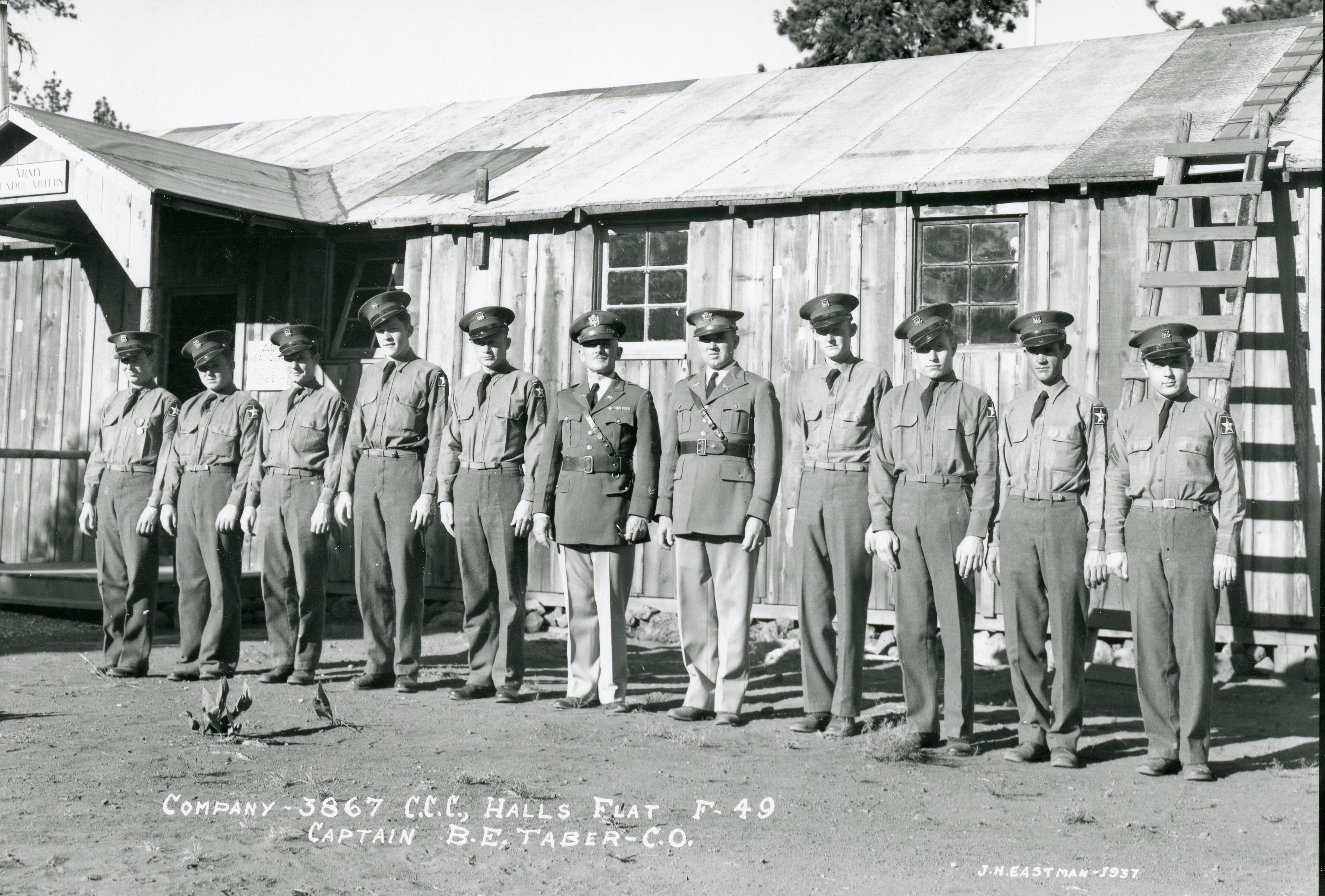
Halls Flat CCC Camp, 1937 courtesy of Hank Martinez
A Civilian Conservation Corp Camp operated at Halls Flat, near Poison Lake, in western Lassen County, from 1933-1942. The camp provided the manpower for the Lassen National Forest’s nearby Blacks Mountain Experimental Forest. This CCC camp did everything from the actual logging of pine beetle infested trees (1.6 million board feet in 1938) to grazing studies and range habitat improvements.
When Fruit Growers established their Lassen Operation they purchased two billion board feet of timber to the west of Eagle Lake. In 1921, Fruit Growers established its second logging camp, designated as Camp B. Many of their camps were portable in nature, in that once an area was logged, the cabins and other buildings could be conveniently be put on railroad cars and moved to the next location.
Train load of logs leaving Camp B
Camp B was unique as it was a mixture of both portable and permanent buildings. It was one of their largest camps that could house over 300 men. While the camp closed by 1926, its concrete foundations for the commissary, along with other remnants can still be seen today. Fruit Growers had a reputation of taking good care of their employees. This was evident at Camp B whereby motion pictures were shown. In addition, the logging camps even had their own baseball teams. This is rather amazing since these men who worked ten to twelve hours a day, six days a week still had the energy left to play ball.
Camp Harvey was a railroad logging camp during the 1940s of the Red River Lumber Company and later Fruit Growers Supply Company and located approximately 20 miles east of Poison Lake.
The cookhouses in logging camps always operated at a loss. However, a cookhouse could make or a break a camp—poor food resulted in an exodus of loggers. In 1948, Fruit Growers raised the price of a meal to one dollar at Camps Harvey and Stanford, and the complaints were loud and clear. Fruit Growers instead of losing 36 cents per meal, they only lost 8 cents.
In 1949, Fruit Growers leased the cookhouses and commissaries at those two camps to H.S. Anderson Company for one dollar. Fruit Growers thought maybe an outside company could handle the operations for more efficiently. They would never find an answer.
By the end of May the cookhouse crews represented by Local 769 of the Bartenders and Culinary Workers Union walked off the job in a wage and hour dispute. Logging came to standstill. The two camps with a population of nearly 500 became ghost towns, with Robert Simons and Harry Beal remaining as caretakers. After the weeks went on and no end to the strike Fruit Growers closed down the camps permanently. In addition, they abandoned that railroad logging line.
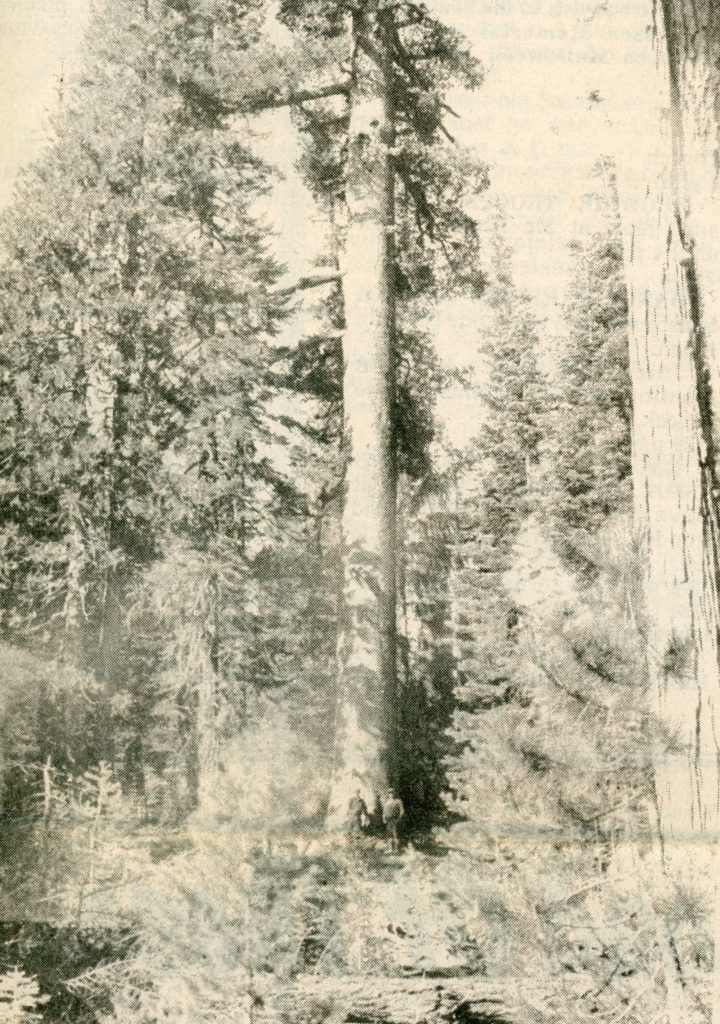
Ernest Cluck and Gene Goni standing at the base of the tree. Lassen County Times Nov. 8, 1978
On the front page of the Lassen County Times of November 8, 1978, there was a bit of irony one of the falling a large sugar pine tree, which running next to it a story of the Westwood Cemetery dispute involving logging.
On November 6, 1978 Ernest Cluck felled the 432 foot sugar pine tree that contained 16,000 plus board feet. It was part of timber sale that Beaty & Associates sold to Sierra Pacific of Susanville, though article failed to mention where the tree was located.
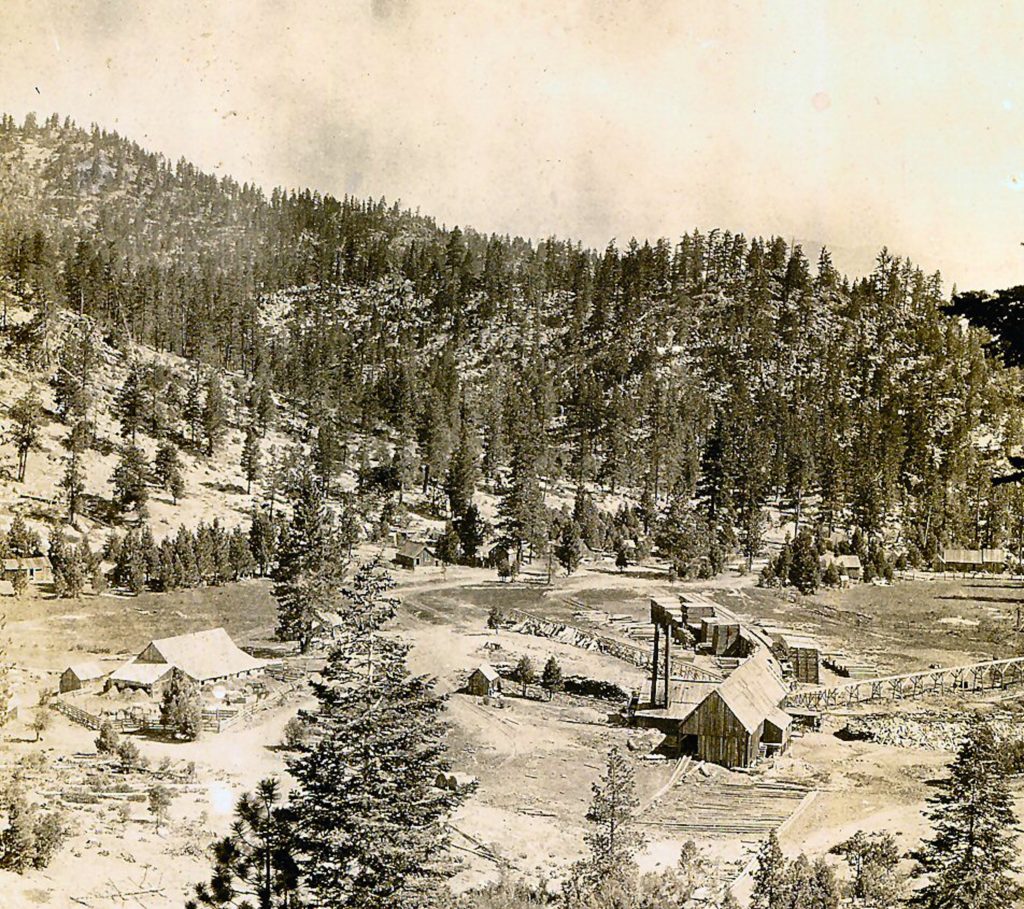
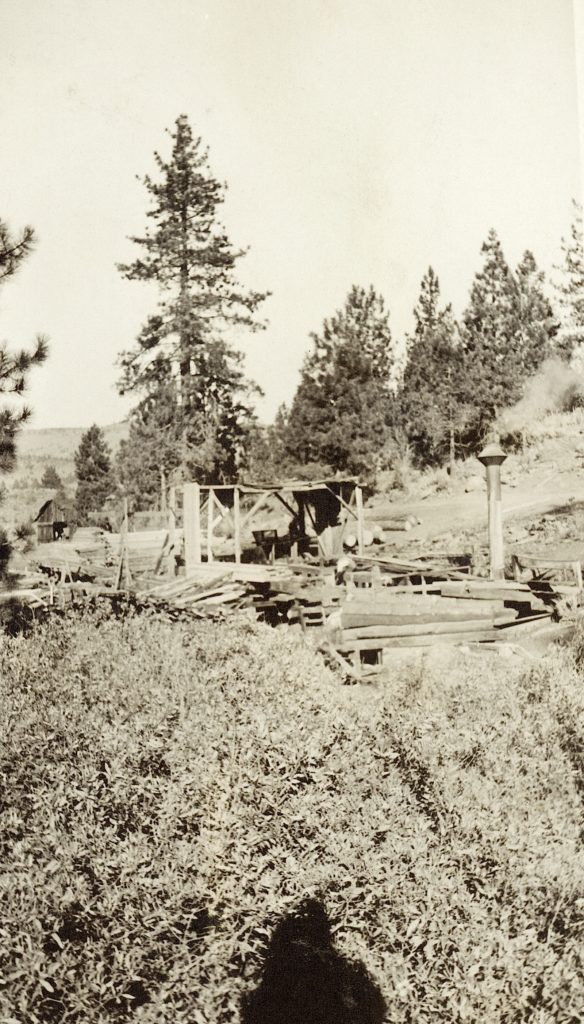
Doyle & Crowder Mill. Courtesy of Marie Herring Gould
First of all, I disclose that I do not know a lot about this sawmill, but I am working on it. The mill built around 1903, was located in what was referred to as Cannon field near the top of Doyle Grade. It had one major customer, the Western Pacific Railroad to provide them with railroad ties while the railroad was being constructed through the region. In 1918, due to the scarcity of machinery brought on by World War I, the Lassen Lumber & Box Company of Susanville purchased and dismantled it to build their new mill in Susanville. In the 1950s, some people going through the old sawdust pile found several gold coins.
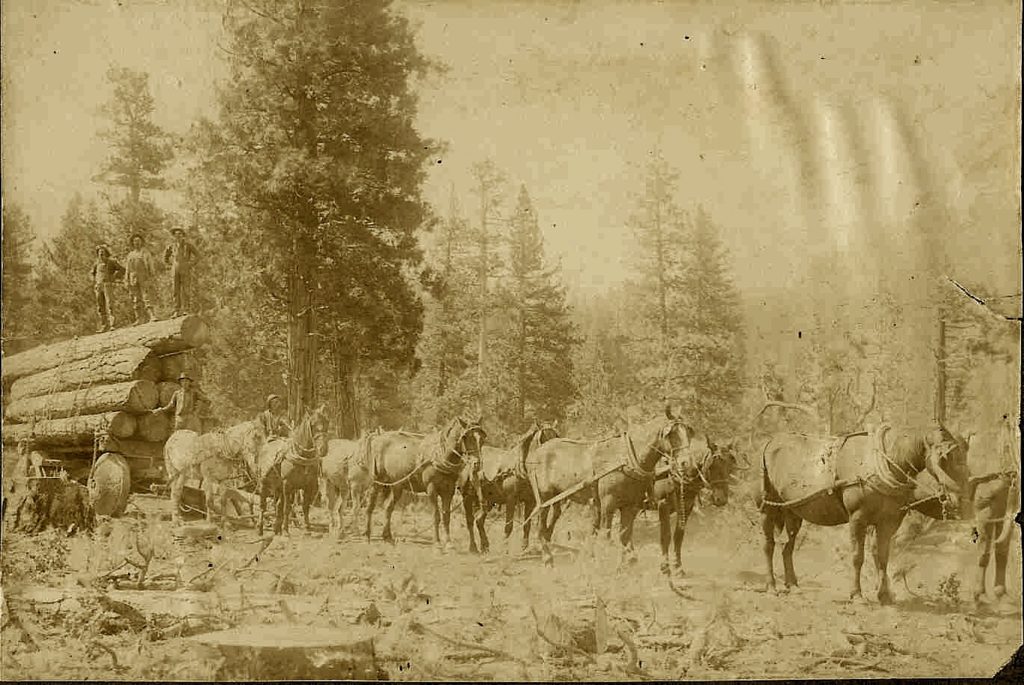
The machine shops of the three lumber companies Fruit Growers Supply, Lassen Lumber & Box and Red River Lumber were amazing operations. When these mills were established it was in a time of transition where within fifteen years logging operations would go from horses to traction engines. The sawmills themselves were caught in this phase as well.
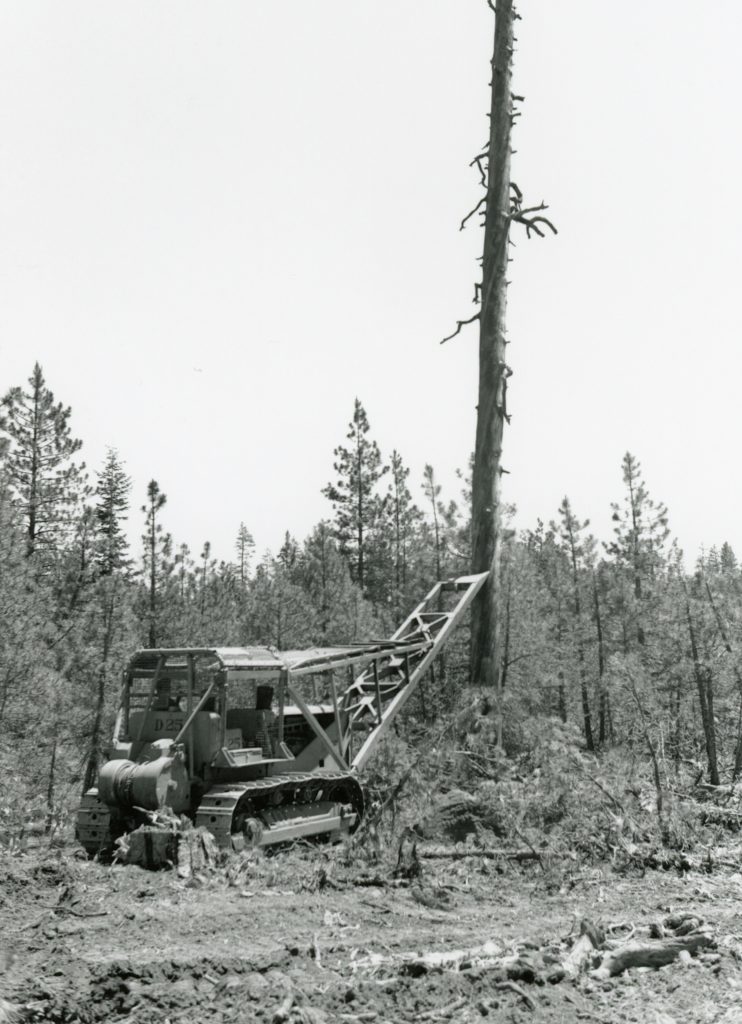
Whether it was a mill foreman or a logger when a person had an idea, they went to the machinist who in their innovate ways came up with a new tool or machinery component. In the 1950s, Fruit Growers Westwood Operation developed a snag pusher to knock down dead trees deemed a hazard for use on the Lassen Operation (Susanville).
The completion of the Western Pacific’s highline in 1931 was not the only railroad development to make news. In the 1930s, Red River’s most unusual railroad logging line, the Piute, came to fruition—so named as it followed Piute Creek in its approach to Susanville.
Red River owned a large swath of timber west and north of Susanville. While they had already logged over its easily accessible timber in Mountain Meadows and Lake Almanor, the Piute line was not intended to service Westwood. The Piute was built to generate much needed revenue to sell timber to other parties, such as Fruit Growers and Lassen Lumber & Box. However, they had a back-up plan; should Red River’s timber sales fall flat, they could mill the timber at Westwood. Continue reading Piute Logging Railroad→
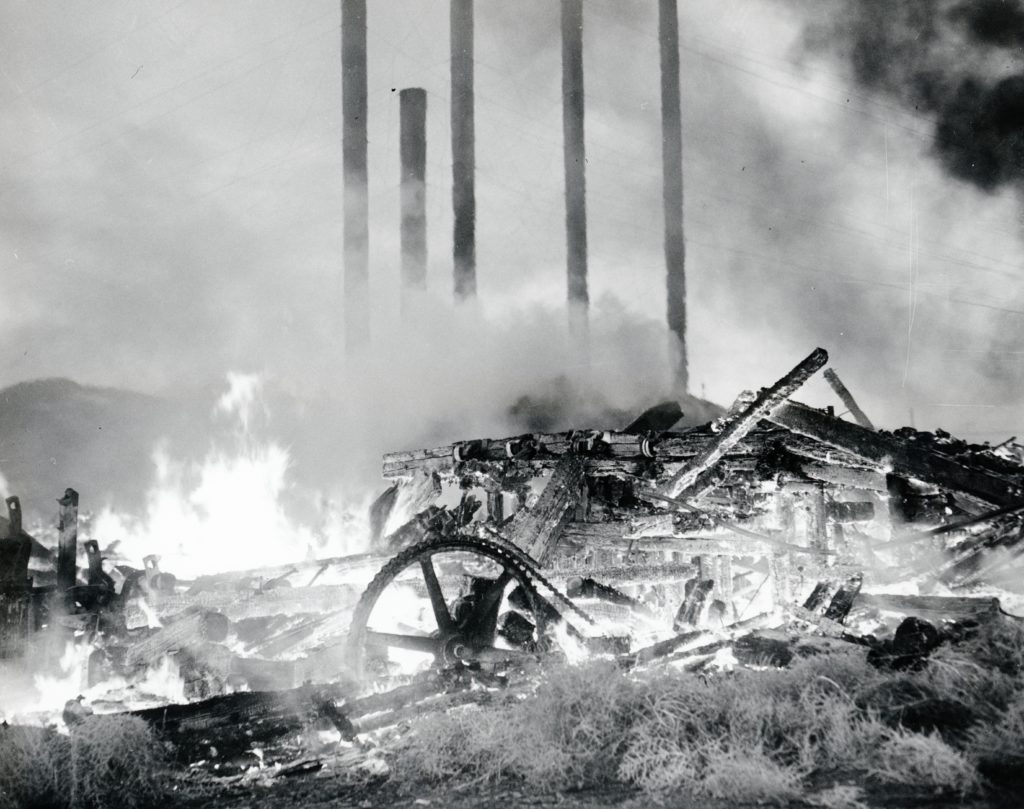
The mill engulfed in flames. Courtesy of Fred Lendman
Susanville’s Paul Bunyan Lumber Company was located in the current neighborhood of Wal-Mart. It was built in 1936 and originally referred to the Cedar Mill, as it was operated by the Springfield Cedar Company.
In 1945, during the long dissolution process of the Red River Lumber Company, one family member, Kenneth Walker continued to carry on in the family business and he took over the Cedar Mill. He also retained Red River’s company Paul Bunyan logo, and he named his new enterprise the Paul Bunyan Lumber Company.
However, it was not too long when disaster struck. A little after midnight on May 22, 1946, Charles Bannerman, the night watchman, signaled the fire alarm. By dawn the mill had been completely destroyed. Like the proverbial phoenix rising from the ashes, Walker would build a new mill, which was placed into operation on February 16, 1947.
Conklin mill, circa 1918. Courtesy of Lola L. Tanner
In 1889, Albert J. Conklin purchased 338 acres consisting of the territory known as Jacks Valley, located between Susanville and Willow Creek Valley. In1907, demand for lumber approached record levels. The rebuilding of the San Francisco Bay area from the devastating 1906 earthquake, along with a new mining bonanza in Nevada were contributing factors. In the spring of 1907, to meet the local lumber needs, Conklin built a sawmill. The mill had a maximum daily capacity of manufacturing 15,000 board feet. Conklin continued with this enterprise until 1920, when he sold to W.J. Johnson. In 1923, after only three years of operation, Johnson sold out to the Red River Lumber Company who closed the mill and removed the machinery.
There were two different sawmill operations on Fredonyer Peak, north of Eagle Lake. The first one was on the Horse Lake side operated by the Shumway family. The second one, and much later in time was on the north side near Bayley Creek reservoir, the latter which was constructed in 1899. It should be noted, that many maps misspell it as Bailey, but it was so named after Likely rancher George H. Bayley.
In 1912, H. T. Risdon established the Eagle Lake Lumber Company and constructed a sawmill at Bayley Creek. Risdon encountered problems finding skilled labor. In time he leased it to Thomas Coulter and Frank Spencer, who in 1919 bought it outright from Risdon. The mill remained in operation until 1942, when it closed for good.