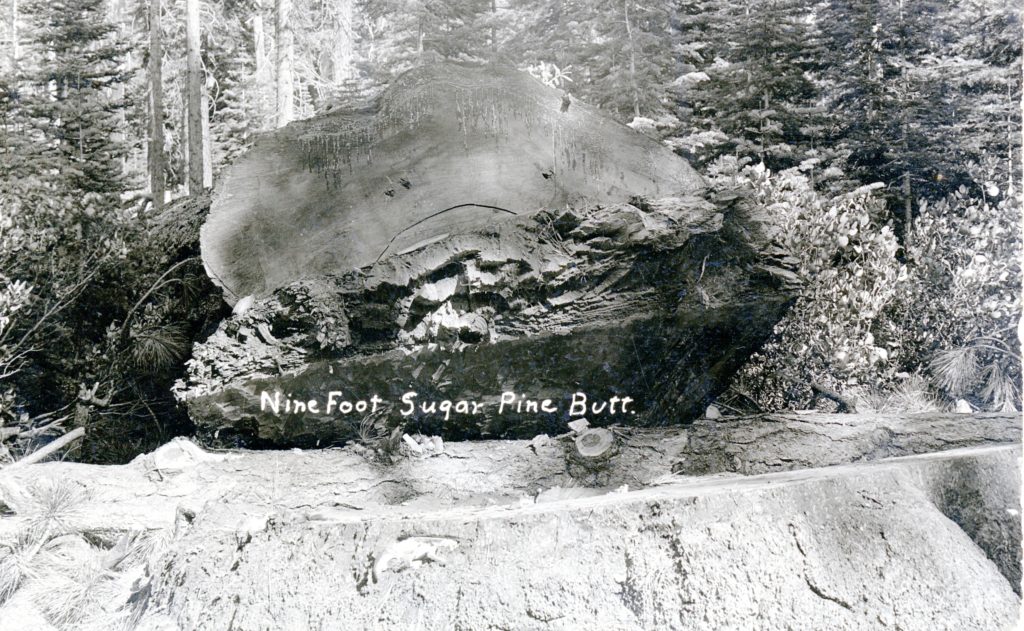
This mammoth tree was cut in 1922 on Fruit Growers property west of Eagle Lake.
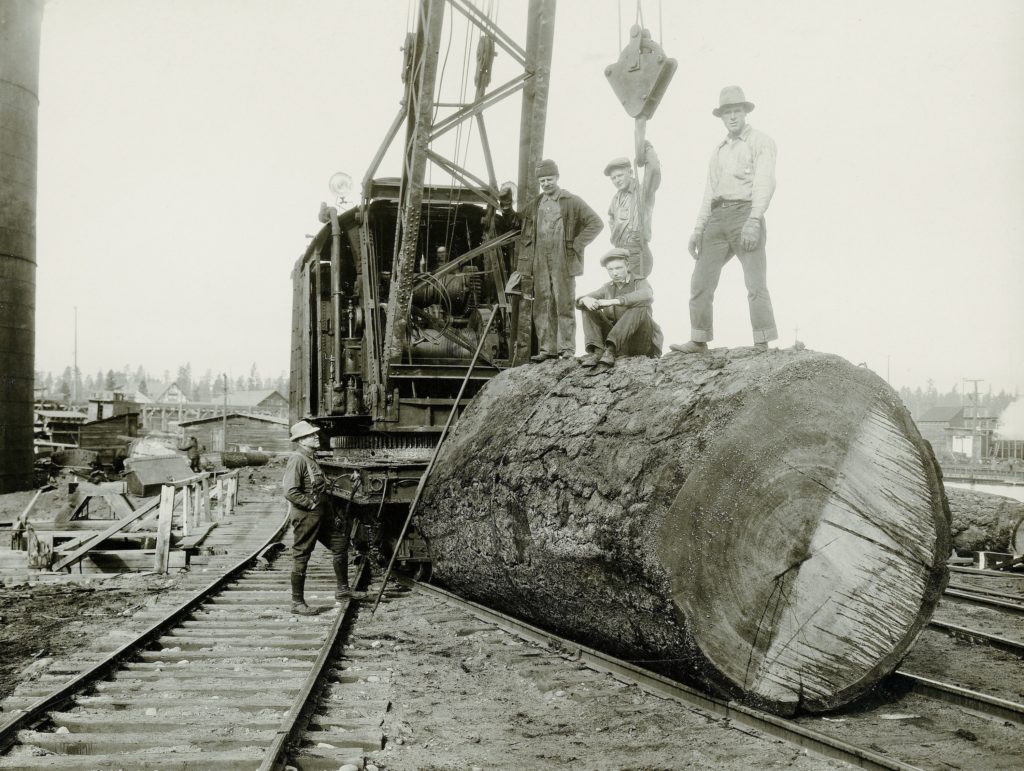
In November 1928 the Red River Lumber Company reported that they had felled a 650 year-old sugar pine tree at Camp 74, in Plumas County, west of Chester. It required three railroad flat cars to bring the tree to the mill in Westwood. It was 101 inches in diameter at the stump and 84 inches at the second cut.* The tree contained 27,570 board feet. Red River noted that this was the largest tree ever brought into the mill.
*For those not familiar trees are bucked/cut into 32 foot lengths.
In the early 1900s, the founders of Collins Pine Company amassed some 60,000 acres of timberland in the greater Lake Almanor Basin. It was not until the late 1930s, that they gave consideration to establish a mill there. In the fall of 1940, after much negotiations the Red River Lumber Company offered a mill site adjacent to Chester, along with thirteen miles of its main line railroad from Chester to Clear Creek Junction where it connected with the Western Pacific Railroad, which Red River estimated its value at $80,000.
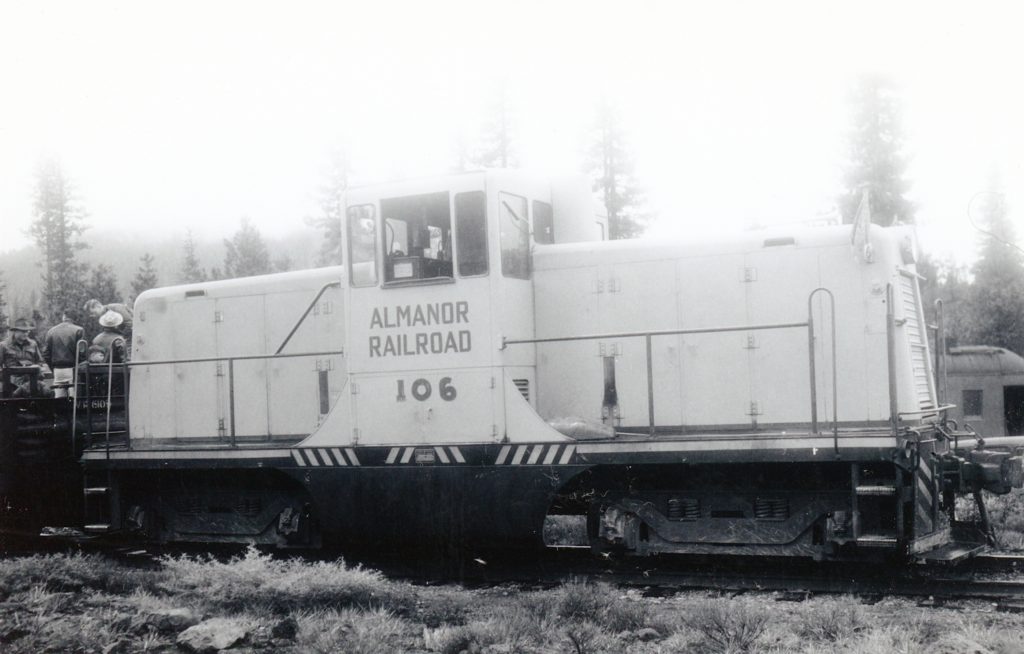
Thus, the Almanor Railroad was born. Collins Pine changed it from a private line to a common carrier, should anyone in Chester desire to use it. Collins Pine had a lot of work to upgrade the railroad line. It also needed motive power, as it decided not to purchase any of Red River’s locomotives. At its Grande Ronde operation, it had discontinued its railroad logging in favor of truck logging. There it had at its disposal a Heisler geared steam locomotive, the 104, and it was put into operation on the Almanor. Initially it worked ideally to handle the railroad’s sharp turns and steep grades. It was later replaced with a small diesel locomotive.
An electric saw powered by a D-2 cat. Courtesy of Fruit Growers Supply Company
In the twentieth century one aspect of logging that was slow to modernize was timber falling. In the mid-1930s, Fruit Growers experimented with a Dow Low Stump Power Saw. It turned out to be too bulky and cumbersome and the fallers returned to falling timber manually. In 1943, Fruit Growers experimented with an electric saw power by a generator attached to a D-2 Caterpillar. To provide for mobility it was equipped with 400 feet of cable. One of the drawbacks was it took three men to operate it one to operate the tractor and two to run the saw. It was not until the 1950s when a more advance line of lightweight saws were introduced that the traditional hand saws and axes were replaced by the power saw.
A sinker long dredged up from the Westwood millpond, circa 1930. Courtesy of Walter “Doug” Luff
Mill ponds are a relic of the past lumber industry. If your are from that era, you recall one particular thing that is forever etched in your memory bank. During the summer months, the stench from these mill ponds were horrendous.
One of the annual maintainence chores was the removal of sinker logs. These were logs that sunk to the bottom of the millpond before they were put through the sawmill.
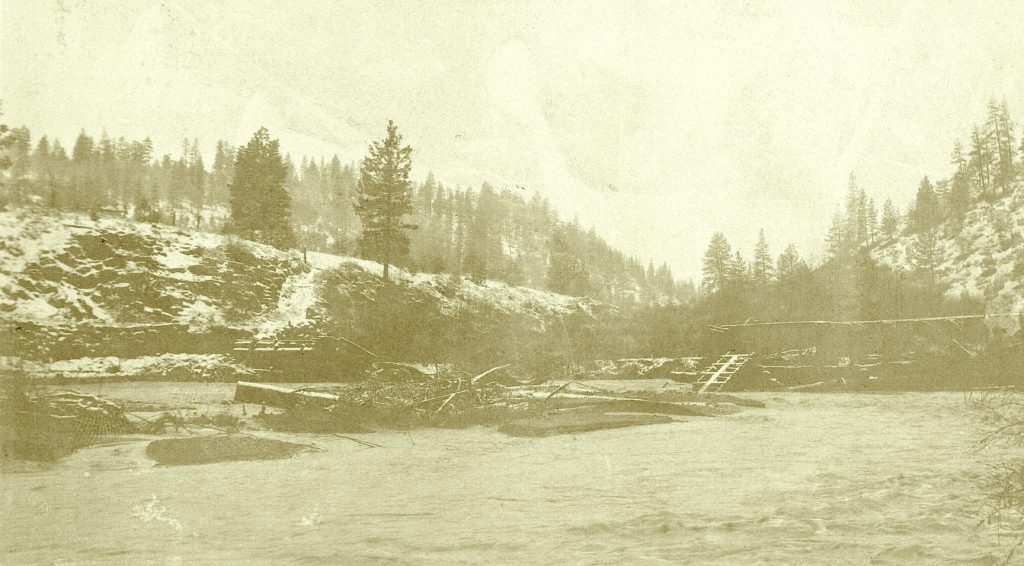
While there were numerous proposals to construct dams in the Susan River Canyon very few ever came to fruition. This dam was constructed in 1886 on the Susan River about a half-mile above Hobo Camp. It was an impressive structure being 250 feet long and 25 feet high. It created a reservoir in which water was backed up over a mile. The dam was constructed to provide waterpower for a sawmill at the location to be featured in a future post. The sawmill and subsequent power plant was destroyed by fire in 1894. The sawmill was never rebuilt and the power plant located downstream where a flume from the dam provided the waterpower. By 1900, this too, had gone by the wayside, and residents were concerned about a possible dam failure, flooding people downstream. In 1906, some unknown party attempted to blow up the dam with explosives, but not familiar, did little damage. Between the railroad construction, in 1913, and time the dam slowly deteriorated. During the drought of 1977, the foundations of the dam were revealed.
Haying at the Elledge Ranch, near Standish, 1900. Courtesy of Camilla MoodyIf you were gainfully employed in Lassen County in the early 1880s, the following was the prevailing wage. Regular farm hands with board were paid $30 to $40 a month. If you happen to just work at harvest time such as haying $2 a day, and possibly board. The sheep industry was a major component in Lassen County’s agricultural community and sheepherders salary ranged from $25 to $40 a month. The task of sheep shearing was paid at 6 cents a head.
In the lumber industry the head sawyer was paid $75 a month, plus board, while the average mill worker received $40 a month plus board. Since firewood was a much needed commodity those laborers were paid on the average 75 cents per cord.
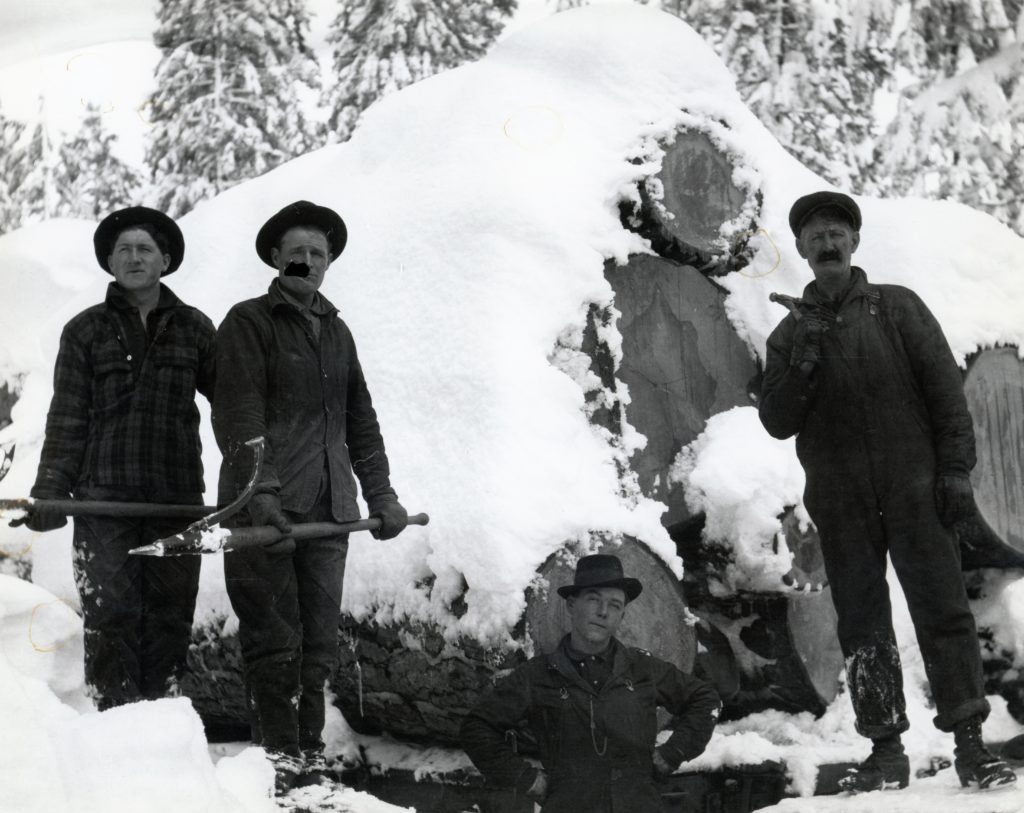
A winter logging crew, 1916. Courtesy of Hank MartinezWhen the Red River Lumber Company moved its operation from Minnesota to Westwood, California it would become quite the learning experience for the company. In addition, the company’s founder, T.B. Walker, desired that the California operation be under the full responsibility of his five sons, which was easier said than done.
One of the sons, Fletcher Walker, was the resident manager of Westwood and had more or less full control of the operations. However, it was necessary for Fletcher to keep his father and brothers informed of the company’s activities, especially since it cost $3,5 million to construct the company town of Westwood during the 1912-1914 era. In addition, another $3.7 million was spent on the purchase of 800,000 acres of timberland in Northern California.
One of the many early family disputes was where to locate the company’s first mill, (there were plans for several small mills throughout Northern California) which would eventually be the location of Westwood. One of the biggest concerns of the Westwood site was that it was located in a snow-belt region. This would have a ripple effect on operations because more kilns would be needed to dry the lumber to hindering logging operations.
Whatever the case may be, it was Fletcher’s goal to operate Red River year round, much to the chagrin of his father. On February 25, 1915, T.B. wrote to Fletcher criticizing him for running the mill during winter storms, and that he should just shut it down. T.B. commented: “I have never expected that we could run all year in the mountains of California. I had in mind when I was securing the millsite where you built, that this would likely be about a nine or ten month’s milling job.” T.B. then chastised Fletcher’s decision to cut white fir and second-class pine trees. Again, T.B. commented, “If we get a mixed lot of lumber cut, considerable of which will pay us no more than the milling and marketing will cost, it will leave us behind in meeting our obligations. I have never figured on cutting timber in California, clean.” T.B. continued to stress in only cutting the best timber to turn it into money to meet its many obligations, especially taxes and bond payments. In addition, Fletcher stated he needed at least a half million dollars to finish the plant. In conclusion, T.B. was sympathetic when he wrote, “I realize the disadvantages and drawbacks that you work under in trying to build a milling plant out in the open woods, with everything to contend with, and where logging, sawing, handling, cutting up and shipping are all at a serious disadvantage, and where you have more or less bad weather, in the winter at least, that naturally makes it an up-hill battle.”
Finally, Fletcher questioned his father’s judgment on the ease of operating a winter mill in Minnesota, and remarked, “I never discovered that it was an easy operation to get through four months of cold and snow.”
The following year T.B. again requested Fletcher to shut down the logging operations in the winter as it was just plain too costly. Fletcher agreed the winter operations operated at a loss. However, his justification was that outfits such as McCloud River Lumber Company that called it “quits” in the sawmill operation on November 1 placed Red River at an advantage by having a ready supply of lumber. In summation, Fletcher wrote, “In place of our figuring from this end on closing down, we have been figuring carefully the pros and cons of taking advantage of the bulging market to produce a bunch of timber of lumber this summer and make a real killing.”
Whatever the case may be, it was a lesson learned and not repeated, so in 1918 Red River discontinued its attempt at year-round logging. One practice that Red River implemented like other large lumber concerns of Northern California of the era was to harvest addition logs during the fair weather season, to have a stockpile to keep the sawmill in operation during the winter months.
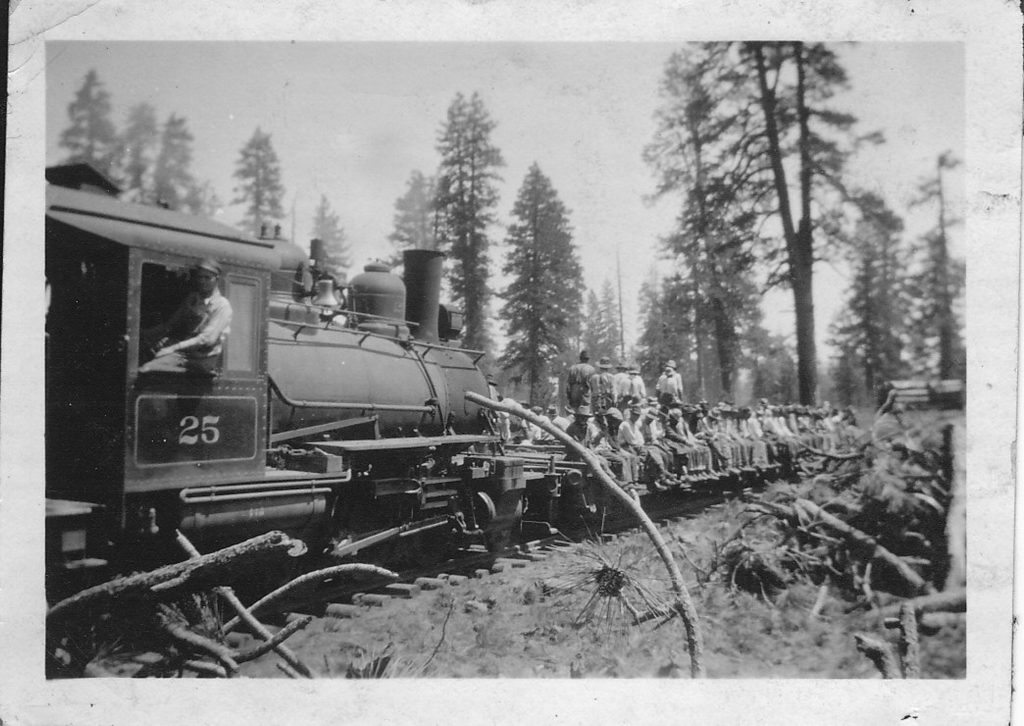
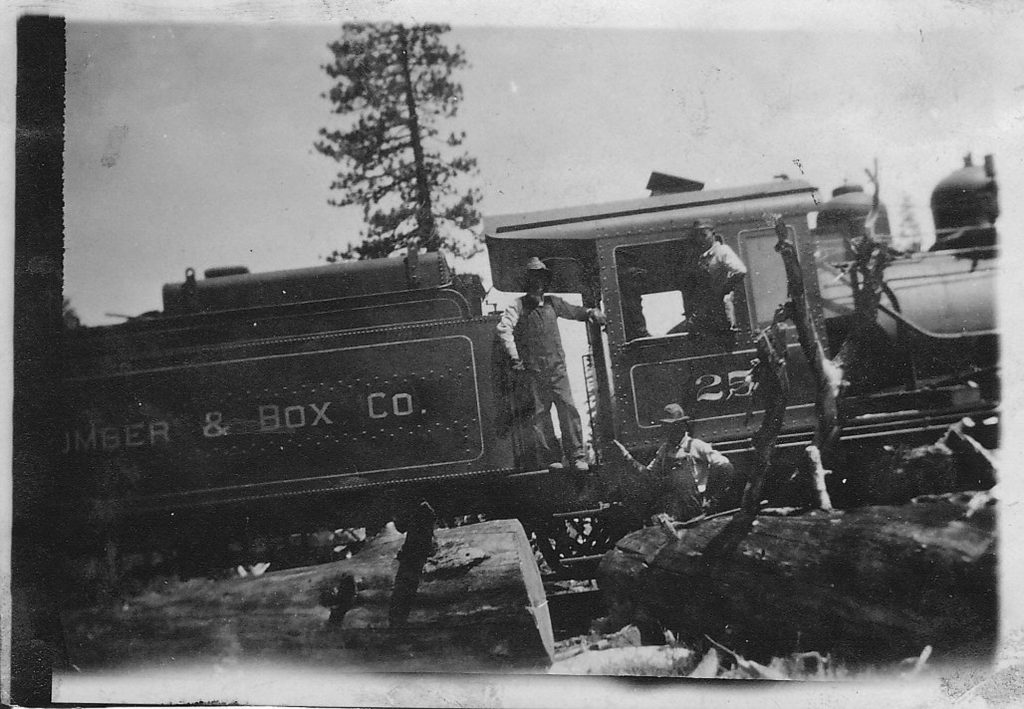
The Camp Lasco commute train. Courtesy of Ron LinebargerTo wrap of the long holiday weekend I share a couple of logging photographs of the Lassen Lumber & Box Company that are provided by Ron Linebarger . Lassen Lumber’s main logging camp, was that of Camp Lasco at the base of Peg leg Mountain that was more or less shuttered in 1929.
Donate! Another shot of the No. 25. Courtesy of Ron Linebarger
October 13, 2017
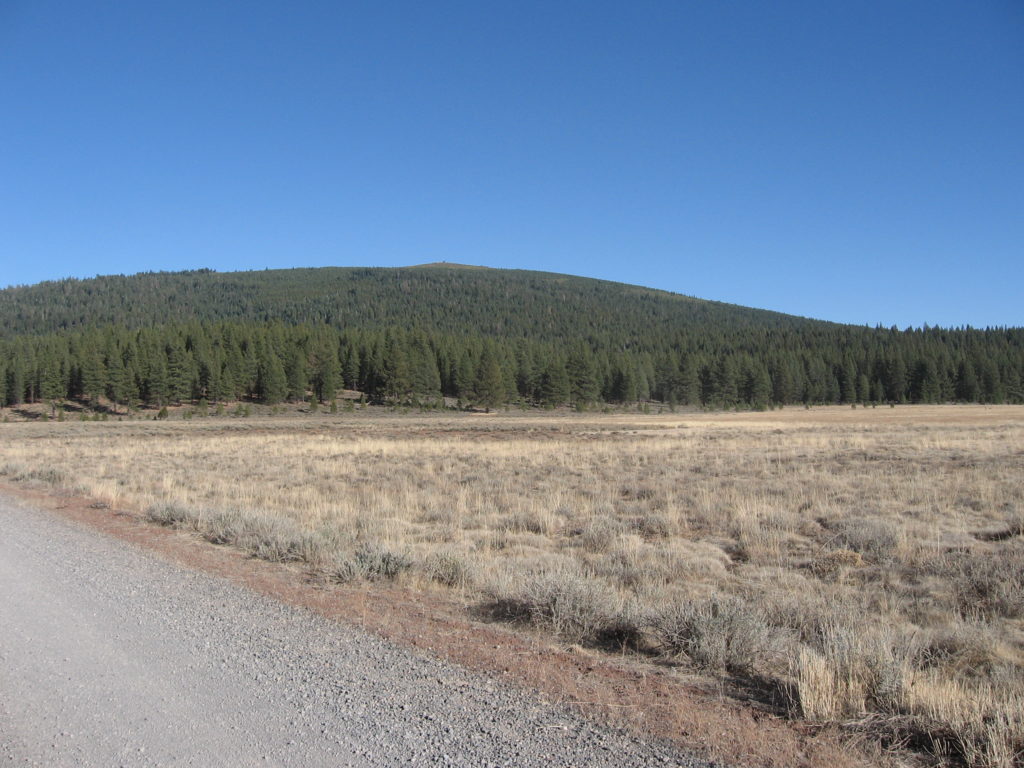
Antelope Mountain on the west side of Eagle Lake. On July 28, 1924 a fire broke out from a steam donkey engine of the Fruit Growers Supply Company near Camp D. In the aftermath Fruit Growers constructed fire lines. The Lassen National Forest sent a bill to Fruit Growers for $156,000. In a negotiated settlement Fruit Growers agreed to replant 2,000 acres of forest service land and to contribute $1,500 annually for a ten year period for reforestation.
October 13, 2017It came to forefront in 1924 when a fire broke out on the west slope of the mountain that destroyed 7,000 acres to timberland. The fire had a legacy when a lookout was built on top, along with the first reforestation program in Lassen County.