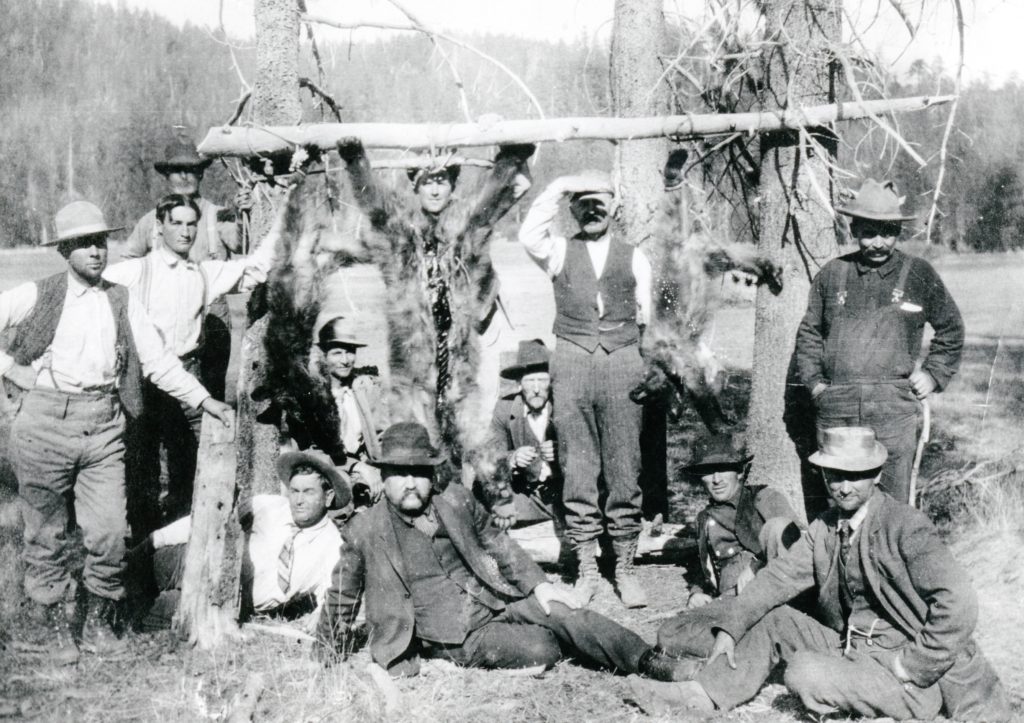
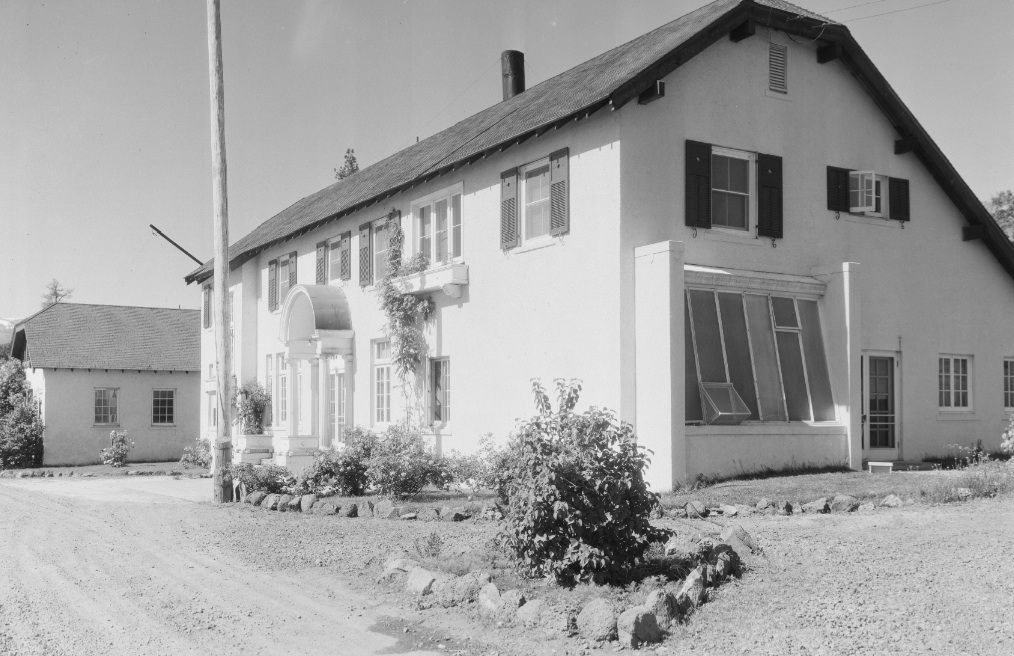
Pacific Coast Bear Club at Grizzly Valley, 1907. Courtesy of Ted Johnson
Lassen County over the years has witnessed an interesting array of organizations. How about the Order of Camels? The Loafer’s Society? The Pacific Coast Bear Club, headquartered at Spoonville, east of Janesville, would be considered an elite men’s club of the early 1900s. The founder, Captain E.C. “Ben” Brown had a colorful past, who experienced good and bad times with business ventures. Timing can be everything, and Brown was at the right place at the right time during the early discovery of gold at Goldfield, Nevada. He was not alone, which began the careers of many influential people in Nevada, including George Wingfield.
In 1906, Brown organized the club, with Nevada Governor John Sparks as its first president. For the next few years bear hunts were conducted at Grizzly Valley, Plumas County. One year they boasted a kill of nine bears—credit to Brown and his hound dogs.
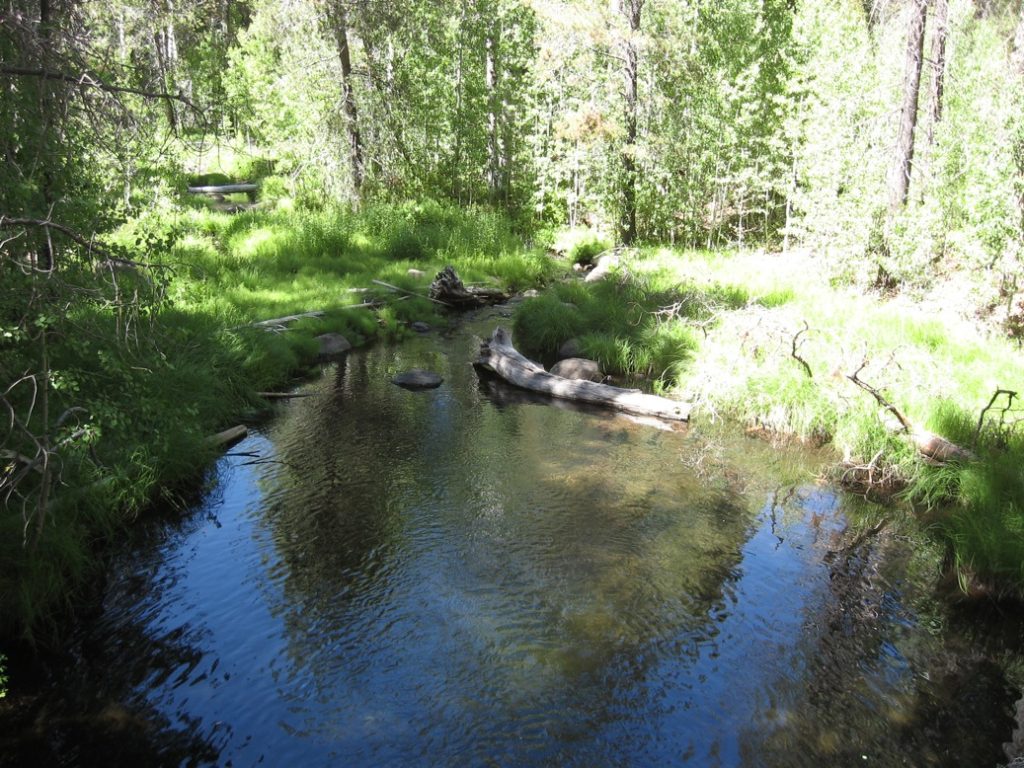
Upper Pine Creek flows year round. Eagle Lake Trout are known to make the journey upstream to spawn. It is my understanding, and I could be wrong, is the brook trout feast upon the eggs of the Eagle Lake trout—hence why some want to eradicate the brook trout.
Clapper Canyon, Black Rock Desert. Courtesy of D. Dickerson
There are certain questions that are destined to be left unanswered. One that has left me stumped was related to the deaths of Edward Clapper and Peter Lassen that occurred in April 1859 in the Black Rock Desert. In November 1859, three Honey Lake Valley residents, U. Johnson Tutt, Antone Storff and Joe Kitts made the 124 mile plus journey to retrieve the remains of Lassen’s body. For the life of me, that they went to all that trouble, why did leave Clapper’s remains behind?
It should be duly noted that in 1990 the skeletal remains of a human body were found in the region where Clapper and Lassen were murdered. After extensive analysis, it was determined it was the remains of Clapper. On May 30, 1992, a burial ceremony was held at Lassen’s Monument to inter the remains of Clapper.
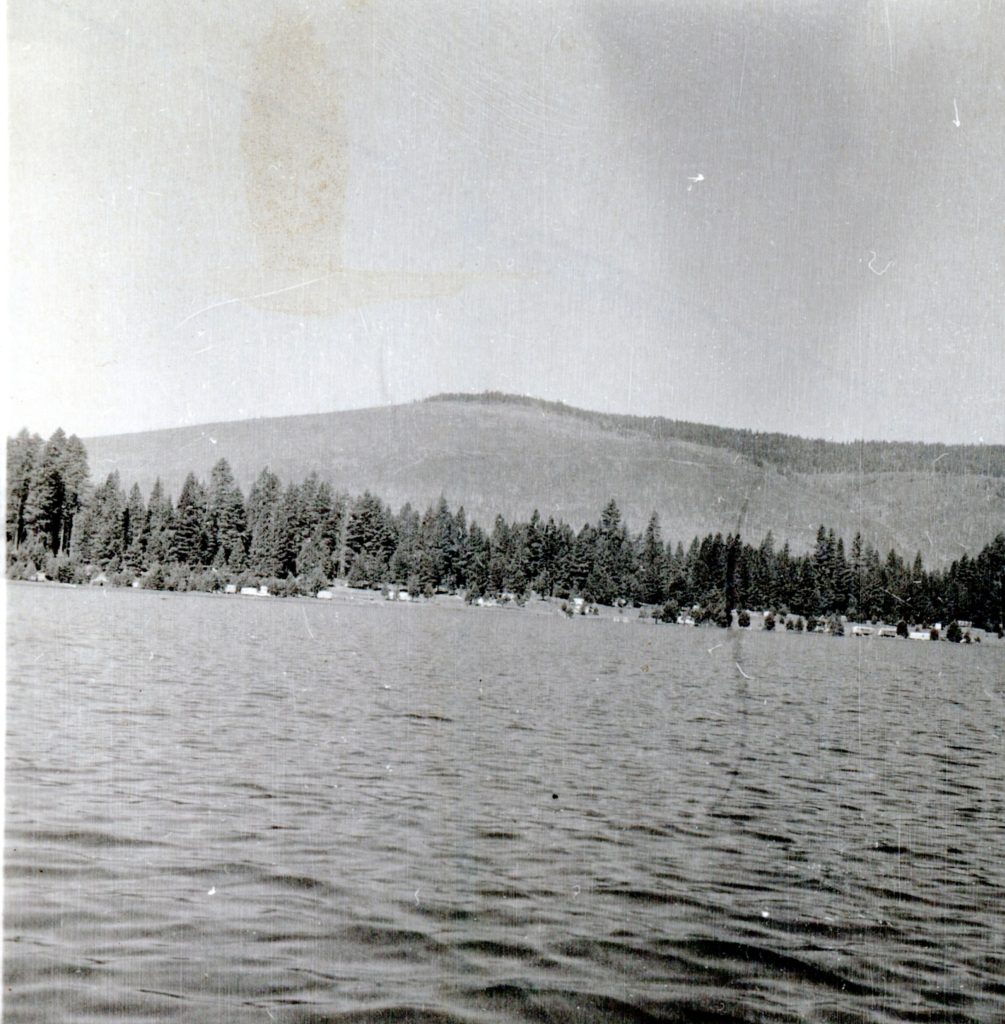
A early 1960s view from the lake of the Circus Grounds. Note the aftermath of the Merrill Fire in the background.
Located at the southwest corner of the lake, was an informal campground known as the Circus Grounds. During the early 1920s the big three lumber companies held a summer water carnival at Sunkist Lodge. The event drew thousands and this location became the overflow for campers. In the early 1960s, the forest service developed three campgrounds at the south shore—Aspen Grove, Eagle and Merrill. While the Circus Grounds, located on forest service property, was allowed to continue on, it having been a popular spot with the locals since the 1920s. By the 1970s, the writing was on the wall so to speak, and forest service converted the site as today’s Christie Campground.
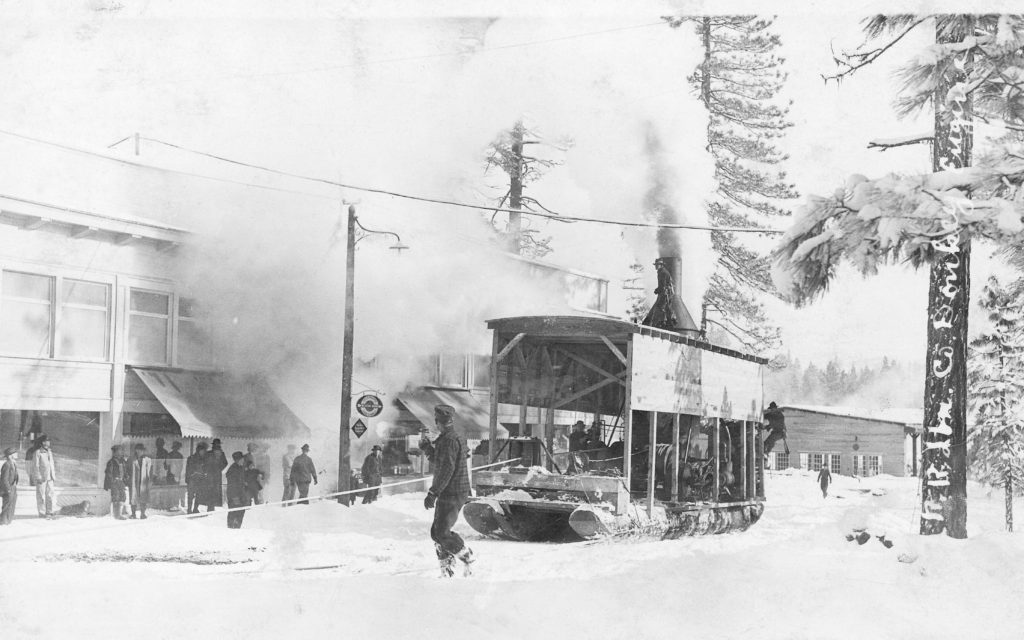
A steam donkey being pulled through Westwood, 1916.
Fletcher Walker, who was the resident manager at Westwood for the Red River Lumber Company, was an interesting individual just like the other Walker siblings. It should be duly noted, that Westwood was Fletcher’s creation and during the early years operation did not handle criticism very well—especially when it came from family members.
First of all, there would be major learning curve as to what worked in Akeley, Minnesota, and what would not work in Westwood, California. Fletcher initially wanted year-round logging in California, while other companies shut down their operations by November. It was Fletcher’s contention they would be ahead of their competitors operating winter logging operations—it would take some time for him to yield because his proposition was not only expensive, and not justifiable. However, from the late teens during the early 1920s, he demanded an early start of spring logging beginning by February and that the steam donkey’s necessary for the operations be mobilized. By the end of that decade it was no longer necessary, as motorized tractors replaced the “donkeys” and Fletcher finally succumbed the hard way that his competitors were right.
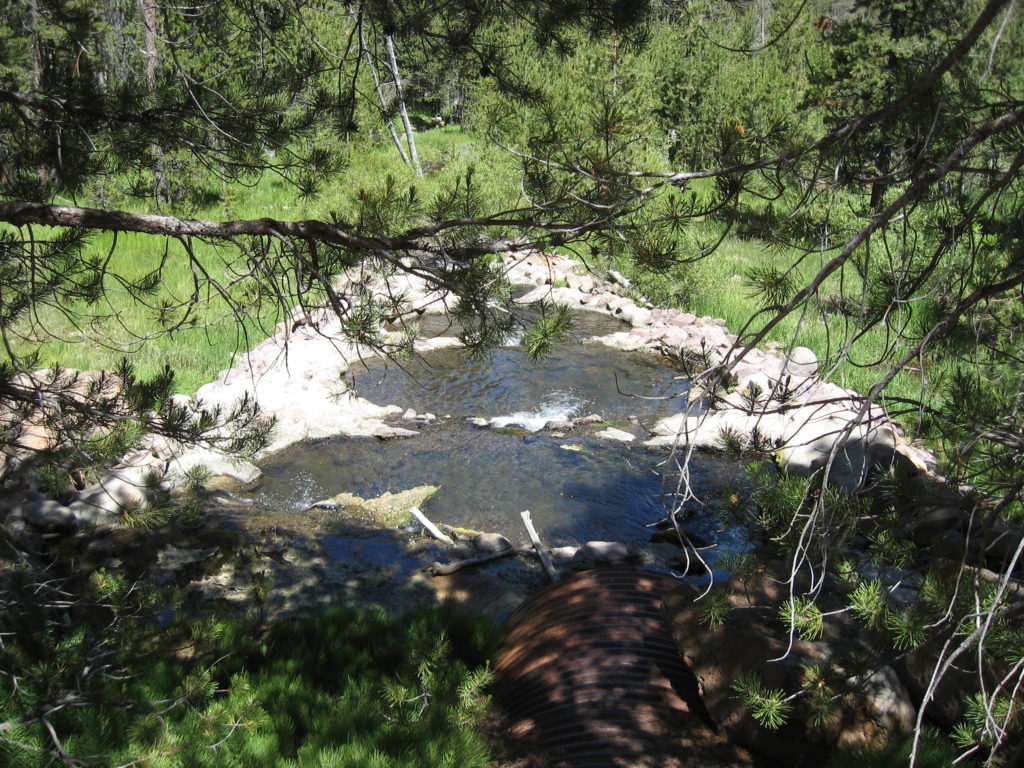
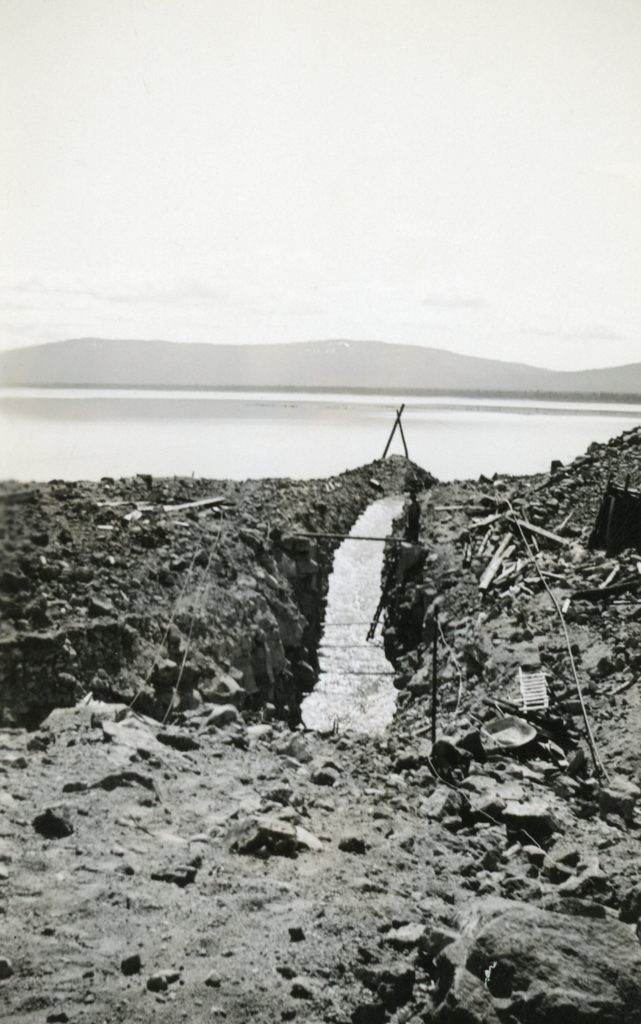
The first of many of deepening the intake to the Bly Tunnel.
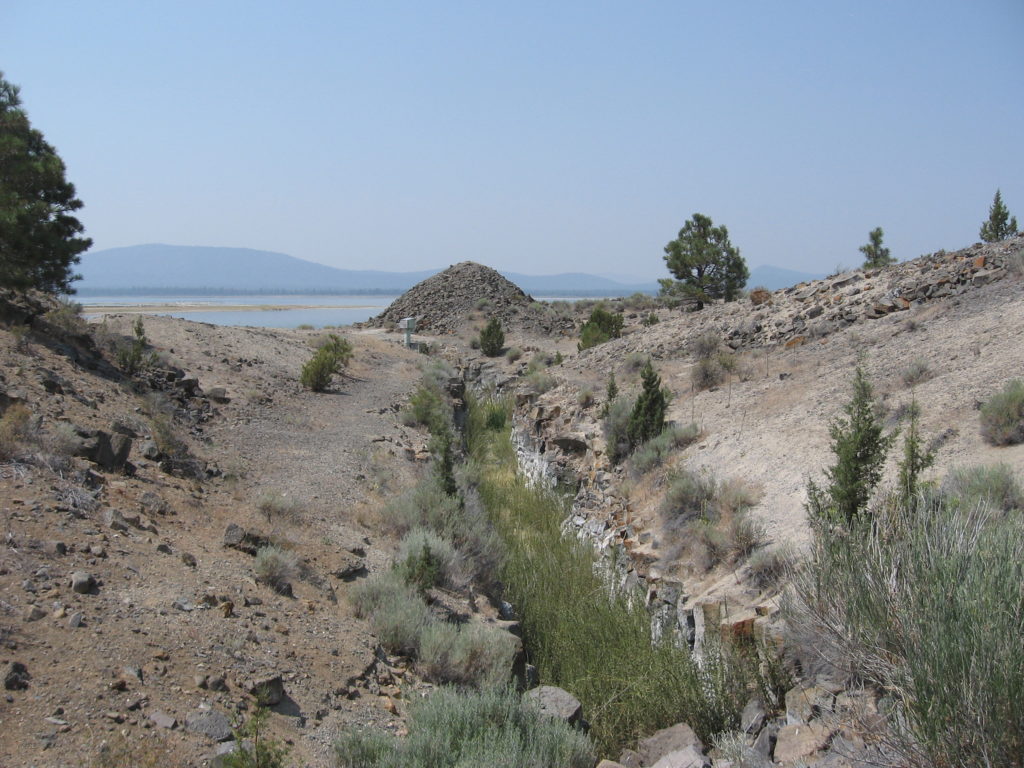
In 1928, the Tule & Baxter Creek Irrigation Districts brought in yet another engineer to examine the Bly Tunnel, with a special emphasis on the inlet channel. Of course, they did like what they were told that it would take at least $100,000 to fix the problem, and it might only extend the life of the project by ten years. The Districts continued on with annual blasting through solid rock to deepen the channel. This exercise in futility finally ended in 1935 when they conceded.
August 9, 2018
Should you ever have the opportunity, it is well worth the visit to see the inlet channel. While I took this photograph August 9, 2018, it does not do it justice of the solid rock encountered. It also means, I either need a better camera, improve my photography skills or both!
Just because one enters into a partnership with a person who has a high profile name, does not guarantee success. While Peter Lassen enjoyed name recognition, his many business ventures had a lot to be desired. In 1851, in near exile from failed pursuits, Lassen and his partner, Isadore Meyerwitz operated a trading post in Indian Valley, Plumas County.
In late June 1855, Lassen along with partners Joseph Lynch, William Gallagher and Samuel Knight began to develop a mining claim on unamed creek in the Honey Lake Valley, to be later known as Lassen Creek. Work would come to a halt, when the water flow from the creek became too low for work to continue. The four men returned to Indian Valley. Lassen was not going to give up. That fall, along with Meyerwitz and Lynch, with plenty of provisions in hand returned to establish a camp at their claim and to spend the winter. A log cabin 10 feet by 12 feet was constructed a half mile or so west of the large ponderosa pine tree. it (The cabin was later enlarged to 16’ x50’). Three other men would join them—Marion Lawrence, John Duchene and Newton Hamilton. The following year some of men sought other claims. Even Lynch had settled on claim along Parker Creek south of Janesville, but eventually returned back to the cabin.
After Lassen’s death in 1859, his estate sold Lassen’s Ranch where he was buried to David Titherington. It did not include the property where the cabin was located and Lynch laid claim to that property. In 1880, Lynch secured a 160-acre federal land patent to that property.
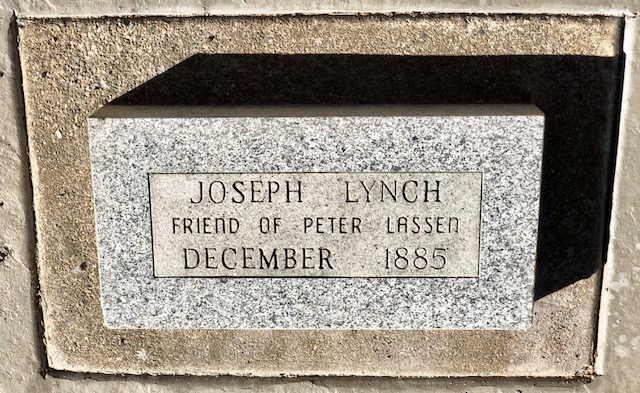
As if he knew his day of reckoning was at hand, at the age of 73, Lynch sold his 160-acre homestead to W.P.Hall on October 20, 1885 for $1,000 with the provision to a life estate to the property. Lynch died that December. In 1896, Peter Vogt who had purchased the property from Hall, burned down the dilapidated cabin that Lassen, Lynch with other comrades had constructed in the fall of 1855.
Over the last couple of days a pogonip had been trying to form over the region. So far we have had two of three contributing factors. High pressure over the region forcing a persistent cloud cover to near the valley floor, and some fog. A true pogonip is when the fog freezes coating everything with ice crystals. The name is from the Native American community when translated means white death, due to the number of Indians who would contract pneumonia from this weather condition.
There are varying types of pogonips. The most common form is when the high pressure holds down the cloud inversion. Thus, in many instances, one only has to travel a few hundred feet above the valley floor to bask in the sunshine. The pogonip season usually runs through December and January. The longest recorded duration, locally, lasted for six weeks in the winter of 1859-60.
On a final note, the National Weather Service states that there is a weak storm front headed our way today. There should be enough winds to break up the inversion, and may be we will see a little sun shine in the afternoon.
In 1914, when Lassen County and T.A. Ramsey did a land exchange wherein the County obtained thirty acres on Richmond Road and Ramsey the County Hospital property at the end of Miller Road. The County went ahead with initial plan to build a new hospital. The County was also in need of another cemetery, as the Susanville Cemetery was running out of plots. It was the County’s original intention to establish a new cemetery on what would later become the Roosevelt School property.