Many may not be aware that truck and railroad logging worked in tandem. Just like transition from horse logging to motorized tractors would take time, it was the same with trucks to be incorporated into logging operations. One of the benefits was trucks could access terrain to difficult for railroad operations. To get the most mileage for buck was the reload station. Trucks were used to log difficult terrain and then instead of driving all the way to mill, the destination was to the railroad’s reload station. The trucks were unloaded, then the logs reloaded onto railroad flat cars, thus an economical way to move volume of logs from the woods to the mill.
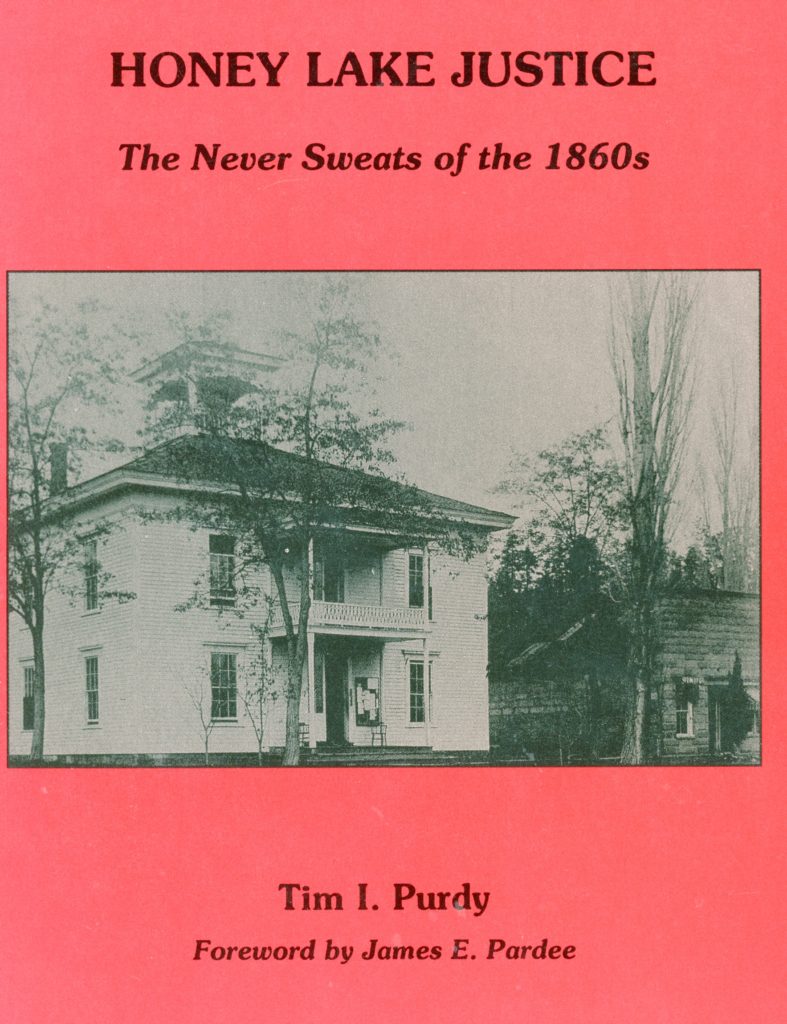
This was the third book I wrote, published in 1993. It was something, I had forgotten about, until this summer when I met Vicki Pardee who was on an adventure in this area back in June. She is not directly related to the Susanville Pardee’s she is still intrigued to say the least. While I would go on to write some twenty books, this is the only with a foreword. I asked Jim Pardee, not only a local attorney, a friend, but also the senior member of the bar. In addition, his grandfather Julien Pardee and father James “Gus” Pardee were also attorneys.
This is what Jim wrote: “We live in age of excess—and on occasion it is good to have these pointed out, directly or indirectly, so that we can endeavor to do better the next time around. I am sure that Mr. Purdy didn’t intend to preach or point the finger. However, when you read his book and are brought to realize that people brought suit to recover $63.65 for a month’s lodging, $51.50 for back wages, and finally a ar bill for 23 drinks at 25 cents a drink for a total of $5.75; we can’t help but reason that inflation in today’s market has gone mad.
”The foregoing preliminary observation is not the main theme of Mr. Purdy’s book. With a broad sweep of his brush, he chronicles the working of the Lassen Justice Court from its inception. He reminds us that the Justice Court was the people’s court; the judges were laymen, and many of the early practitioners had questionable legal backgrounds. However, by and large, justice was done.
”As senior member of the Lassen County Bar and a practitioner in Lassen County for forty-four years, I have observed the court and the personnel change from a laymen Justice of the Peace to a lawyer Justice Court Judge.
”Mr. Purdy’s endeavors cover only a limited space in time. It leaves the reader asking for more. Hopefully, there will be a sequel reaching well into the Twentieth Century.”
Note: I do have some copies of this slim volume available. It is not enough to warrant a listing on the book feature page. If anyone wants one it is $10 includes shipping. One way to pay is go to the subscribe page and go to donate. Or for those who have an aversion of buying online, just email me your address, and I will send it to you on the honor system.
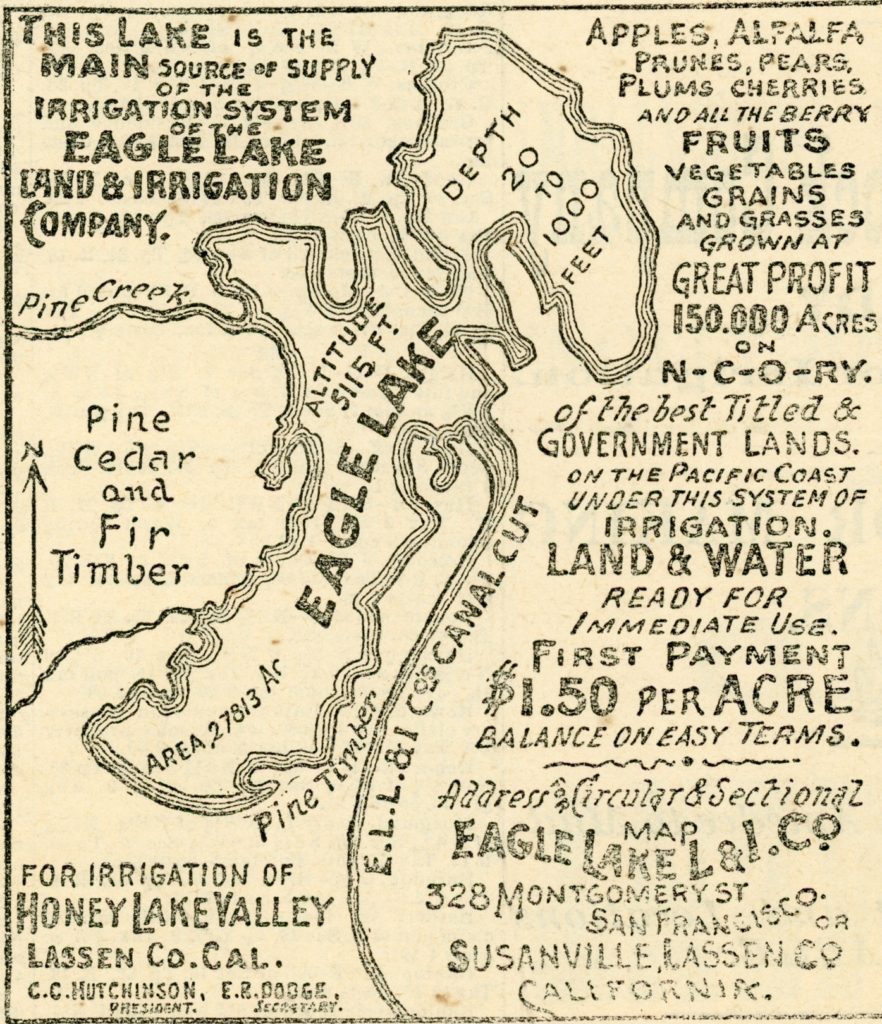
A portion of an 1892 advertisement for the Eagle Lake Land & Irrigation Company
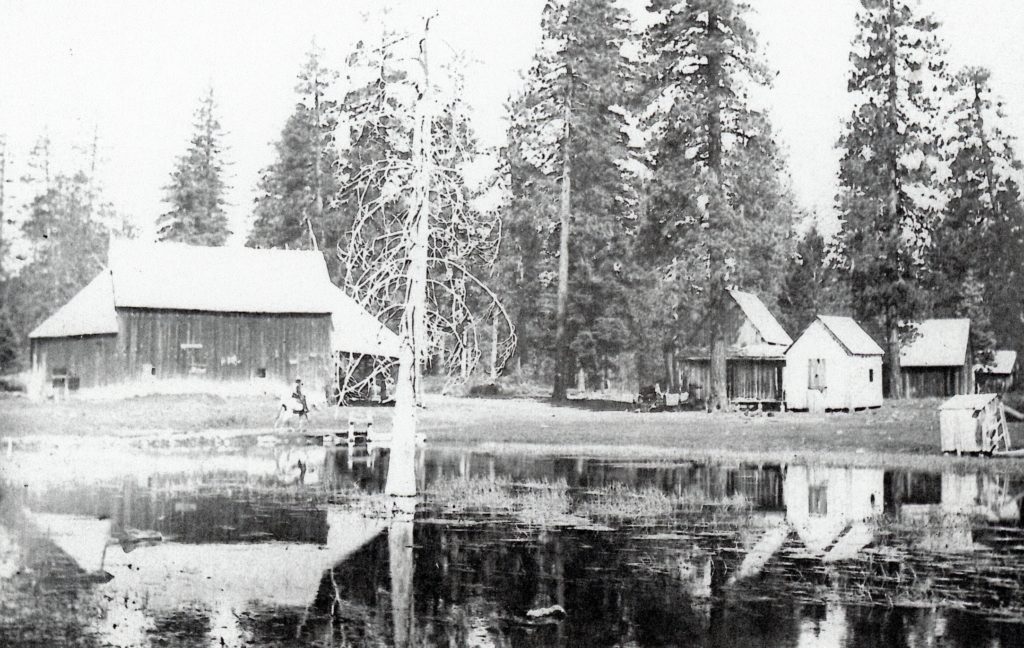
In 1891, the Eagle Lake Land & Irrigation Company was organized to resurrect Merrill’s Eagle Lake enterprise. They had a two-prong approach. The first was to install a pumping plant at the lake, along with the needed canal system stretching all the way to Amedee in eastern Honey Lake Valley. Once put in place, they would receive revenue from the sale of water that in turn could be used to complete the tunnel construction. Oddly enough, the company would start work on the tunnel from the lake side, whereas Merrill’s tunnel was on the Willow Creek side, but that work did not begin until the fall of 1892, after the pumping plant was installed and in working order.
Eagle Lake Land & Irrigation Company’s inlet channel at Eagle Lake, 1916.
By the spring of 1892, work was well under way. While waiting for their order the machinery of the pumping, there was another essential element ditches needed to distribute the water. Like Merrill’s plan, Willow Creek would provide the main conduit to deliver the water to the Honey Lake Valley. From the pumping plant to Merrill’s tunnel and the headwaters of Willow Creek would require two miles of ditches—there remains some interesting rock work. From Belfast to the other side of Amedee a twenty-one mile ditch was constructed.
In early June 1892, some twenty-one tons of equipment for the pumping plant arrived by rail at Amedee. The company had purchased a Hooker Hydraulic pump. The 80-horsepower boiler had the capacity to move 60,000 gallons of water per-minute.
On September 15, 1892, the moment of truth had arrived when the pump first tested. By October water from Eagle Lake was flowing all the way to Amedee. This was a tremendous achievement and proving to the naysayers it could be done.
Eagle Lake Ditch, near Amedee, February 2018.
Four months later in February, everything would come to a crashing halt with the Financial Panic of 1893. There are some historians who believe that this far worse than the Great Depression of the 1930s. Whatever the case may be, it was the beginning of the end of the Eagle Lake Land & Irrigation Company, who would never see if their was project would be successful. Heavily in debt, numerous lawsuits filed by creditors left the company bankrupt. The pumping plant remained idle, and portions were slowly hauled away. The last was a six-ton boiler brought to the Wilson sawmill in Susanville in 1904. However, today the crumbling cement foundations still remain.
When Lassen Volcanic National Park was established in 1916, some of its most notable features—Supan Sulfur Works, Drakesbad and Juniper Lake—were privately owned. It would take nearly four decades to acquire these properties. It made the park rangers job very difficult when those owners did something that went against park policy, yet there was nothing they could do.
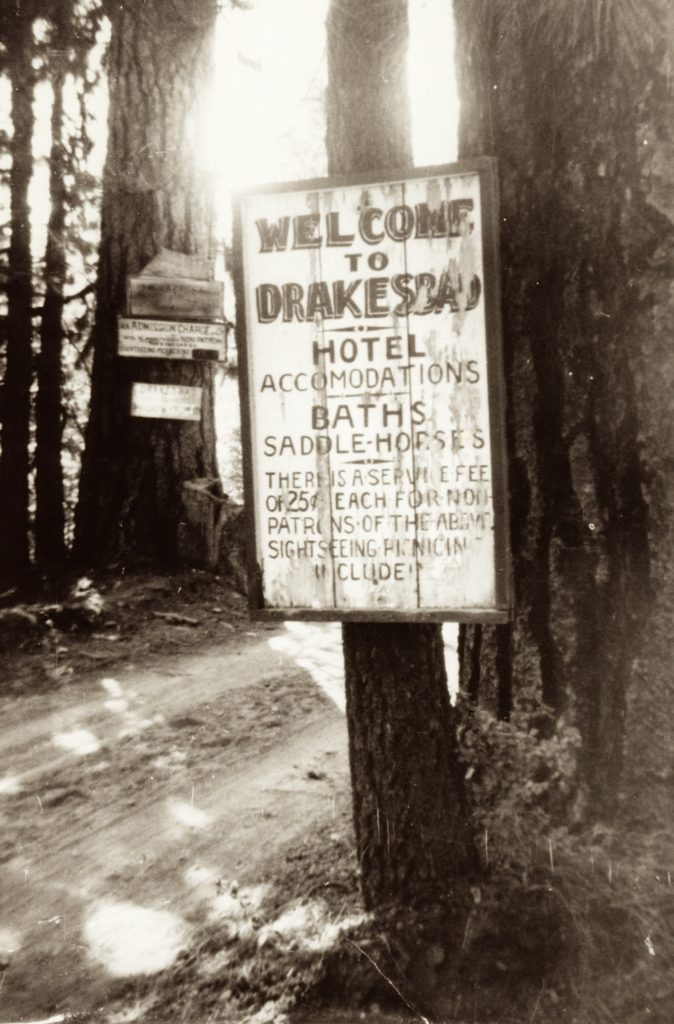
In 1923, the Sifford family owners of Drakesbad began charging a twenty-five cent access fee to non-guests who visited the property. After all they owned such features as Boiling Springs Lake and Devils Kitchen. In addition, the park had not developed a road into the park, making Drakesbad one of the easiest places to access Lassen Peak. This generated numerous complaints for the park to contend with. As Roy Sifford later recalled, it was a bargain, since for this nominal amount one could gain access to the park, without having to pay the standard park entrance fee. The admission fee remained in place until 1952, when Sifford’s leased Drakesbad.
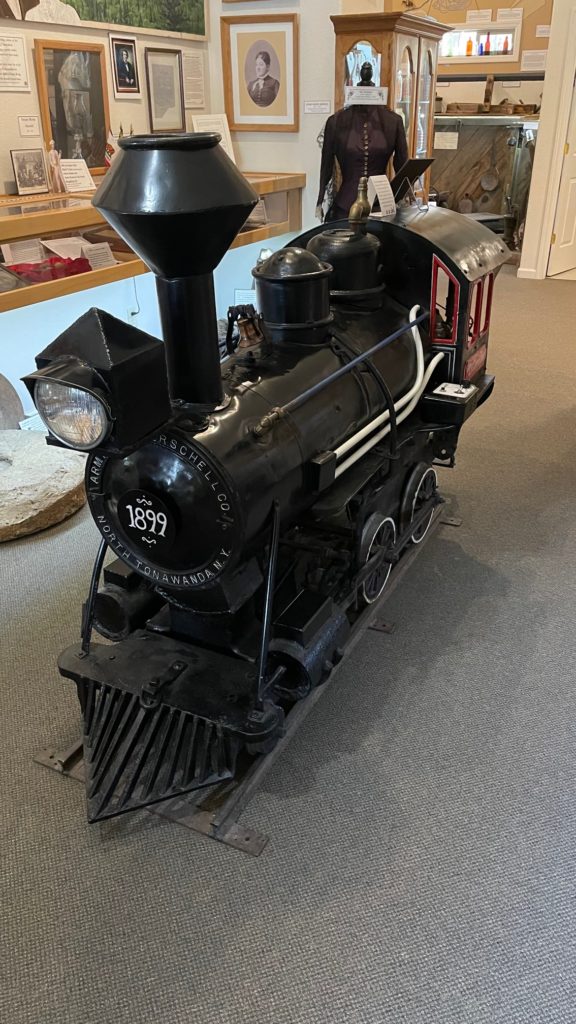
The little locomotive on display at the Lassen Museum, August 26, 2021–Jim Chapman
In the spring of 1957, the Susanville Elementary Parent Teacher Association (PTA) announced big plans for that summer’s Carnival to be held in Susanville’s Memorial Park. It was a bold concept and to make a permanent addition to the park—a Kiddie’s Train. Charlie Weston and large group of volunteers were in charge. They built a replica of a New York Central steam engine.
On. Friday evening, July 12, 1957 was the PTA’s Carnival. While there was an assortment of activities such rides on Shetland ponies, the train was the star attraction. Over 1,000 people rode the train. It was a busy night since the train could only carry 16 to 20 passengers at a time.
For the remainder of the summer, rides were offered on the evenings of Wednesday, Saturday and Sunday. Though on Sunday afternoon’s rides were also offered. The price ten cents a ride.
At this time, I do not know how long it operated, though I would say probably about eight years. If anyone happens to know that answer or has other information they would like to share, it would be greatly appreciated.
Susanville’s founder, Isaac Roop, happened to be the town’s first realtor. In 1861 he began selling town plots, though it was not until 1863, when Roop hired E.R. Nichols survey the initial town.
Roop, as the old saying phrase goes, did a “land office business” as a real estate agent. During his eight years that there are records for, he sold 194 lots for a grand total $34,143.50. A nice tidy sum, especially considering Roop never owned the land.
When a U.S. Government Land Office was opened in Susanville in 1871, it was discovered that Roop had never taken the proper procedures to procure title to the townsite. Thus, owners of town lots were vulnerable to claim jumpers, who could file a patent process with the Government Land Office and become the rightful owner of the town. It literally took an act of the U.S. Congress to rectify the situation and on May 20, 1872, Congress approved a townsite and vested title in all lots to the District Court Judge. The judge then had the task to reissue deeds to the current owners to the town lots.
Fredonyer’s Claim to what would become Susanville, which he filed in 1857 and can be found in Book A. Mining Claims, Lassen County.
Once upon a time, to leave Fall River Mills to head west to the Sacramento Valley, one travelled over Winters Toll Road through the Pit River Canyon. The toll road was built in the 1870s by Frederick Knoch and his brother-in-law, Deidrick Murcken for $3,000. In 1930, the route was abandoned when Highway 299 was constructed. I understand now that this is popular with whitewater kayakers. I never been to Pit River Falls, though it is part of my family’s heritage, since Knoch, was my great-great-grandfather.
In the past we have explored the topic of control burnsby the Red River Lumber Company. With the fire situation at hand, this is going to be discussed widely across the West.
First a bit of background. Clinton Walker, a member of the family owned Minnesota based Red River Lumber Company came to California in 1899 to examine timberland as part of a westward expansion. By 1908, the Company had acquired nearly 800,000 acres of timberland primarily in Lassen, Plumas, Shasta and Siskiyou Counties. Long before the Company cut down a single tree, it had been conducting light/control burns throughout its holdings.
In the spring of 1912, Clinton Walker had planned to do a control burn at Clear Creek, Lassen County. He invited both state and federal foresters to observe. Coert DuBois of the U.S. Forest Service led the call to inform Walker to cease and desist and not do it. Walker ignored their pleas and it went ahead as schedule. He did invite those foresters to attend and they reluctantly showed up. They documented the event by taking notes and photographs (would that be a treasure to locate). Dubois who had been critical of the Walkers and their methods, routinely wrote opinion pieces in the west coast newspapers. He did a 360 degree, and complimented Walker on his systematic light burning approach.
Things changed quickly. The following year, Clinton Walker left Red River over a dispute with the family about its operations. Thus, the light and control burns were suspended. Twenty years later, Clinton would return. At that he time lamented about the neglect of their forests and wrote: “I have never been able to understand why, when we had successfully proven the feasibility of the work of control burns and its advantages, that we discontinued it. In this regard I think we committed a grevious error that has already caused us staggering losses and now have our forest in a very precarious condition.”
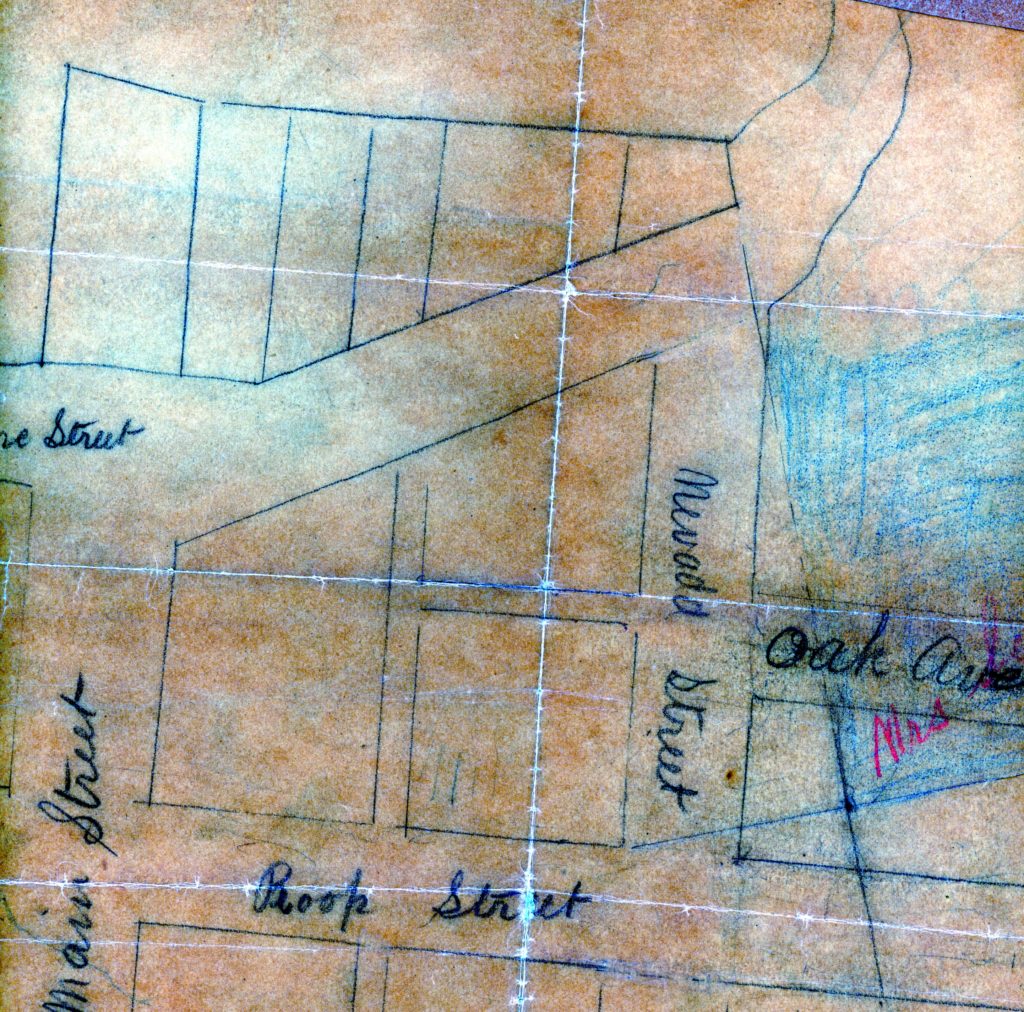
This was one of the original streets of Susanville, and an interesting one at that. Oak Avenue was located between North Pine and North Roop Streets. It started at Nevada Street and extended beyond Willow Street. It should be noted, North Roop Street ended at Willow Street. However, Oak Avenue only extended forty feet from Nevada, due to the fact there was no right-of-way. In December 1882, a petition by the residents of the area, requested the Lassen County Board of Supervisors to abandon Oak Avenue. The board obliged and so no more Oak Avenue on paper.
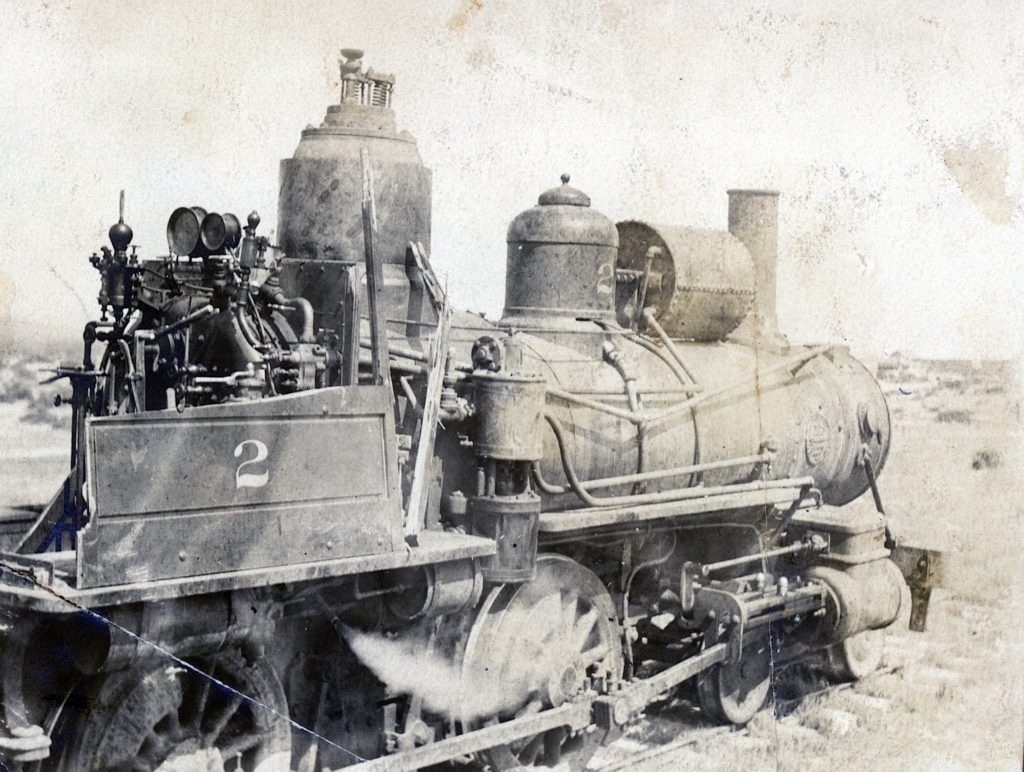
While I periodically write about the Nevada-California-Oregon Railroad (NCO) that went from Reno, Nevada to Lakeview, Oregon, there are times a bit of refresher is needed for those just tuned it. First it should be noted, it was a narrow gauge railroad, so its rolling stock is much small than the traditional standard gauge railroad that most people are familiar with. From the NCO’s inception in 1879, it went through a lot of changes in its early years. First and foremost, it was known as the Nevada & Oregon Railroad. During its early evolution there were changes in ownership and direction. Whatever the case may be, it was not official until 1893 when it became the Nevada-California-Oregon Railroad.
Now, to the other topic at hand. In 1884, the Nevada & Oregon purchased its No 2 Baldwin locomotive new for $4,750. According to David Myrick’s NCO railroad locomotive roster the No. 2 was retired on December 31, 1918—presumably scrapped.