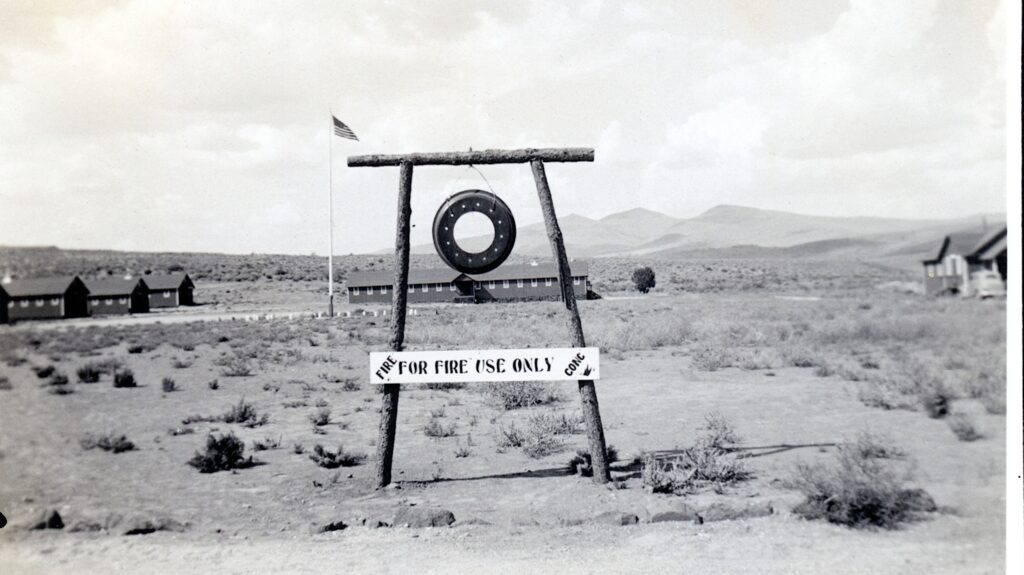
The Fire Gong at the Secret Valley CCC Camp—-C.H. Bennett Collection
There was a fire gong at the Secret Valley CCC camp. This is new territory for me and until I saw this photograph, I did not even know a fire gong existed. Fires, at that time, were not that common in eastern Lassen County, so it probably did not receive that much use. If anyone can shed more light on the fire gong, it would be welcomed.
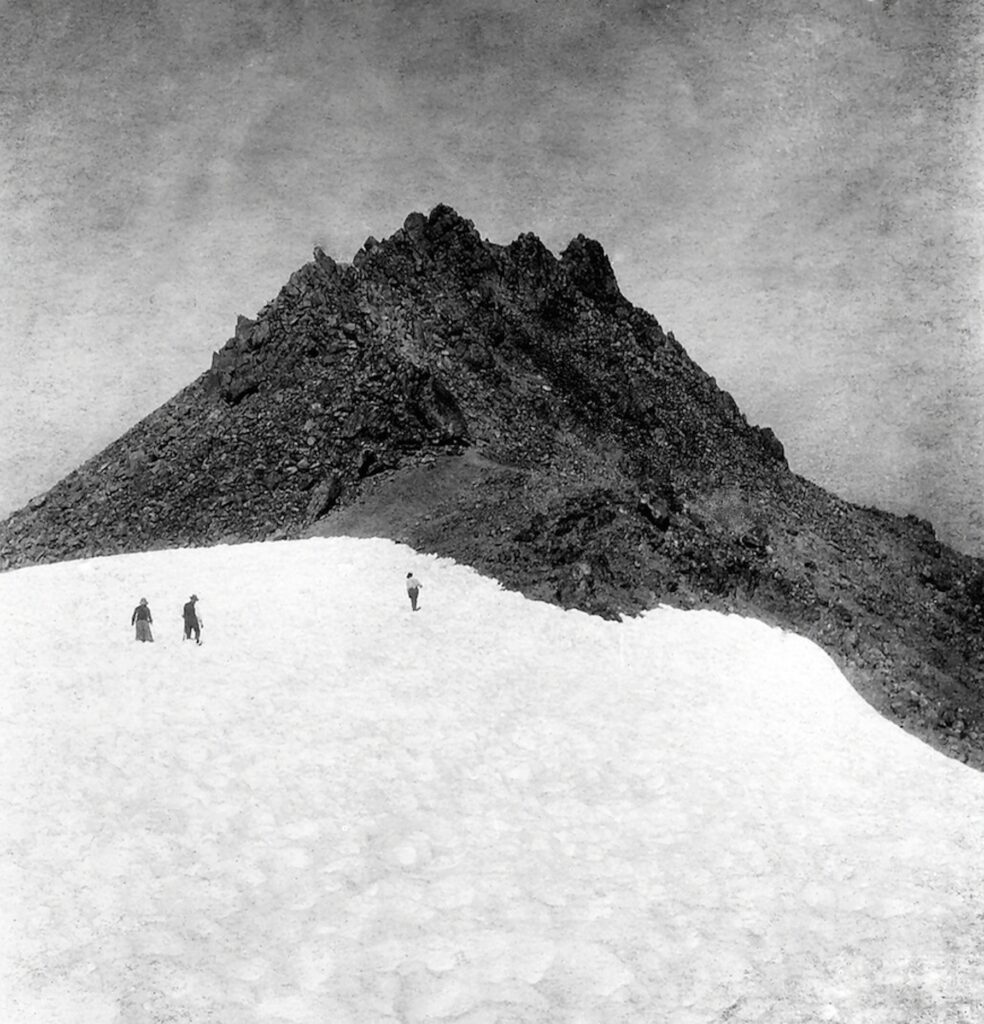
For those who have hiked to the top of Lassen Peak, it can be a spectacular view. Personally, however, the first time I made the ascent it was disappointing. This was, and showing my age, was in the fall when they used to burn the rice fields in the Sacramento Valley, so when I made that initial ascent there was layer of brown smoke over the Sacramento Valley. Enough of that.
Who the first Anglo to climb Lassen Peak, we may never know. There is a dispute. However, we do know that in the summer of 1851, a prospecting party of ten men headed north from Onion Valley, Plumas County, in search of another fabled gold tale, the “lone cabin mine.” Once they reached Big Meadows (now Lake Almanor), they decided to forge ahead and climb Lassen Peak—-possibly the first to do so. One of those men, Grover K. Godfrey, a twenty-six year old New Yorker, observed from his vantage point at the top, “The sight is unrivaled in beauty and magnificence. It is like the vision of some dream land. I fancied I could see all the kingdoms of this world at one glance.”
The next group to climb the peak did so on official business. In the fall of 1863, as part of the geological reconnaissance survey of Northern California, Josiah D. Whitney of the California State Geological Survey sent four men to conduct field work—William H. Brewer, Clarence King, James T. Gardiner and Richard Cotter. It took the party two attempts to climb the mountain. On September 26, when King reached the summit, the wind was so fierce that he had to retreat. Beside the wind, another problem was encountered in the form of cloudy weather that obscured the view. This condition would not allow the men to make observations of lava flows and other remnants of volcanic activity. The windy weather brought snow, so they had to wait a few extra days to make the second attempt.
On September 29, at 1 a.m. with the aid of moonlight they began their second climb. King was again the first to reach the summit. The four men watched the sun rise from their perch. Brewer, like Godfrey, was in awe of the view. Years later he exclaimed, “Although I have often reached greater altitudes, that days stand out in my memory as one of the most impressive in my life.”
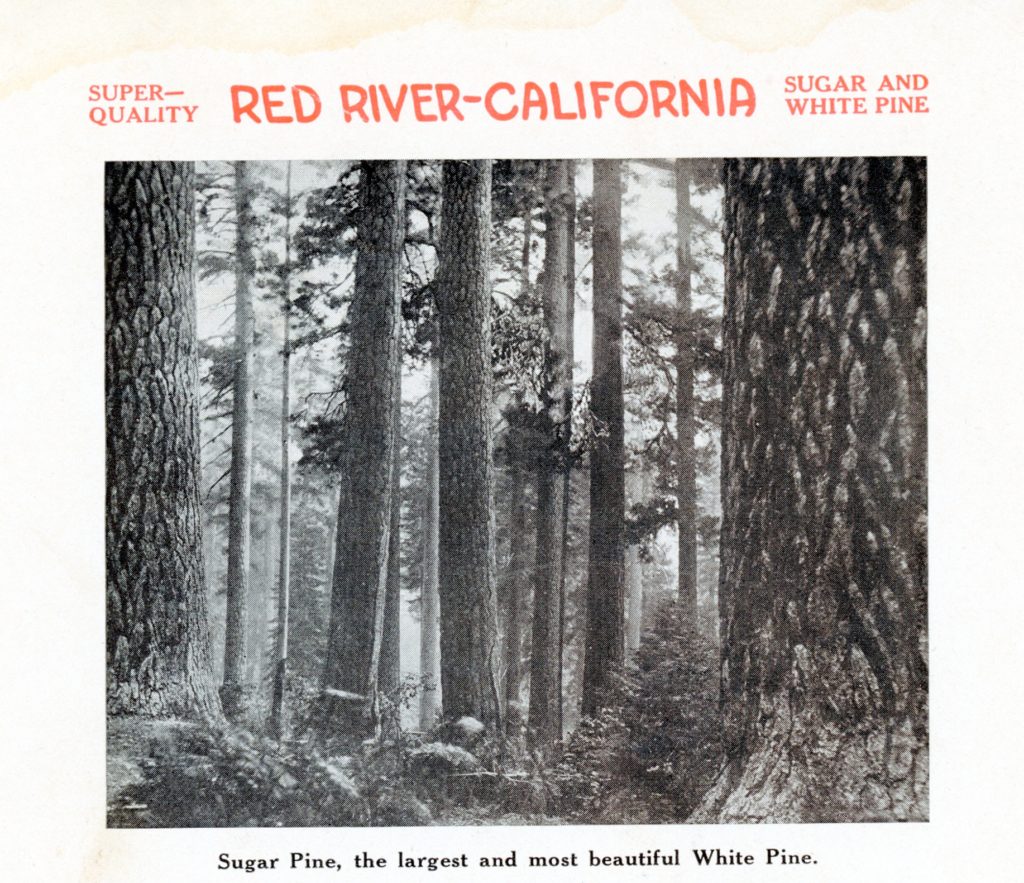
An early promotional brochure of the Red River Lumber Company
The sugar pine was highly sought by lumbermen, and especially for the manufacture of wooden boxes. The pine is noted for its straight grain and another feature was manufacture into lumber has no odor. The latter was desired by fruit and vegetable growers.
The sugar pine was so named for its surgary pitch. Noted naturalist, John Muir wrote: “The sugar, from which the common name is derived, is to my taste the best of sweets, better than maple sugar. It exudes from the heartwood, where wounds have been made, either by forest fires or the ax, in the shape. of irregular, crisp, candy-like kernels, which are crowded together in masses of considerable size, like cluster of resin beads . . . Indians are fond of it, but on account of its laxative properties only small quantities may be eaten.”
In the fall of 1915, Robert Strahorn brought new life to the project. Strahorn had a reputation for developing these type of projects. One of the biggest changes was the line would start at Flanigan, Nevada, on the eastern edge of the Honey Lake Valley and its terminus at Cedarville, California. By the spring of 1916, it appeared real progress had been made with right-of-ways secured from the Department of Interior and many of the landowners. In addition, it was announced that Lakeview, Oregon would be the new terminus. For those familiar with the country the railroad now had the daunting task to to cross the Warner Mountains at Fandango Pass. First a grandiose three-mile tunnel was proposed, but was reduced to a 4,820-foot tunnel, which still alleviated 700 difference from the top of the summit. Continue reading Surprise Valley Railway, Part II→
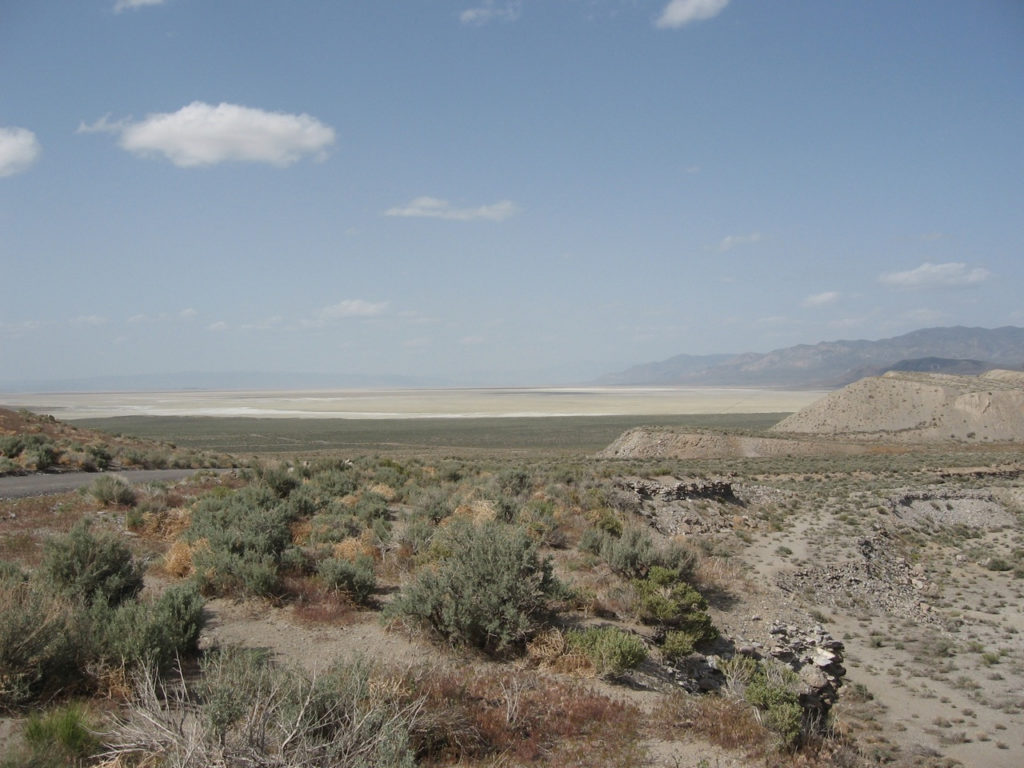
Sand Pass, Washoe County, Nevada, looking north at the Smoke Creek Desert, 2008.
In 1903, the Western Pacific Railway was incorporated with its main goal to build a 810 mile line from the San Francisco Bay Area to Salt Lake City. They were successful in one aspect. On November 1, 1909, the last spike was driven on Western Pacific’s line at Spanish Creek Bridge near Quincy, California. When the railroad was incorporated, it proposed to build twelve branch lines. These “feeder” lines were extremely important to generate rail traffic, which would provide necessary revenue for the fledging railroad. One of these proposed lines called for a Surprise Valley Railway
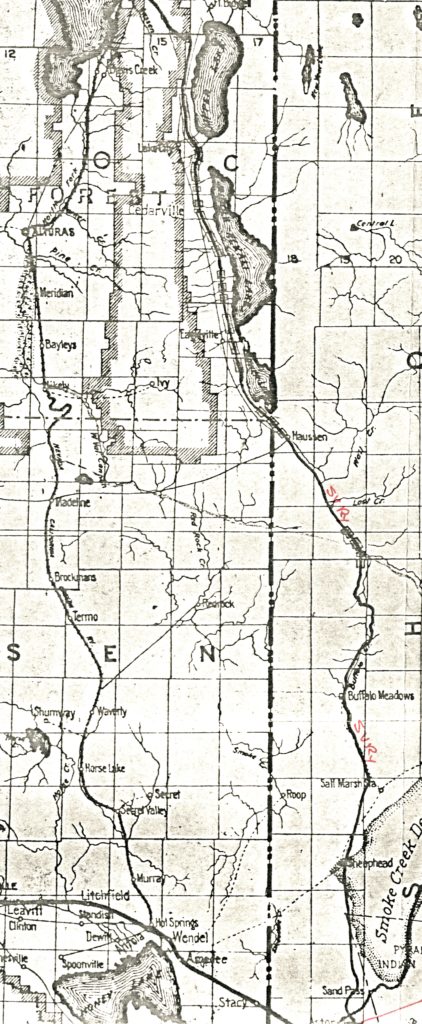
In April 1912, the Western Pacific did a reconnaissance survey for the initial line. The starting point was at its Reynard Station on the east side of the Smoke Creek Desert. The record is not clear if the line would traverse across the Smoke Creek Desert to the west side. From the Buffalo Salt Works on Smoke Creek’s west side, the line went in a northerly direction through Buffalo Meadows, onward to Duck Lake Valley and into Surprise Valley. It is interesting to note this was the same route from Buffalo Salt Works to Surprise Valley, that the military used inthe late 1800s as a supply route to Fort Bidwell, at the far north end of Surprise Valley.
In the summer of 1913, there was a lot speculation when it was announced that the Surprise Valley Railway incorporated in the state of Oregon. It was duly noted that the intended goal was raise $800,000 through the sell of stock. In March 1914, it was revealed that J.E. Sexton of the Eureka and Nevada Railroad was ready to construct the a narrow gauge railroad line for the Western Pacific from Smoke Creek to Surprise Valley. As the months passed by, all was quiet with the project.
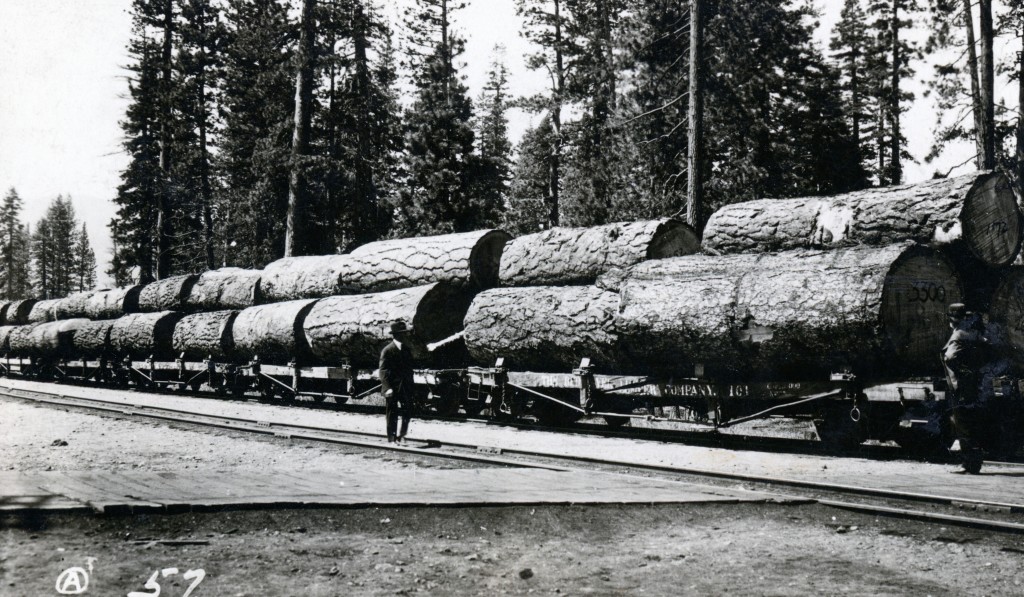
Train load of logs leaving Camp B, FGS Company,1923—Dick & Helen Harrison
For lumber companies back in the day, taking photographic scenes to show case premium logs and/of forest scenes served an unusual purpose that the casual observer would not be aware of. The photographs were used in portfolios to show bondholders, investors and other stakeholders what they were getting for their money.
This particular photograph is very revealing. These are Fruit Growers logs on Red River flat cars. When both Fruit Growers and Red River established their mills, they made agreement with the Southern Pacific Railroad to provide them with rail cars to transport the logs to the mill, saving the companies an expense. Red River found out the hard way that Southern Pacific was not always reliable and eventually purchased their own cars to care of those situation. In this particular instance, Red River was being a good neighbor to Fruit Growers and came to their aid to lend them some cars.
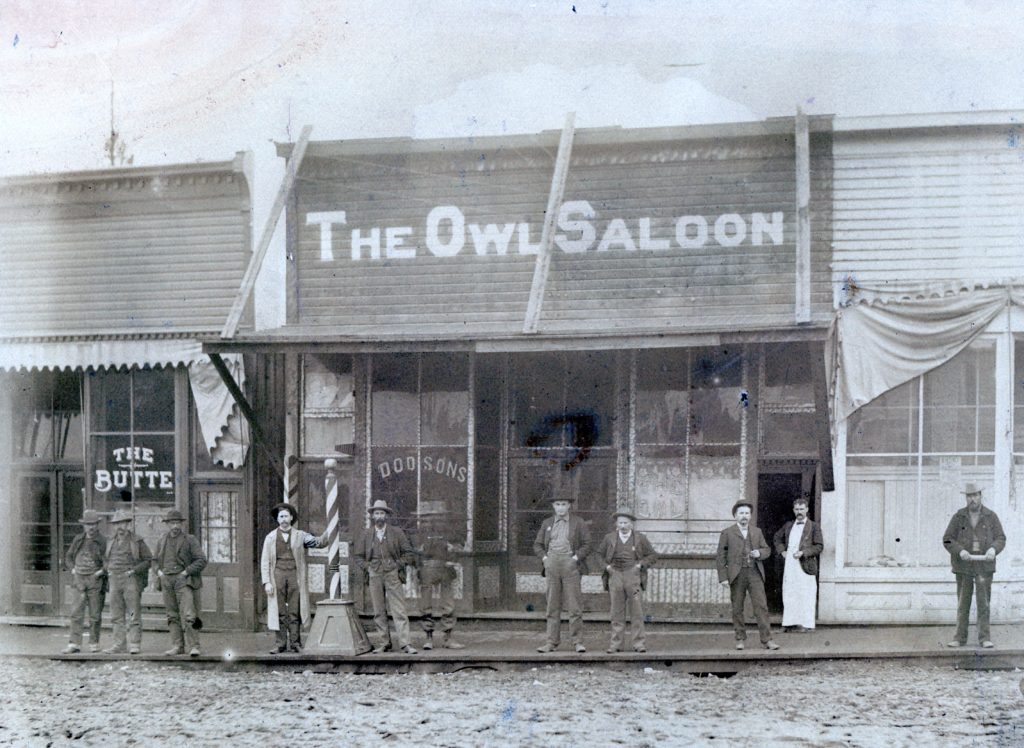
Susanville’s Owl Saloon circa 1907. Ironically, this establishment burned down only six weeks after Prohibition took effect in 1919. Courtesy of Del & Diane Poole
When Susanville was incorporated as a city in 1900, it had one glaring problem—it had no funding mechanism in place. During the debate whether to incorporate, proponents made it clear there would be no property tax. It was their belief that the City could operate on revenues generated from business license fees, especially the lucrative fees set by the state on saloons. Lassen County still collected the liquor license fees on the five saloons in Susanville. The County fathers were not going to give up this money without a fight, and they did.
It was a messy legal battle. It would force the City to impose a property tax assessment until the liquor license issue was resolved. In August 1903, the City imposed a tax levy of 40 cents per $100 assessed value.Of course, there were critics and even talks of disincorporation.
Relief would soon arrive. On August 25, 1904, the California Supreme Court ruled in Susanville v Zimmerman, et al that the town’s saloon owners had to pay the license fees to the City.
Today, I am suffering from some kind of mental block, as I am unable to pick a topic to write about. It happens from time to time. After all, this month, has witnessed a milestone of 3,000 posts since this website originated back in 2015. That is a lot material covered. So, I am taking a brief break today.
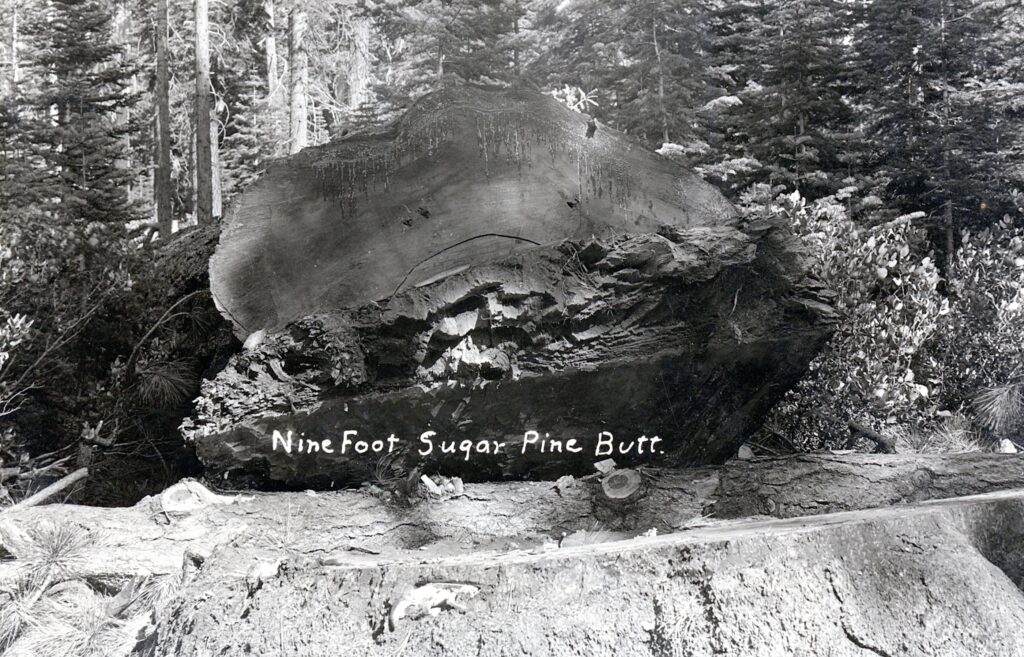
P.J. Thompson who was a professional photographer in Susanville from 1912-1920 did exceptional work. This postcard, today’s featured photograph, of an nine-foot sugar pine butt was not his best. We all have our moments. Hopefully, Labor Day Weekend will give me some inspiration.
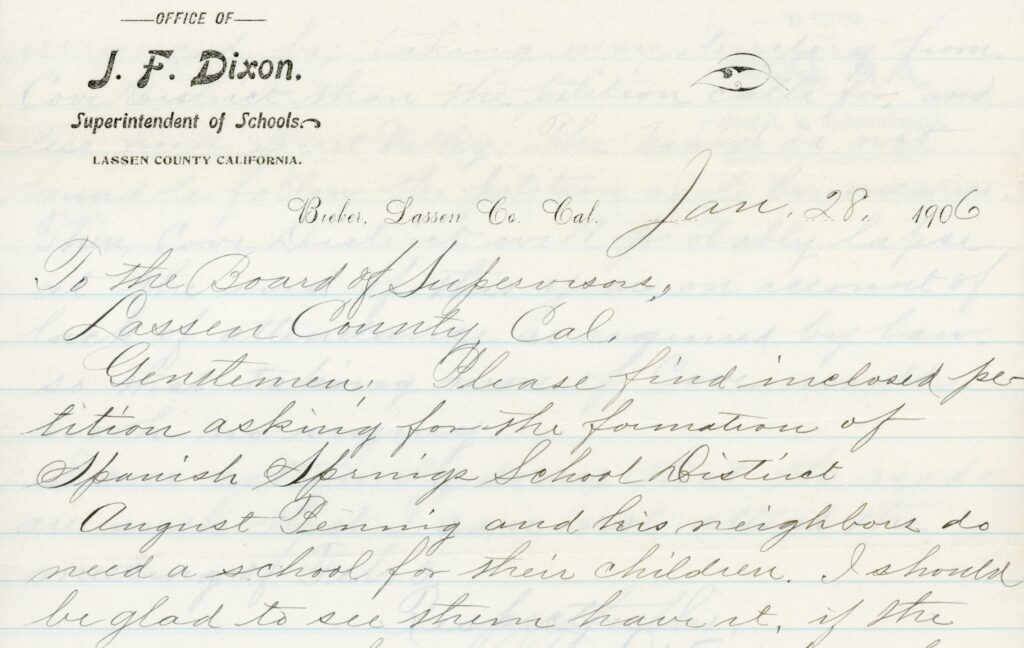
A portion of Superintendent of Schools letter for consideration.
There were only a handful of proposed rural schools in Lassen County that were never approved. Spanish Springs School District was one of them.
On January 28, 1906, Lassen County Superintendent of Schools, J.F. Dixon, received a petition from August Penning requesting the formation of a school district, to be named Spanish Springs.. Penning stated he and his neighbors were too far removed from
the nearest schools at Cove in the eastern portion of the Madeline Plains and Secret Valley to the south. Dixon was concerned about the proposed boundaries, for it could jeopardize the enrollment
populations of the Cove and Secret schools. On the other hand, Dixon requested that the Board of Supervisors to consider Penning’s petition carefully, for he felt that the Spanish Springs residents would benefit from having a school. At the March 5, 1906 meeting, the Board of Supervisors declined to consider the petition, stating it was received too late. No attempt was made by residents press the issue any further.
Spanish Springs is a locale in the southwestern corner of the Madeline Plains. Folklore has it that it was named for a Spaniard who was the first person to locate there, but subsequently abandoned his claim. On April 5, 1875, J. O. Conard filed the first claim to the springs. In the mid-1880s, August Penning located on Conard’s abandoned claim and operated a stage station there during the late 1800s through the early 1900s. In 1893, Penning was granted a liquor license to operate a saloon with one provisin no more than one quart of distilled spirits to any person. On November 17, 1941, the Pennig family sold their Spanish Springs Ranch to John Sugadi for $11,000.
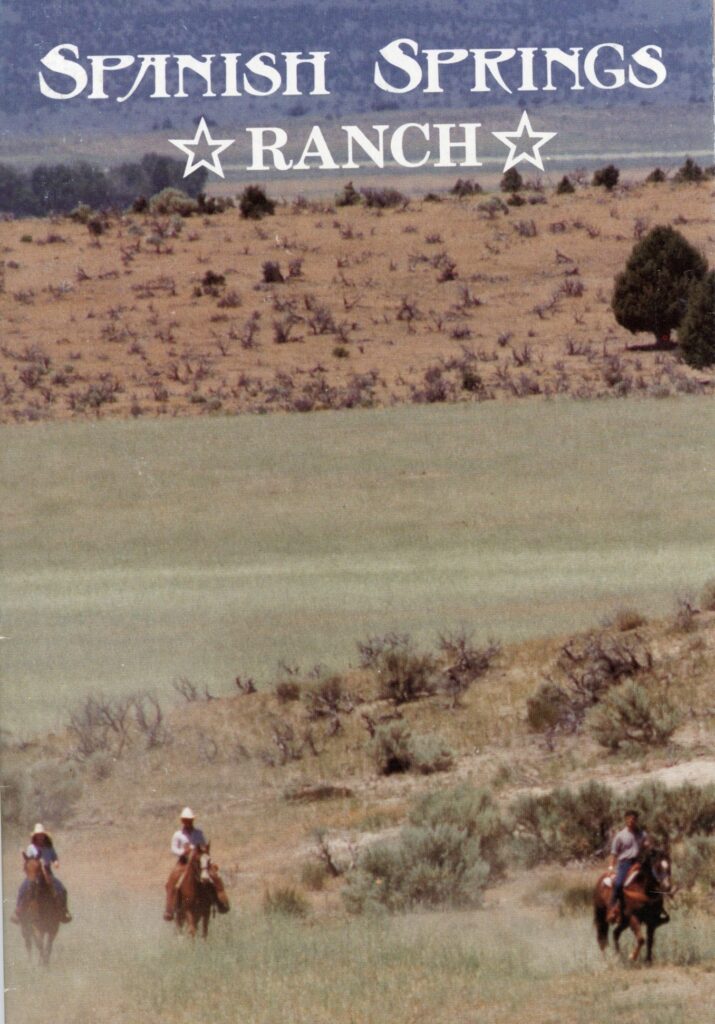
It was in 1989. when R.C. Roberts established the Spanish Springs Guest Ranch, that for a time put the area on the map. They offered spring and fall cattle drives for their guests to take part, though to partake was not cheap. The facilities and accommodations were not shabby either. My last dining experience there was in June 2004, with Franklin Dill (Lassen High Class of 1933). It was another year or two when the 3,500 acre ranch was auctioned off, but the guest ranch portion was never resurrected.
This is one of those instances where I have been derelict in duties to chronicle the history of Robert’s enterprise. However, those who had business dealings with Roberts, it was not always a pleasant affair. In 2000, I felt the ire, when the Roberts Estate wanted to hire me to do extensive water right research, but I had to decline for his advisory the John J. Casey Estate had already retained my services. Enough said, but the Casey Estate was prompt on payments for my services.