It was on March 20,1987, the nurses at Lassen Community Hospital, then affiliated with St. Mary’s reached an agreement ending the eight week strike. Stephanie Kruse representing St. Mary’s stated, “Everhting went very well. It is over.” While union spokeswoman, Noreen Frieling added, “The ink is on the paper. It’s done.”
The Portola Depot. Notice the rails had been recently laid, no ballast.
The Feather River Rail Society will be holding a Western Pacific Convention celebrating the 75th Anniversary of the California Zephyr. It is scheduled for April 11-14 at the Feather Falls Casino and Lodge at Oroville. Some of the featured items are Historic and Modeling Clinics, as well as Archive and Photo Exhibits. For more information visit http://Wplives.org
In October there will be a Southern Pacific Historical Convention to be held in Sparks, Nevada. I will provide more information on that event when it becomes available.
The north shore of Eagle Lake, 1920, where Udell proposed to build a dam. Courtesy of Lola L. Tanner
In 1910, San Francisco attorney Alva Udell came up with a novel approach to tap Eagle Lake without the aid of a tunnel. Udell proposed to tap the lake at the north end, only a mile from then Troxel’s residence (better known to many as Stones). The intention was to build a dam on the lake and a canal leading over to the Willow Creek springs. This route, it should be noted, is the lowest division separating Eagle Lake from the headwaters of Willow Creek. Continue reading Eagle Lake – The Udell Project→
Main Street, Susanville, 1885. Courtesy of Betty Barry Deal
This is what the L.M. McKinney Lassen County directory had to say about Susanville in 1885:
The county seat of Lassen county, is situated about one hundred and fifty miles northeast from Sacramento, and ninety- five miles northwest from Reno, Nevada. The location itself is a peculiarly attractive one, lying as it does just at the base of the Sierra Nevadas, where the mountains give way abruptly to a comparatively level plateau and an unobstructed view over thirty miles is obtained, including almost the entire expanse of the Susan River Valley. The river itself rises in the mountains west of the town, flows past on the south side, thence in a southeasterly direction to its mouth, some twenty-five miles distant where it empties into Honey Lake. For about half of this distance (that part adjacent to Susanville) the land is thickly settled; small farms, well built and attractive residences, and large and commodious barns and outbuildings being the rule. The remaining portion of the valley will, with irrigation, unquestionably develop as well. The United States Land Office, located at this place, shows a record of 1694 cash, 1279 final homestead and 73 final desert entries, and there still remains within the limits of this district much valuable timber lands open to claimants, as well as so rated desert land which only needs irrigation to bring it up to a standard in fertility which will compare favorably with any land of the State. Susanville has one newspaper, The Lassen Advocate, weekly, which is the official county paper. It is ably conducted by Messrs, McKinsey & Hayden, proprietors. The school facilities of the town are fully up to the times; the Methodists and Congregationalists have fine and commodious church buildings, and the organizations are well sustained. Its hotel accommodations are amply provided for in two hotels, the Johnston House, a well conducted establishment, kept by Messrs, Dowling & Myers, being worthy of special mention, and among its business interests may be specially noted the Lassen Mills, with a capacity of forty-five barrels of flour per day, which is kept constantly running. Outside communications are had by daily stage line to Reno, twenty miles of this route on the end next to Reno being by rail. Two other lines are run during seven months of the year, one to a connection with the California and Northern Railroad to Oroville, and the other to Chico, connecting at that point with rail to all parts of the State. It has a money order post office, and Wells, Fargo & Co’s Express.
The Sacred Heart Church will hold its annual St. Patrick’s Dinner this Saturday, March 16 at Monsingor Moran Hall from 4 to 7. Costs: $20 for Adults; Children 6 to 10 $15 and those under six free.
This annual event started in 1917. The menu, of course, has evolved over the years. For decades the traditional corned beef and cabbage was never served. In 1974, Father William Storan was appointed the parish priest. In 1975, he requested that corned beef and cabbage be placed on the menu and that the church would slowly phase out spaghetti and roast beef.
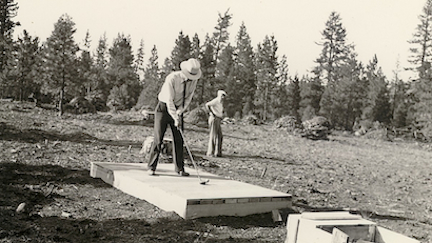
One would not normally associate the sport of golf in a community composed mainly of lumberjacks and sawmill workers like Westwood back in its hey day. However by 1920, the golfing phenomenon swept through Northern California and this lumber town was no exception.
The “divot diggers” as they were affectionaly known then took a little longer to take hold at Westwood. By the early 1920s, Susanville could boast three golf courses, albeit crude by modern day standards. Even Chester, then just a mere hamlet, had a golf course.
As early as 1921, Westwood’s golfing enthusiasts began the debate to establish a golf course. Yet, they just could not generate enough momentum to pull it off. This all changed in 1929 when Westwood’s golfing community organized a club. Those original duffers consisted of Ross Morehouse, Gene Huggins, Bob Pullman, F.W. Koerner, F.M. Jayne, Bill Corbett, Dan Taylor and C.C. Baptie. Continue reading Westwood’s Golf Course→
Its never been easy to make a living on the Madeline Plains. By1920 many a homesteader’s dream was shattered and moved elsewhere to make a living.
As the old saying does, as one door closes, another opens. This was certainly the case for the Madeline Plains. The nation’s Prohibition brought opportunities for some. For the plains, its isolated location was not a hinderance for bootleggers. Far enough away from the eyes of law enforcement, but not too far to market is major product—jackass brandy.
For one person, Ira Evans, this did not sit well for him. Evan’s owned the two-story hotel in Madeline. He had difficulty in finding managers for the facility. The last one he hired, turned out to be a notorious bootlegger. In 1929, enough was enough. Evans had the hotel dismantled. The salvaged lumber was taken to Alturas to build dormitory housing for the Pickering Lumber Company.
Red River Lumber Company operated numerous logging camps from 1913 through 1944 when it sold to Fruit Growers. The camps were assigned numbers, though in no particular order. The majority of the camps were short lived and only had a span of one to maybe three years. One of the more interesting camps was Camp 33, but referred to as Town Camp, as it was located less than a mile west of Westwood. What made it unique was that Red River’s company town of Westwood would experience from time to time a housing shortage for its employees. On occasion, this camp was used to house mill workers instead of loggers.
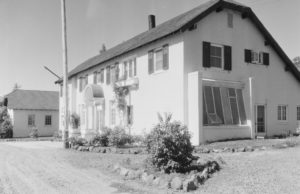
The Hall residence, 1895. Today, the location is the 1600 block of Susanville’s Main Street, the current location of Grocery Outlet.
Wright Patrick Hall is known for many things, especially that as a long serving Lassen County Clerk, and also that as the Lassen County Treasurer/Tax Collector. He first came to Susanville in 1860, and then moved to Nevada for a brief stay before returning. On May 22, 1877, he purchased 480 acres one half mile east of Susanville from Heiro K. Cornell for $700. In 1885, Hall began selling lots with Main Street frontage. In 1895, Hall hired surveyor William D. Minckler to plot 160 acres known as Halls Addition, but everyone called it Halltown. The bottom land of Piute Creek separated Halltown from Susanville. It was not until the 1920s that the two communities slowly grew together.
The Sacred Heart Church will hold its annual St. Patrick’s Dinner this Saturday, March 16 at Monsingor Moran Hall from 4 to 7. Costs: $20 for Adults; Children 6 to 10 $15 and those under six free.
This annual event started in 1917. The menu, of course, has evolved over the years. For decades the traditional corned beef and cabbage was never served. In 1974, Father William Storan was appointed the parish priest. In 1975, he requested that corned beef and cabbage be placed on the menu and that the church would slowly phase out spaghetti and roast beef.