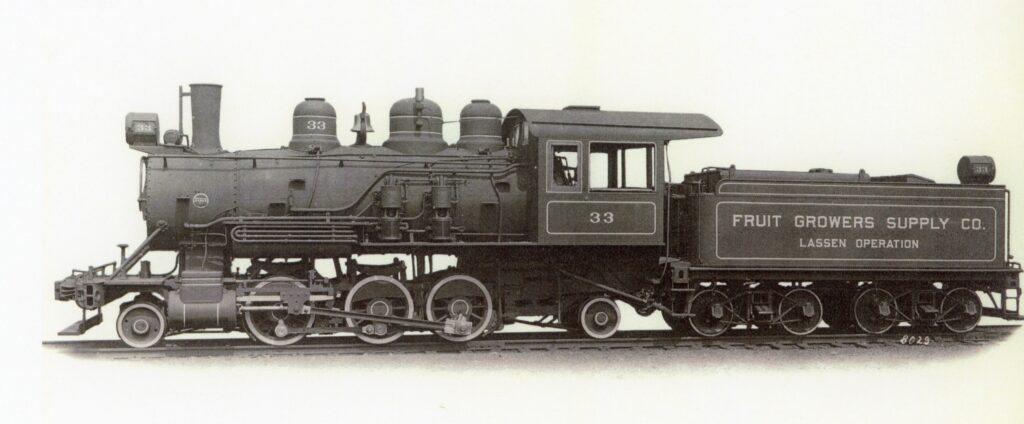
In 1921, Fruit Growers bought a new Baldwin locomotive, that was designated the No. 33. Some where the down line they changed it the No. 2. In 1952 Fruit Growers discontinued railroad logging on the Lassen (Susanville) Operation. In 1955, Fruit Growers announced the closure of Westwood Operation. In 1956, Fruit Growers sold the entire Westwood Operation to a liquidation company Wershow & Weisz. Some Fruit Growers locomotives were included and auctioned off in the fall of 1956. If No. 33 was included, that information would be in my Fruit Growers Westwood file that is in storage.
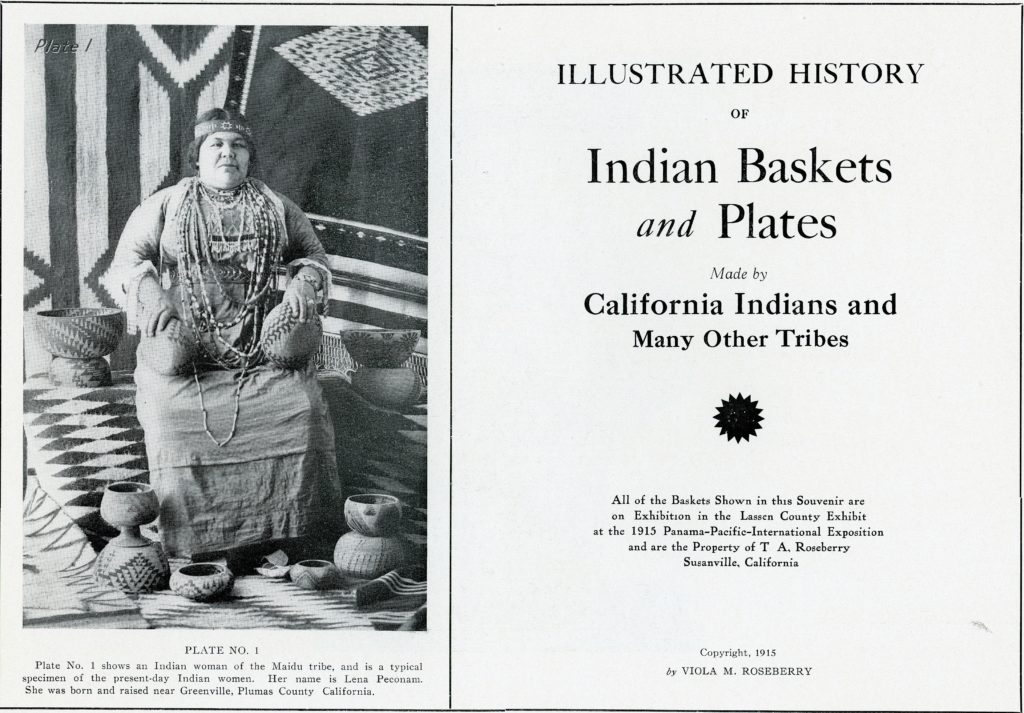
Viola Roseberry published an illustrated history of California Indian Baskets for the Exposition
Susanville resident Viola Roseberry (1860-1936) had a special fondness of Native American heritage and that of their basketry. She possessed a large basket collection. In 1915, the collection was displayed at the Panama-Pacific International Exposition held in San Francisco. To coincide with the exhibit she published a book, Illustrated History of Indian Baskets and Plates made by California Indians and Many Other Tribes. Book had a price of 50 cents.
The cover picture is of Lena Peconum who has numerous descendants in this area. Viola wrote stories behind the baskets, such as one Maidu woman Comanche, who at the time was believed to be the oldest Maidu weaver, approaching 100 years of age, and residing in Genesee Valley, Plumas County.
Many of the Indian baskets on display at the Lassen Historical Museum, 115 N. Weatherlow St., Susanville, was a part of the Roseberry Collection.
The grave of Isaac N. Roop, Susanville Cemetery, circa 1966.
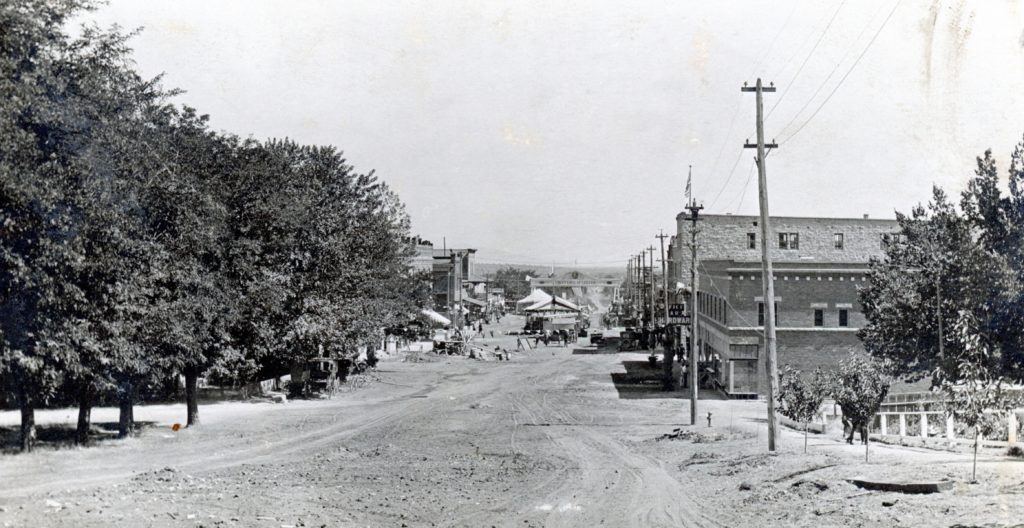
It was on Valentine’s Day 1869, that Susanville’s founder Isaac N. Roop passed away from pneumonia. He was only 47 years old. One of the unique contribution that Roop did for Susanville, does not that garner much attention. Susanville which one of the oldest communities of the western Great Basin, has an extra ordinarily wide Main Street. This was a fire prevention measure. Thus, should a fire break out, it could be contained to either the north or south sides of Main Street. It worked very well, and only time it failed during destructive fire of 1893. in which all of the business district was reduced to ashes.
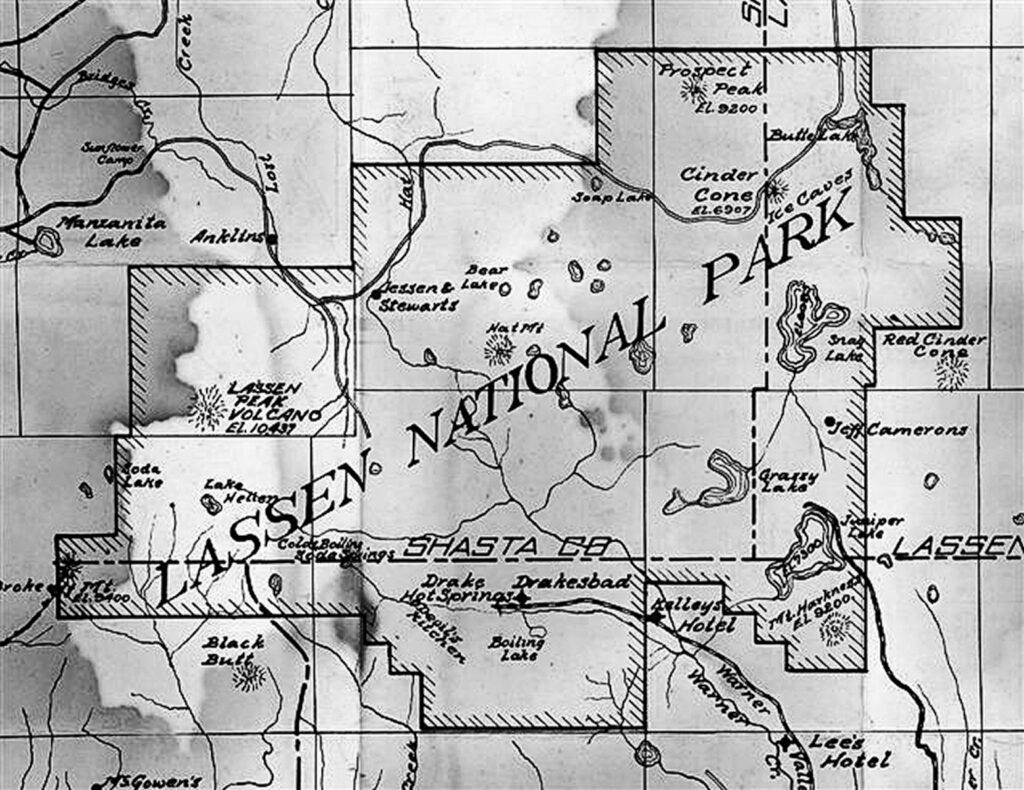
A 1919 Westwood Auto Club Map of Lassen Volcanic National Park
One of the original concepts that the national parks were to be small in size. For Lassen Volcanic National Park it was true to form, and to some extent it still is. When created in 1916, the total acreage was 80,050 acres. There is some discrepancy as the Interior Department noted that it was 79, 561 acres and that included 880 acres private inside the park’s boundary. One of most visited spots visited today at Lassen is Manzanita :ale, which was not included in the initial park.
In 1928, the Lassen Volcanic National Park Association was formed to correct the boundary issue. These were of an assorted geographical features and one historic one–Nobles Emigrant Trail. Lassen National Forest opposed the so-clled “land grab.” Park officials prevailed and on January 19, 1929 25,192 acres was added to the park. It was not until 1931 the Park purchased Manzanita Lake from Pacific Gas & Electric.
While this was good news, there were other obstacles to overcome. Some of major attractions inside the park were privately owned-Devils Kitchen/Drakesbad, Juniper Lake and Supan Sulfur Works. More on that later.
About a week ago Ken O’Connell relayed the following message, and an interesting train question at the conclusion. Hopefully, there are astute readers that can answer Ken’s question. You may contact him at oconnell@uoregon.edu. Of course, you can always share you reply here, to enlighten us.
Ken wrote; “Recently I’ve been traveling through Alturas each time to drive to Reno to see my sister who is in Care. I have a question regarding the railroad transport in the 1940s and 1950s. My father, Daniel O’Connell, worked for Southern Pacific as an electrician. He would often ride along as several engines would pull a freight train that needed electrical work in one of them. Sometimes he would stay over night at a station in town and return to our home in Oakland, CA the next day.. My mother would say, “Your father will return tomorrow as he is staying in Alturas.”
“I see the hundreds of freight cars on tracks west of town. What role did Alturas play in those years as a station on the trains from the bay area?”
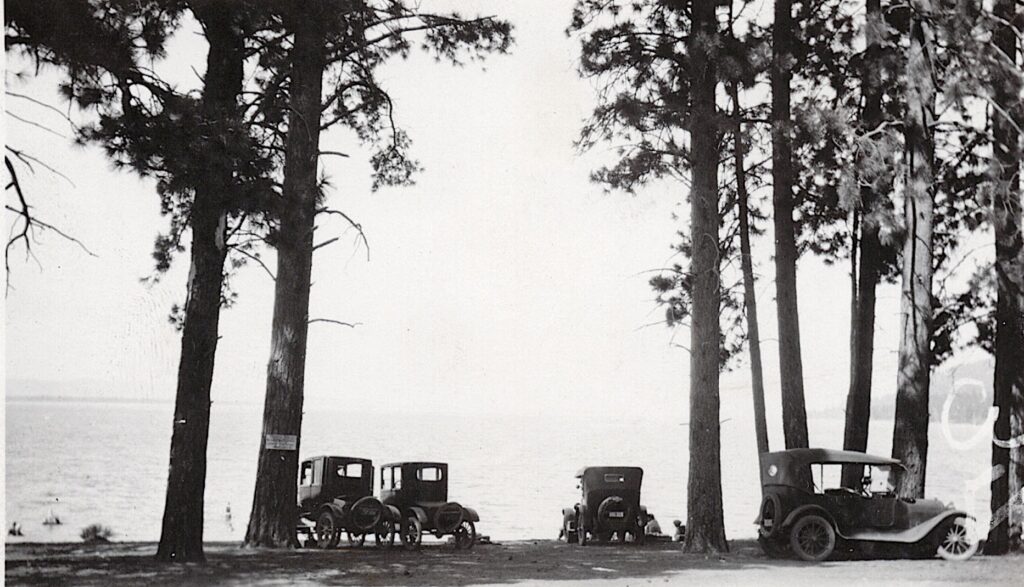
First, I happen to like this photograph taken at the south shore of Eagle Lake. Second, I do not have any knowledge about the picture. Third, in June I had a bought an Epson V39II Scanner. Last week a forced myself to use it. It has been a challenge, but slowly and surely I shall overcome the learning obstacles. Anyhow, to make a long story short, the above was the first scan.
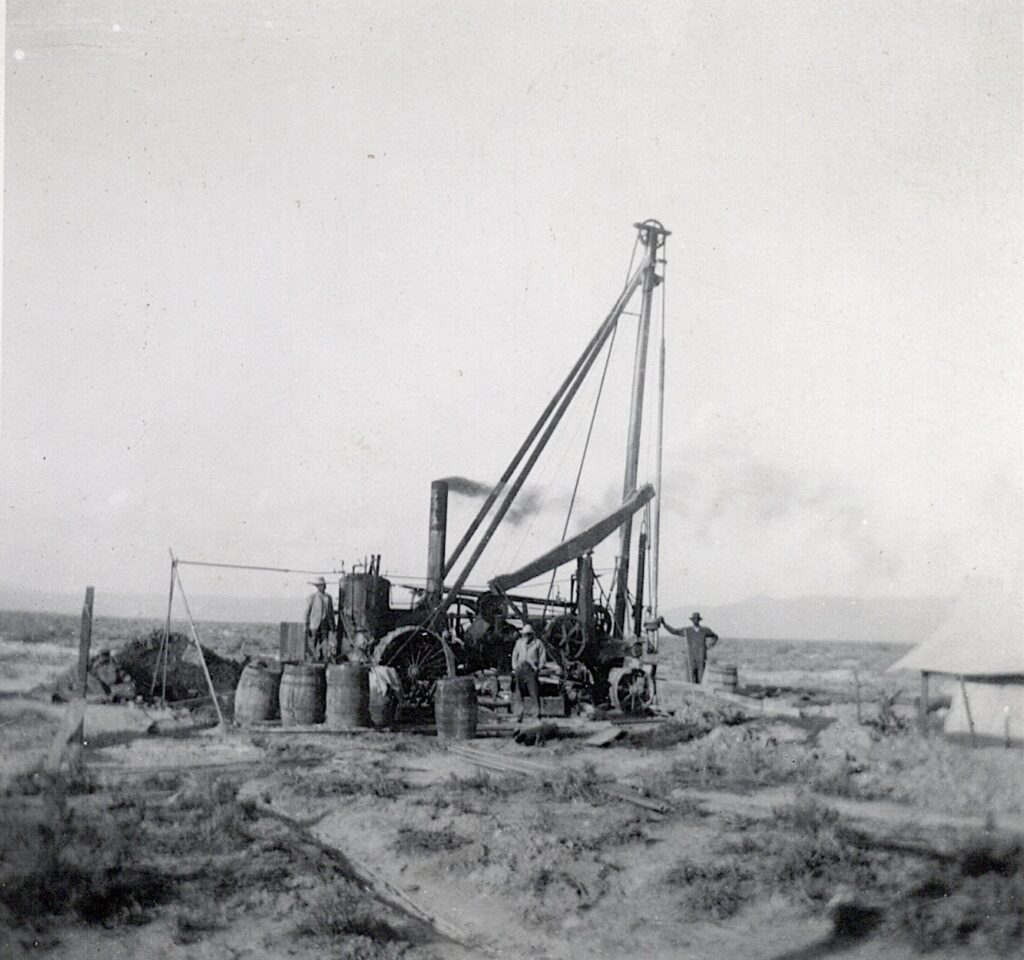
Caudle & Warden drilling a well for the Western Pacific at Calneva.-C.R. Cudle Collection
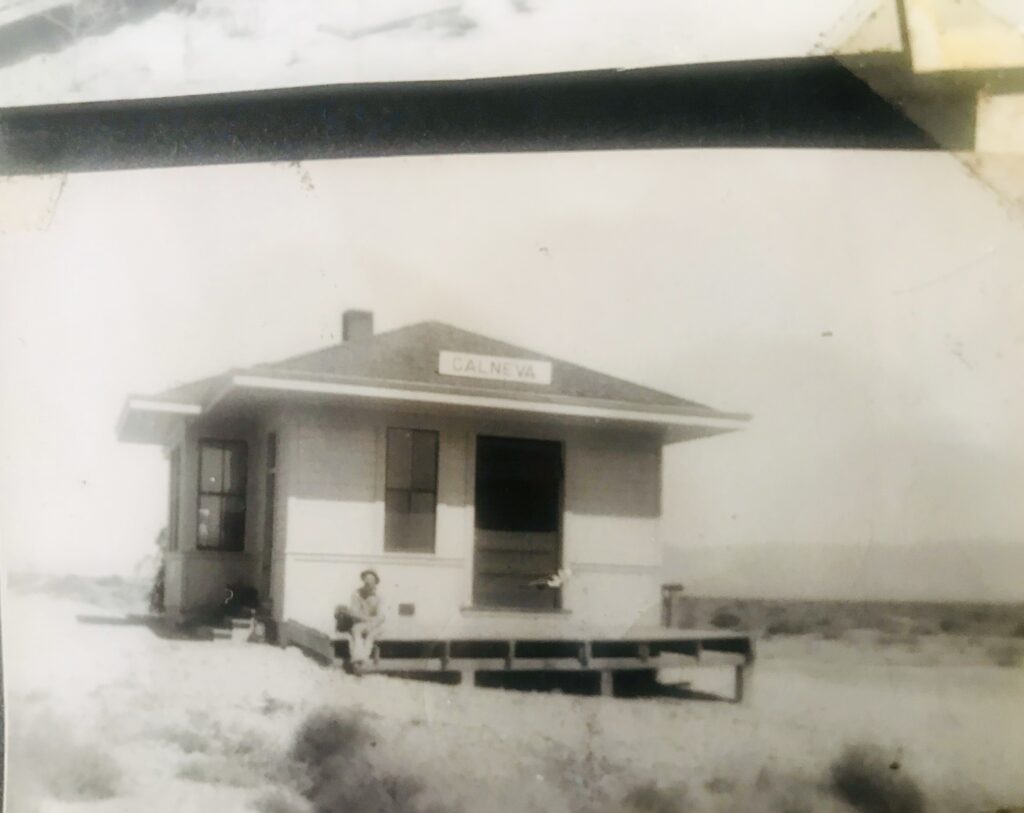
Calneva was located in the eastern Honey Lake Valley with a close proximity of the California and Nevada border, approximately six miles east of Herlong. In 1910, the Western Pacific Railroad established the Calneva Station. During the 1910s, this area experienced a great deal of homestead activity. Individuals were lured there by a promise of water from the South Lassen Irrigation District, that planned to divert water from the Little Truckee River via Long Valley Creek to irrigate the desert lands of eastern Honey Lake Valley. Those and other proposals never materialized.
Calneva Station-Courtesy of Russell Umbraco
In 1921, the Western Pacific Railroad received permission from the California Railroad Commission to abandon the station. They cited in 1920, only 61 passenger tickets were sold and freight revenue was $435.01–the station’s total profit for that year $117.27.
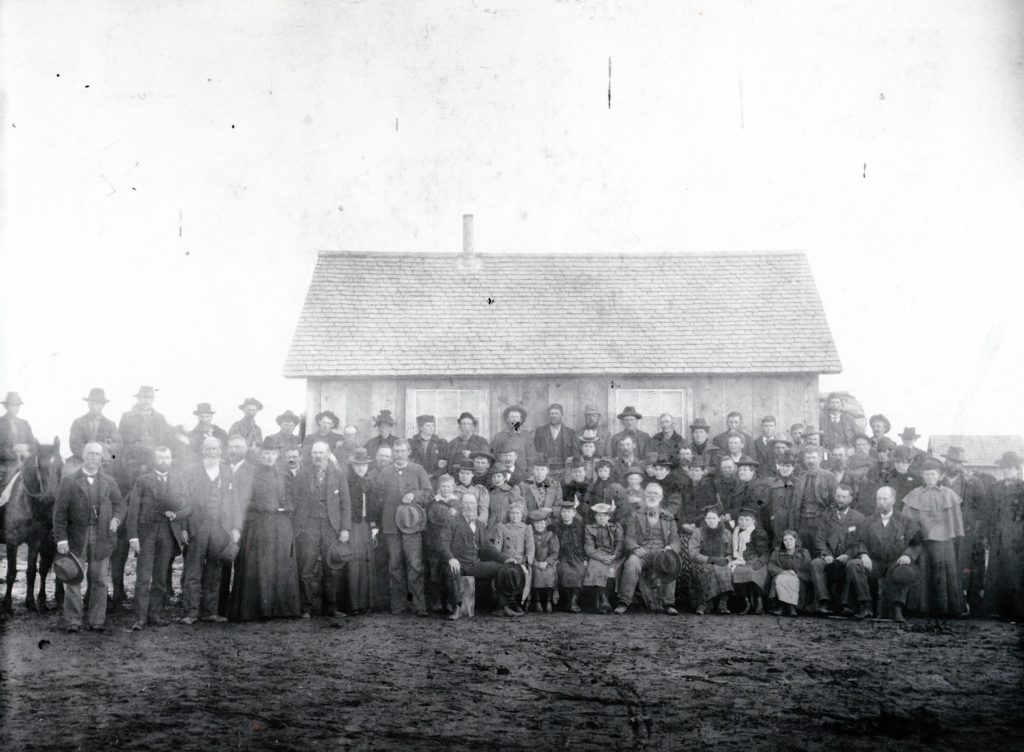
Members of the Honey Lake Valley Colonial Club assembled in front of the Honey Lake School, at Datura, 1897. Courtesy of Betty Barry Deal.
In 1898, was the groundbreaking moment for planned utopian community of Standish. Its founder, William Smythe envisioned it based on the religious beliefs of Myles Standish and economic structure promoted LDS leader Brigham Young. Smythe believed that people desired to escape the industrial cities of the East, for a more simple life in the West. Water was to needed to irrigate the land. so the Standish Colony purchased the Susan River irrigation system, which would be its downfall. The colony did entice a few New England transplants to Standish who introduced a new plant to the region, which is enjoyed by many each spring for its fragrant blossoms–lilacs.
A distant view of the Kirmess-Courtesy of Dolores Gasperoni
One of the more disastrous fires in Susanville occurred in August 1915, when a large portion of the block containing the Emerson Hotel, the Hyer House Hotel and the Methodist Church were destroyed. The losses were heavy, none of the buildings were fully covered by insurance.
Members of the Methodist Church were determined to rebuild their church that was constructed in 1901. The skeletal walls were deemed fit for re-use. While insurance covered a large percentage of costs to rebuild, more funds were needed. It was decided to hold a Kirmess Festival. Those not familiar with the term, is of Dutch origins. While it has several meanings one is that it involves an outdoor fair/festival for charitable causes, usually affiliated with a church.
In early March 1916, members of the church announced a four day Kirmess festival to raise funds to rebuild their church. The kirmess was scheduled for March 28-31. On the first day, it took on air of Mardi Gras with a parade that included the majority of the community. Entertainment was held every night at the Orpheum Theater. On Thursday night Guy P. Johnson won the election and was crowned Kirmess King. A good time was had by all and nearly $1,000 was raised for the Methodist Church.
In 1912, F.T. Cromwell, a land speculator arrived in the Honey Lake Valley. Using other people’s money he laid out a town where the Western Pacific and NCO Railroads crossing. The site is the current town of Herlong. Amidst all the hoopla, there was a drama to be found. The construction of the Cromwell Hotel and other improvements had to be abandoned as the unpaid workers clamored for payments.
Court judgements started accruing. The finale was on February 7, 1914, a court auction was held at Cromwell. Nearby Stacy resident, Ferdinand Zarbock reported that everything tangible to the townsite of Cromwell was sold under the hammer on that date. The frame of 40 x 70 ft. hotel building, some loose windows and doors and lumber all went for $100 to C.W. McQueen. Some eight inch well casing sold for $5 to F. Zarbock. The proceeds barely covered the cost of the auction.