In 1919, Pacific Gas & Electric Company announced an ambitious $100 million project to construct five dams and powerhouses on the Pit River in eastern Shasta County.
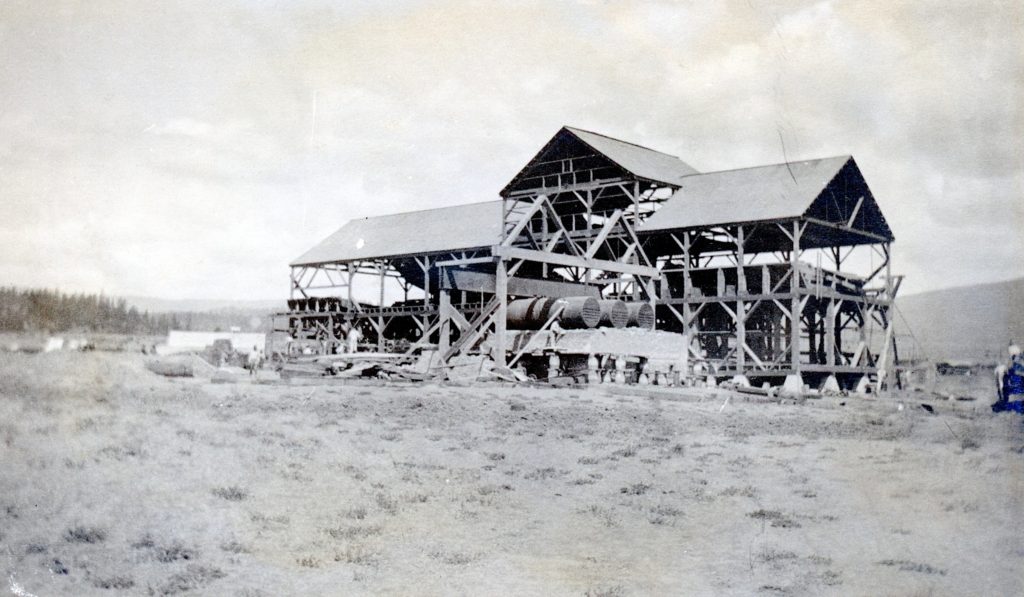
Pit No. 3, 1925 -Lola Tanner
In 1923, construction began on the Pit No. 3 Powerhouse with an estimated cost $13.5 million. On July 18, 1925 dedication ceremonies were hold upon its completion. As was customary in the morning an assortment of dignitaries gave speeches, When they were done Miss Bernice Downing a newspaper woman from Santa Cruz threw switches and the power plant was in operation. After that, the guests were escorted to the construction camp and treated to an elaborate lunch.
The dam, of course, created Lake Britton. It was named for then PG&E’s Vice President John Britton.
On July 20, 1850, Peter Lassen while leading a group of prospectors through region named this body of water–Honey Lake. It was so named after. a sweet dew substance found on the wild grains in the early mornings. A member of this property,, J. Goldsborough Bruff thought differently. On October 5, 1850 he named it Derby Lake for his friend George H. Derby, a United States topographical engineer, who at the times was surveying Southern California. The name, Derby, never stuck.
If you happen to be traveling along Highway 36, between Mineral and Susanville, one of notable features is the Chester Causeway. Travelers be forewarned as its is undergoing highway rehabilitation this summer (2025) and expect road delays. The following is how the causeway came to be.
In 1925, Great Western Power Company announced its plans to enlarge Lake Almanor. The raising of the dam would flood a large portion of Chester Flats, thus flooding a number of roads, and also Red River Lumber Company logging railroad network. Controversy arose when Great Western informed the Plumas County Board of Supervisors that the road across Chester Flats would be re-routed to follow the high water contour. The residents of Chester and Westwood were furious, for such a proposal would add an additional seven miles between the two communities. They wanted a causeway in which the current route would remain the same. Great Western balked at the idea. After all, a causeway would cost Great Western $220,00, while to re-route the road would only cost $50,000. To make a long story short the opponents bypassed the Plumas County Board of Supervisors and had the State Highway Department intervene. In 1926, an agreement was made between the State and Great Western that a causeway would be constructed.
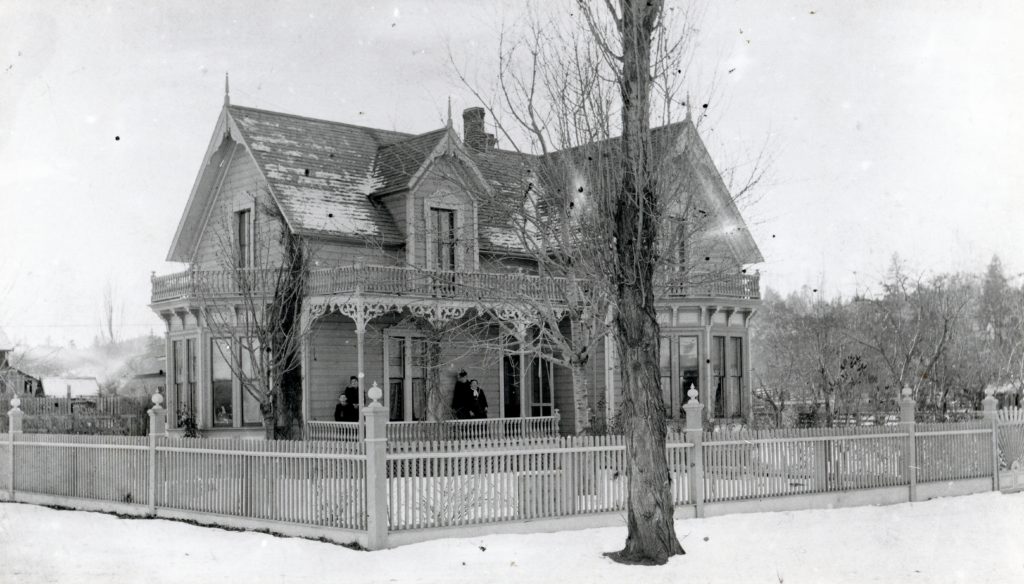
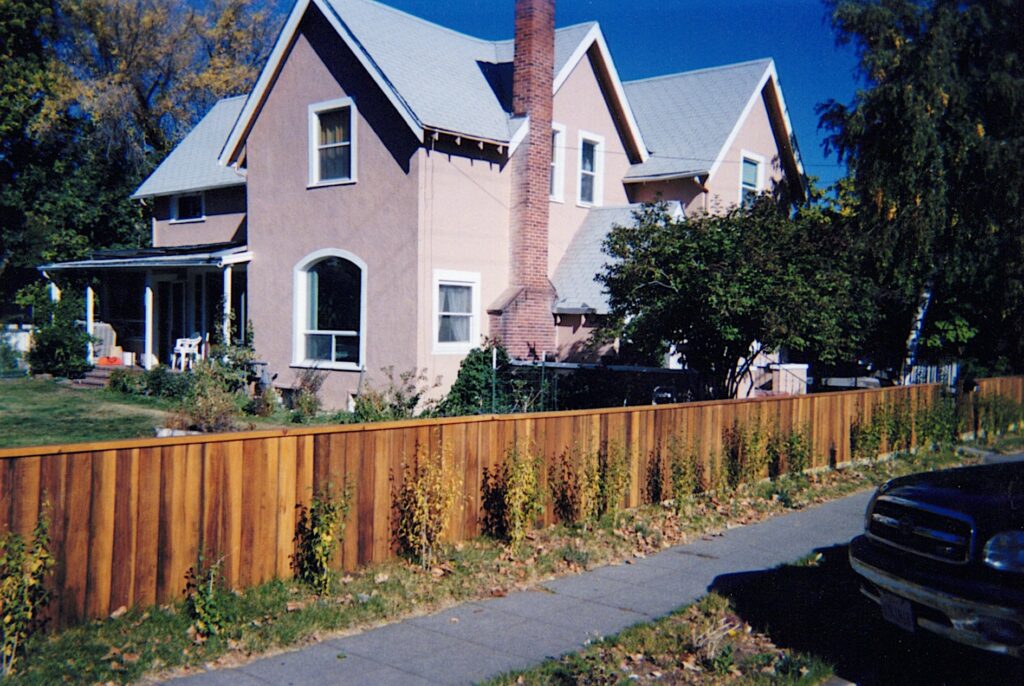
1405 Main Street, Susanville—Courtesy of George Sargent
In July 1925, Harry Riddell began construction of a home on the northeast corner of Main and Grand. The estimated cost was $8,000, a very expensive residence at that time. Instead of hiring a contractor, Riddell used day laborers to construct the house in various phases. The first item of business before actually construction of the house, was the building of a curved cement retaining wall.
In August 1938 Steve and Helen Sargent, proprietors of the Grand Cafe purchased the Riddell home. After some minor remodeling the family moved in on September 1, 1938. The home still remains in the Sargent family.
Western Pacific’s depot at Doyle, 1921-Courtesy of Lola Tanner
Personally, I have almost no information about this depot. Kerry Cochran, Archive Manager for the Western Pacific Railroad Museum provided the following:
“The Depot was located at Mile Post 362.55at an elevation of 4,301 feet. The Western Pacific had the 22 X 70 foot depot built in 1910. The station was retired as a train order station in 1952. In 1956 the WP filed a notice to reduce the station to non-agency status and the depot was officially retired in 1957”
If any one has additional information and/or recollections, that would be great.
Lassen County Fair, 1922. Courtesy of Lola L. Tanner
In the summer of 1922, Bert Jensen, Russell Brownell, C.E. Lawson, L.E. DeForest and H.H. Riddels formed the Lassen County Fair Association. It had been sixteen years since the last fair, and these ambitious men were not only going to correct that, but make the county fair an annual event.
They wasted no time to put together a fair, but a permanent fairgrounds as well.. Twenty acres of land were acquired which is still the present Lassen County Fairgrounds. In July the Association announced its plans to construct a substantial grandstand, along with a race track. There was plenty community support for a fair as merchants and the agricultural community raised $4,000. In early August Susanville contractor, J.J. Woodward was hired to build the grandstand for $3,256.44.
On Friday, September 29, 1922, large crowd assembled for the opening day of the fair. A lively time was had by all. However, it was not a financial success, and faced a nearly $4,000 deficit. The Association was optimistic since future fairs would be spared the cost of the fairgrounds as well as the grandstand. In 1925, the Fair Association approached the Lassen County Board of Supervisors for some financial aid at the tune of $2,000 and the board obliged.
In 1930, the Lassen County Fair Association was disbanded due to the nation’s economic crisis. In 1935, T.S. “Stan”Brown . Lassen County Farm Advisor brought the fair back to life. This time the County took over the operation and the Fair Association donated its fairgrounds property to the county.
Haying Scene, Murrer Ranch, Willow Creek Valley, 1923–Lola Tanner
Haying at one time was a extremely labor intensive endeavor. There would be rotating hay crews, working on ranch, and then move on to the next one. Lest we not forget the kitchen crew to feed all those hard workers.
Haying on the Sugru Ranch, with Sugro Hill in the background, 1900–Robert E. Trussell
On a quarterly basis, I ask you the reader, if there is something you would like to learn more about or maybe its something you heard, but question its validity. So here is an opportunity to participate. I will do my best to answer any questions. It should be noted, it may take awhile for the answer to appear as a post. The primary reason, many of the daily posts are done nearly a month in advance. So by the time you read this I am already working on posts for the middle of August, or at least I should be. Whatever the case may be, I look forward to hearing from you. Of course, it should be noted that paid subscribers requests receive priority. In addition, you can always send a request at any time.
This is a random thought/observation because of the photograph depicted. Prior to Anglo settlement streams and small rivers flowed freely. That changed when the settlers started to divert waters by means of ditches. The result, soil erosion created deep cuts in the streams’ banks. Upper Willow Creek, east of Eagle Lake still flows naturally, as it always has, as there are no diversions there. In the mid-1920s that portion of Willow Creek was not only subject to spring flooding, but addition water from Eagle Lake via Bly Tunnel.
Folsom/Houghton property, 1946–Special Collections, U.C. Davis
As there has been so much local chatter going around about the recent destruction of Susanville Memorial Park Grandstand, here is some history about the property before it became a park.
In 1909, Cyril “Cy” Houghton arrived in Lassen County. After the establishment of Westwood, Cy went work for the Red River Lumber Company. In 1934, Cy, along his wife Eleanor and their family opened a dairy which, is now Susanville’s Memorial Park. In 1938, the dairy received extensive damage from the Piute Creek flood. At one point, he considered abandoning the dairy, but changed his mind. In 1942, Cy’s dairy closed for business. He put the property up for sale, asking price $7,000.
Piute Creek flood of April 9, 1938. Courtesy of Margaret A. Purdy
Not one to be idle, Cy later when went to work for Sierra Army Depot at Herlong and retired from that place in 1957.
Another view. Most people know this site today as Susanville Supermarket. Courtesy of Betty Barry Deal