This railroad town on the east side of Honey Lake was short-lived. It did have several business partnerships-some remarkable and others not so much.
In the spring of 1892, the boomtown was its peak, there were livery stables. One of these Brubeck & Alexander, and their business arrangement last only one month.
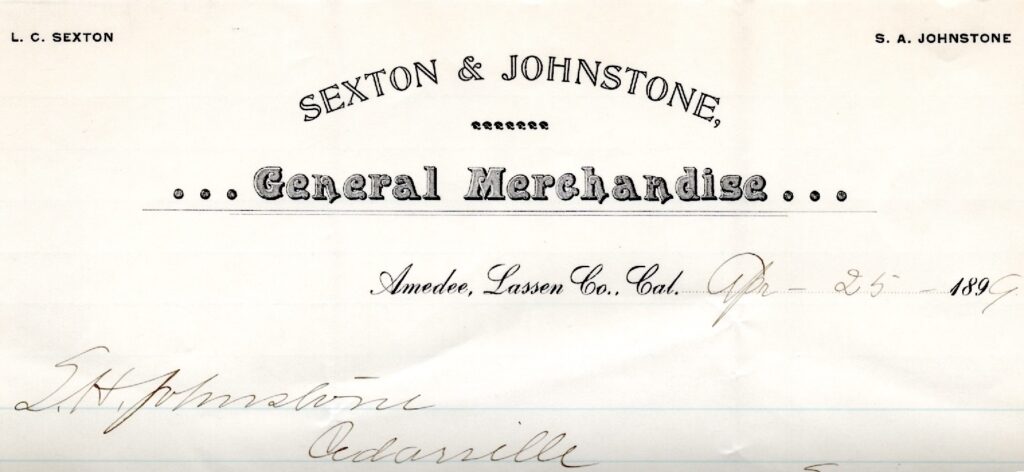
In 1893, the town’s leading merchant, E.C. Brown filed for bankruptcy. L.C. Sexton and Sam Johnstone acquired Brown’s general mercantile store. In 1899, Johnstone bought out Sexton. In 1901, Johnstone and Jacob Hart purchased the Amedee Hotel. In 1903, Hart dissatisfied with Amedee, sold out toJohnstone.
This Amedee business partnership lasted less than a month. Courtesy of Tom Armstrong
By 1907, Johnstone had enough struggles of doing business at Amedee and he sold Carl Young. Young bought in a partner, George Callahan. Young quickly sold his interest to Callahan and cited that the town was “too dull for him.” Little did Young know that Amedee was on a verge of a revival. The good times would not last and by World War I the town was in a rapid decline.
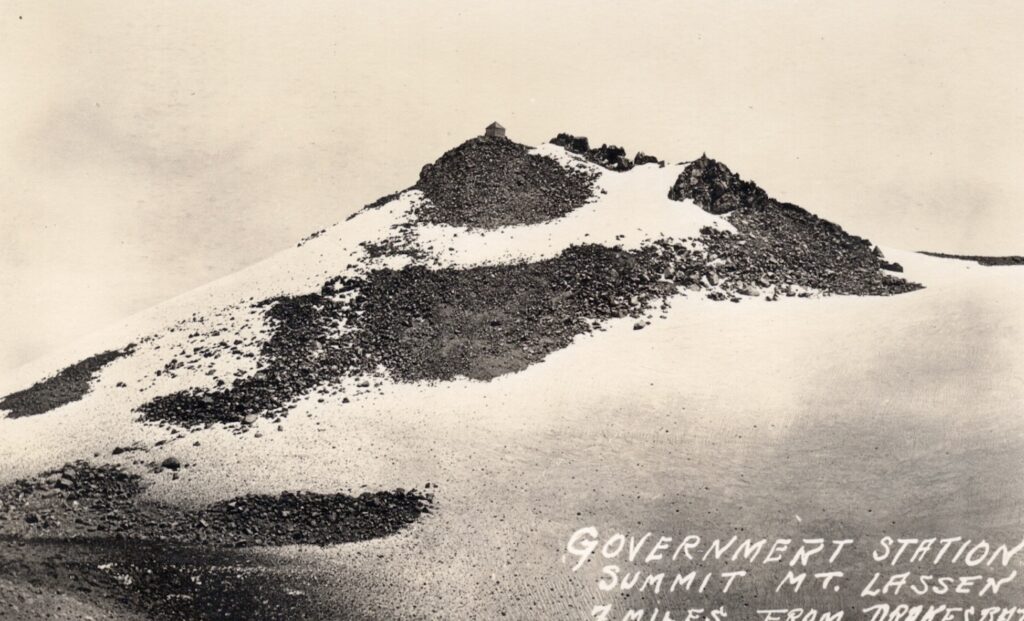
This is a rare view of the summit of Lassen Peak. First is pre-eruption and second is the forest service lookout that only existed in 1913 and 1914.
Prior to the creation of Lassen Volcanic National Park, much of the domain was under the jurisdiction of the Lassen National Forest. Since the peak was the highest point on the Lassen Forest it was only natural that it was the site for its first fire lookout. In the winter of 1912-13 Lassen Forest Supervisors, L.A.H. King designed a collapsible building that could be easily taken apart, transported and reassembled. In most cases these portable lookouts could be hauled by pack animals. The small structure measured ten feet long by six feet wide. Two were built that winter, with one destined for top of Lassen Peak. In June 1913, mules were used to pack the lookout building for Lassen, at least to its base. At that point, man was designated the beast of burden. It took four men two days and sixteen trips to log all the pieces and the sparse furnishings to the top of Lassen. Its first and only occupant was W.H. Packard of Woodland.
Since the eruption of May 31, 1914 and subsequent ones Packard’s services as a lookout attendant on Lassen Peak for 1914 were not needed, for obvious reasons. It was remarkable how well the lookout held up through the summer. On September 13, eruption number 52 greatly damaged the structure. Nine eruptions and seventeen days later it was gone.
One never knows for sure where your final resting place may be. In one instant, there was a disinternment of a grave of a girl who died in 1924 in Susanville. She was buried in the Susanville Cemetery and nearly 70 years later her family had the remains moved to a cemetery in Oroville.
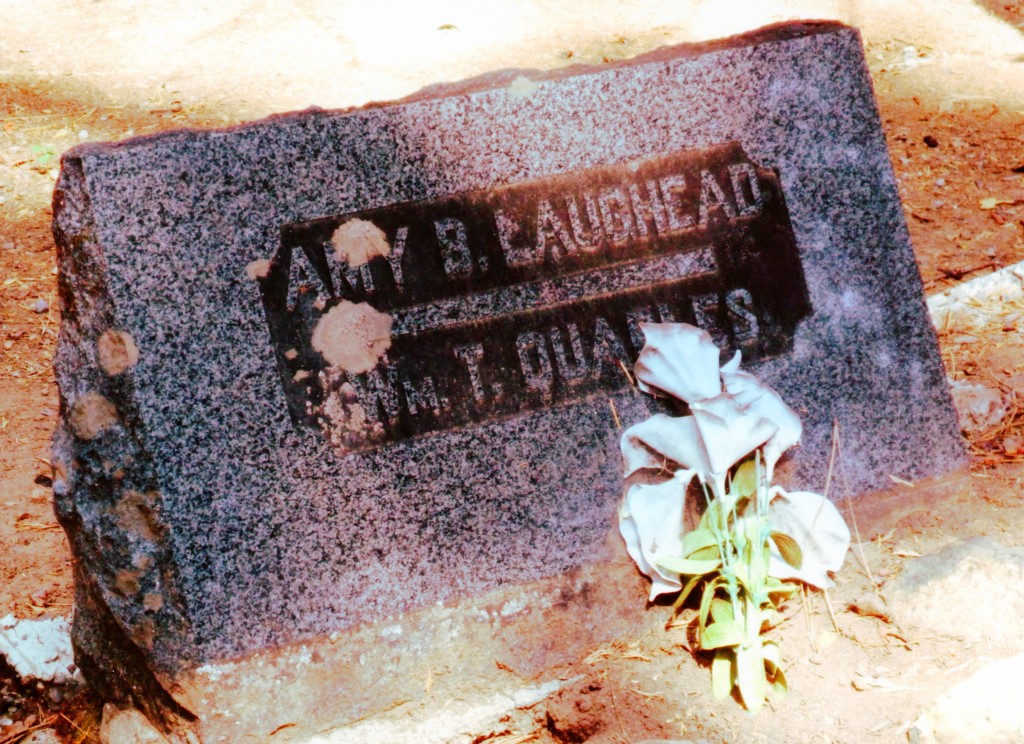
Then there is the case of Amy Laughead. She was a first cousin to Red River Lumber Company’s founder, Thomas Barlow Walker. Her claim to fame, is that of her son, William B. Laughead, who developed the famous Paul Bunyan caricature that later became the trademark for Red River. Amy is a perfect example of you just never know where your final resting place might be. She died in February 1939 at Westwood and was buried in Sacramento. Seven months later, her son had her remains disinterred and brought to the Westwood Cemetery. When he died in 1958 he was buried in the plot in Sacramento where his mother was originally interred.
As the old saying goes the first generation makes it, the second uses it and the third loses it. Only 13 percent of family owned businesses make it past the third generation.
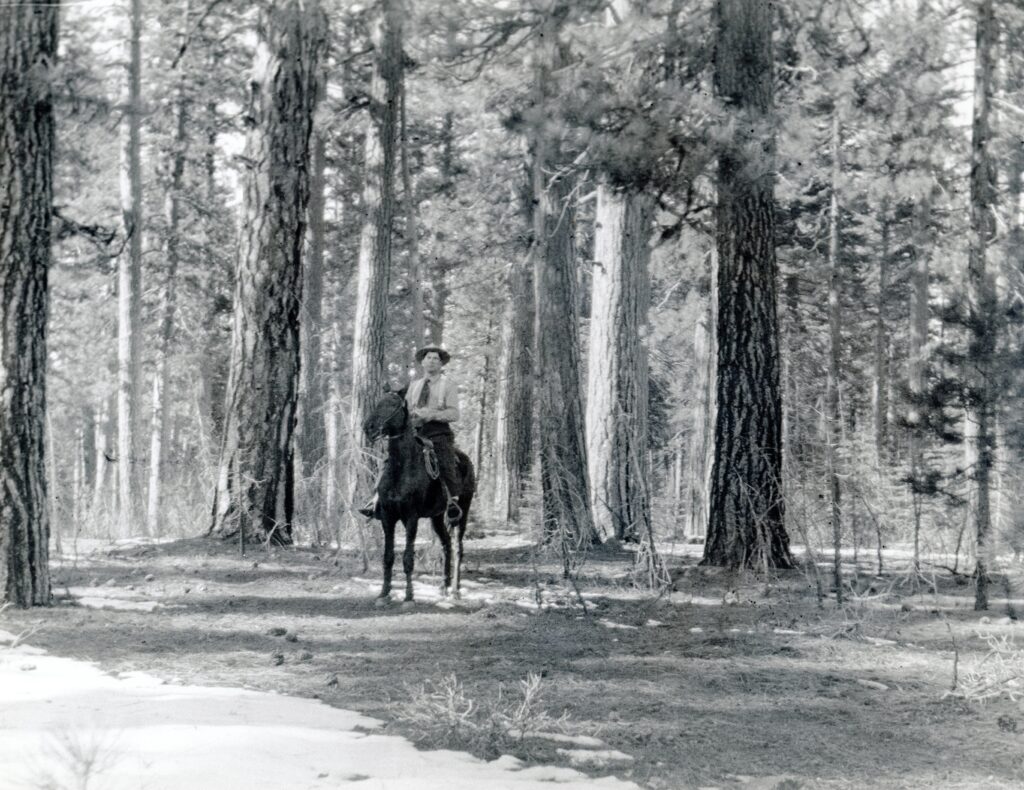
In the late 1890s and early 1900s, Red River Lumber Company’s founder, T.B. Walker relied heavily on professional timber cruisers during his westward expansion. It should be noted that this new endeavor once established would be operated by his sons. It might have looked fine in concept, but the personality clashes between the brothers painted a different story.
After Westwood was established in 1912, Fletcher Walker would manage the mill operations and town. Willis Walker would handle the forests and logging operations. By 1913, Clinton Walker was disgusted by his brothers’ antics resigned from the company. The other two brothers, Archie and Gilbert remained in Minnesota.
Whenever a Red River forester moved on his position was not replaced. This would take a toll on Red River’s timber resources. During Red River’s financial crisis of the 1930s, Clinton Walker returned to the company. He lamented about the conditions. On August 10, 1935, Clinton Walker wrote to his brother Archie,:
”It is regrettable that the house of Walker has no forest man. Kenneth [Walker] covers the nearest, but he seems to be absorbed in the performance of log contracts; our annual fire and insect losses are staggering. A systematic annual light burning at the right season of the year would reduce an ultimately eliminate these sources of loss and the cost would be insignificant as compared to the loss and yearly fire hazard conditions in the forests. Burning by means of power burners on or dragged behind tractors could be done very cheaply and the prospective danger of injuring hollow hulled trees could be eliminated by following the burning with a few shovelers. For the entire period of the Walker family timber operation we have centered our attention exclusively to lumber operation. We are doing nothing but slash down that wonderful forest and letting the fire and beetles burn and eat us down year by year without raising a hand to afford protection from these annual staggering losses.”
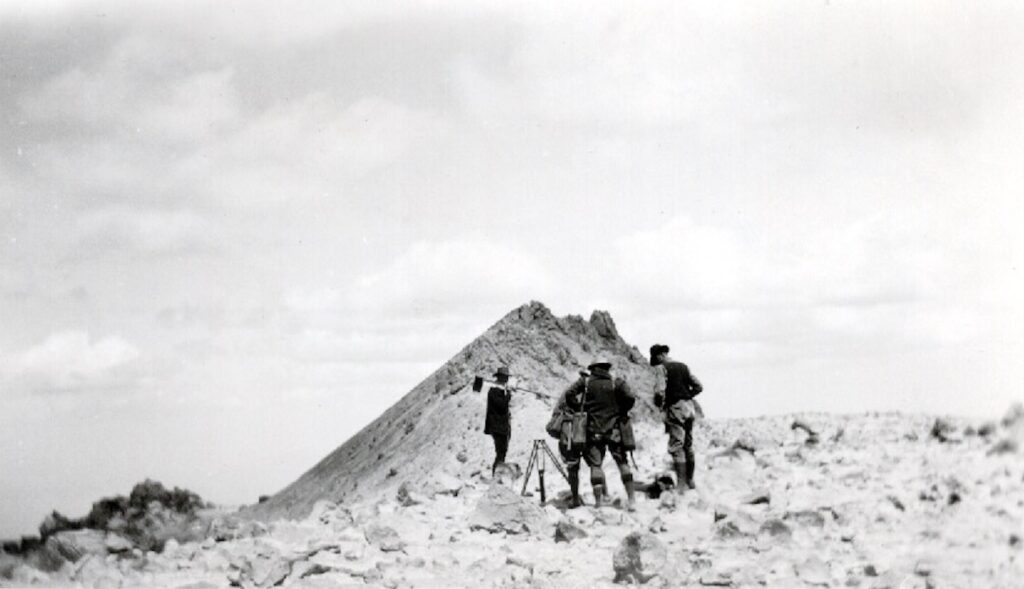
U.S. Government geologists resting at the summit of Lassen Peak, August 1923 – Carl Caudle Collection
Guest registers are unique historical document and they vary, since one size does not fit all. Today, we examine three.
Roop House Register. In 1856, when Isaac Roop established his trading post along the Nobles Emigrant Trail, which would become the foundation of Susanville, he kept a guest book. This allowed emigrants to write freely. Here is an interesting entry: Sunday, August 31, 1856. “Another Sabbath has passed on the swift pinions of Time and we are a week nearer eternity. A few more and we shall have passed smoothly down the stream of life and paid debt of nature. How different then will this far famed Elysian Valley appear! What great and stupendous changes will have taken place? Where now stands Lassen’s log Cabin, a modern pig sty will have been erected and round the sage covered Ranch will be a rail-worn fence, composed of chiefly of piles of brush. Who among this generation will be able to recognize this valley? Echo answers “nary a buggar.”
Lassen Peak. In September 1865, Kendall Bumpass guided a party to Mount Lassen at the request of Watson Chalmers, publisher of Red Bluff Independent newspaper. When the Chalmers party scaled the peak, they found a bottle there that was used as an impromptu register. The jar contained various slips of paper left by previous climbers and the Chalmers party added their names to it. Over the years a guest register was placed on the peak for people to memoralize their trek to the summit. Sometimes the register was supplied by the Sierra Club and other times by the Siffords of Drakesbad. Periodically, the park service conducted surveys to see how many people were climbing it. In 1933, for instance, from July 1 to August 18, 24,561 entered the park. Of that number, 3,725 climbed the peak and written their names in the register. Park officials calculated then that 15 of every 100 visitors climbed the lofty peak.
Max’s Mausoleum. This is an obscure site, created during the filming of a major motion picture in the late 1920s. This was common for commercial movies to be filmed here, but that is another story. Max’s was located in a narrow canyon west of Astor Pass, which is between Pyramid Lake and Honey Lake Valley. A small tunnel was carved into the hillside, about seventy-five feet. An alter was installed. After the production ended, a register was placed. It is my understanding the register was removed in the early 1970s and donated to the Nevada Historical Society.
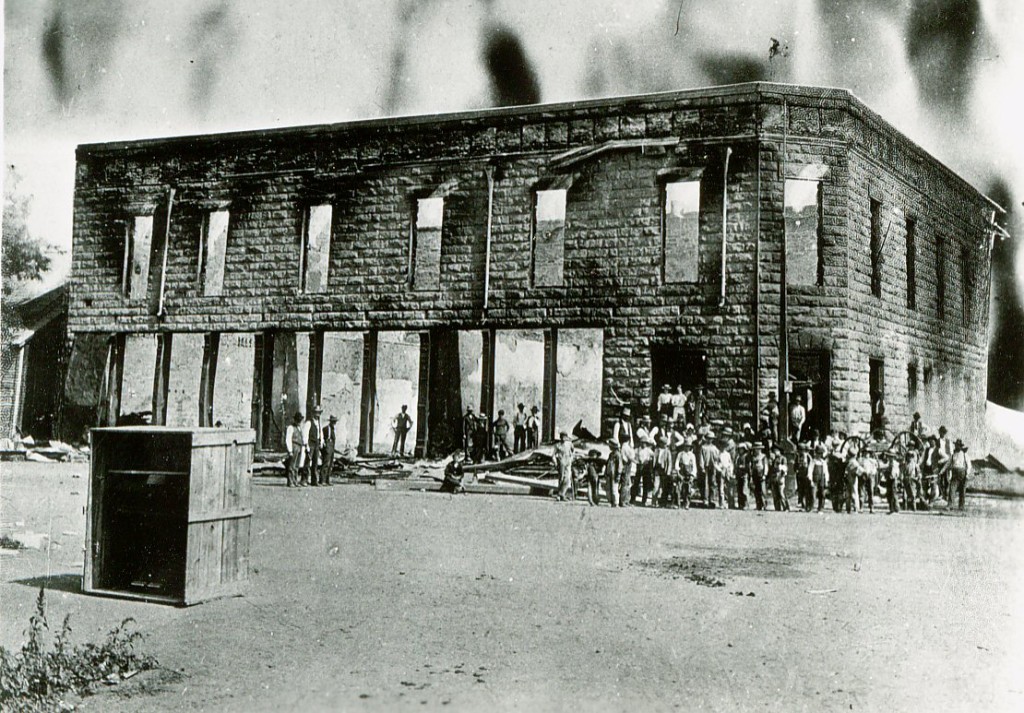
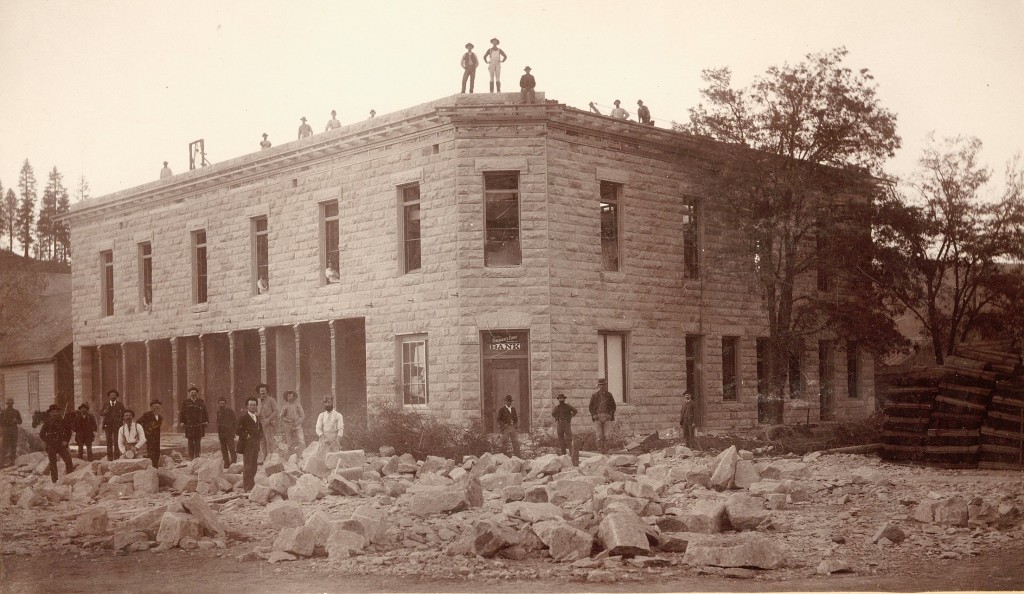
The 1890s were quiet times around these parts. The economy was slow to rebound due to the national depression. However, at that time, Susanville was served by two newspapers (Lassen Advocate and Lassen Weekly Mail) and those editors struggle for content. In the fall there were the county elections that were not dull as there were a full slate of candidates. There was, however, a major castrophic event when the Masonic Temple, that had only been constructed a little over four years ago was destroyed by fire. In the fall, Reno contractor, C.E. Clough inspected the standing stone walls and deemed it to be sound. He was awarded the contract to rebuild the structure.
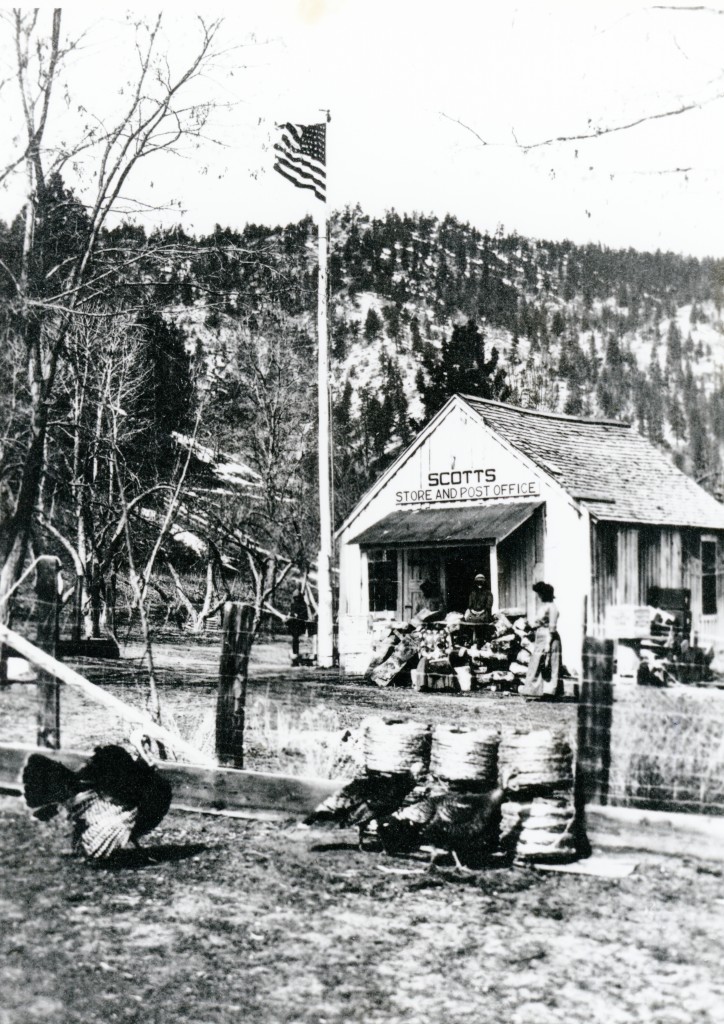
Scotts, a Western Pacific station in Long Valley. Courtesy of the Nevada Historical Society
Yesterday, I wrote about Eslie Cann while working at the Nevada Historical Society would send information and copies of photographs from time to time. The above photograph was one of them. The story does not end there. In 2002, during the preparation of my book Lassen County Almanac: An Historical Encyclopedia I contacted the Nevada Historical Society requesting permission to publish this photograph. Their reply was unexpected. They informed me that they did not have that photograph in their collection anymore. They stated that they discarded some border counties photographs.
As to, Scott’s it was a little known Western Pacific Station in Long Valley. It was located about three miles south of Constantia. It was so named for Charles and Franceska Scott who located there in 1901, from Fish Springs, Nevada. With the railroad station, they decided to open a general store and even established the Scotts Post Office. The post office only operated from 1912 to 1916. In 1918, they sold their 3,160-acre ranch to Antonio Saralegui.
Construction of the $20,000 Masonic Hal in 1893-Philip S. Hall
Today, is World Gratitude Day and I grateful for so many things. Of course, there have been so many people that have enriched my life while researching and preserving this rich history.
While they are no longer with us, I want take this opportunity to thank a trio of people and who are intertwined–Eslie Cann, Philip Hall and R.B. “Doc” Tangeman.
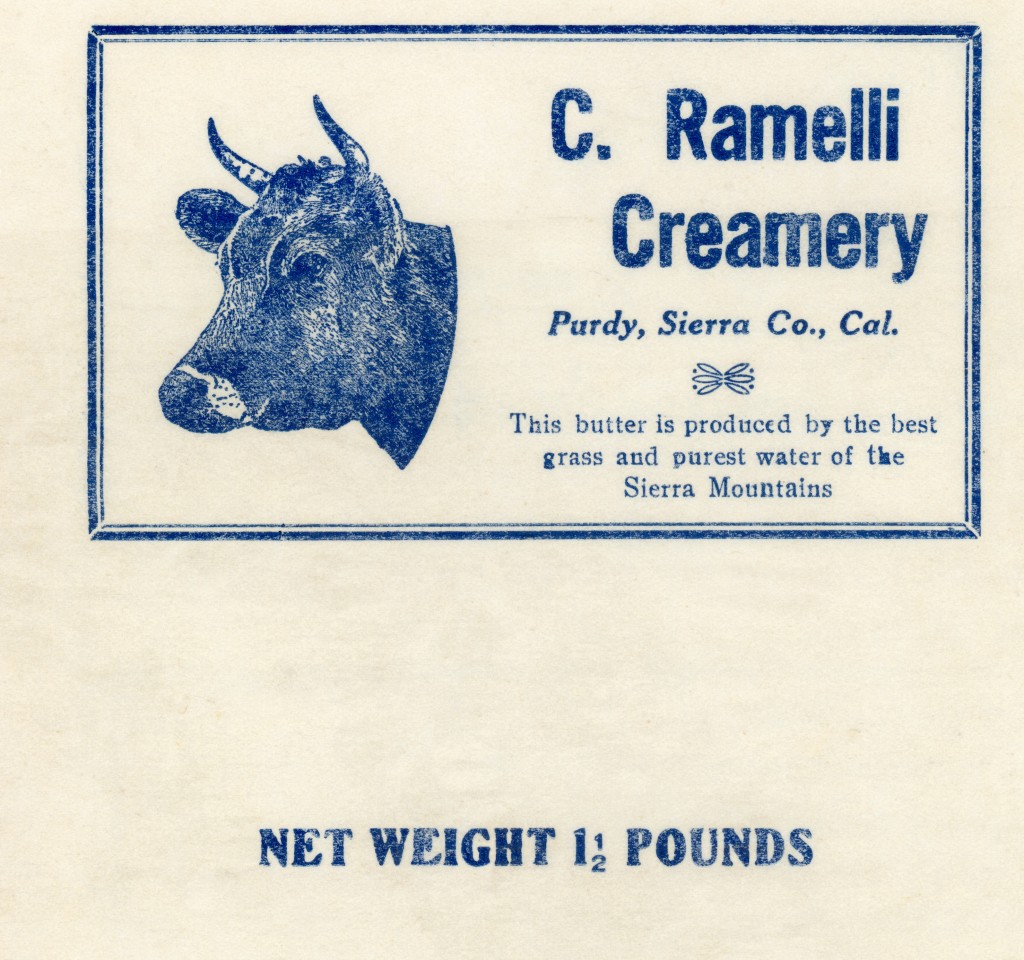
Ramelli butter wrapper. Courtesy of Eslie Cann
Eslie was a part of the Ramelli family of Long and Sierra Valleys. When I first met her, she was working at the Nevada Historical Society. It should be noted, that I began my research at a very young age. Anyhow, whenever she spotted something whether it a newspaper article of the late1800s and or new photograph acquisition that pertained to the Lassen region she would send a copy to me.
Two Nevada Historical Society members, were Lassenites. Phil Hall, who was born at Constantia in 1909 and Doc Tangemen, a well known and respected veterinarian. It was through Elsie that I really got know these two fine men. Of course, things change. Eslie retired and moved to Long Valley, next to her daughter and son-in-law, Corinne and John Matley. In 1994, Phil moved to Forestville to be near his family. Doc from time to time would visit Phil, and upon his return to Susanville, Doc would deliver to me a manila envelope from Phil of historic photographs.
These folks were so precious, and I am forever grateful to them.
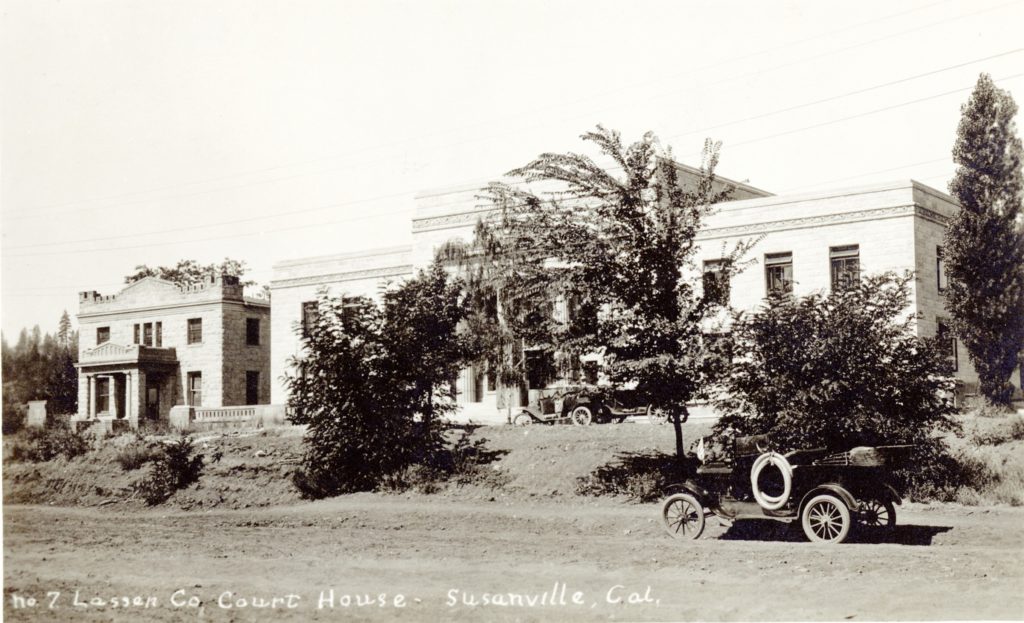
Lassen County Courthouse, spring 1917. Courtesy of Elberta M. Fraley
On Friday September 21, 1917 at 2:00 p.m. dedication ceremonies were held for the new Lassen County Courthouse. It was a grand affair, as it was the Second Annual Meeting of Northern California Counties’ Association that was held in Susanville. Those counties included Modoc.Shasta, Siskiyou and Trinity. The dedication was a short affair, only three speakers, the notable one was Attorney Grover C. Julian.* The public was then invited to tour the building.
It should be noted, that many offices were not fully furnished, and that would not be accomplished until late October. The sidewalks and the retaining walls were not built until 1918.
Note: The initial building took 18 months to complete at a cost $125,000. In 2019 the courthouse renovation began, not to be confused, with a restoration. Its been six years now, at a cost of well over $8 million and the building sits vacant
Tim
*Ask me when you see me, I can inform you about courthouse Julian collection.
It was a rarity for local Native Americans to have a professional photographer take their portrait in the late 1800s. This was case of Mattie Jackson, a Maidu. She was born circa 1878 in Susanville, the daughter of Sam Jackson and Chief Daughter. A number of local Maidu and Paiute women worked as domestic for their Anglo counterparts. Her employer, might have been instrumental is having this professional photograph taken.
In 1900 Mattie married Pete Ives. who he was of mixed race, his father was Anglo and his mother Native American. They had one child, Douglas.
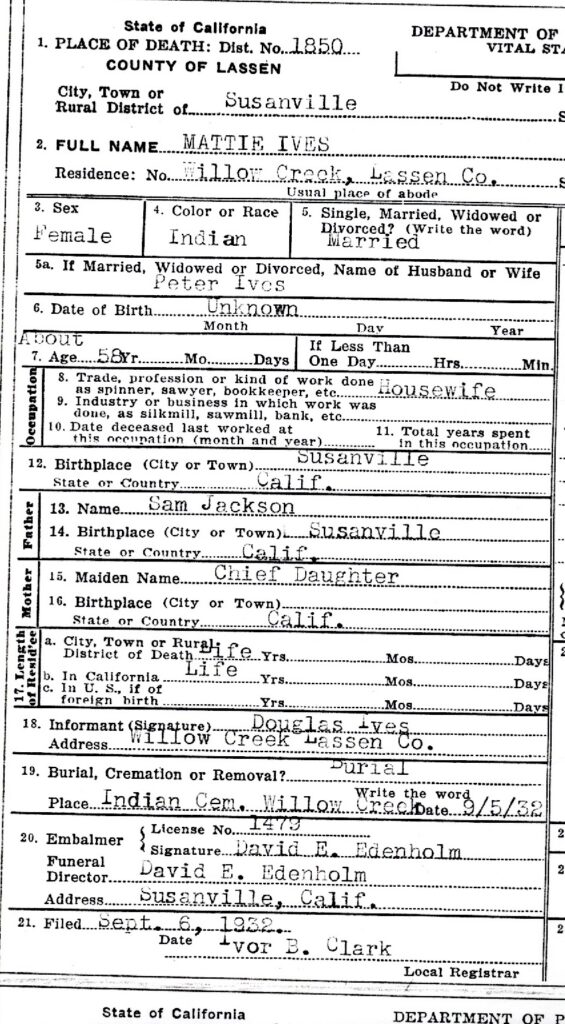
Mattie’s death certificate
The Ives family spent their life between Janesville and Willow Creek Valley. Mattie died at Willow Creek on September 2, 1932 and is buried at the Indian Cemetery near the Jackson family home in Willow Creek Valley.