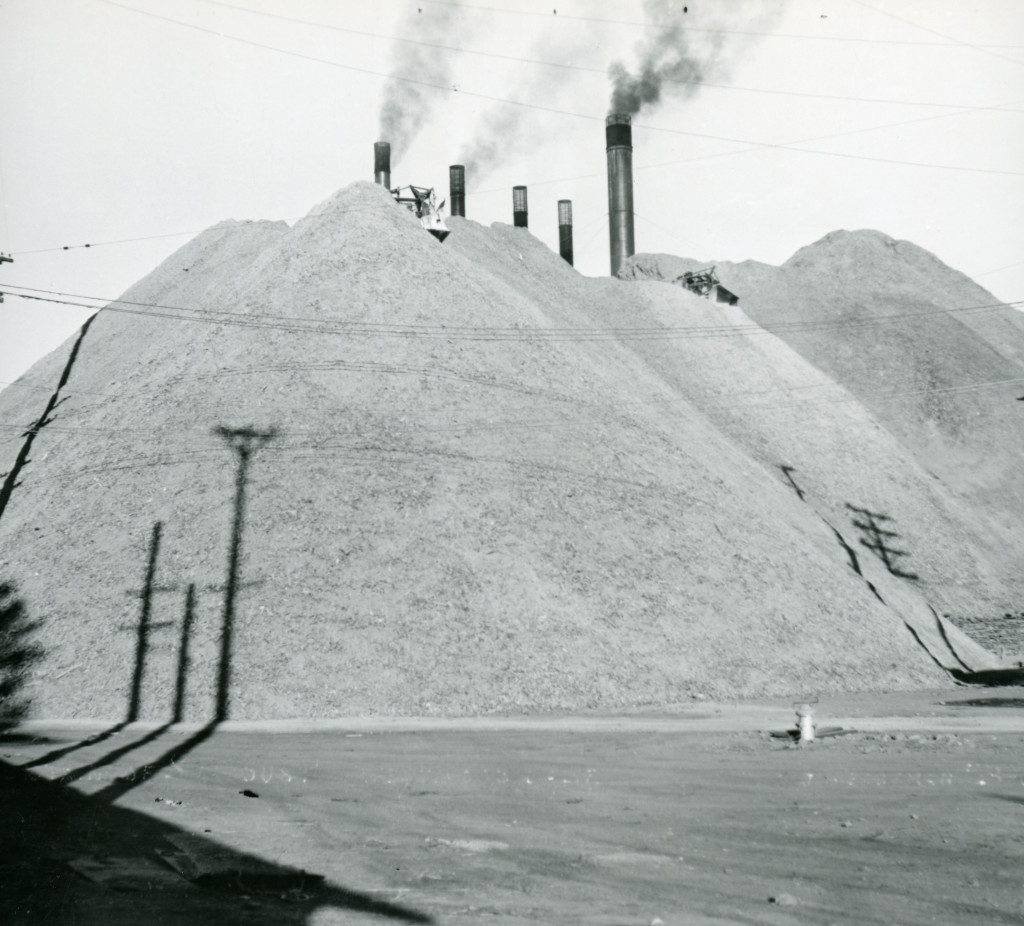
In the mid-1920s, Red River Lumber Company had two hydro-plants in operation to generate power for Westwood. This abundant power supply created an unusual man-made landmark. Red River was able to conserve its sawdust/wood waste pile, which took on a life of its own as it started looking like a small mountain. This created a nice reserve of free fuel that was readily available at any time should there by interruptions from the hydro-plants. To comprehend just how large it was, a Ripley’s “Believe it or Not” column once designated it as the world’s largest waste pile. In 1941 it lost its status to Portland General Electric Company who reported having a 130-foot high pile of sawdust. Continue reading Red River’s Saw Dust Pile→
The 1931 Fake Eruption of Lassen Peak. Courtesy of the Plumas County Museum
Well, folks I finally did it, and succumbed to my own “Pandora’s Box” so to speak. You the reader are the beneficiary. I am delving into all kinds of archival records that I have not inspected in years.
There is the tale of Long Valley resident, Cary Sturgess, a mathametician who was half-albino, straight down the middle—which there is supporting documentation. Some interesting material surfaced about Viola Roseberry’s Native American basket collection of the early 1900s and how much she was paid to display them at San Francisco’s 1915 Panama-Pacific Exposition. I hope that if I dig a bit deeper, to locate material of the Eagle Peak Ski Area near Doyle of the 1970s.
After the failed first Spalding subdivision, it was brought back to life as Spaulding Tract, The story of the inserted “u” for another time. In 1924, this time around, the Spalding family with a new subdivision on the west shore of Eagle Lake, hired real estate developers to promote it. This gave birth to the Eagle Lake Cabin Site Company.
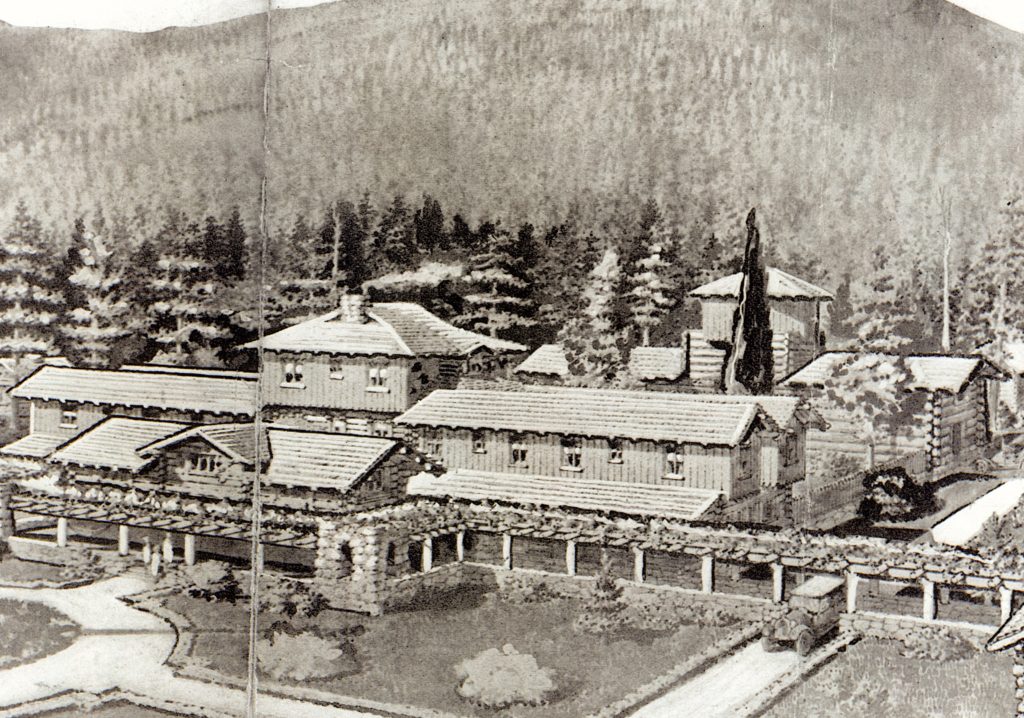
Promote they did. These folks were shrewd, and knew first hand the local residents were not their market, because they knew there was nothing there to get excited about or invest in. The Eagle Lake Cabin Site Company produced a brochure to entice folks primarily in Southern California of this hidden gem, more spectacular than Lake Tahoe. To lure people to buy lots, as an enticement was the proposed grand hotel to be built, similar to the famed El Tovar Inn at the Grand Canyon.
The lots initially sold for $50 each. When the company began selling lots in the spring of 1925, they were confident that the entire tract of 5,964 lots would be sold out in six months. While they did not reach that goal, they did sell over 3,000 lots.
In 1926 sales dramatically taped off. This was due in part of the new lot owners when came to inspect Spaulding Tract. First they encountered poor roads and when they finally arrived there were not any visible signs that gave the slightest hint the place was a resort community. So digusted many of the lot owners refused to pay property tax for a non-existant resort community. Thus, the Eagle Lake Cabin Site Company faded into oblivion.
There was time, that Ravendale on the Madeline Plains was more than a wide spot on Highway 395. Like so many locales, it had experienced some interesting times.
One of these accountss involved the Ravendale Elementary School during the 1938-39 school year. Frances O’Brien had a contract to teach school that year for $1,320. When the school opened in the fall, six students had enrolled. The enrollment then dropped to four, and then to two, and by January 1939, there were no students. The trustees questioned whether they were obligated to pay O’Brien’s contract since there were no students. The matter was referred to California Attorney General Earl Warren. Warren informed the trustees that they had to pay O’Brien’s contract whether she had any students or not. Warren did state that the trustees and O’Brien could negotiate a compromise. Whatever transpired is not known. The school re-opened in the fall of 1939, with thirteen students. However, Emma Metcalf replaced O’Brien as the teacher.
Seasoned California residents know that not only did Attorney General Earl Warren later became the Governor of California, but he went higher up on the ladder and became the Chief Justice of the United States Supreme Court.
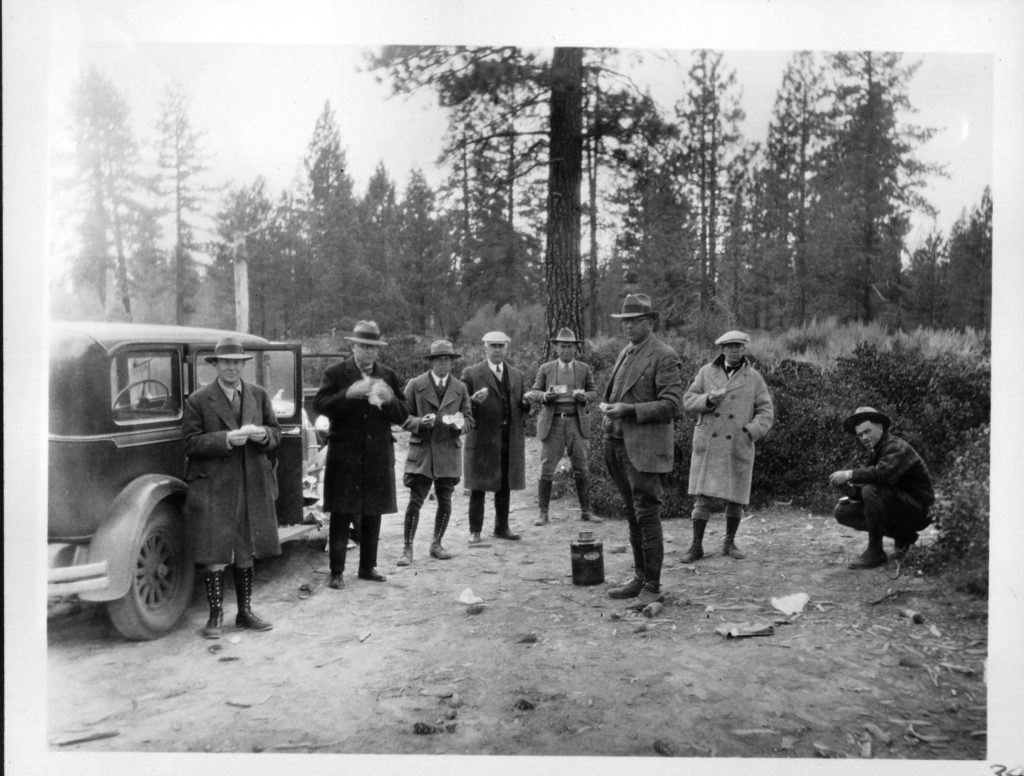
Lunch break of park and Western Pacific Railroad officials, 1930. Courtesy of the National Park Service
For the casual observer who decides to make a detour off Highway 44, near Poison Lake in western Lassen County, to travel the dirt road north to Pittville, one will see a variety of sights along the way. One of the first encounters is that of Halls Flat, a small non-descript sagebrush covered flat surrounded by pine trees. Nothing to get excited about, but like watching one of those late night infomercials, there is a lot more in store!
In the late 1910s, Tehama County rancher, Walter Davis Hall (1886-1960) used this area for summer grazing and on April 29, 1926, he was granted a 160-acre land patent—hence the name Halls Flat. Little did he know, that not to far in the distant future, this spot would be an amazing hub of activity.
It first began, in 1930, when the Interstate Commerce Commission approved what many refer to as the Highline or Inside Gateway that connected the Western Pacific Railroad from Keddie, California with the Great Northern Railroad at Klamath Falls, Oregon. This just happen to coincide with the development of Lassen Volcanic National Park and this future railroad line would come close to the park’s eastern boundary. Customary at the time, Lassen Park and Western Pacific had a courtship—the park seeking a concessionaire, while the railroad hopefully would see increased passenger service among other amenities.
This is where, Halls Flat could have played a pivotal role. Western Pacific would develop a resort at Manzanita Lake in the park. At Halls Flat, or maybe Poison Lake, where a railroad station would be built, there would a stop. At this point, passengers would disembark and be shuttled by bus through the northern section through the park to their destination at Manzanita Lake to spend days recreating. To build the lodge at Manzanita along with other amenities was estimated at $275,000. Due to outside legal issues, the Western Pacific had to suddenly withdraw from the proposal.
The stage was set, for different reasons, and Halls Flat became a major hub of activity during the 1930s and 1940s that we will explore in future installments.
My father, Leroy W. Purdy was born on March 7, 1927 at Susanville’s Riverside Hospital. Seasoned readers will recall that he was a colorful character back in the day.
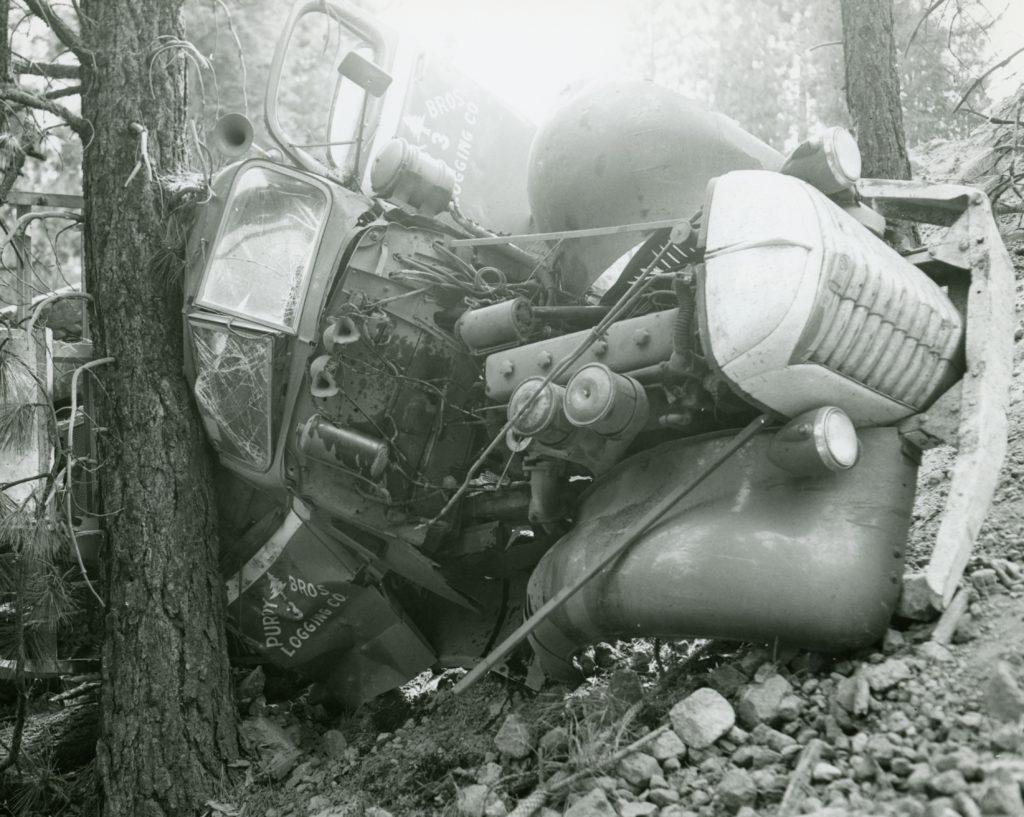
Leroy spent most of his life in logging. His first hand introduction was logging at Red River Lumber Company’s Camp Harvey, with his best friend and future brother-in-law, Bob Rea. When his brother, James, returned to Susanville after World War II, they formed a partnership known as Purdy Brothers Logging. Times were really good for fifteen years, and then the Black Widow entered the picture. Their world came crushing down, and the partnership dissolved.
Leroy continued a solo logging career, later forming L&M Logging. Those days I remember well, spending many summers working out in the woods growing up. My father noticed my enthusiasm which eventually, I received a stern lecture from him, “No son of mine is going to be a logger.” With that career option gone, who knew later I would be writing the history of the logging industry among other topics.
The Round Barn, Little Valley, Lassen County, prior to it being moved to Fall River Mills. Courtesy of Tom Glunt
The livestock industry has always played prominent role in the region’s economy. However, with time, everything evolves, horses and sheep no longer play a prominent role as they did in the past.
Recently, I came across an interesting statistic. During World War I eight million horses perished in the variety of the conflicts—1.8 were German horses! A staggering figure. It was after all a transitory time, motorized equipment was still in its infancy stage. The Caterpillar tractor company made so many experimental changes during the war, that locally, after the war would revolutionize logging methods.
An interesting Lassen County landmark was constructed in Little Valley tucked away in the northwest section of Lassen County. In 1916, R.L. “Bob” Johnson constructed what became known as the “Round Barn.” Johnson needed a structure where he could train horses during the winter months, as they were in great demand in World War I. Over the years, the elements, etc., took a toll on the building. By 2004, the Fort Crook Historical Society had started a movement to relocate the barn to their museum complex at Fall River Mills. It was a slow process, but they succeeded, and is now restored to its glory.
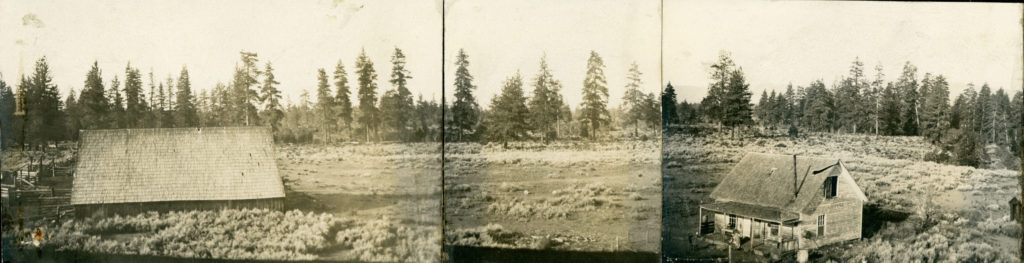
John S. Spalding’s second homestead at Eagle Lake, circa 1919. Courtesy of Wyn Wachhorst
On July 6, 1914, the Lassen County Board of Supervisors approved John S. Spalding’s subdivision for the Town of Spalding, on the west side of Eagle Lake. It was Spalding’s intent to develop a summer resort. The Susanville newspapers had extolled wonderful praise for the project.
Yet, momentum was difficult. First, there was competition of other developments taking place—the volcanic eruptions of Lassen Peak, the construction of Lake Almanor and the newly built company town of Westwood. Yet, one of Spalding’s biggest obstacles was access, or in this case, lack thereof. Even since 1900, considerable pressure was applied to the Lassen County Board of Supervisors to make road improvements to Eagle Lake, though very little materialized. The resort town was a failure. Only one lot was sold, of note it was a purchase by a retired Lassen County school teacher, Asa M. Fairfield.
In September 1924 the Spalding family petitioned the Lassen County Superior Court to dissolve the townsite and was granted.
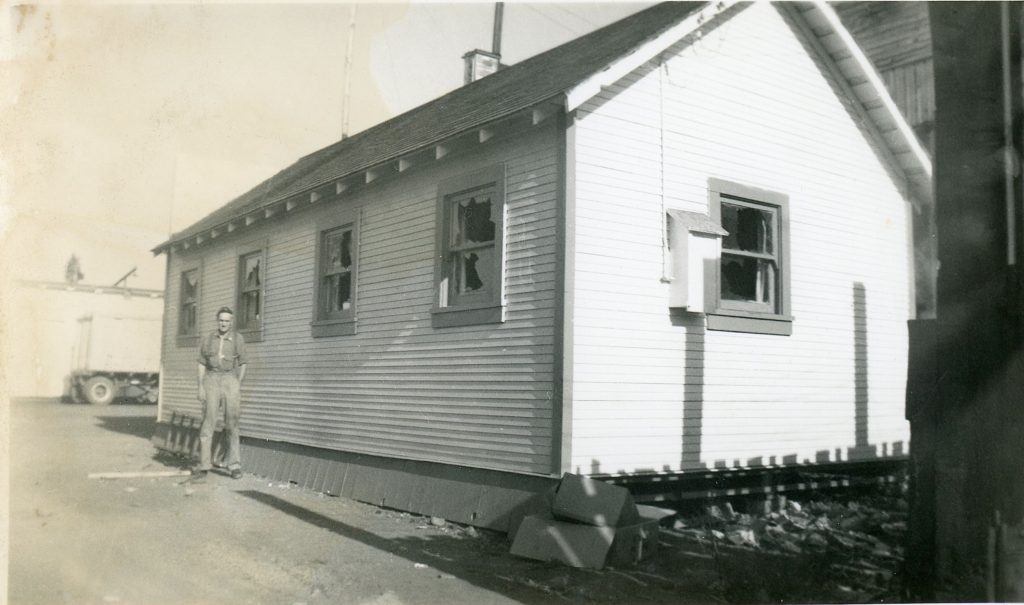
After the rioting broke out from the court hearing a small group of CIO sought shelter in their building, (it being a small structure measuring 16 by 24 feet). It was only a matter of time that angry mob would descend. Aid arrived in the nick of time before matters got completely out of control with Lassen County Sheriff Olin Johnson and his deputies. Johnson had Jack Granger, a respected AFL member, be his spokesman. Granger’s is plea to the angry mob stated: “Fellows I ask you on behalf of Sheriff Johnson and those women and children in the building to open way and let them be taken out of here. We are aware of the hysteria that got us all and there is no thought of fear. Let’s play ball with the Sheriff.” The mob obliged and all those inside—29 to be exact—were escorted unmolested from the structure by the sheriff deputies. It was still a harrowing experience as the crowd had slashed the car tires of the sheriff deputies and they had to drive away on the rims!
The AFL resented the CIO headquarters; many considered it a symbol of the labor problems of Westwood. Exactly what the AFL’s intention were was anyone’s guess. Once the evacuees were escorted out of the building, the mood of the crowd changed and then someone yelled, “Let’s do something.” Within in moments, the American flag on top of the building was lowered. Then in a wild frenzy the mob began dismantling the building. Within thirty minutes it had been reduced to rubble.
Tensions between the two labor groups would continue for years. Even after the AFL in a 1941 special election to become the sole union to represent Red River Lumber Company employees, resentment lingered with many CIO’s for decades.