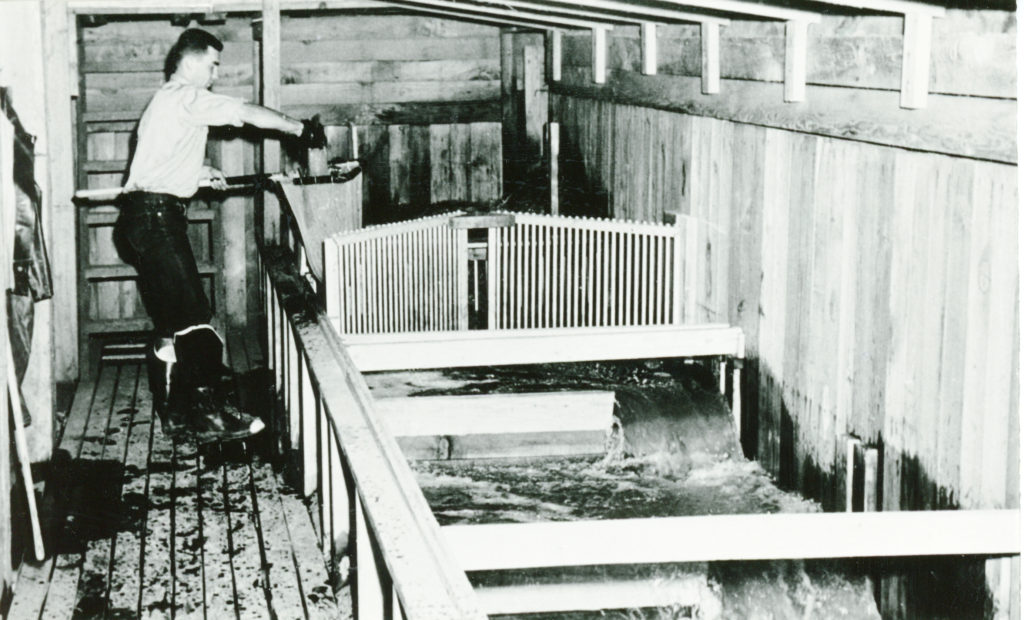
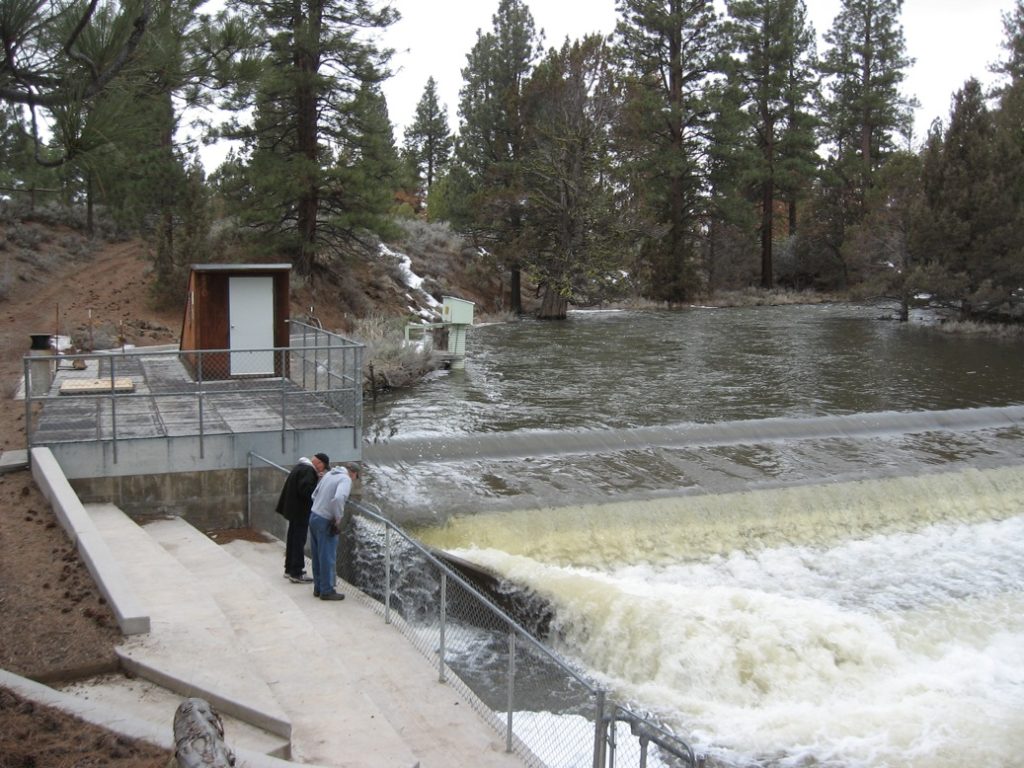
Inside the Pine Creek Fish Trapping Facility, April 6, 1961. Courtesy of Department of Fish & Game
The Eagle Lake trout nearly faced extinction, but fortunately now it is a success story. Between the drought and the Bly tunnel, not only did the lake drop to record low levels, but the Pine Creek estuary became so silted the trout could not go up that stream to spawn. By saving grace, the winter of 1937-38 witnessed tremendous precipitation, that allowed for substantial spring run-off that cleared the Pine Creek channel.
In 1948, the California Fish & Game came forward to save the trout. In 1950, Harry Chandler, a biologist was successful in setting up a trap to catch spawners. One adult spawner happened to yield 2,000 eggs. Those eggs were taken to the Crystal Lake Hatchery were they hatched and reared. While that was a good start more needed to be done. In 1958, the Wildlife Conservation Board allocated $38,810 to construct a fishing trap/egg collection station at the mouth of Pine Creek, and also the Crystal Lake Hatchery with an additional four more rearing pounds. It was money well spent as the following year sixteen adult spawners were caught. Thus, a very successful start and we know the rest.
This is an excellent time to visit the facility, especially for those who have never been there.
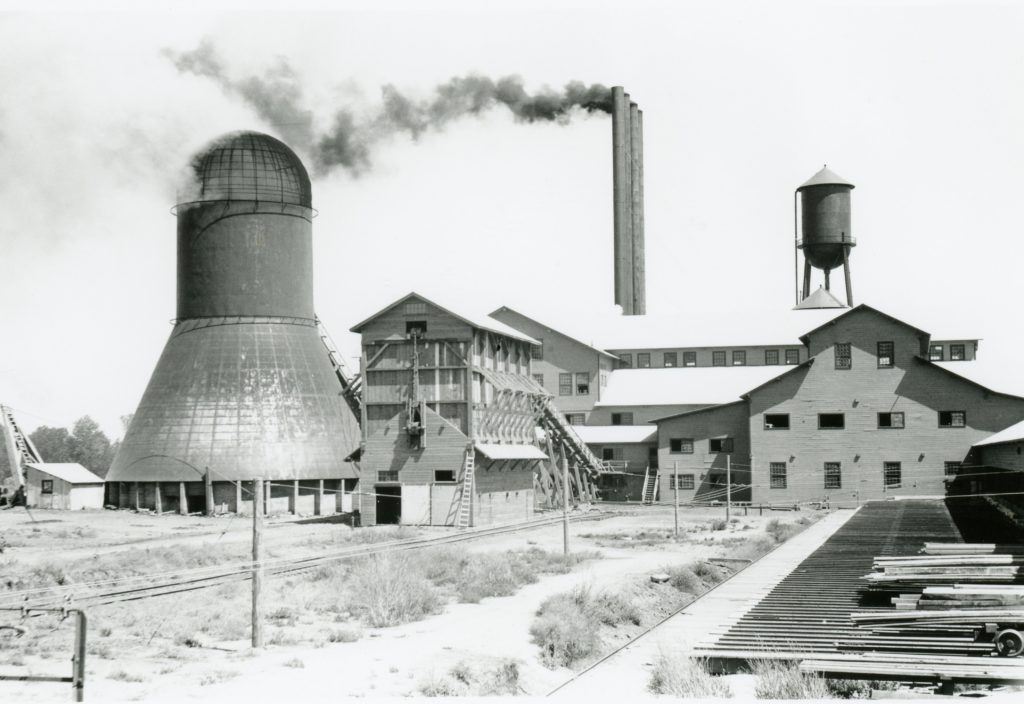
The Susanville plant, 1921. Courtesy of Ed Standard
In this era of being bombarded with the term “fake news” the City of Susanville deserves a gold medal award to distort the record to accomodate someone’s warped mind. It should be noted, after all, I have spent the majority of my life researching the region’s history to provide an accurate record versus false statements, which is different from folklore. For instance, when my Eagle Lake book was published in 1988, Bob Amesbury congratulated me, since he had written a book on the lake, too. Bob went onto say that he had all the bullshit and I had all the facts.
Fast forward to the summer of 2018, when at the City’s urging I met with with two officials, Mr. McCourt and Ms. Schuster, concerning the history of Riverside Park. It was an exercise in futility, for this dynamic duo, could care less about the history of site, and were bound and determined to change the name of Riverside Park to Fruit Growers Park, regardless of the facts, which ultimately they were successful, using a deceptive survey, that the general public was excluded.
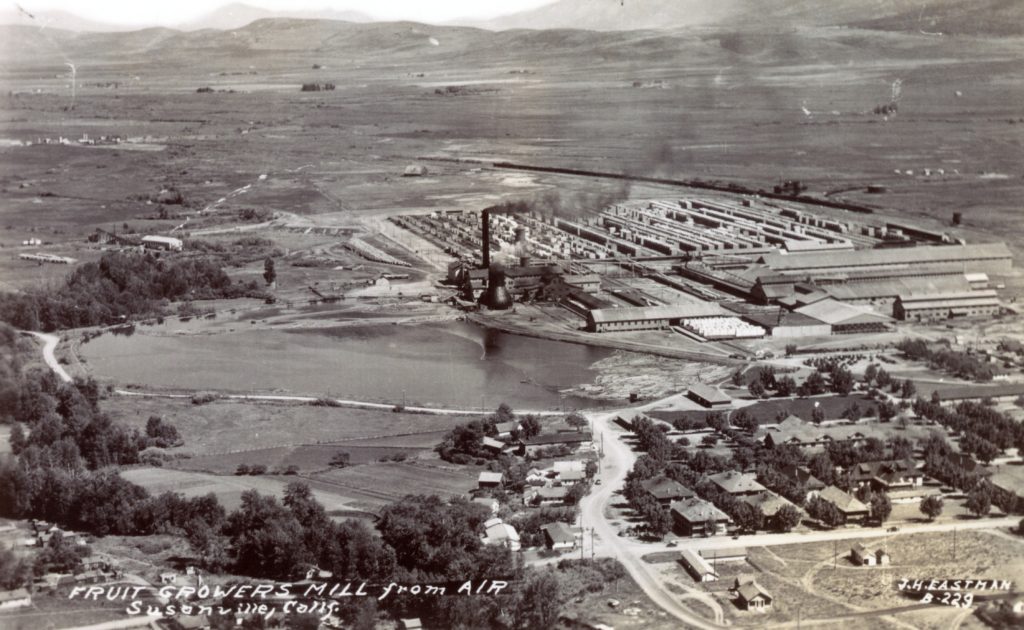
Fruit Growers Supply Company, 1936
Oh, dear reader, it gets worse. To support their claim they lied on the record at a city council meeting at the September 5, 2018, and that information then appears in the local newspaper only to get perpetuated. One of Schuster’s first comments that the city gave Fruit Growers the millsite property consisting of 256 acres, which it should be noted was larger than the city itself, and was located over a mile away from the city limits. Just the twenty acre parcel where the park is located, Fruit Growers purchased that from George and Pearl Bassett for $9,500. In all, Fruit Growers spent more than $60,000 for the millsite property and water rights. It just gets worse. Schuster noted that Fruit Growers sold the mill to Eagle Lake Lumber Company in 1944. Fact, Fruit Growers sold to Eagle Lake Lumber in 1963 for $875,000. Later on it was mentioned that Fruit Growers donated the park property. Excuse me. The city purchased it in 1976 for $23,000 from Sierra Pacific Industries, and it was not the city’s first choice. The city was trying to buy Vallejo Meadows along Piute Creek, north of Willow Street, and west of Parkdale, as part of a greenbelt program, but that deal fell through.
In closing then, with the City’s current thinking, Riverside Hospital where I was born and lots of others could not have existed under that name, as it must have been Fruit Growers Hospital.
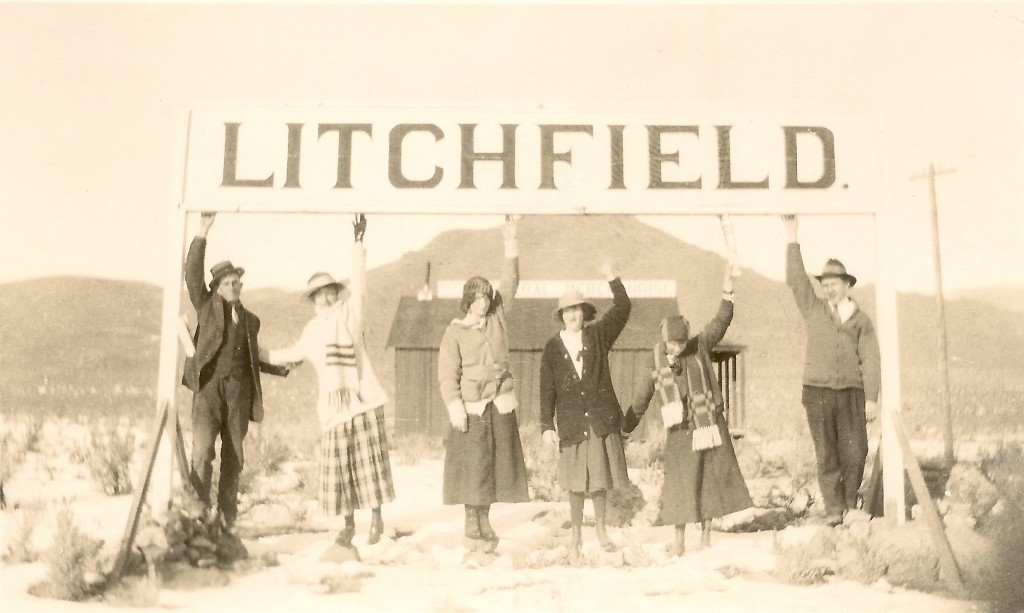
A town is born, Litchfield. Courtesy of John M. Gibson
Today, a graveside service is being held at the Lassen Cemetery for Clara Beth Haley Green, a great-granddaughter of Andrew Litch. When the family relayed the news of Clara Beth’s passing, they were bewildered by the fact the entry in the online encyclopedia Wikipedia, states that the town of Litchfield is named for Thomas Litch. Of course, this is false. While there is a ton of information to be found on the internet, it does not mean that it is accurate. Even commercial sites are not immune from providing paying customers with erroneus material.
In 1912, with the construction of the Fernley & Lassen Railroad was surveyed to go through ranch of B.F. Gibson and its location in that part of the Honey Lake Valley made it an ideal place for a combination townsite and railroad shipping point.
As Standish was less than three miles away, Gibson offered residents of that community free lots for those willing to relocate, which he dubbed his enterprise, New Standish. However, his offer was not well received, so Gibson named is his new town, Litchfield, in honor of pioneer settler and his father-in-law, Andrew Litch. By the way, the Thomas Litch referenced in Wikipedia, was Andrew’s son.
A little background for those not familiar with the topic, that I wrote about in the spring of 2015. Granville Pullen first came to Lassen County in 1870. He moved around, and in 1901 he bought a ranch near Janesville. In 1914, at the age 76, he retired from the ranch and bought a home in Janesville. It should be noted that Pullen had been collecting various artifacts and curious for forty years. Upon his retirement he opened a small museum to display his collection. People were fascinated and donated items to him.
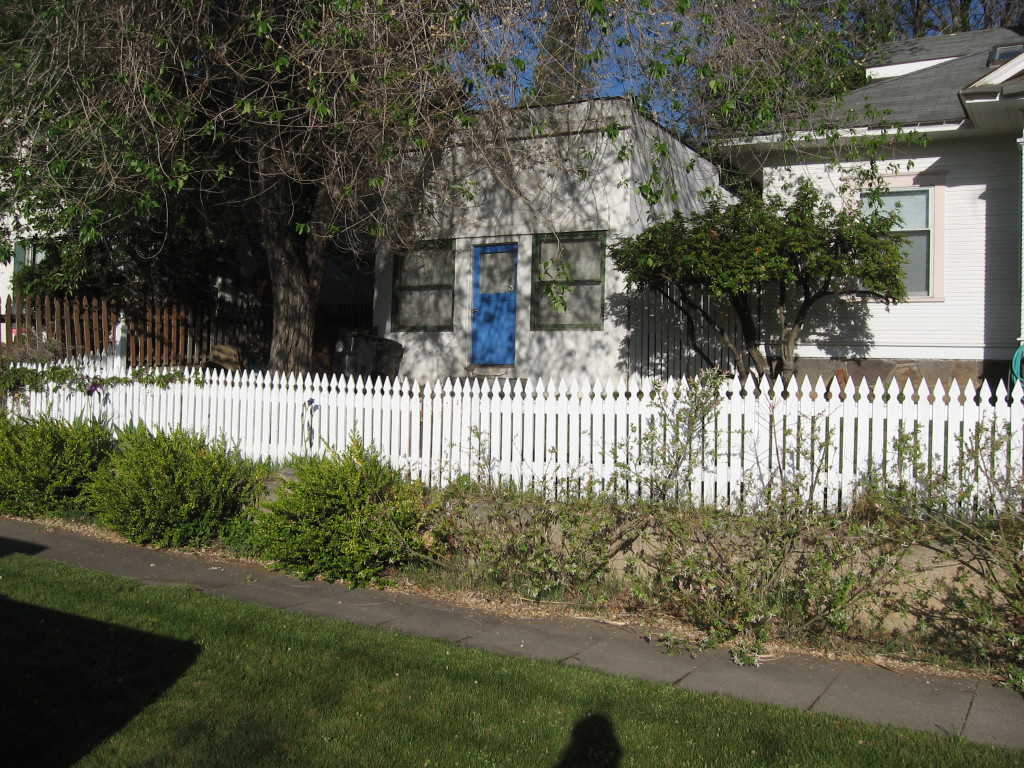
In 1920, Granville and his wife, Mary, bought a home on South Roop Street in Susanville. Next to his new home, he had a small concrete building constructed to house his museum and it opened to the public on June 18, 1921.
When Pullen passed away in 1926, his wife did not share her late husband’s possession for his artifacts. In early 1927, Mary donated the bulk of the collection to Lassen County and many items were put on display in the new Veteran’s Memorial Building. At the December 5, 1927 meeting of the Lassen County Board of Supervisors a discussion was held regarding the Pullen Museum. Mary Pullen offered the museum building on Roop Street to county on the condition it would be moved to another location. County Purchasing Agent E.F. Koken informed the board that it would be too difficult to move the building and the county declined the offer.
Diamond Mountain, circa 1940. Courtesy of Margaret A. Purdy
It is interesting to note that before the Red River Lumber Company and the Fruit Growers Supply Company harvested a single tree, the two companies stated with their sustained harvesting practices they would operated into perpetuity. While both companies no longer operate sawmills, they own large swaths of timberland, which is routinely harvested. However, large swaths of territory the companies would log contained a great deal of volcanic rock, not the best soils for second growth trees. In addition, when they did a tremendous amount of logging in these areas, it coincided during a twenty year drought cycle from 1917-37, that until this time the region had never experienced since the Anglo settlement of the 1850s. On the other hand, they had a positive outlook. Take for instance during the dedication ceremony of Fruit Growers sawmill in Susanville in 1921. Charles Emerson, a well known merchant and rancher was one of many dignitaries to speak. Emerson told the crowd of his own reforestation locally. Emerson recalled that as a child [he was born in Susanville in 1868], forty years ago, he helped plant a tract of pine trees on the family ranch just south of Susanville on Diamond Mountain. Those seedlings, he said, had become a fine stand of pine timber, many of which were 22 to 24 inches in diameter.
That was one of the front page headline stories of Susanville’s Lassen Advocate newspaper of April 1, 1927. The following is what the newspaper reported:
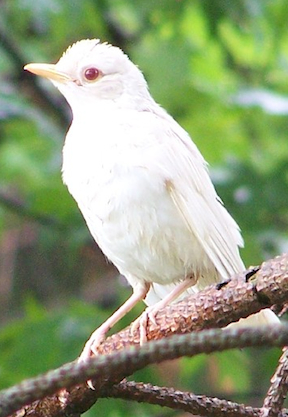
“James Madison, the young son of Mrs. Jessie Madison, saw a strange looking bird flying on the Hulsman Ranch about a week ago. After several attempts to get near enough to see what it was, he shot it. Nobody seemed to be able to tell what it was, so John B. Christie sent it to the University of California Berkeley for any information they might be able to give.
“During the past week a reply has been received that the bird was a Albino robin and that it is a very rare specimen for this section of the country.”
The Red River Lumber Company archives in Minnesota provides a wealth information on so many topics. Of note, the kept interesting records and observations about logging/sawmill operations throughout Northern California and Oregon.
One area where company officials “Whitewash” is that of industrial accidents. After all, it should be duly noted especially in that era, logging and sawmill operations were very dangerous occupations. Of course, in company records, invaribly the employee was at fault.
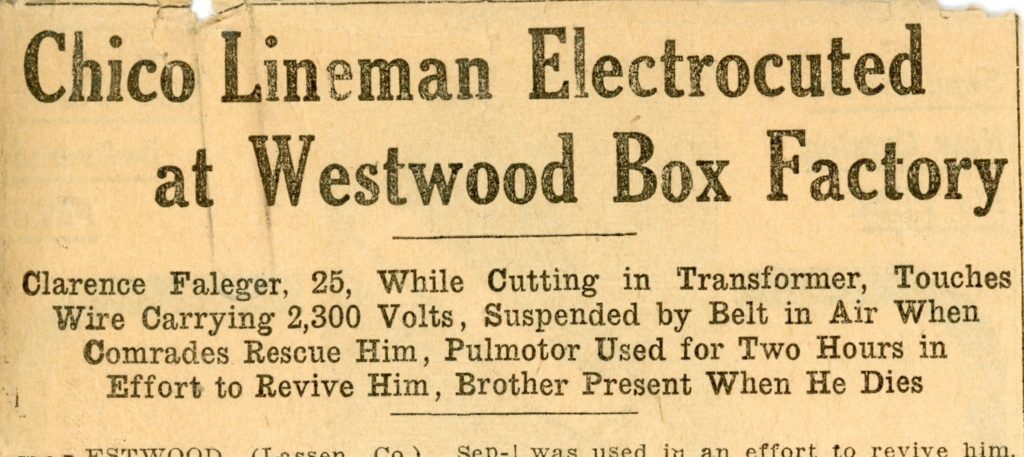
A perfect example is that case of Clarence Falegar. On September 7, 1916, Fletcher wrote: “Day before yesterday while one of our electricians was at work on a high voltage line, 2300 volts, he got a hold of a live wire in each hand causing a dead short through his body, killing him instantly. He was a young fellow by the name of Clarence Falegar who was raised on the Falegar Ranch in Falegar Gulch of Mountain Meadows, had had been at work for us a couple of years. He was 23 years old, single, has a brother working here and his Father lives in the Sacramento Valley, I believe. This make, as I recall, the 13thman to be killed on the construction and operation of this plant in three years, which is a pretty heavy price for the lumber and development of the plant, but I do not know how any one of the accidents could have been avoided as long as we have the element of heedlessness, carelessness and disregard for ordinary precaution along with the element of accident.”
On a quarterly basis, I ask you the reader, if there is something you would like to learn more about or maybe its something you heard, but question its validity. So here is an opportunity to participate. I will do my best to answer any questions. It should be noted, it may take awhile for the answer to appear as a post. The primary reason, many of the daily posts are done nearly a month in advance. So by the time you read this I am already working on posts for the middle of May, or at least I should be. Whatever the case may be, I look forward to hearing from you. Of course, it should be noted that paid subscribers requests receive priority. In addition, you can always send a request at any time.
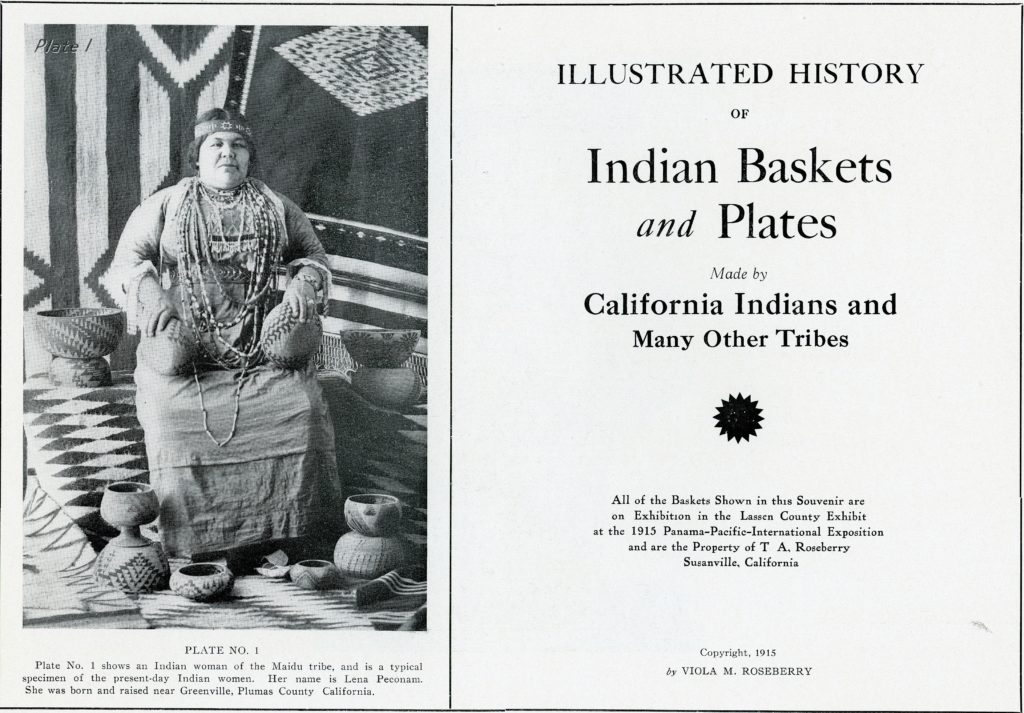
Viola Roseberry published an illustrated history of California Indian Baskets for the Exposition
The Panama Pacific International Exposition (PPIE) held in San Francisco during 1915, was a very big deal for California. Not only would it show case the Golden State as a whole, it went the further step that each of California’s 58 counties would be recognized. Not only would each county would have to maintain a manned exhibit, that every county would have a designated day at the Exposition. Before his passing, John DeLaHunt gave me an original panaroma print of Lassen County Day at the PPIE.
Lassen County retained the services of Russell Brownell to handle the county’s representation and exhibit. He entered into various contracts for the year long event. One of his first contracts was with Pittville resident George Louks. Louks would provide the exhibit with some fifty stuffed animals ranging from a bear, a bald eagle, two skunks among the various list. He was paid a total of $150 at increments of $12.50 a month.
Brownell’s next contract was with Susanville resident, Viola Roseberry, for her collection of some 300 Native American baskets to be displayed. She, too, like Louks, was paid the same amount. However, she was also hired at $27.50 per month to work at the exhibit. Just think how times have changed. After all she could live in San Francisco on less than $30 a month.
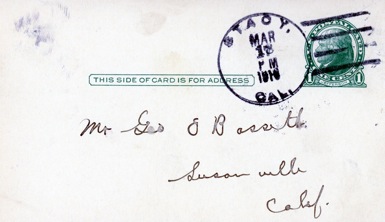
Stacy was a small agricultural community in eastern Honey Lake Valley and serviced by the Fernley & Lassen Railroad. The post office was established on July 11, 1912 and named for Stacy Yoakum Spoon, a wife of one of the town’s promoters. Of note, the Yoakum name may not be familiar to many. Stacy’s father in the early 1900s was the manager of the San Francisco Ranch in Willow Creek Valley, known today as Five Dot. Her sister, Eulalee, married Robert Trussell, a well known Johnstonville family back in the day.
Once upon a time, many years ago, when I was with my Dad, we met an elderly gentleman, who my father introduced me to him as the “Mayor of Stacy.” At that time, to be quite honest, I am not even sure if I knew where Stacy was. Anyhow, that man’s name was Allson Newman, a native of nearby Sierra Valley. In 1916, Newman’s parents, Ferdinand and Jennie located to Stacy, where is father operated a store and the post office. After his father’s death in 1942, Allson took over the family business and postal duties, too. As the region continued to de-populate, the Stacy Post Office closed on June 30, 1951. In the course of time, the Mayor of Stacy, would finally retire to make his home on South Spring Street, Susanville.
Stacy Depot. The town was named for Stacy Yoakum Spoon, wife of Grover Franklin Spoon, one of the town’s developers and its first postmaster.