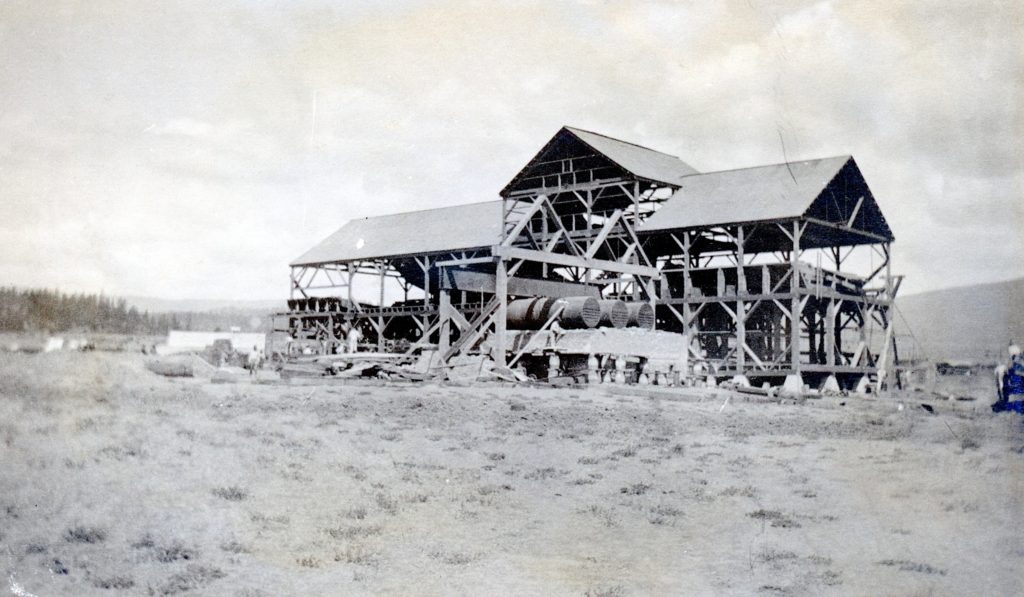
Lassen Lumber & Box Company’s mill under construction, 1918
In the spring of 1918, construction began on Lassen Lumber & Box Company’s mill on Alexander Avenue. The project was done in two phases. First there was the “small mill” officially desginated as Mill No. 2. This mill was placed into operation on August 1, 1918. The first plank was put on display at the Susanville Post Office. It was not anticipated that the “large mill” also known as Mill No. 1 be put into operation until early 1919. This was due to labor shortages and the difficulty in obtaining machinery due to World War I.
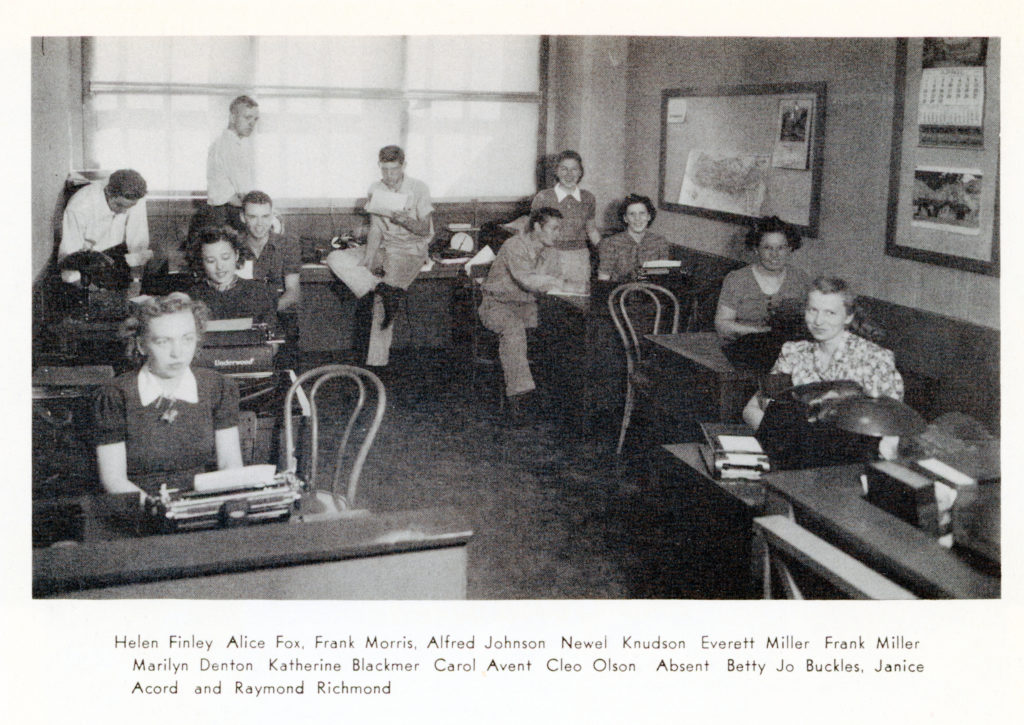
This was the name of Lassen College’s first student newspaper. How it came to be was pure accident, as it was not planned. In September 1939 the college offered a Creative Writing course. It was a venue for students to practice writing news article and general composition.
At the beginning of the second semester the class published a mimeographed newspaper, the “Jaysee.” By February the paper came out on a weekly basis. There was no assigned editor. Instead to give everyone an opportunity for a hands on approach, each week everyone rotated assignments.
The initial paper was financed by selling candy bars at the basketball games. In April it was deemed necessary that it would need an advertising department to finance future issues.
Fast forward to the Spring of 2019 and a new online student newspaper is now published at Lassen College known as “The Paw.”
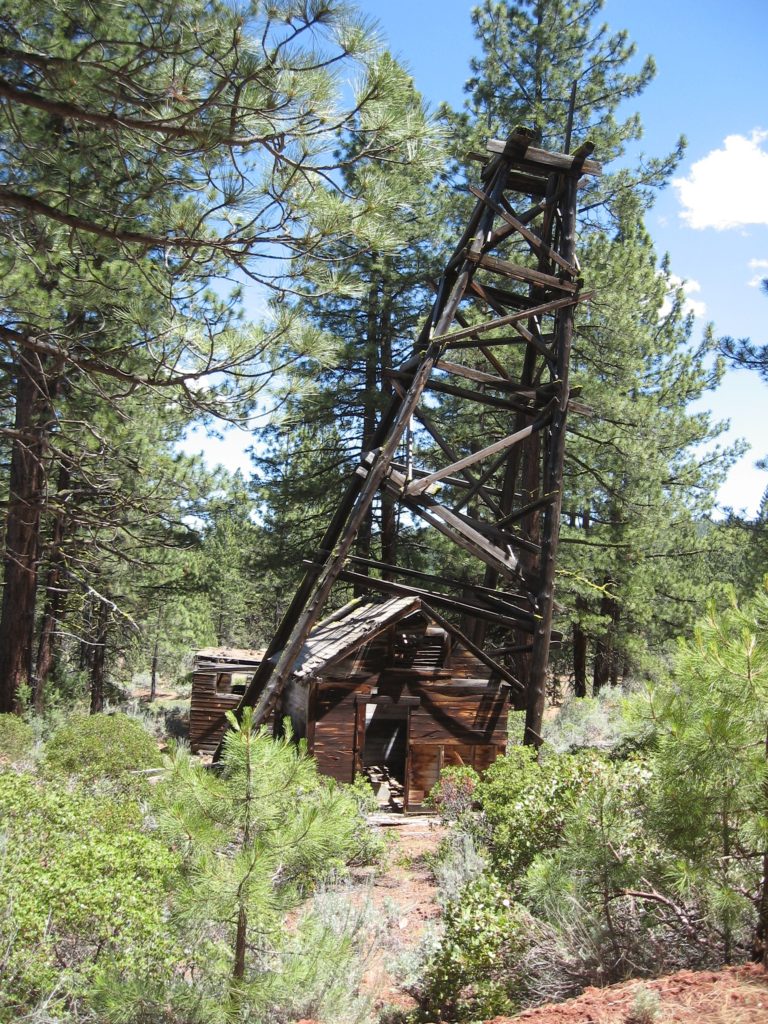
For some this will be easy and others pondering the state of the arrested decay. An easy clue is that in 1948, it was one of three railroad logging camps in existence in Lassen County.
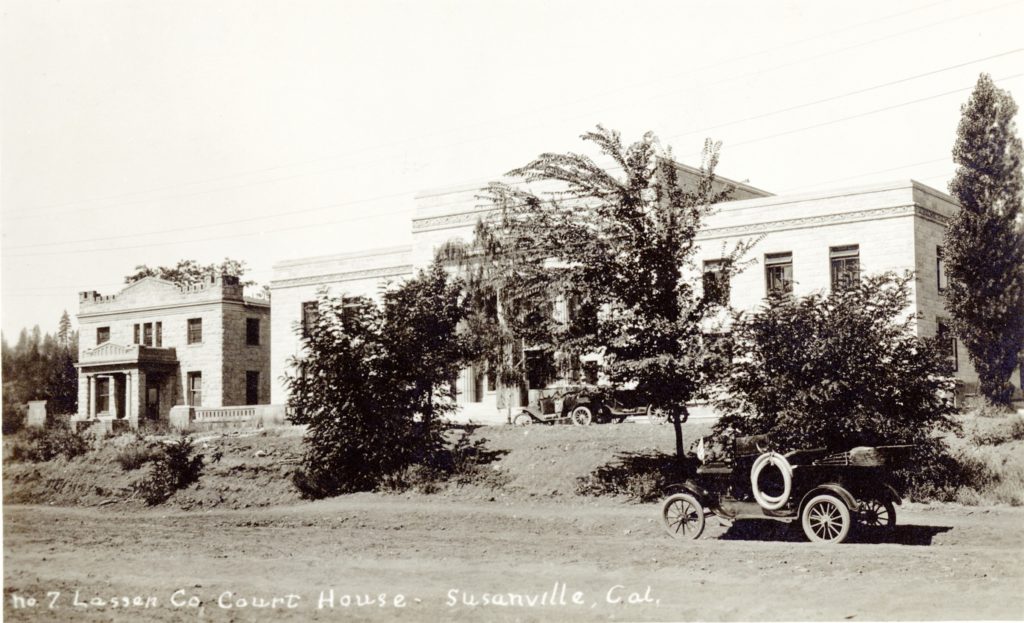
Lassen County Courthouse, spring 1917. Courtesy of Elberta M. Fraley
If you happen to stop by the Lassen County Courthouse you might be in a big surprise. The offices are in the process to be vacated from the building while it is being overhauled. The County Clerk/Recorder and the Treasurer/Tax Collector are to be moved to the ground floor of the annex behind the courthouse, while the Assessor is a block away at the corner of Roop and Cottage Streets.
Of course an item of interest, is will the two large Boston ferns in the lobby survive the transition? Years ago, I spoke with former Lassen County Clerk Nadene Wemple about the ferns. After all, she was well versed in the building’s history. It should be noted her family had a dynasty on the clerk’s office, her father George Tomb was county clerk and so was her mother Maude Tombs. Nadene could not recall what the original plants were the graced the left and right stair wells. It was not until the early 1920s, that the Boston ferns were planted and have thrived all these years later, with many years receiving almost no care at all.
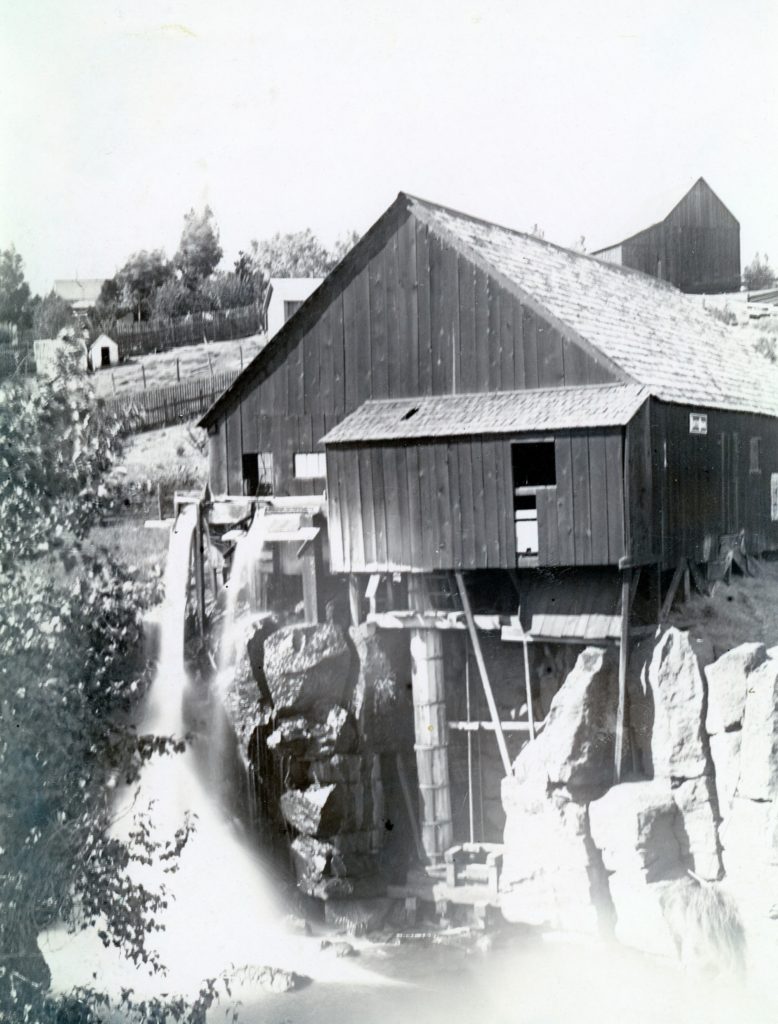
Arnold Planing Mill, circa 1905. Courtesy of Philip S. Hall
For many years the Arnold Planing mill located adjacent to the Richmond Bridge, Susanville, was one of the most photographed sites.
It was built in June 1873 by L.J. Abel and George Barley. This, like the other mills in the era, was powered by water. They constructed a ditch and flume about a quarter-mile upstream on the Susan River from the mill. It became known as the Arnold Ditch, and while it no longer conveys water, it is still used as a reference point to determine property boundaries. The mill primarily manufactured doors, sash, blinds, furniture stock, cornices and other related items.
In 1877, Abel & Barley sold the mill to Ezra P. Soule for $1,526.15. In that same year, Ezra’s daughter married Leroy D. Arnold. Shortly thereafter, Leroy operated the mill. In 1912, he retired and his son, Ezra Arnold took over operations.
On August 6, 1914, at approximately two in the morning, the residents of Susanville were awakened from their slumber by the alarm of fire. The Arnold mill had caught fire, and little could be done to save it. It was severe blow to the younger Arnold, his loss estimated at $10,000 was not covered by insurance. It was believed that a hobo had camped there for night, built a small fire to prepare a mill, but never fully extinguished it.
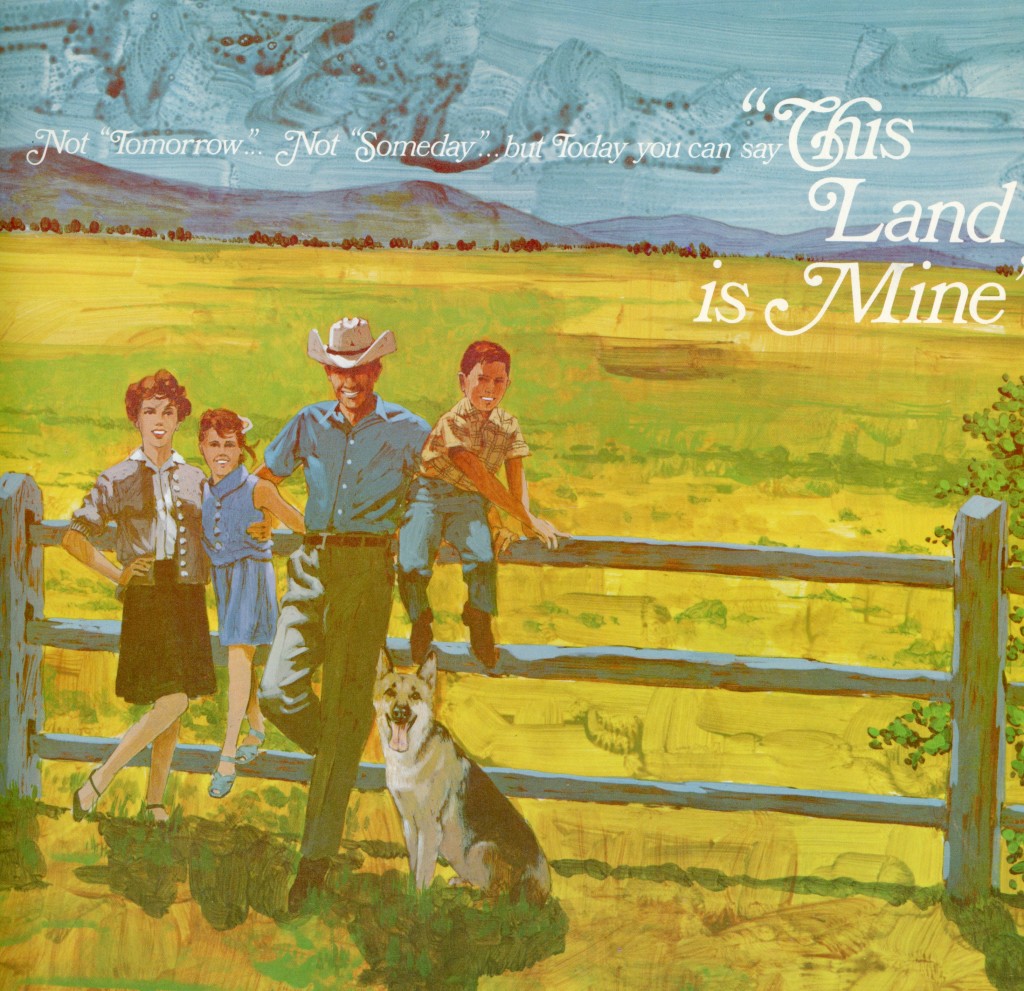
In 1968, the Occidental Petroleum Company purchased a large portion of the lands owned by the Rees T. Jenkins Land & Livestock Company. On the west side of the Madeline Plains, they subdivided thousands of acres into 20-acre parcels they named Moon Valley Ranch. The first unit was recorded on July 12, 1968. The Company’s advertising of the region made it too good to be true. “Now you get it all at Moon Valley Ranch: prime recreation land, within 4 miles of a 2,500 acre lake, in Northern California, the next recreational capital of the West and profitable investment property almost certain to appreciate as California’s recreation-hungry population continues to explode . . .And what a price now you can buy 20-acre parcels for less than $199 an acre–$150 down, $29 monthly.” Their portfolio expands on all the nearby wonderful recreational areas, such as skiing and golfing at Westwood, though they did not mention that Westwood was some seventy miles away. Also they did not disclose the fact that the golf course at Westwood was only proposed. The Company was correct in their advertisement that is was “The magnificent, away-from-it-all Moon Valley Ranch” to “land-that-time-forgot.” Moon Valley Ranch is a perfect example why there are disclosure laws in the real estate industry today. Numerous folks still invest in that property, purchasing parcels site unseen, only to realize that they bought a lot on a sagebrush plain or a rocky hillside covered with juniper trees.
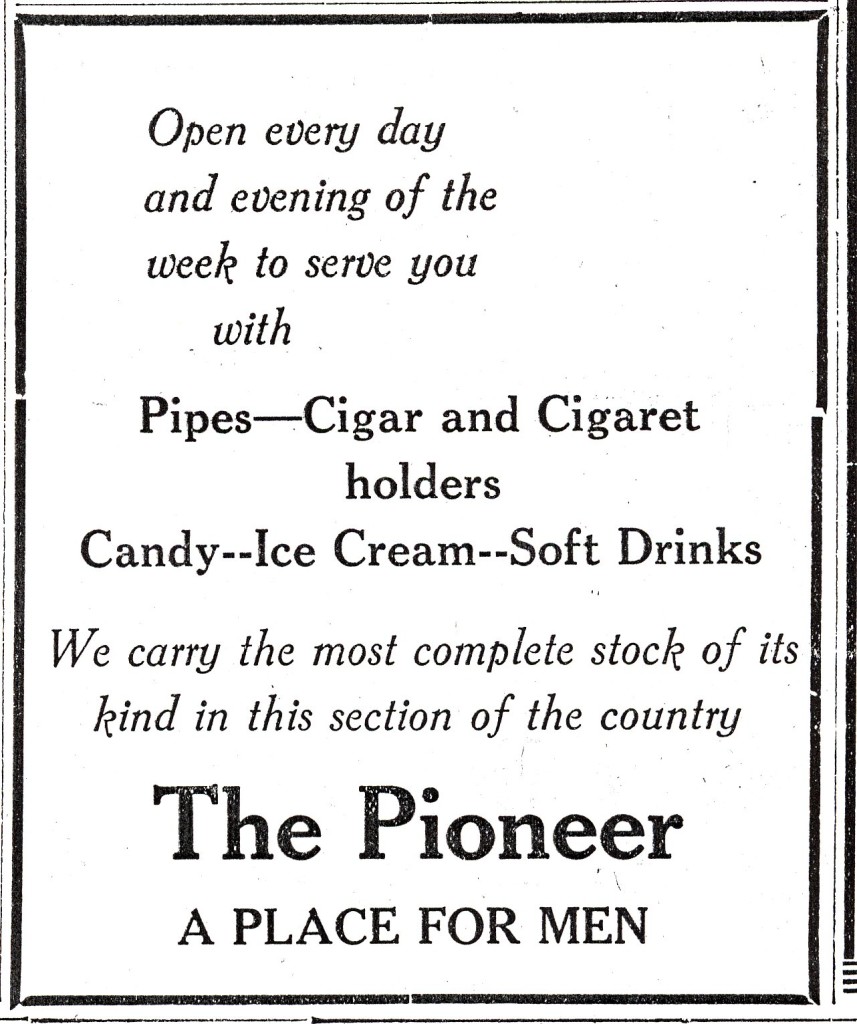
A 1920s advertisement for the Pioneer. It had to change its ways during prohibition.
In 1920, Grass Valley business man W.H. Tuttle purchased the Pioneer Saloon, Susanville’s oldest business. For many this was something a deranged person might do, since the nation’s prohibition of alcohol had just been implemented. Not only that, Tuttle announced he was going to replace the old wooden structure with a two-story concrete one.
To make up for the lost revenue from the sale of alcoholic beverages Tuttle branched out into the wholesale mercantile trade. In a very short time this enterprise turned out to be very lucrative, he specialized as a distributor of tobacco products and candy. In 1929, he sold the Pioneer Mercantile Company to John Solari and M.A. Griffin. After the repeal of prohibition the mercantile aspect continued until the late 1970s.
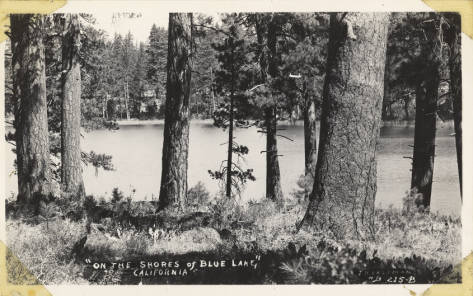
Blue Lake located in the very far northeastern part of Lassen County, is one of the many hidden gems around these parts. In 1929, the Lassen County Chamber of Commerce sent a petition that it should be included in the state park system. It did not fare well, due to the fact the property surrounding the lake was privately owned. Of course, things change with time. In 1932, R.C. Turrittin attempted to cash in on the California State Park Bond Fund. He offered to sell the property surrounding Blue Lake to make it a State Park, though the title was not in his name. The California Division of Parks liked the proposal and deemed it an important addition to the State Park System. Turrittin requested $12,000 cash–$8,000 from the State and $2,000 in matching grants each from Lassen and Modoc Counties. There was a problem with the deal.While Turrittin negotiated with the State and Modoc County, he failed to include Lassen County, where the lake is located, though it was frequented more by Modoc residents due to its proximity to that county. Lassen County politely stated that since they had never received the proposal and that their budget had been adopted, they could not consider the proposal until the next fiscal year. The proposal was tabled and that was the end of it.
On a final note, in 1941 the Modoc National Forest acquired the Blue Lake property through a timberland exchange.
Seasoned residents will remember this store located at 711 Main Street which is currently occupied by Iron Horse Gym. M.A. Griffin came to Susanville in 1912 from Loyalton. In 1920, at this location he operated a men’s clothing store. Griffin along with O.C. Watts revamped the men’s store into a five and dime variety store, and it opened on March 7, 1936. It was affiliated with the Ben Franklin stores. Griffins closed down in the 1960s and was replaced with Super 88, a similar type of store.
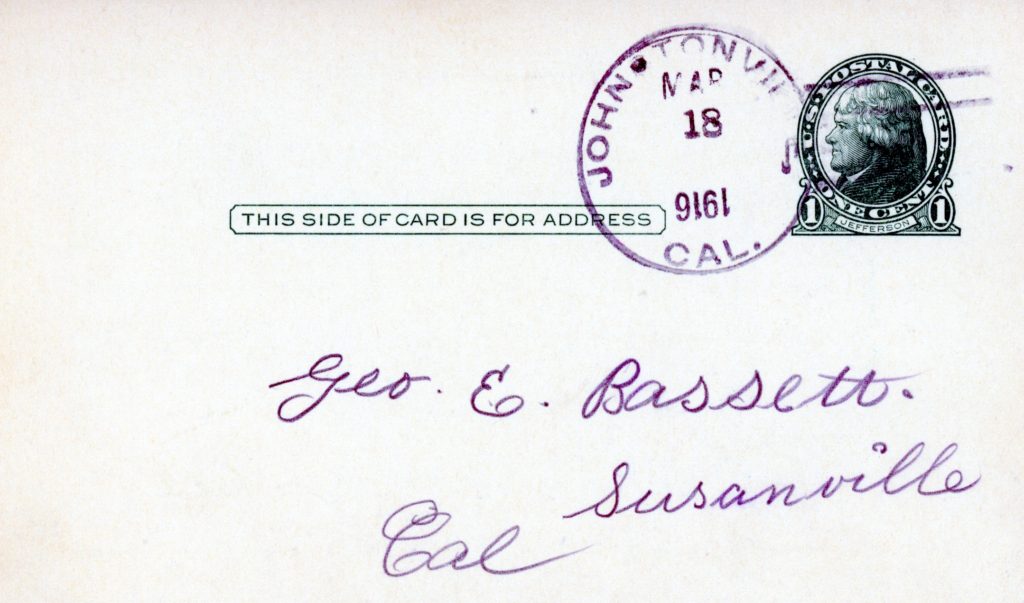
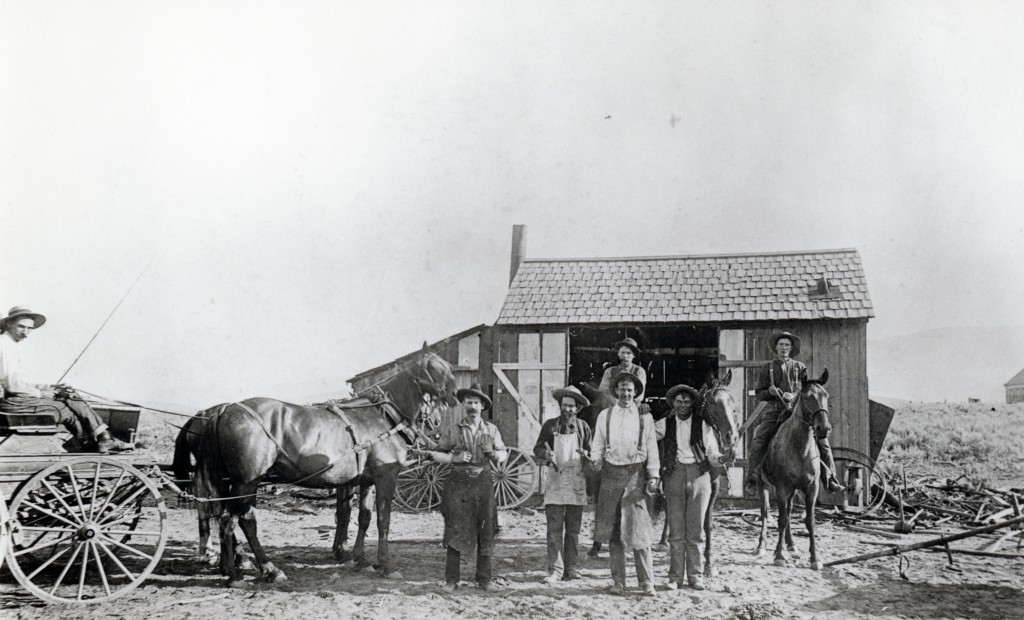
Johnstonville’s close proximity to Susanville hampered its development. Initially, for many years there were only two institutions that existed a school and flour mill. When the Diamond Mountain Creamery was established there, it was an impetuous start for the development of a community. Soon to open was Aaron Hooks blacksmith ship. This was followed by Andrew Spoon’s general store. On November 15, 1902, Spoon had established the Johnstonville Post Office. After a few years Spoon sold out to W.T. Stark in search of new opportunities. On March 3, 1936, Stark’s store, home and along with the post office was destroyed by fire from an overheated chimney. Once reimbursed by insurance all was rebuilt. The post office closed on October 27, 1943.