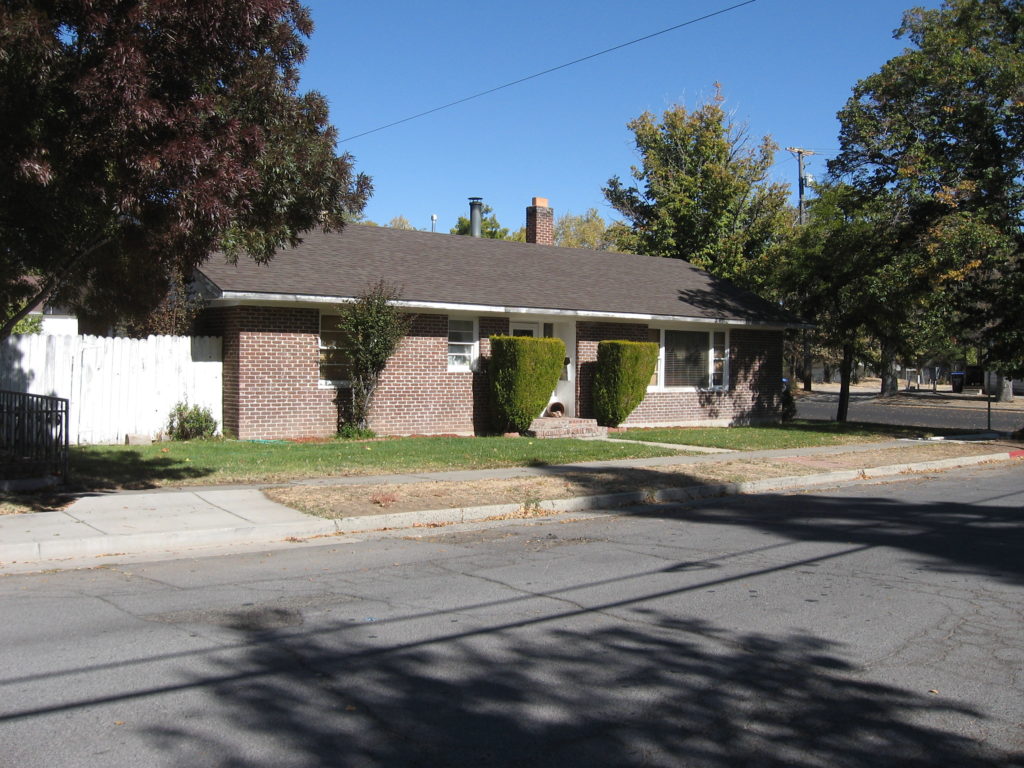
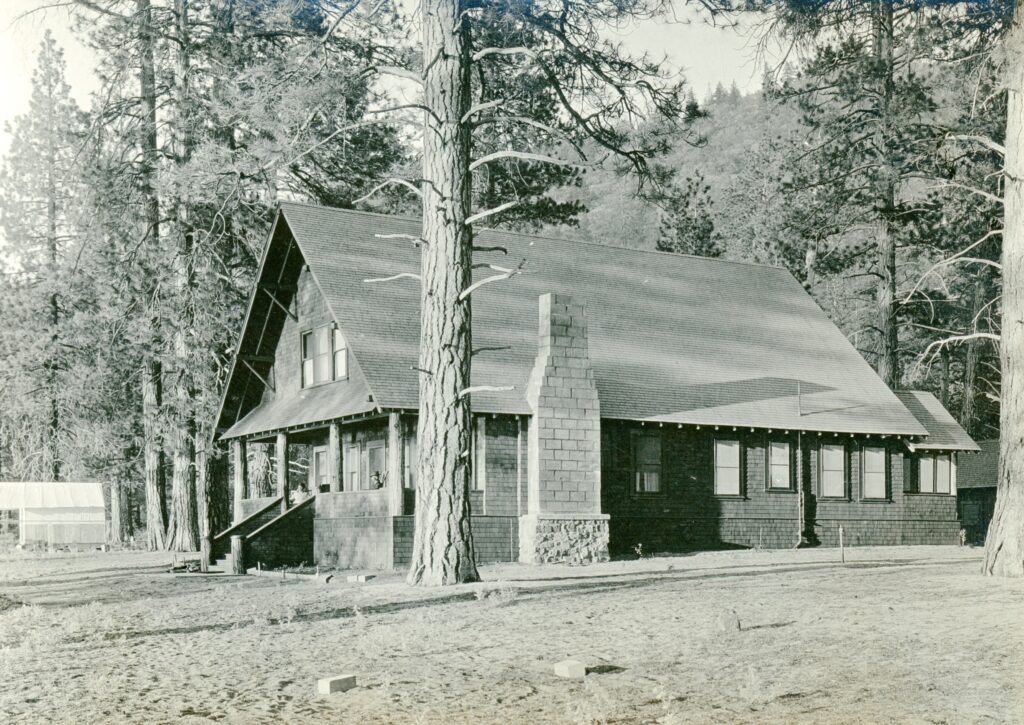
This brick house on the corner of Mill and South Gay Street has a story. Before it was built, the lot was occupied by a Victorian house. That blue Victorian house moved to adjoining lot to its west. This house was built repurposed brick. In 1948, the two-story Washington School, that was built in 1900, was condemned by the State. The bricks used to construct this house came from that school. Since that school was located on Cottage Street, only a block away, transporting the brick was not an issue.
The Susanville Grammar nee Washington School, nee Washington, as it appeared in 1948
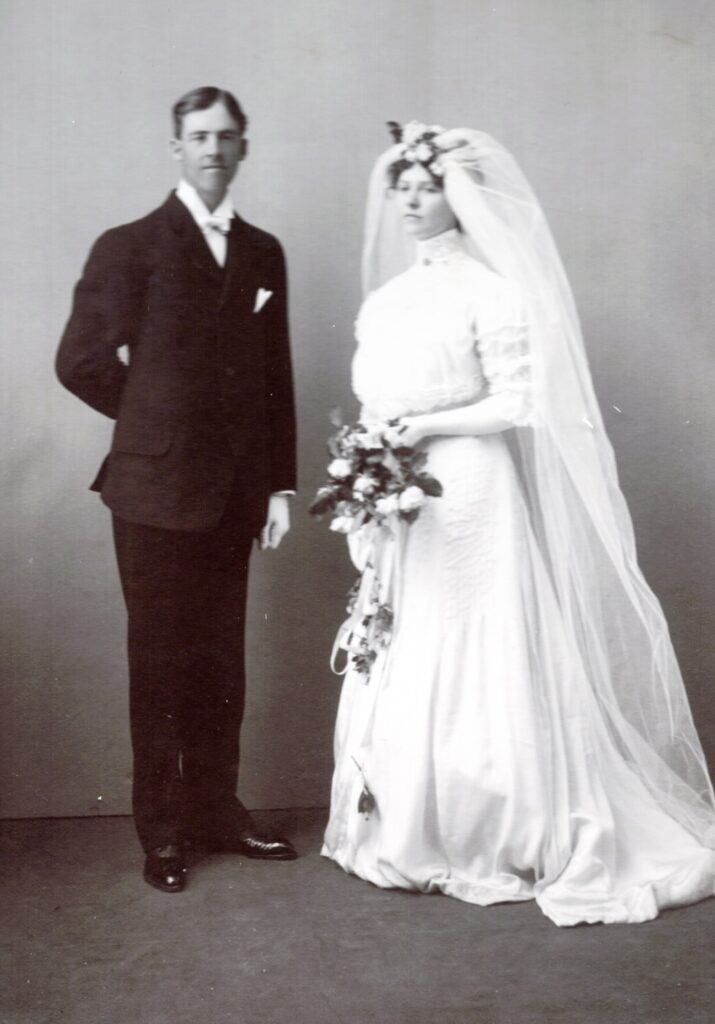
Russell & Line Goumaz wedding photograph Courtesy of Philip Hall
Russell Brownell – Lassen CountyAssessor. He was born in Lookout in 1884, but grew up in Oregon. In 1912, he returned to Big Valley as an advocate for the Allen Camp Dam on the Pit River, which is still being debated.In 1914, he was elected Lassen County Assessor. The following year he was in charge of Lassen County’s exhibit at the Panama-Pacific Exposition in San Francisco. In 1918 he was re-elected Assessor, only to resign a year later. At that time with George McDow, they subdivided a tract of land east of Susanville, known as the Milwood Tract, which extended from Hall Street to the fairgrounds, and Russell Avenue is named for him. Brownell, was an avid booster of Lassen County.One of the projects he was working on was with the NCO Railroad was to change its terminus from Wendel to Susanville where a new route would be constructed from Secret Valley via Belfast to Susanville. However, his death came suddenly on January 5, 1923 from pneumonia. Without his energetic enthusiasm, not only did the railroad project fell through, but the Milwood Tract floundered, in which in time was acquired by the Red River Lumber Company, which fought with the City of Susanville for two decades on annexation of the property.
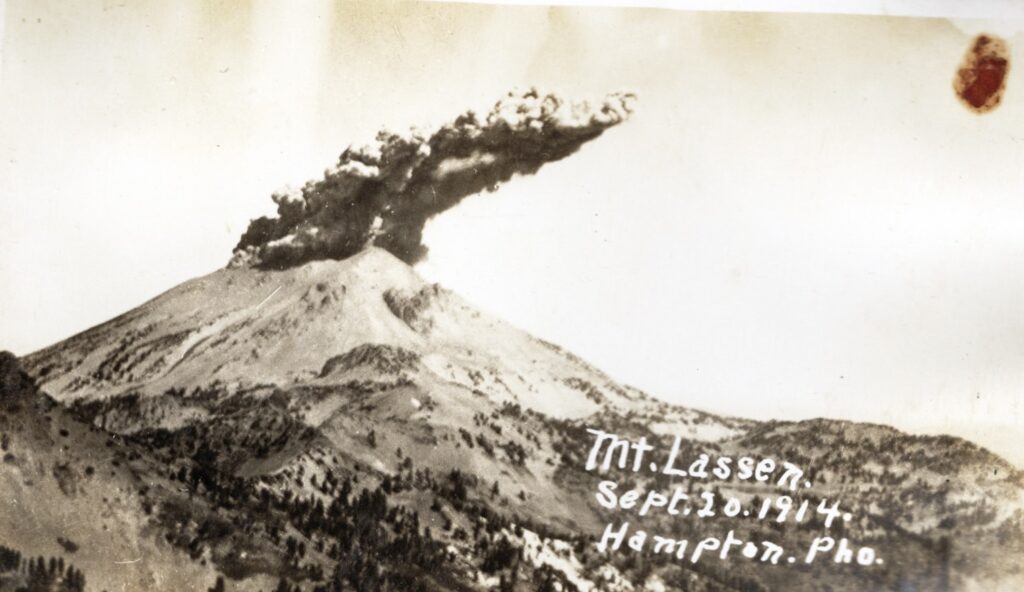
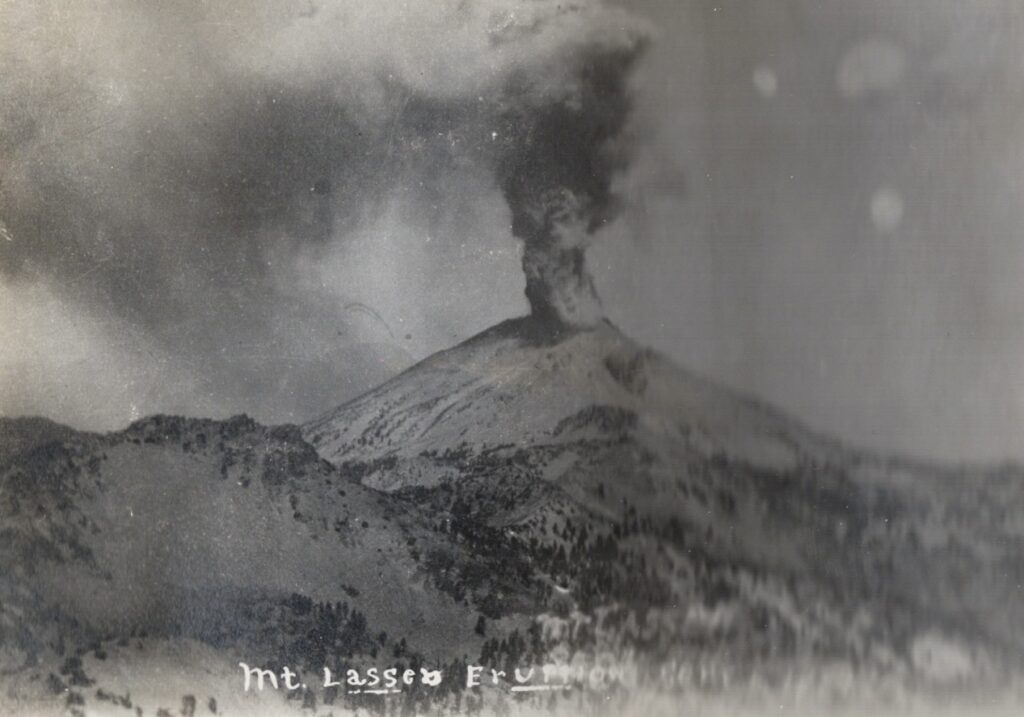
Call it what ever you may, and most people will refer to it as at Mount Lassen, though it is officially Lassen Peak. It does get confusing especially since so many of the prominent points of the Cascade Range have the appellation of Mount, i.e., Hood, Ranier and Shasta. When Lassen came into national prominence during its notable eruptions of 1914-15, it prompted the United States Board of Geographic Names to resolve the name issue. On June 2, 1915, the board officially named it Lassen Peak. But not everyone embraced the official designation. For example in 1917, when the peak had another eruption, E.W. Hayden of Susanville’s Lassen Advocate wrote, “Old Mount Lassen (we’ll call it Mount, if we want to) had another tremendous eruption of steam, smoke and ashes on Wednesday, and the display is regarded as one of the greatest since it ‘came back’ as a volcano.”
There have been stories of fake eruption of Lassen Peak. The granddaddy of all fakes occurred in 1929 when a complete plaster-of-paris replica of Mount Lassen was constructed. Its designer-builder was GeorgeCollins, brother of Lassen Park Superintendent Walker Collins. The mammoth two-ton project was built at Mineral. It was equipped with water pipes, to generate steam like eruption. Completed in August, it was to be Tehama County’s feature display at the California State Fair in Sacramento. All went well with the transport to the capital city. The “mountain” had to be hoisted by crane from the main floor of the pavilion to a second level. During that procedure the rope around the base fell apart, and the mountain came crashing down. As one reporter wrote “Mount Lassen went blewie.” Accordingly, it made its own eruption, or more nearly an implosion, whereby debris from the replica was widely dispersed and the noise of the whole commotion heard several blocks away. In one sense the mission was accomplished, for Tehama County received an unexpected windfall of publicity from its miscued fake mountain eruption display than otherwise anticipated.
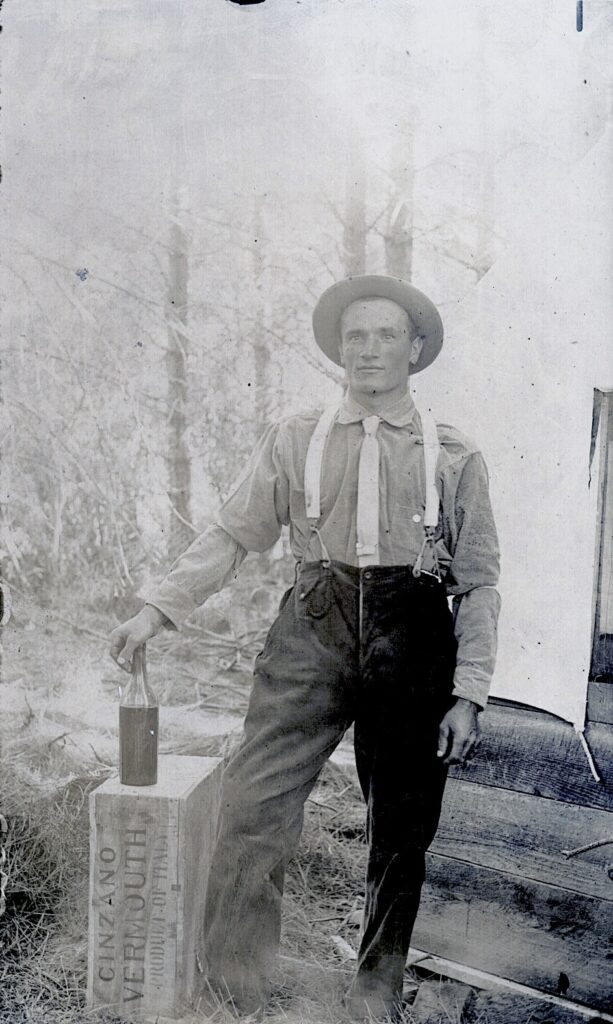
Pete Saffores (1882-1960) was a one time wine merchant-Courtesy of Margaret Purdy
In the 1920s, the local newspapers unleashed its creativity when describing every day affairs. Then there was prohibition which required a lot of newspaper ink. To be creative in 1926 the Lassen Advocate’s coverage of the bootleggers selling “dago red” and referred those arrested for their activities eloquently called them “wine merchants. Those arrested were Rudolph Parrish, Pete Gaudio and Pete Manfredini and known throughout community for their other activities.
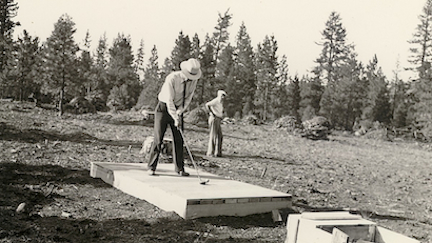
Susanville Daily News, June 9, 1936 Local Golfers To Play Sunday.
With two team victories already under their belts this season, members the Susanville Golf Club will invade foriegn territory Sunday in quest of their third victory.
According to word received here today, the Portola divot diggers are ready to welcome the locals in a return engagement. The match will probably replayed on the beautiful Mohawk greens.
Jack Weir, chairman of the committee in charge, is busy preparing a list of Susanville golfers who intend to enter that match. It is expected that some twenty members of the club and their guests will make the trip.
The locals have an unmarred record this season, having defeated both Portola and Westwood on the local C.C. Ulch course. However, they may run into difficulty on the green fairways of the Mohawk course.
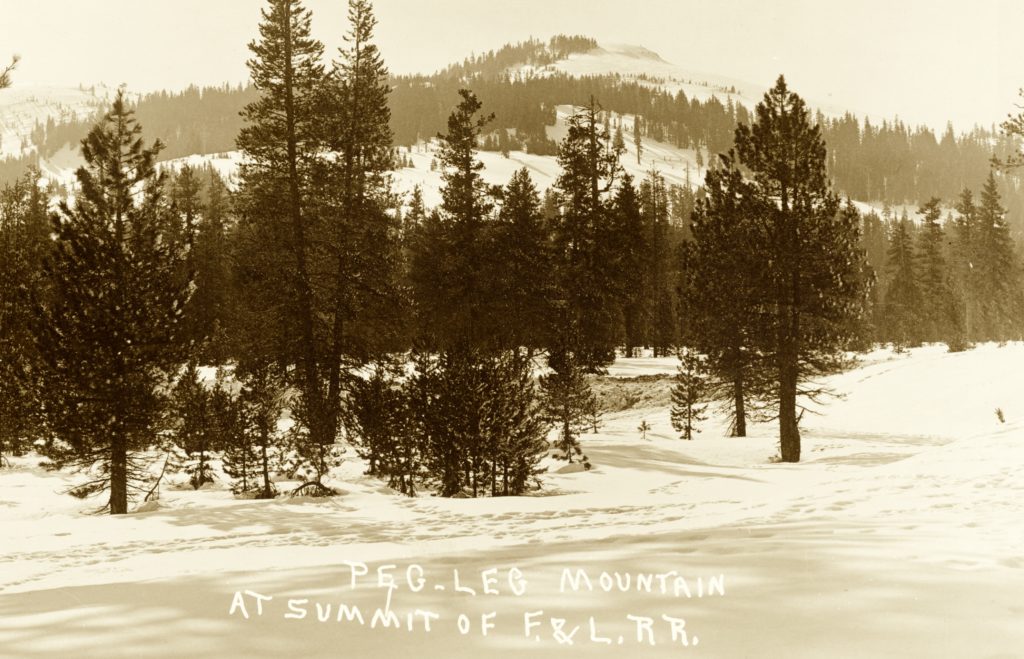
Peg Leg Mountain, February 1914. B.R. Zimmerman Collection
This mountain, for those not familiar is located a short distance northeast of Westwood. In 1864, David Johnson (1815-1904), who was better known as “Peg leg”, came to California. While en-route to the Sacramento Valley, his wife, Martha, aged 35, died on October 12, 1864, at Devils Corral, Lassen County. Johnson transported her body to Mountain Meadows where he buried her, which is known as the small cemetery at the 101 Ranch.
Peg leg was known as an old time mountain man who spent his summers in this region and wintered with his family at Red Bluff. In March 1903, his son, John W. Johnson was granted guardianship of Peg leg, who had been declared insane by the Court. Peg leg had two daughters, Mrs. Elizabeth Howard and Mrs. Mary Heckle. John had filed a request to sell the Mountain Meadows property for $800. The sisters contested the sale, as they cited the land was worth at least $1,400. The court approved John’s petition. Peg leg’s property was sold to W.C. Lucas and J.A. Virden for $800. On April 5, 1904, David “Peg Leg” Johnson died at the Napa Asylum for the Insane. His family brought his remains to Mountain Meadows in June and interred them next to his wife, Martha, and their twenty-nine year old son, Ralph, who died in 1884.
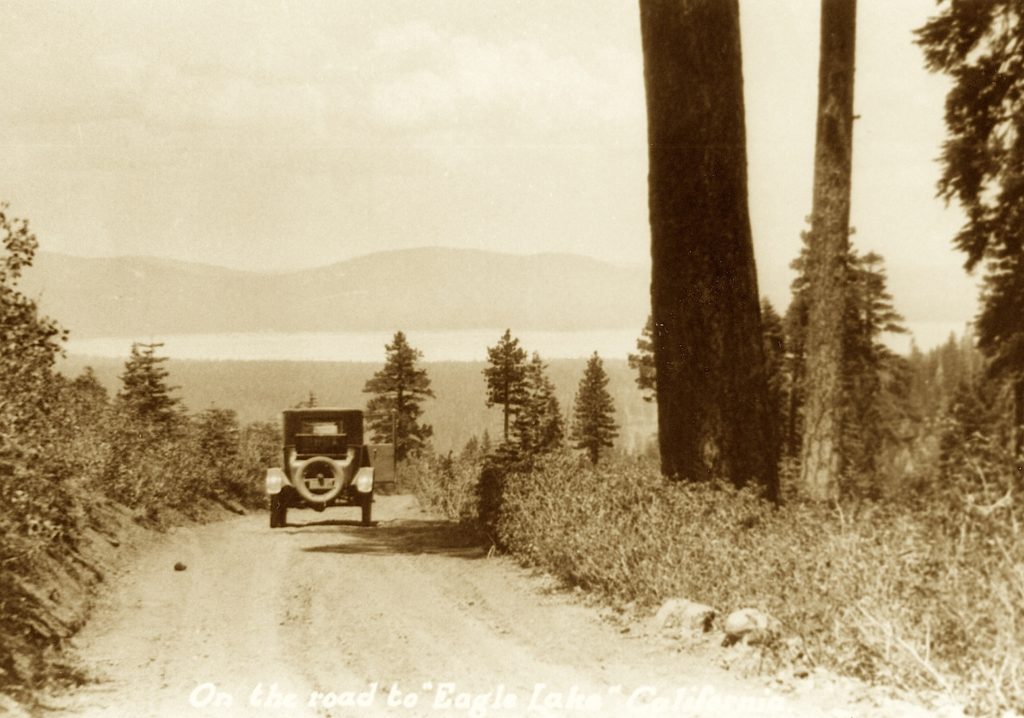
Eagle Lake Summit, 1923. Courtesy of Dick & Helen Harrison
On October28, 1913 Susanville hosted a good road meeting with Red Bluff dignitaries. It should be noted the California highway system had not been formed. With the development of Westwood and the Fernley & Lassen Railroad there was prosperity in the air. The Susanville Lassen Advocate urged the locals that it would be in their best interest to have a suitable road to the south shore of Eagle Lake. Between a good road to connect with Red Bluff and the rail connection from the east Eagle Lake would become a tourist mecca.
Gallatin House, 1924, Wyn Wachhorst
It should be noted that Malvena Gallatin had just completed in her summer home at Eagle Lake. Gallatin owned property in Tehema County and the Red Bluff route would be ideal for her. In attendance was an engineer by the name of Leon Bly and a member of the the Red Bluff delegation. Thus, the stage was set for Bly-Gallatin meeting and the high water levels of the lake.
In 2017, I conducted a Susanville Cemetery Tour, as part of the Lassen County Courthouse Centennial. The tour focused on those interred there that had an association of with the county. So I thought would share some of the graves we visited, and we start with Howard Meylert.
Poor Howard, he liked numbers, but the numbers did not like him. He died at the age of 44, after a 14 day bout of typhoid fever. In 1882, he came to Lassen County from his native Pennsylvania to work in his uncle’s general store in Janesville. At the age 28, he was elected Lassen County Treasurer in 1888 and re-elected in 1890. In the fall of 1892, near the end of his second term, he decided not to run again as the Bank of Lassen County was in the midst of formation. When his term expired he went to work at the bank as cashier. Do not let the title fool you, Meylert as the sole employee basically ran the bank. He remained in this capacity until his untimely death in 1904. On a final note, Meylert was the first person to hold an elected to a county office, but that as a elected official for Susanville as a Trustee, which he served in that capacity until his death.
The unpacking of the archives continues. For some strange reason, I always grab a box of loose papers and photographs. Sooner or later I am bound to find boxes of organized files destined for a waiting file cabinet. More about that later.
Early in my research years, I met a wonderful person, Betty Barry Deal (1921-2017). She was a daughter of two pioneer families – Barry and Elledge.. * While they were not hoarders in the typical sense, they kept documents and other historic memorabilia. For years, Betty gave me boxes of records. Many I catalogued, but for some unknown reason, there were two I had not.
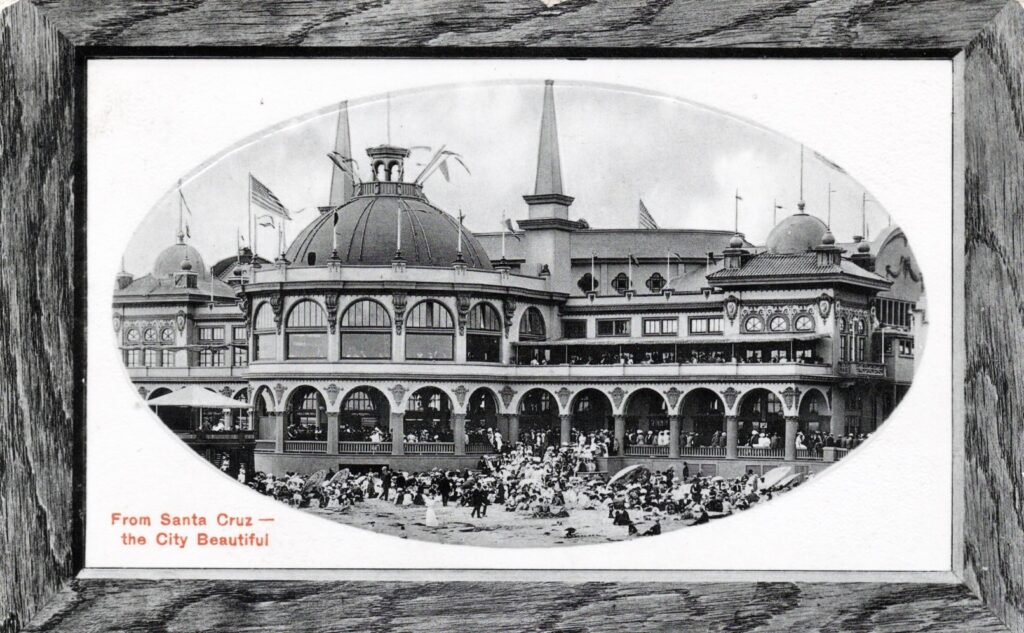
Of course there are out items such as this 1917 postcard of Santa Cruz.
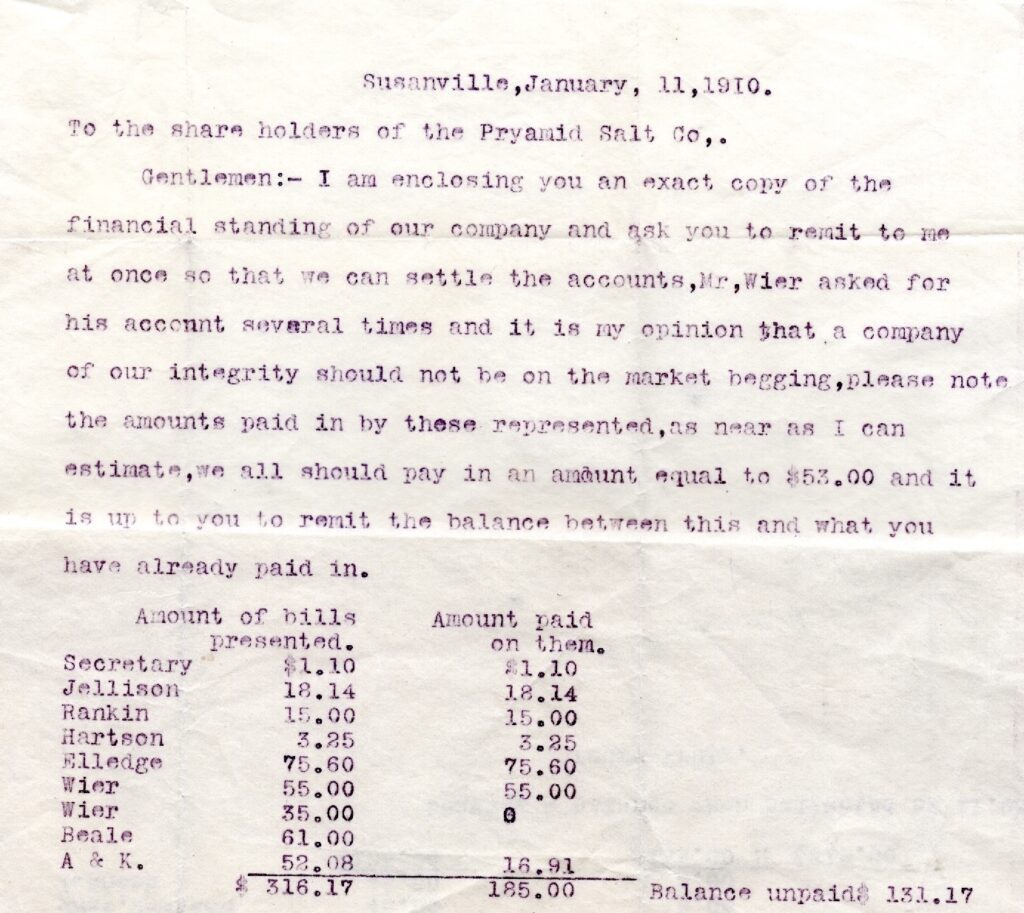
Assorting the boxes while tedious, there is a treasure trove. There are letters that gives an insight of behind scenes such as the formation of Standish that we will explore later. Then, some documents I am just plain dumbfounded as in today’s first illustration. In all my years of research I have not ever come across a reference of the Pyramid Salt Company.
Tim
*One of Betty’s first cousins was JoAnn Elledge Uptegrove, who shared a striking family resemblance. I would normally see JoAnn at the grocery store, and I would automatically think of Betty.