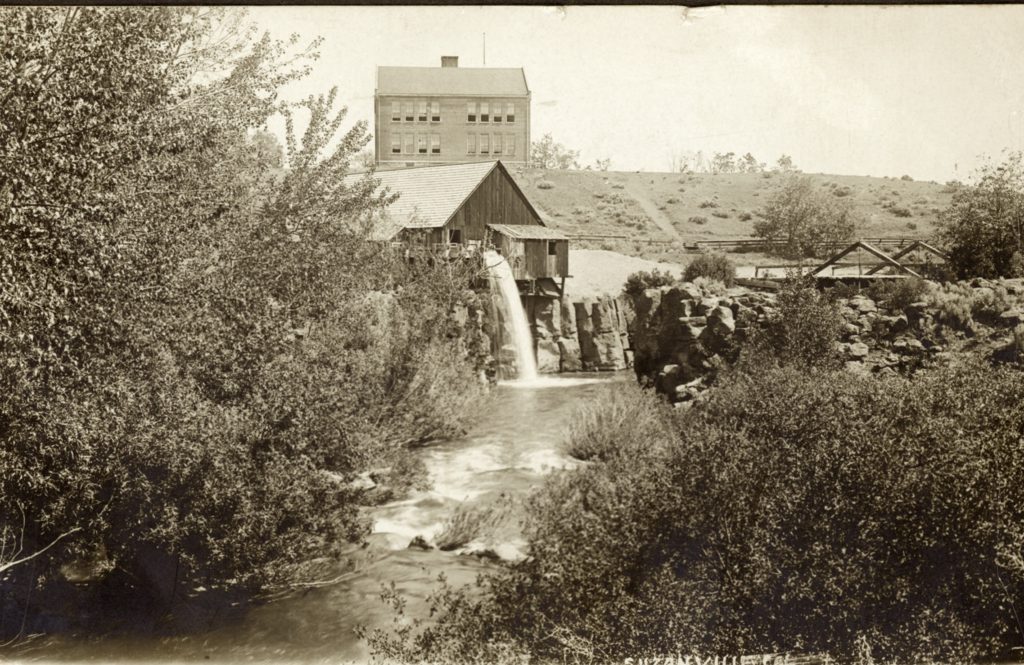
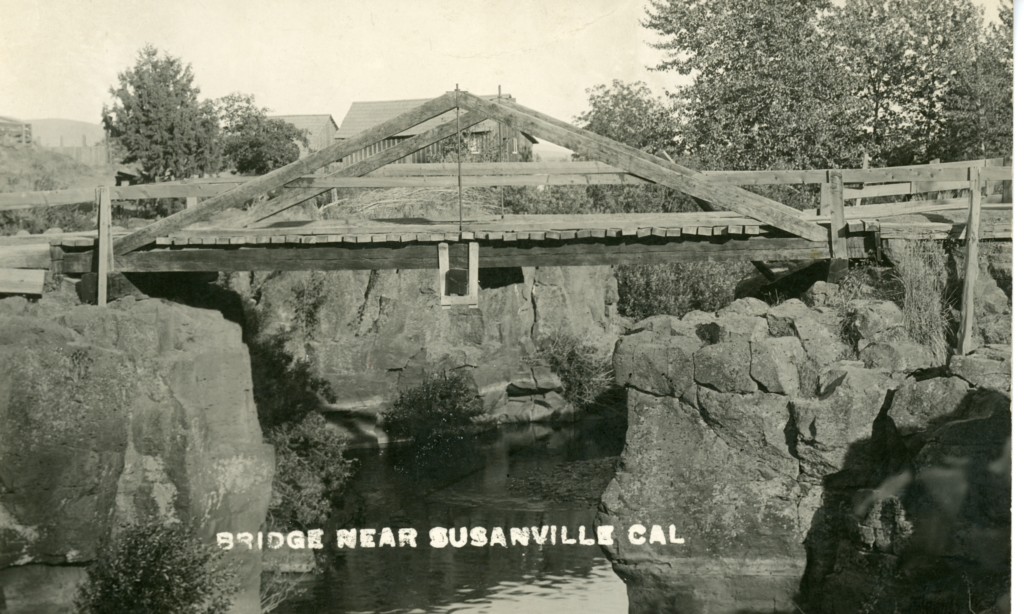
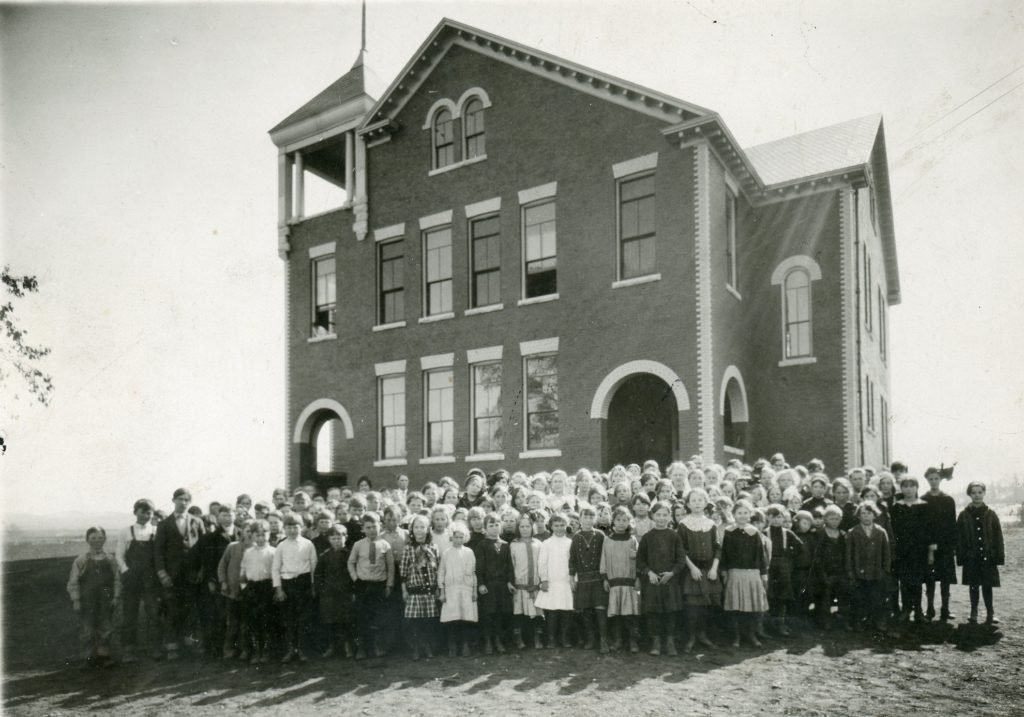
The Arnold Planing Mill along the Susan River near the Richmond Road bridge was one of the most photographed landmarks in the area before it was destroyed by fire in 1914. Of course, enhancing the view was the Susanville Grammar School (later renamed Washington) on the hill above. Then there was the wooden Richmond Road bridge that was replaced in 1915.
Richmond Road Bridge, circa 1910. Courtesy of Lola L. Tanner
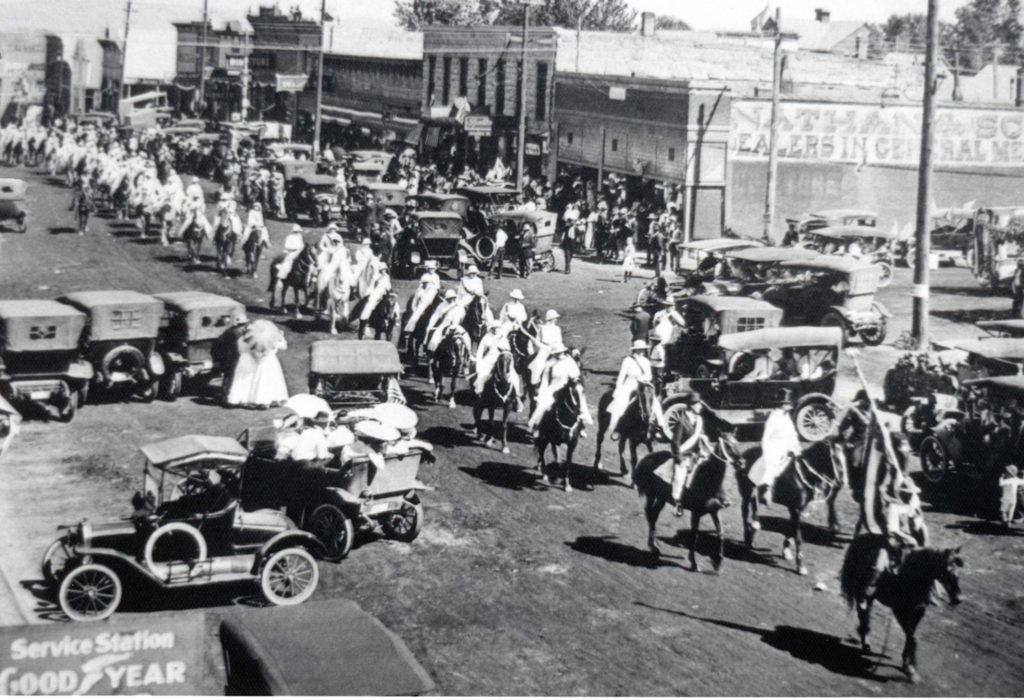
The Susanville Volunteer Fire Department went all out to put on a two-day grand Fourth of July celebration for 1916. The festivities began at 9:30 a.m. on Monday July 3 with a band concert with the music provided by the Westwood Orchestra. This was followed by horse races, foot races, more band concerts, a boxing match topped off with an outdoor evening dance.
The activities kept coming the next day. There were firemen’s competitions between Alturas, Susanville and Westwood. There were more boxing matches, baseball games, band concerts with a parade that afternoon.
At 8:30 p.m. was the grand fireworks exhibition. The location and viewing points were unique, no doubt with fire safety in mind. The fireworks display occurred at the intersection of Riverside Drive and Prospect on the bluff above the Susan River. The public was urged to view the fireworks on the opposing bluff where the Susanville Grammar (nee Washington) School. An hour later a Mardi Gras and carnival dance capped the celebrations.
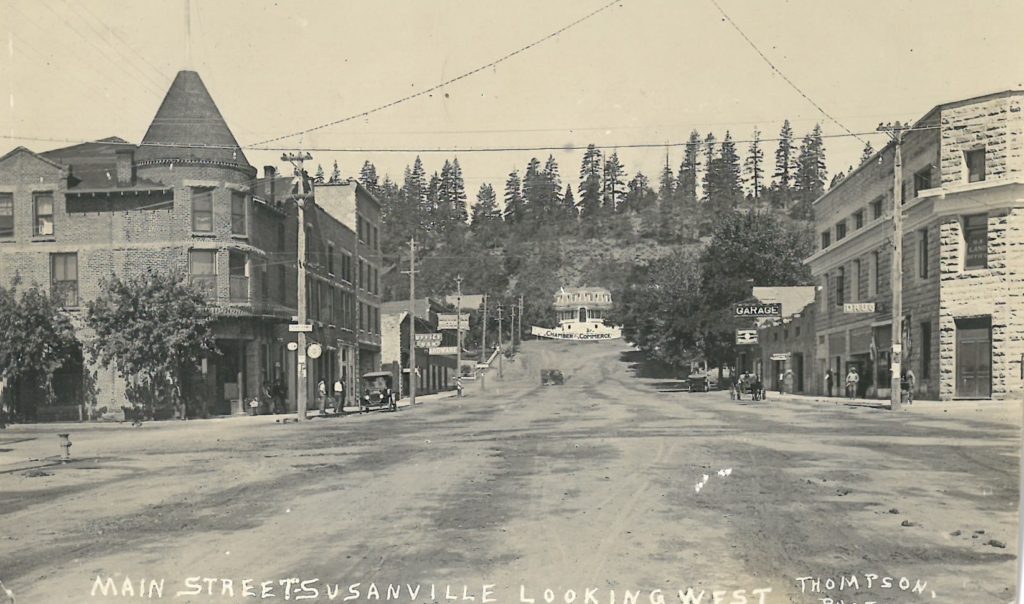
The grammar school, 1915. Courtesy of Royce Houston
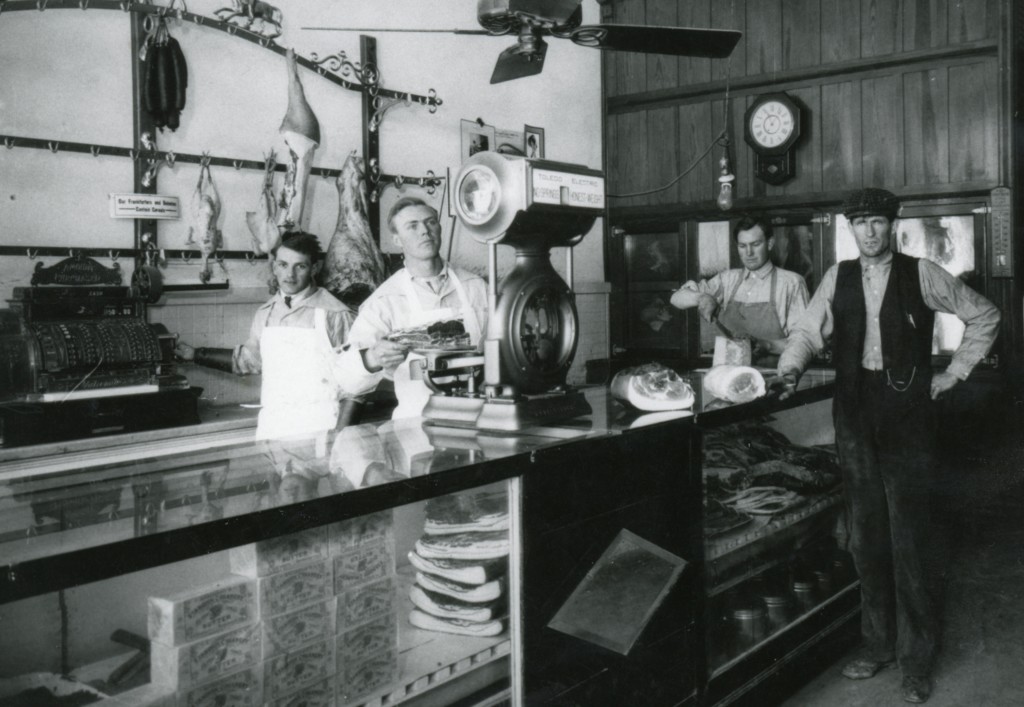
D. Wood & Sons Butcher Shop, Susanville, 1914. Courtesy of Verna M. Wood
In the spring of 1910, the Hunsinger & Wood Meat Market wanted to inform their customers that they have a nice supply of pickles, cheese, cooked ham and smoked fish. This they believed would solve anyone’s lunch problem.
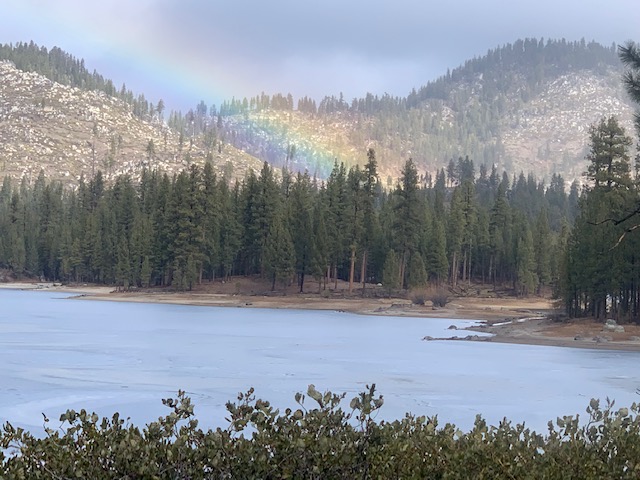
Antelope Lake in Plumas County is a popular recreational spot for a number of Honey Lake Valley residents, as well as nearby Nevadans. It is part of the State Water Project of the California Department of Water Resources. The project’s original intent was to provide water to Southern California to augment that of the Colorado River. The State Water Project has 21 dams and over 700 miles of canals, pipelines and tunnels.
Antelope Lake is part of the project. The 113 foot tall earthen dam was constructed in 1964. It has a surface area of 931 acres with a maximum capacity of 47,466 acre feet.
The following is kind of daffy considering the source. In January 1964, the Lassen County Historical Society published a bulletin on Hayden Hill. Nothing to dramatic, until in a section of tidbits referred to as “Did You Know,” becomes bizarre, which the following appeared.
“When the election for County Seat was held during 1864, Susanville, Janesville and Hayden Hill were the three towns selected at the meeting held April 1. On May 9, 1864, a vote was taken and when the votes were counted it was a close choice. Susanville won over the other two by one vote.”
The author of above, also wrote the early history of Hayden Hill which appeared in the same publication. It is duly noted that gold was discovered at Hayden Hill in 1869, though the mining town was not established until 1870–six years after the county seat election!
Judging by the visitor’s plates of this popular lake, one would think you were in the State of Nevada. On the other hand, the water impounded there is destined for Los Angeles.
Camp 38, Red River Lumber Company, 1922. It was located on the east shore of Lake Almanor. Courtesy of R.S. Pershing
While I have touched upon this topic before, I came across an interesting letter and how Red River was managing its forest. There are a number of institutions that search this site for all kinds of information, natural history being one. As public service, I bring this bit of information to the surface for future researchers.
On August 10, 1935, Clinton Walker wrote to his brother Archie, who resided in Minneapolis. Archie was stable figure in the Red River Lumber Company’s management, since the company had vast holdings there as well.
Clinton was involved in the initial timber acquisitions in California. In 1913, he resigned over a family dispute on the future operations. He came back into the fold during Red River’s financial crisis of the 1930s. Enough background and onwards to Clinton’s commentary.
”It is regrettable that the house of Walker has no forest man. Kenneth [Walker] covers the nearest, but he seems to be absorbed in the performance of log contracts; our annual fire and insect losses are staggering. A systematic annual light burning at the right season of the year would reduce an ultimately eliminate these sources of loss and the cost would be insignificant as compared to the loss and yearly fire hazard conditions in the forests. Burning by means of power burners on or dragged behind tractors could be done very cheaply and the prospective danger of injuring hollow hulled trees could be eliminated by following the burning with a few shovelers. For the entire period of the Walker family timber operation we have centered our attention exclusively to lumber operation. We are doing nothing but slash down that wonderful forest and letting the fire and beetles burn and eat us down year by year without raising a hand to afford protection from these annual staggering losses.”
On Thursday, June 24, 1926 the City of Susanville ordered a ban on fireworks due to the high fire danger. The city, as a precautionary measure, asked the Lassen County Board of Supervisors to burn the vegetation bordering the city limits.
The next morning around eleven a.m. all hell broke loose when a forest fire broke out about four miles south of Susanville. By noon the Roy Ramsey ranch house (known today as Les Allen) was in the fire’s path. Fortunately, the nearby Ramsey irrigation ditch was able to fend off the fire. Next in harms way was the Lassen County Hospital which narrowly escaped the fire’s fury.
In effort to keep the fire from reaching town, a back fire was set. It was not good. It did the opposite, starting a branch fire just below Hobo Camp, and in the worst case scenario, jumped the Susan River and headed towards Inspiration Point. A fire crew was stationed on Quarry Street, at the base of the bluff as attempt to keep the fire under control, though a flare up nearly threatened the Elks Lodge. On the other hand the timber on Inspiration Point bluff was not spared. By Monday the fire was finally suppressed. Amazingly, not a single structure was lost, though the Red River Lumber Company did loose considerable timber.
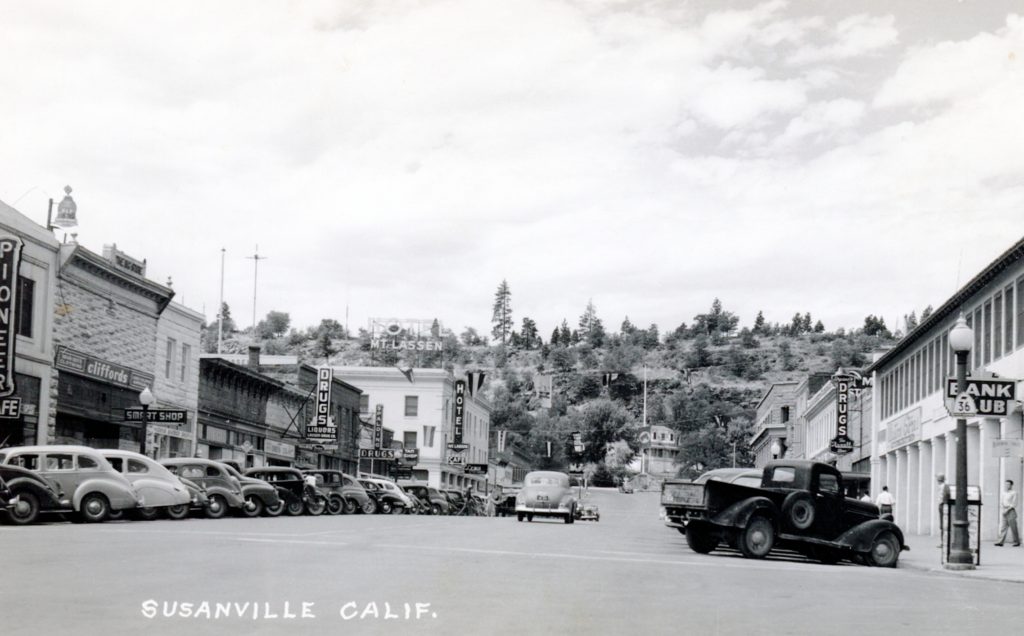
Main Street, Susanville, 1945.
One may ponder why I used these two photographs for illustration. If you examine them, the 1915 shows the bluff forested, the latter thirty years later, with pine trees missing due to the aftermath of the fire.
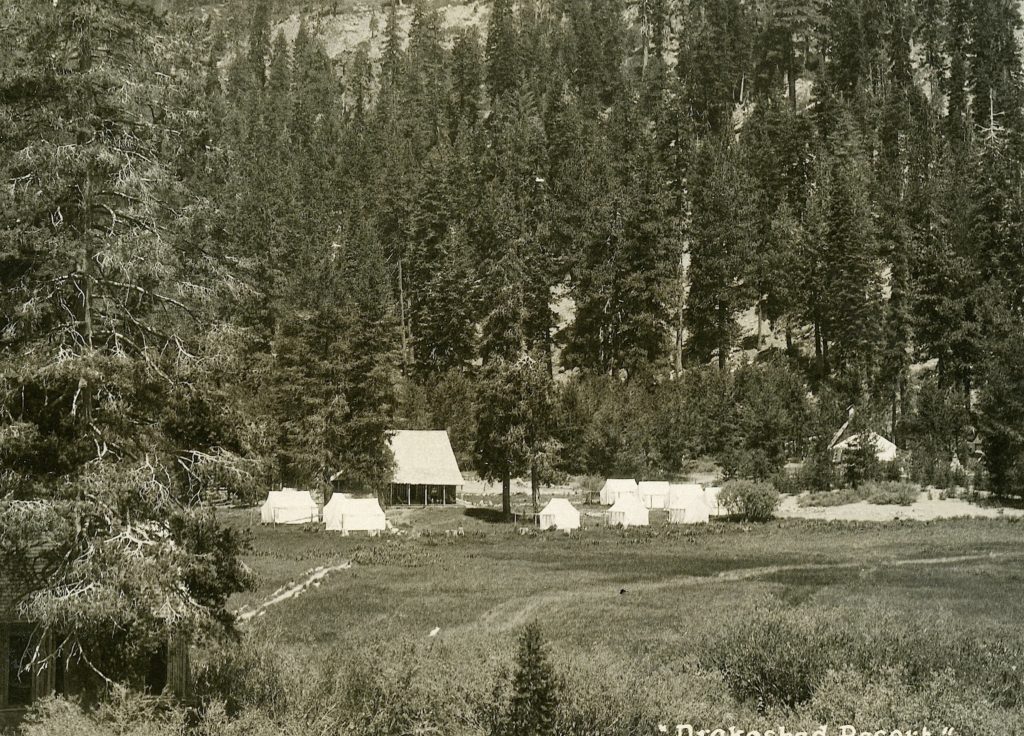
Drakesbad, circa 1930. Courtesy of the Sifford Collection
Many a soul has experienced over time criticism from family or friends over a purchase or taking a new direction in life. This scenario played out at Drake’s Springs.
In June 1900, a Susanville school teacher, Alexander Sifford, at the urging friends, went to Drakes Springs for the health benefits of the hot springs. The experience was more than Sifford ever dreamed of. Before he returned to Susanville, Sifford entered into an agreement to purchase Drakes Springs.
When Tom Sifford, Alex’s brother, heard the news he thought his brother was just plain crazy for buying the remote mountain property for $1,000. Because of Tom’s initial reaction, Alex did not divulge the entire financial transaction. The $1,000 was a down payment. Alexander Sifford paid $6,000 for Drakes Springs, with annual payments of $1,000.
Alex Sifford, along with his wife, Ida, and two children, Pearl and Roy would transform the place into Drakesbad and continue to operate it until the 1950s when it was finally sold to Lassen Volcanic National Park. As for Tom Sifford, it would be a decade later before he made his initial visit to Drakes Springs.
For those not familiar with Drakesbad it is a “historic guest ranch” located in the upper end of Warner Valley in Lassen Volcanic National Park. More about this in the months to come.
Drakesbad contains a number of hydro-thermal features such as Boiling Springs Lake and Devils Kitchen. It was the hot springs at Drakesbad proper that garnered a lot of attention. The first person to locate there was Thomas Malgin, a sheepman. In 1875 Malgin constructed a primitive bath house utilizing the hot springs. When time permitted he would be a tour guide for visitors to take them to points of interest, including Cinder Cone.
In 1880, Malgin moved on and abandoned the place. In 1885, E.R. Drake moved in. Drake had been in the region since the 1850s. He was a jack-of-trades—miner, guide, fur trapper, saloon keeper, etc.
Drake was originally a squatter. In 1887, Quincy resident, F.B. Whiting purchased Malgin’s 80 acres at a Plumas County delinquent tax sale for $8.11. In 1888, Drake paid Whiting $50 for the property. In time, Drake would file for 320 acres of government land patents surrounding his property, eventually owning 400 acres.
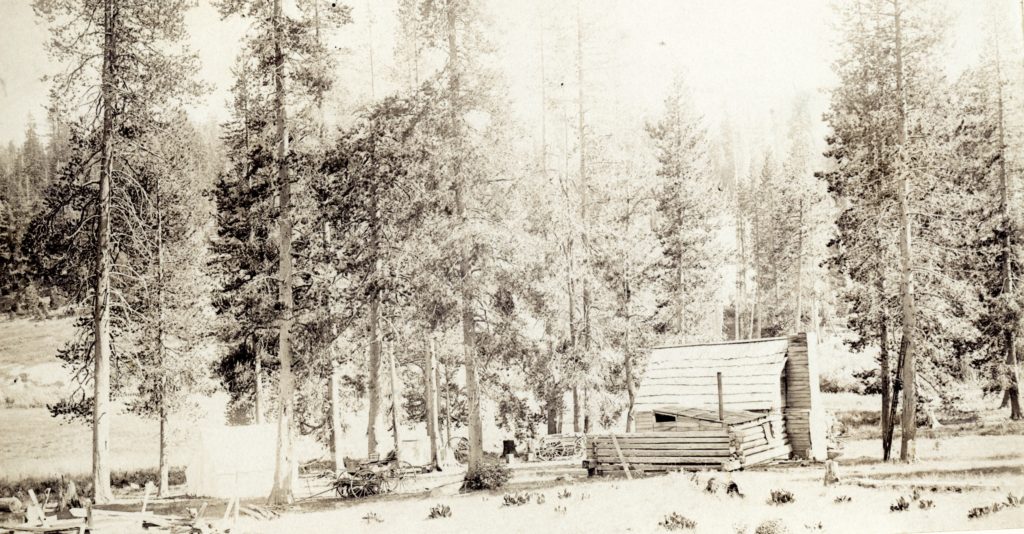
In 1890, the industrious Drake transformed his modest log cabin into a small lodge, that would be enjoyed by numerous visitors decades to come. In time, his place simply became known as Drakes Springs.
There were two drawbacks that hampered the resort’s potential, though it was not an issue for Drake. These were poor road conditions and a short season. For instance the trip from Susanville to Drakes Springs was a two-day journey. The other is that the location experiences heavy snowfall. Thus, the operation was basically what we would refer to today as one from Memorial Day to Labor Day.