Honey Lake, 1868

Honey Lake, 1984
Honey Lake, February 1984. To the right is the Hartson Sand Ridge. Photograph courtesy of Bob Sorvaag

Yesterday, we explored what was originally thought of as a strange phenomenon when Honey Lake went dry in 1859. A decade later the residents were puzzled by the high water of Honey Lake. In 1868 Honey Lake had reached its highest level ever witnessed. There, of course, a lot of speculation causing the lake to be so high, just as there was when it went dry. Many believed that the lake now contained springs, thus, why the lake was ten feet higher than known, flooding a lot of adjacent farmlands. There was even speculation that if the lake level continued to rise, that a channel be constructed to drain the lake into nearby Pyramid Lake. In the course of time, the lake level subsided and in 1887 it went dry.

Donate

Honey Lake, 1859

Honey Lake, 1938

A strange thing happened in the fall of 1859 that took the residents of the Honey Lake Valley by surprise—Honey Lake went dry. For the Anglo residents this had never happened before. In addition, in 1856 two people drowned in the lake. This led to all kinds of theories as to how this could have happened.

Personally, I enjoy newspaper writers of the past for their wit. On October 29, 1859, Oroville’s Butte Democrat newspaper entered in the discussion and wrote: “Some of the papers are endeavoring to account for the sudden disappearance of the waters of Honey Lake. One editor suggests that they have sunk into vast fissures of the earth, caused by an earthquake. This theory might be objected to on the ground that if such fissures had been created, water would more probably arise therefrom than descend. Our deliberate opinion, formed after the most mature reflection and consultation of the most learned authorities upon the subject, is, that the waters which constituted what was formerly Honey Lake, have been drunk by the “Guyas Custas.” We shall prepare a paper upon this subject, to be deposited in the archives of some Historical or Geological Society.”

Donate

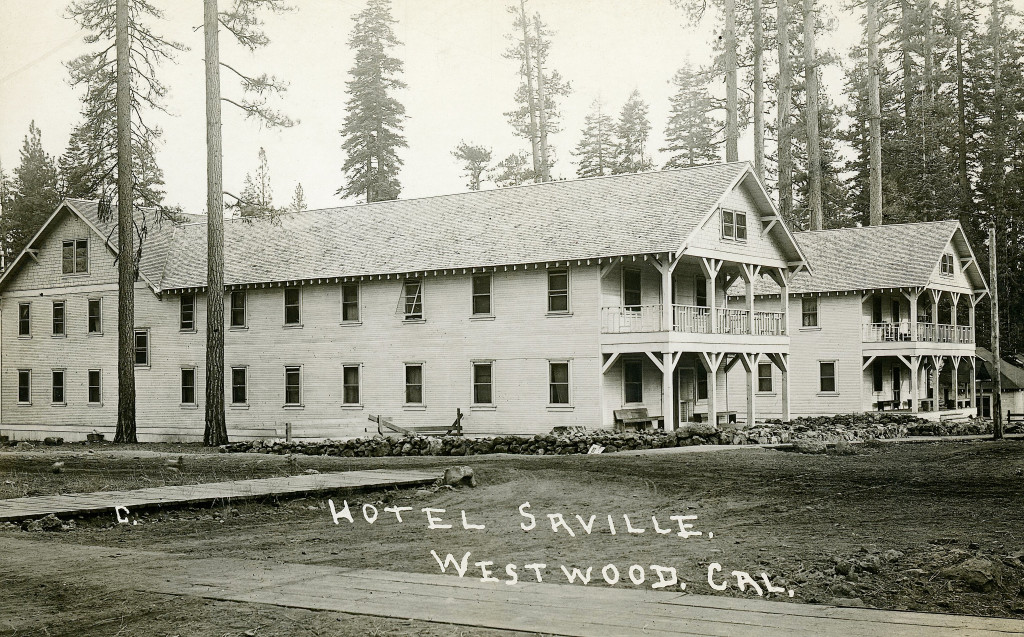
Westwood’s Hotel Saville

Hotel Saville
Hotel Saville, Westwood, circa 1914

This was a real misnomer, for it was not a hotel, but a boarding house in Westwood. Built in 1913, it was one of the first rooming houses constructed there for Red River’s employees. It was a substantial structure with 250 rooms. Initially it housed Spaniards, though in time many of them relocated across the millpond to Old Town. It was destroyed by fire on March 30, 1918.

Tim

Scotts, Lassen County

Scotts
Scotts, courtesy of the Nevada Historical Society

Scott’s was a little known Western Pacific Station in Long Valley. It was located about three miles south of Constantia. It was so named for Charles and Franceska Scott who located there in 1901, from Fish Springs, Nevada. With the railroad station, they decided to open a general store and even established the Scotts Post Office. The post office only operated from 1912 to 1916. In 1918, they sold their 3,160-acre ranch to Antonio Saralegui.

Support this site and Subscribe today!

Dixie Fire Update

An interesting map of the Dixie Fire Courtesy of CDF

It is nice to be able to report that after burning more than 100 days the Dixie Fire is 100% contained. The fire burned over some 963,309 acres. There is, however, a lot of work to be done, but at least one phase is finally over with.

Tim

Susan River Dam Proposals

Crazy Harry Gulch, June 4, 2020

During the late 1880s during the dam building frenzy throughout the region, I thought it was always rather peculiar that a dam was never built in the Susan River Canyon. There was one proposal to place a dam just below Devils Corral, but nothing materialized.

In Lassen County’s 1968 General Plan it proposed to dam the Susan River at Devils Corral. It was the county’s belief that not only would be beneficial for irrigation, but for recreational purposes as well. The same report also proposed a dam on Willow Creek, just below Petes Creek. Of course, neither of those two propositions transpired.

In 1987, a proposal was made to dam the Susan River near Crazy Harry Gulch, about eight miles west of Susanville, for hydroelectric power. Tudor Engineering of San Francisco , proposed a 170 foot high dam, at a cost of $30 million.  This, too, never materialized.

Donate

A Different kind of Log Reload Station

Reloading logs at Camp 14, Lake Almanor—Minnesota Historical Society

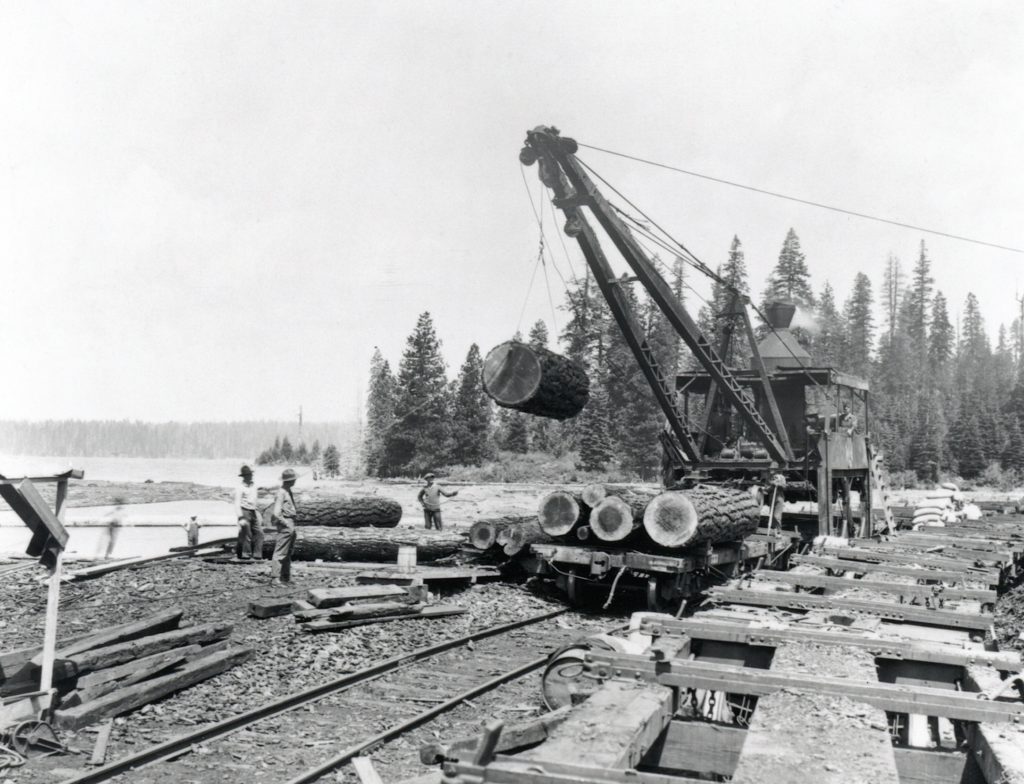
One of the challenges that Great Western Power Company encountered building the dam that created Lake Almanor was the removal of pine timber. They estimated between Almanor and other other reservoir site of Butt Valley that there was 200 million board feet of timber. In 1911, Great Western contacted the Red River Lumber Company who at that time still had not decided where they would construct its first mill. In July 1913, after much wrangling the two reached an agreement. Great Western would pay RedRiver one dollar per thousand board feet of pine timber removed—approximately $200,000. Red River estimated the cost at $500,000.

With the agreement, and time being of the essence as the dam would be complete and the flooding to create Lake Almanor would begin by the spring of 1914. That fall Red River put its loggers at a frantic pace to fall some 80 million board feet of timber, which would be subjected to initial flooding.

In the spring of 1914, Red River using a gasoline launch boat, would float the timber to the east side of the newly created lake by Big Springs. From there the logs were reloaded onto railroad cars and shipped to Westwood for milling. They would repeat a similar procedure in 1924 at Butt Valley and again in 1926 when Lake Almanor was enlarged.

Support

Camp A – Fruit Growers Supply Company

Camp A
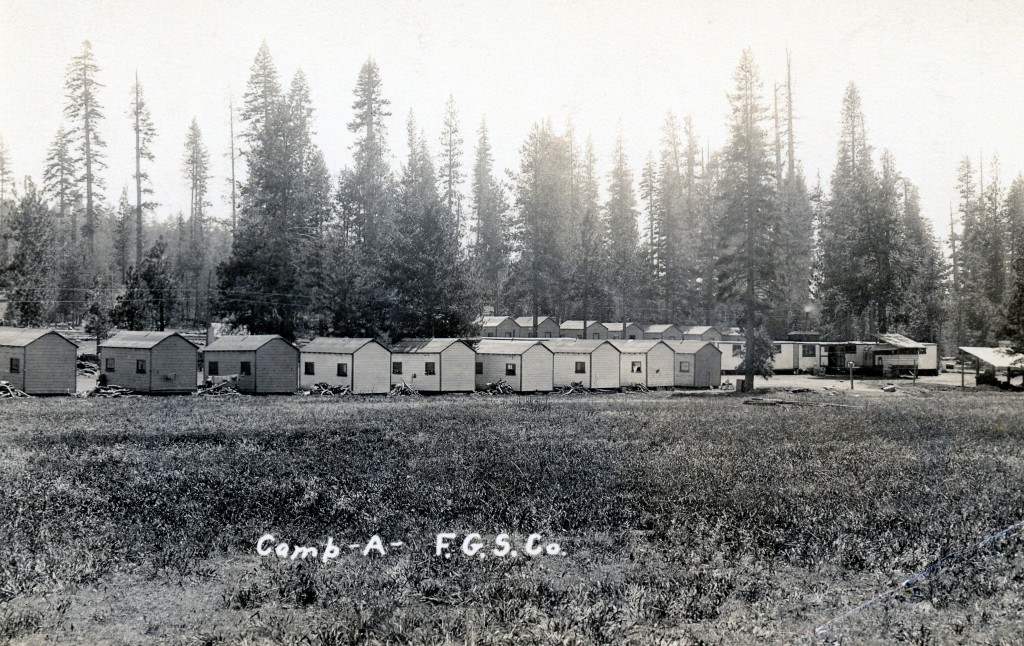
Camp A, Fruit Growers Supply Company, located just north of McCoy Flat Reservoir, 1921

In the summer of 1920, Fruit Growers started their logging operations near McCoy Flat Reservoir, while their Susanville mill was still under construction. Since logging then, was seasonal in nature, they wanted to make sure they would have a steady supply of logs ready when the new mill would be placed into operation in the spring of 1921.

Camp A was the first of ten railroad logging camps of Fruit Growers Lassen Operation. It opened on July 1, 1920. The operation was comparatively small, only logging 720 acres that season. On April 29, 1921 the first woods crews were dispatched by rail, where they encountered three foot of snow on the ground. The first item of business was to remove the snow from the railroad spurs, so that the timber fallers could start work. Within in a weeks’ time, logs were already being shipped to Susanville. In addition, a second camp, known as Camp B, opened three miles to the north of Camp A. Between the two camps, they housed over 600 men.

Support

Yikes, the 1926 DeForestation of Lassen National Forest

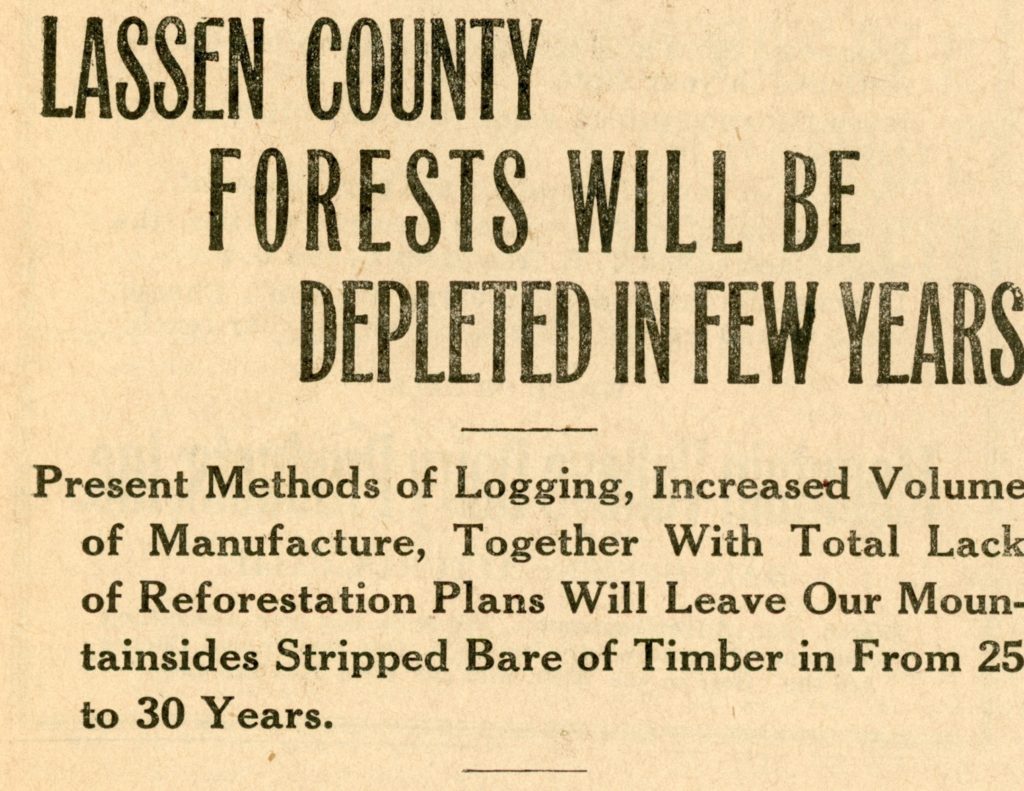
Lassen Mail, April 16, 1926

In April 1926 a conference of forest service foresters was held in Susanville. It was district forester S.B. Show whose statements caused alarm.  Show had been doing extensive studies for a number of years of the nation’s timber resources.

Show noted that the timber resources of the southern states were rapidly being depleted and that, in turn, would put more pressure on the forests on the west coast. When Show was asked how long the forests of Lassen will last, he replied that at the present rate cutting from 25 to 30 years.  Show continued that practically nothing is being done to reforest the lands that are being denuded by the timber operations and unless some constructive plan is worked out it is only a question of only a few years when the mountainsides of Lassen County will be bare and the only great natural resources within our boundaries will be depleted.

Show was not all doom and gloom. He stressed the importance of reforestation. He also noted the current tax assessments on timber provide the owners of such lands with little or no incentive to preserve timber for the future. It is interesting to note that later in the year the Lassen County Board of Supervisors reduced the timber assessment tax rate by twenty-five percent.

Support

The Prison Debate Continues

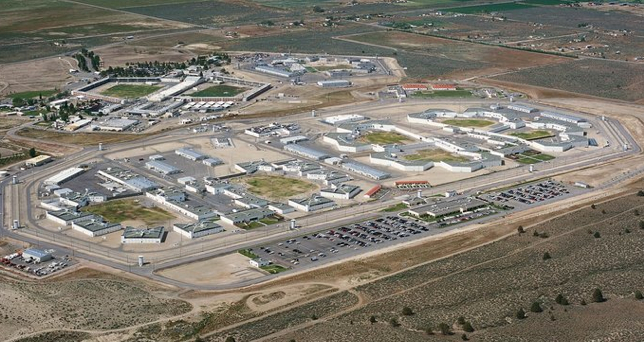
CCC & High Desert State Prisons

Earlier this year, the State of California announced plans to close the California Correctional Center at Susanville by June 30, 2022.

In the early 1950s discussions were being held among the progressives in the community that the lumber industry, that had such a profound economic impact, was now fading. The big question was what to replace with it. A state prison sounded like a worthy option that would also be stable. On October 13, 1953, the first public hearing was held in Susanville to discuss the merits. Earlier in the year, California Lt. Governor Goodwin Knight, toured the region and thought that Susanville was a favorable site for a future state prison. Not everyone was in agreement. There were some in the community who gave it tremendous support, while an equal number who were dead set against. As is customary, there was also a large segment in the community that had no opinion. Ten years later, a dedication ceremony was held for the nine million dollar California Correctional Center.

Subscribe

Exploring Lassen County's Past