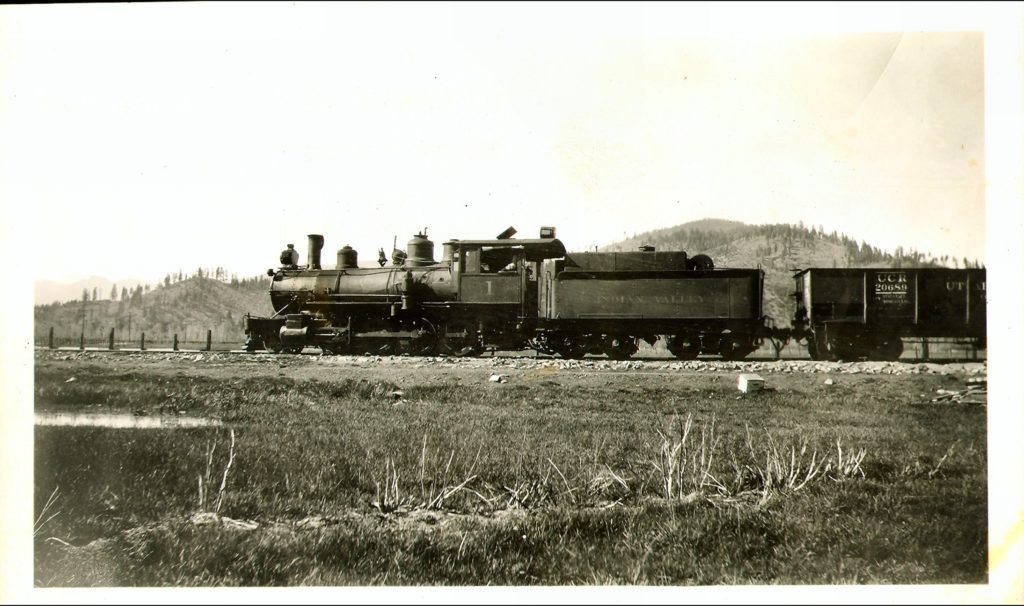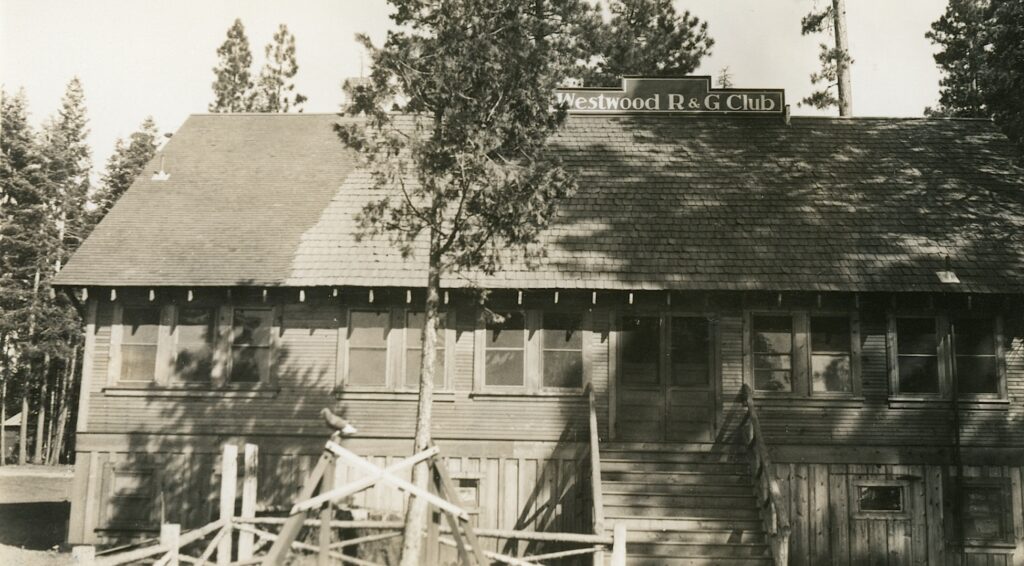
Red River Lumber Company operated numerous logging camps from 1913 through 1944 when it sold to Fruit Growers. The camps were assigned numbers, though in no particular order. The majority of the camps were short lived and only had a span of one to maybe three years. One of the more interesting camps was Camp 33, but referred to as Town Camp, as it was located less than a mile west of Westwood. What made it unique was that Red River’s company town of Westwood would experience from time to time a housing shortage for its employees. On occasion, this camp was used to house mill workers instead of loggers.
Red River Lumber Company was unusual in that it did not routinely have commercial films made of its operations, as their competitors did. It was deemed a good business practice to show prospective retail buyers, as well as investors, of one’s operation. In the 1930s, Red River officials debated the issue, particularly as it might be beneficial if forced to sell Westwood. On the other hand Red River’s neighbor the Fruit Growers Supply Company routinely had films made. For them it was important for the citrus growers to see what was involved with their investment.
In the summer of 1928 Caterpillar tractors sent a camera man to Westwood to film Red River Lumber Company’s entire operation–from the falling of trees to finished board. Caterpillar was interested in Red River’s operations. Red River’s skilled machinists were constantly making improvements to Caterpillar tractors. Among old time Red River employees there was the folklore that Red River had more patents on Caterpillar tractors than Caterpillar. Whatever the case may be, in November 1928 the film made its debut at the Westwood Theater.
It would be interesting to know if the film exist in Caterpillar archives. After all, Fruit Growers had a 1925 film of their Lassen Operation in their archives, which I did a showing at the Susanville Depot many years ago.
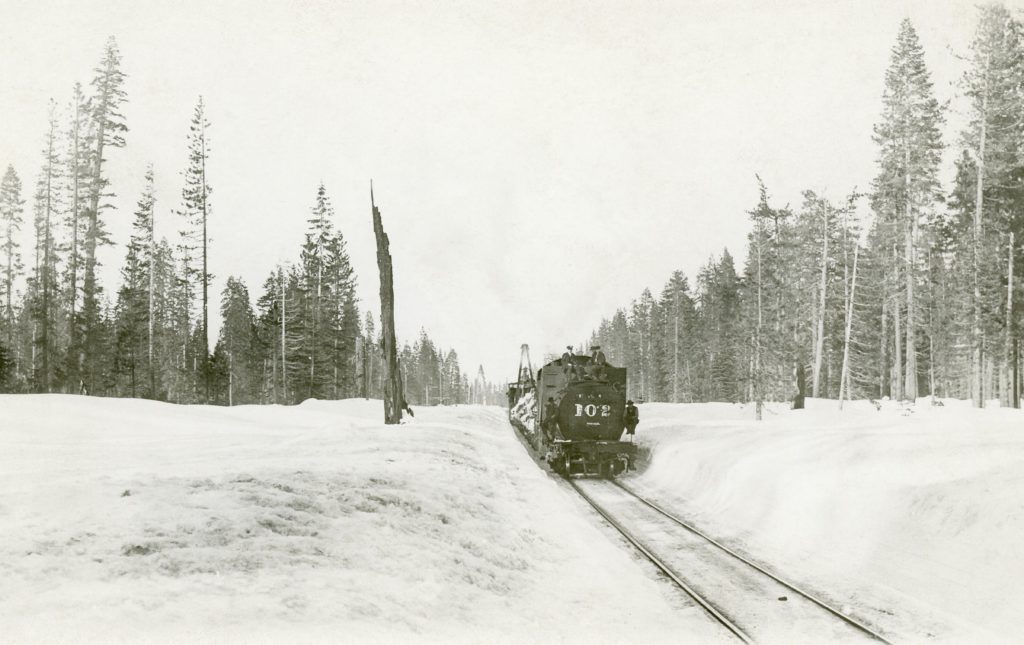
The Red River Lumber Company at its Westwood operation developed its own fire trains used to fight forest fires. Of course, Red River had its extensive railroad logging network. However, if Red River wanted to access the Southern Pacific’s railroad tracks between Westwood and Susanville there were protocols set by Southern Pacific. In 1936, a Southern Pacific Bulletin stated ”The fire train of the Red River Lumber Company may make the following speeds: Between Mason and Westwood Junction, 35 MPH’ Between Westwood Junction and Susanville, 25 MPH; and through all tunnels, 10 MPH.” I do not know what type of restrictions the Western Pacific imposed.
M. Moses was the second claim recorded in Roop’s Land Register. He settled on present day Susanville Ranch Park and referred to Piute Creek as Smith’s Creek.
This small stream a tributary to Susan River is approximately ten miles in length. For a brief period it was originally known as Smith’s Creek, who and why it was so named such we may never be known.
Another peculiarity is the spelling of Piute. Back in the 1850s and 1860s that was how the Anglo settlers of the western Great Basin spelt the name for the Native American tribe now referred to as Paiute.
Piute Creek was also the source for the original water supply for Susanville. It would be replaced with what is now known as Cady Springs in the Susan River Canyon.
Flood waters from breached earthen fill trestle, April 1938. Courtesy of Betty B. Deal
In 1935, the Red River Lumber Company completed its railroad logging line known as the Piute that traversed a portion of the canyon the creek flows through. Just above Desmond Meadows, the Piute line crossed Piute Creek. In an effort to save money, Red River decided to forgo a wooden trestle, and substitute an earthen fill. It was a rather substantial one at that, being over twenty-five feet tall. The winter of 1937-38, was one for the record books. By the end of March, 1938, the spring run-off was in earnest. The earthen fill at Desmond Meadows was equipped with a culvert to handle the stream flow. It was no match for this type of heavy water flow and then the culvert became blocked with debris, creating a substantial reservoir. As one eyewitness observed, this newly created lake extended back 300 feet from the fill with an estimated depth over twenty feet. On April 9, the fill breached, sending a wall of water downstream creating havoc in its path and washing away segments of the Piute railroad tracks into the fields of its dairy property now known as Susanville Ranch Park. In the aftermath, Red River decided not to repair the destroyed trackage. Red River took its time salvaging the line, since the company had given consideration to abandon railroad logging. In the 1940s, the abandoned railroad grade was converted into the Paul Bunyan Logging road.
Westwood Junction was that of the Fernley & Lassen branch of the Southern Pacific, built by an agreement with the Red River Lumber Company. At this point the railroad constructed a spur line to the south of the newly created town of Westwood. The Southern Pacific’s goal was to extend the line north to Klamath Falls, Oregon. It was after all, the Red River Lumber Company’s intent to build several mills, the next one scheduled for near Lookout. By 1917, the Southern Pacific was anxious to extend the line north, but Red River was not ready. The mammoth mill at Westwood was more than it could handle. In the meantime, the Southern Pacific was nervous that its competitor the Western Pacific might extend a branch to Westwood and siphon off traffic, since Southern Pacific’s five-year agreement with Red River which the railroad had all inclusive freight deal was about to expire.
Then came along World War I and that changed everyone’s plan. When the war ended, the nation went into a severe recession, so expansion was off the table for many. . In the meantime, the Southern Pacific focused on the troubled Nevada-California-Oregon Railroad, as an alternative route north to Oregon, which it eventually did.
This site, it should be noted, also served as a junction for the railroad logging operations of the Fruit Growers Supply Company and the Lassen Lumber & Box Company.
Lassen County wanted to oblige, but it had no funds. They deferred to take any action and turned the matter over to the federal immigration officials. J.C. Borden of the Immigration Bureau was brought in to investigate the situation. What he found on his arrival was that of the forty-five applicants only a handful were eligible to receive aid to pay for their return to Mexico. Yet, the issue was also moot, as Borden noted, because all the Mexicans had gone back to work. He informed the Board, should the issue arise again, that under a federal ruling any alien who had been in the United States for three years and becomes indigent can be returned to his native land with the cost borne by the federal government. Continue reading Westwood’s Deportation Continued→
Westwood’s Old Town, home of many of its immigrant workforce. Courtesy of Hank Martinez
One of the more unusual annals in Red River’s history was deportation. Red River hired a large percentage of foreigners whether it be Scandinavians, Italians or Mexicans. By 1929, with the downturn in the lumber market, the company was forced to layoff some of its workers. If they thought that the layoff was temporary, they allowed the affected worker to remain. By 1930, however, Red River sought alternatives, as they could no longer bear the financial burden. Continue reading Westwood’s Deportation of Immmigrants→
In the mid-1920s, Red River had two hydro-plants in operation to generate power. This abundant power supply created an unusual man-made landmark. Red River was able to conserve its sawdust/wood waste pile, which took on a life of its own as it started looking like a small mountain. This created a nice reserve of free fuel that was readily available at any time should there by interruptions from the hydro-plants. To comprehend just how large it was, a Ripley’s “Believe it or Not” column once designated it as the world’s largest waste pile. In 1941 it lost its status to Portland General Electric Company who reported having a 130-foot high pile of sawdust.
Anything of this magnitude created its own hazards. One of the first lessons learned was how to prevent it from spontaneous combustion. A conveyer belt, along with a steam shovel and caterpillar tractor were employed to constantly work on the sawdust pile—whether adding to it or feeding the conveyer belt to the power house. It was not unusual for a worker to get trapped in a sawdust pocket where one could easily die from suffocation. While no fatalities of this nature occurred, there was one death attributed to the sawdust pile. On the morning of January 20, 1925 Alexander Kollinkoff was killed when he was struck by a large piece of frozen sawdust while operating a steam shovel.
Red River also explored other ways to utilize this enormous wood waste pile. When the mill operated at full capacity it produced 400 hundred tons of sawdust and wood chips in a twenty-four period, over half of which was used to fuel the boilers in the powerhouse. In February 1927 Red River installed an interesting piece of machinery, one that manufactured the modern day version of briquettes. This impressive device was capable of compressing a ton of wood waste into briquettes every hour. About a third of the wood waste which it compressed into briquettes could be used for home use, camping or even at the plant itself.
Packaging tape with the Paul Bunyan trademark.Courtesy of John Webb
In the logging camps in Canada and Northeastern United States as folklore would have it, tales of the mythical Paul Bunyan was born. Stories were passed around in the camps, no written account.
In 1900, W. B. “Bill” Laughead, a cousin to T.B. Walker, went to work in Red River Lumber Company’s logging camps at Akeley, Minnesota. There he undertook many jobs starting as a camp chore-cook and ending as a construction engineer. After eight years of working in the woods, he decided to move to Minneapolis working odd jobs and experimented with free-lance advertising work. It was at this time, Laughead drew the first known character drawing of Paul Bunyan, in part of an advertising campaign for Red River’s new California operation. Laughead created the company logo, of a circular design, with his Paul Bunyan’s face, accompanied on the outside with the words Paul Bunyan’s Pine and it became Red River’s registered trademark. The logo was placed on many products and even on its logging trucks. For a short time, Red River even bottled their own soda beverage, with the embossed bottles displaying the trademark. When the company expanded into other operations, they changed it to a Paul Bunyan Product.
In the 1940s, during the dissolution process of Red River, Kenneth Walker continued in the lumber business. In doing so, the trademark was transferred to him, since his own enterprise was the Paul Bunyan Lumber Company.
Pat O’Dea, Courtesy of the University of Wisconsin
In 1919, Charles J. Mitchell arrived in Westwood like so many before and after him seeking employment. The Red River Lumber Company had high turnover in its workforce and always had openings. Little did Red River know their new hire was a famous football player. Then again, Mitchell used an alias. After all this was in an era, where few people carried any type of identification, and Social Security numbers were non-existent. Continue reading Pat O’Dea—The Kangaroo Kicker→