Tag Archives: Red River Lumber Company

The American Plan

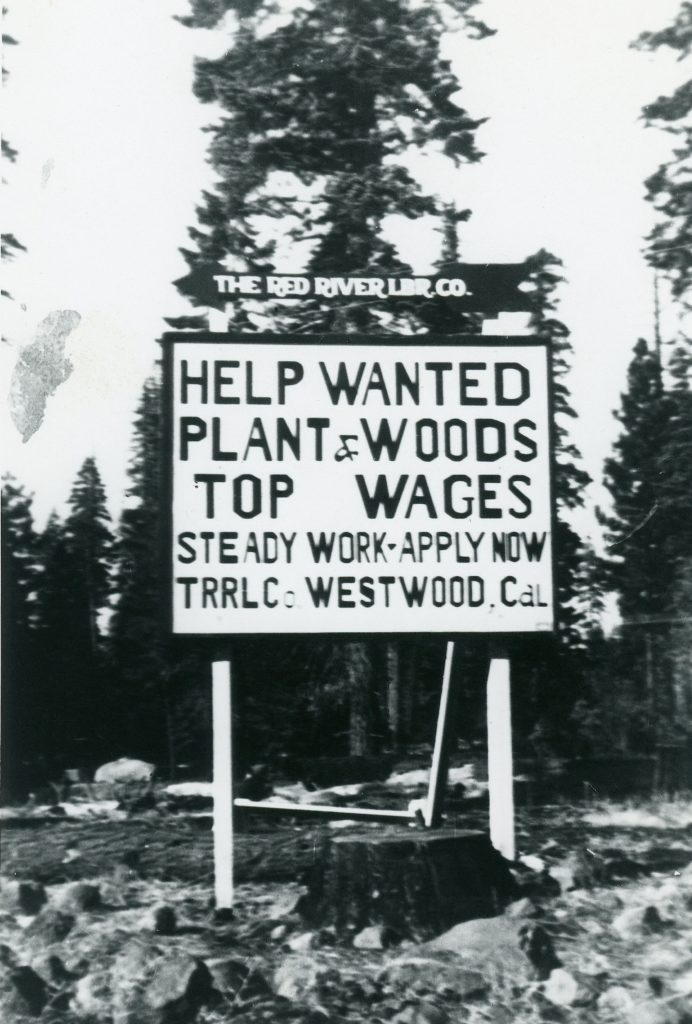
Red River Lumber Company had a large employee turnover.

The labor movement received a big boost during World War I. However, unions lost some momentum after the war as nation went into a recession. Industry on the other hand came up with strategies to counter act the union movement. One of these was the American Plan. The plan had its origins from the labor turmoil of World War I and was first adopted in November 1919 by the metal trades. In time, the Industrial Relation Association of California got behind the movement. It recognized that the model had to be flexible, since there were many variables between industries.

The plan deemed unions a nuisance—a barrier between the employer and the employee. In the simplest of terms, both the employer and employee had to maintain certain obligations. For the employer, one of the critical factors was to design its business wherein the employee was guaranteed steady employment.

In 1921, the Red River Lumber Company adopted the American Plan as a way to stave off the union movement. Actually, during the 1920s Red River’s labor issues were nominal. By the end of the decade, things changed. It was not just from Red River’s own financial turmoil, but the lumber market was headed in a downward
spiral, even before the stock market crash of 1929. Like many lumber operations, Red River was forced to curtail operations.  On July 28, 1930, Red River reduced wages by 15% and adopted a five-day week, with an eight hour working day. Red River did make a concession for its employees. It reduced the rents in Westwood accordingly and board at logging camps was reduced to $1.25 a day.

The American Plan at Red River was put to the ultimate test, but circumstances were overwhelming. Red River sought other solutions and company would experience labor turmoils during the 1930s.

Donate

Hotel Saville Explained

Westwood Independent, April 2, 1918

Last Friday, (10/6/23) featured a photograph of Westwood’s Hotel Saville. It confused some readers, as they did not think that the Red River Lumber Company allowed and/or operated hotels in Westwood. Those readers are correct.

Red River, in its own peculiar way, named their boarding houses “hotels.” These facilities housed single men, while houses were reserved for families. The Hotel Saville was built in 1913, and was one of the first rooming houses constructed there for Red River’s employees. It was a substantial structure with 250 rooms. Initially it housed Spaniards. In a bit of trivia, when T.B. Walker visited New York City on financial matters, he always stayed at the Hotel Saville.

On Sunday night, March 30, 1918 a fire broke out on the the lower floor of the Saville.  The fire spread quickly and some five hundred men battled the blaze. Every effort was made to contain the fire, for fear it might spread to neighboring Westwood Club and Opera House.

Tim

California’s Workmen’s Compensation Act of 1913

Westwood Hospital

In 1911, the California Legislature implemented a voluntary Workmen’s Compensation Act. It failed way short of its goals. In 1913, the introduced a new version, but this time it was mandatory. It initially affected large manufacturers. In yesterday’s column, T.B. Walker was not pleased with this legislation and with the construction of Westwood underway, there was no way to avoid it.

Companies had two options: 1) They could make payments to the State which set up a special account or 2) They could self insure.

Red River Lumber Company went the self-insured route. Each month one-dollar was deducted from employee’s salaries. This money would fund the Westwood Hospital. For employees it was a good deal. In turn, they received full medical coverage, and even for not work related injuries. As far as I am aware Red River continued with the self-insured route until they sold Westwood in 1944.

When Fruit Growers Supply arrived on the scene they, too, opted for self-insured, just as they did at Hilt. In 1942, Fruit Growers opted out of self-insured and money collected from employees were sent to the State. This was not so good for employees, because their insurance covered only accidents on the job. One of the side effects was hospital at Hilt was closed, but converted into a first aid clinic.

Support by subscribing.

California Politics, 1913

Hotel Saville
Hotel Saville, Westwood, circa 1914

When T.B. Walker was scouting his westward expansion of the Red River Lumber Company he examined all angles. Two important topics were politics and taxes. He was not fond of California politics, but then again he did not like Minnesota taxes.

In Walker’s opinion he though  California had an anti-business stance, and he was concerned about future legislation impacting on Red River’s profit. In a 1913, letter to his son, Willis Walker, T.B. made reference to the passage of legislation concerning
workmen’s compensation and providing medical benefits. T.B. wrote:” There is a very unsatisfactory labor liability law that seems to be more drastic than has been passed in any legislature.  I am aware that the prejudice against business in California has got so far along that it is but little use of make any defense or efforts at protection of our legal rights and proper treatment.”

In summation, T.B. declared: “The California Legislature is a sly,
reckless gang of socialists, and have succeeded in completely
deceiving the people through which they can make successful war
against capital and enterprise”

Tomorrow: The California Workmen’s Compensation Act of 1913

Support by subscribing.

Red River Lumber Company’s Mill B

Mill A, Westwood, 1914–Leona F. Byars

Truth be known in the beginning Red River Lumber Company had three sawmills at Westwood. The first was a portable circular sawmill powered by an old hay threshing machine engine. This mill was assembled  in September 1912 and sawed its first piece of lumber on October 1. This mill would provide lumber for construction of Mill B. Mill B would in turn supply lumber for Mill A, the permanent one.

Mill B had a 40,000 board feet daily capacity. The mill was pushed to its limits and it became around the clock operation. Of that output, common grade lumber was utilized to build the town and highest-grade lumber was stored awaiting shipment for when the railroad arrived.

There are discrepancies as to when Mill A was placed into operation. Some accounts have that the first board produced occurred as early as May 1, 1914 and others as August 1. Interestingly, both Mill B (temporary) and Mill A (permanent) were running at the same time. The record is not clear what Red River’s plans were for Mill B. Unfortunately, the issue was resolved when on September 8, 1914, it was destroyed by fire. The fire had originated when sparks ignited the nearby sawdust pile. The fire was fanned by strong winds, which quickly spread to the temporary mill and destroyed it. All efforts were made to contain the fire to the mill, which they succeeded thereby saving the nearby planing mill and lumberyard. While the mill was equipped with automatic sprinklers they malfunctioned during the fire. After the fire, it was discovered there was a piece of wood inside the pipe blocking the flow of water.

Support by subscribing.

Who to Blame?

Red River’s lumberyard up in flames, September 17, 1917. Courtesy of Walter “Doug” Luff

For years corporations and politicians, too, during any major event play the unfounded  blame game to curry favor in public opinion, even what they relayed had no factual basis. At the same time, behind closed doors, their actions were the opposite.

An interesting case occurred on September 17, 1917 when the south lumberyard of Red River Lumber Company’s Westwood operation caught fire.The fire destroyed two million board feet of lumber valued at $800,000. Officials were quick to pass judgement that it was an arson set by the Industrial World of Workers (IWW) a union detested by lumber companies. While the charges would later be unfounded, Red River’s initial message of the dangers of unions was the major headlines and that was what the public believed.

The story does not end there. Red River filed a lawsuit against American Cast Iron Pipe Company for $91,305.31 for defective water pipes that hampered fire-fighting. As can be customary in civil litigation, the case dragged on and did not go to trial until June 1923. The court side with American Cast Iron Pipe  and Red River lost the case.

Support by subscribing.


Industrial Workers of the World

Employee entrance at Red River Lumber Company’s mill, Westwood

Since it is Labor Day, it is only fitting to have a topic about the labor movement. With the events leading up to World War I, demand for lumber soared. It was in the Pacific Northwest that two labor organizations—the Industrial Workers of the World (IWW) and the American Federation of Labor (AFL)—gained momentum in union organizing in the lumber industry.

The IWW had an image problem. It was considered radical in its
thinking for the time. Some considered it a communist organization. It gained notoriety for its strikes that were marred with violence. It
was from these and other factors, and with the emergence of the Loyal Legion of Loggers and Lumberman that hindered its movement.

After World War I the lumber market plummeted. This weakened labor’s leverage to organize unions. Yet, by the early 1920s, Fruit Growers Supply Company and the Lassen Lumber & Box Company established sawmills at Susanville. So these operations combined with Red River Lumber Company at Westwood, the IWW saw a lot of potential in Lassen County.  IWW members worked very hard to recruit there, but with little success. It could be perilous duty and arrests and convictions of suspected organizers occurred. Case in point is the story of Charles Griswold, alias Thomas B. Miller. A Red River employee, Griswold worked the green chain at the mill. He was arrested and charged with the violation of the Busick Injunction for recruiting members for the IWW—the Busick Injunction deemed the IWW was a part of a communist syndicate. On March 25, 1925 Griswold was taken to Susanville and a short jury trial was held. The jury deliberated for ten minutes before they came back with a guilty verdict. Griswold was sentenced to six months in the Lassen County Jail. He could consider himself fortunate for many who were charged with the same offense never had a trial and were automatically sent to prison.

The biggest problem IWW faced in Lassen County was that all three
lumber companies paid the prevailing wage, if not above, and provided better housing than found in other regions on the west coast. The employees had few grievances, so there was no incentive to be a part of the labor movement. It was because of these conditions that Lassen County sawmills remained union free during the 1920s.

Support by subscribing.

I am Stumped

A P.J. Thompson late 1910s postcard

Today, I am suffering from some kind of mental block, as I am unable to pick a topic to write about. It happens from time to time. After all, this month, has witnessed a milestone of 3,000 posts since this website originated back in 2015. That is a lot material covered. So, I am taking a brief break today.

P.J. Thompson who was a professional photographer in Susanville from 1912-1920 did exceptional work. This postcard, today’s featured photograph, of an nine-foot sugar pine butt was not his best. We all have our moments. Hopefully, Labor Day Weekend will give me some inspiration.

Tim


A Made-To-Order Town

The soda fountain in the Big Store. Westwood, circa 1917

Awhile back I wrote about Frona Colburn’s’ 1922 book The Kingship of Mount Lassen. As promised from her book, is her account of Westwood.

”Like a trip on the magic carpet is the transformation wrought at Westwood, a model town in Plumas County, set in the heart of a virgin pine forest skirting the southern base of Lassen Peak. All about one clean, sweet smell of newly cut pines, and the whole atmosphere is one of humming activity among an intelligent and contented populace. The five thousand inhabitants live in modern homes in a natural forest park. An eye for the beautiful has left the big white pines standing wherever possible, even along the graded streets, and the approach roadways leading into and out of town.

“It was the author’s good fortune to arrive at Westwood at noon, hot, thirsty and covered with volcanic dust. Imagine the surprise and joy of finding an up-to-the-minute department store—large, airy and cool—where a delicious crushed pineapple ice cream soda all but saved one’s life.  And the price, fifteen cents! This drink was served with all the daintiness of a metropolitan soda fountain, by a chap in white coat and apron spotlessly clean, and with manners to correspond.

Westwood has just ‘growed up’ in the heart of the woods, sixty miles from Nowhere, and is the last word in a logging camp. What gave it impetus? The constructive imagination of its founders.

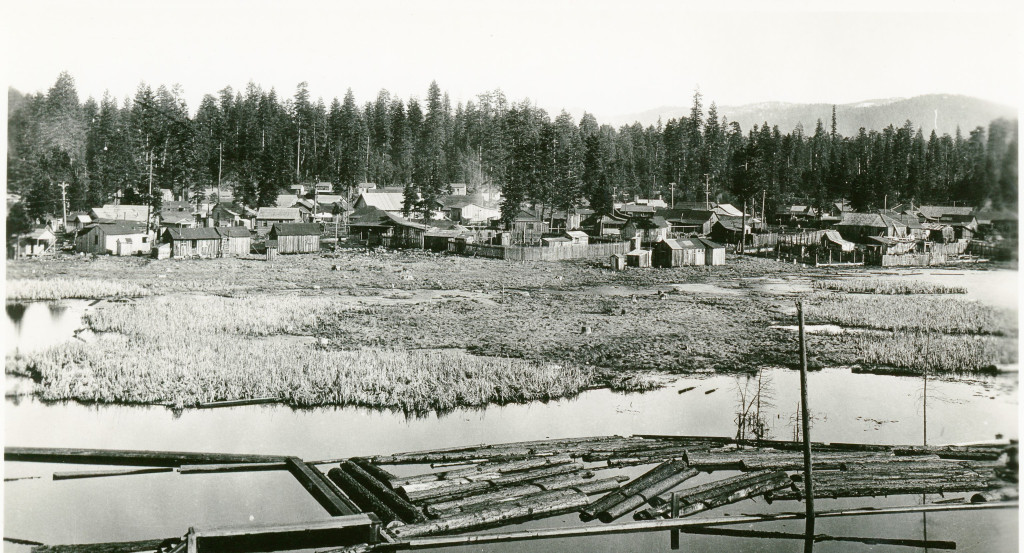
Westwood, 1915. Courtesy of Leona F. Byars

“It is the pride and glory of the Walker family to have a nearly a perfect plant as it is possible to create and this desire includes evrything connected with the industry of lumbering. The whole atmosphere of Westwood is one of work. No loafers are permitted to stay long enough to breed dissensions. Every person bears his or her share of the work to be done, consequently there are no paupers and no destitution. Nor is there a shack in the town.

”Westwood baseball teams are not only natty in appearance but they can and play ball. Like the neatly-uniformed band they are an inspiration to all the surrounding countryside. Westwood musicians are in demand wherever good music has an appreciative hearing. The men at the head of the Red River Lumber Company not only know how to live themselves, but are willing that others may share in benefits derived from an intelligent, constructive attitude toward a big problem—that of pioneering in and out-of-the-way neck of the woods. The situation at Westwood would have delighted the soul of Peter Lassen, who was something of a sawmill man himself, and had a true woodsman’s love of trees.

“The Red River Lumber Company gives the following as their attitude toward the industry:

”It is our hope, by forestry practice, to so conserve the trees spite of our cutting (the largest of its kind) the actual amount of timber will never grow less but will remain forever a permanent thing of beauty, a field of labor and a source of supply.”

Donate

The Climate Change Issue of the early 1900s

Red River Lumber Company tree fallers
Red River Lumber Company, 1915

California did not know what to think of T.B. Walker and his Red River Lumber Company timber acquisitions in Northern California during the early 1900s. Walker at times was coy with the California newspapers about his intentions. This was due in part that the California operations would be run by his sons, and not by him.

Conservationists and farmers of the Sacramento Valley were concerned should Walker use the same timber practices as employed in Minnesota as it would be detrimental to the environment. They were concerned of the climate change effect when the mountains were denuded of trees, impacting snowmelt and erosion.

To calm the public fears, Walker stated:  “I will make my timber a perpetual resource. When I begin to manufacture lumber, my saws will cut timber only as fast as nature reproduces it.”  When questioned why he did not follow the same practice in Minnesota, Walker stated: “Conditions are far different there. Their excessive taxation forced me to cut the timber as fast as possible. Minnesota land is worth more for agricultural purposes after the timber has been cut off. In Shasta County, the timberland is not worth 50 cents an acre after the timber is cut off.” In conclusion, Walker stated he could do a better job conserving his vast timber holdings than the government.

Support by subscribing.