Since today is the Paul Bunyan Festival in Westwood, here is the origin of the town’s mascot.
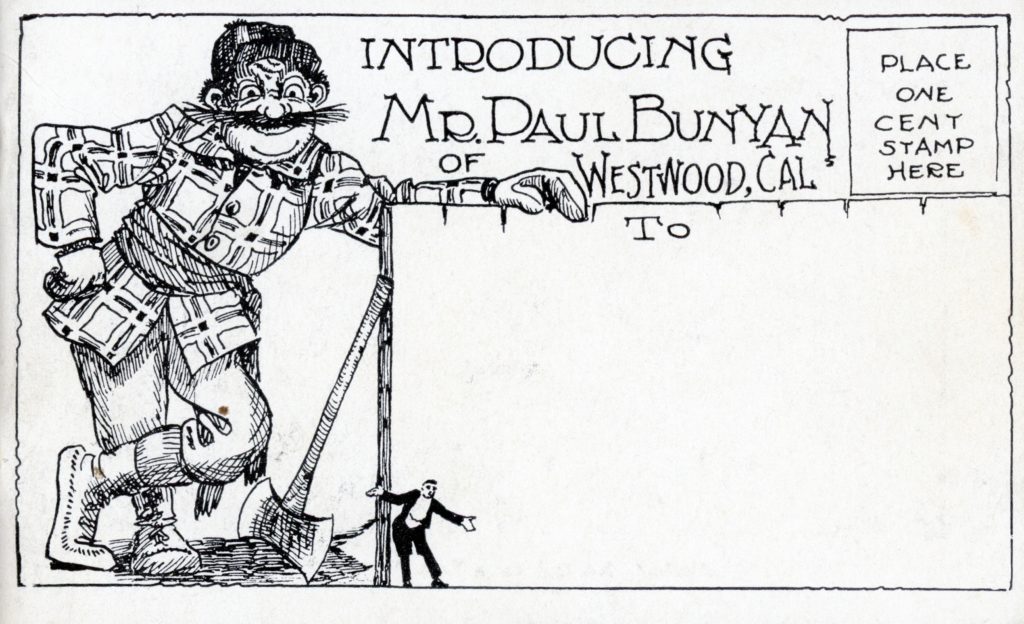
During Red River Lumber Company’s expansion to California, they had number of hurdles to overcome. Since they would be using a different species of pine, than what they had previously used in Minnesota, they had to monumental task to educate their customers. Part of the duty fell to Archie Walker in Minneapolis, and he contacted his cousin, W.B. “Bill” Laughead, who was doing some free-lance advertising work to assist him. At this time, Paul Bunyan was a little known folklore, associated with loggers. The two came up with the idea of Paul Bunyan, and prior to this no one had rendered a drawing of the mythical logger. Continue reading Introducing Paul Bunyan→
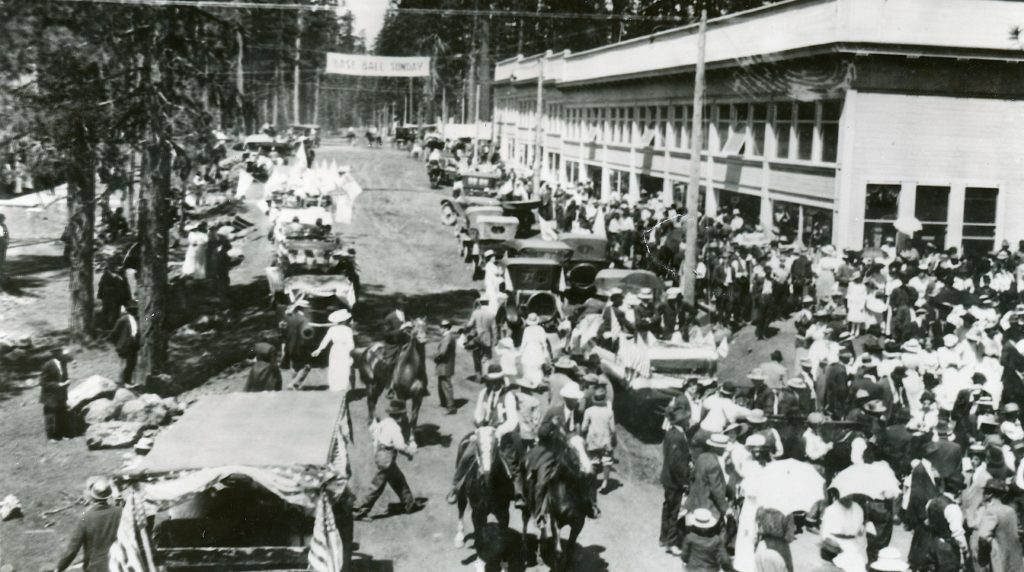
4th of July 1915 celebration at Westwood. Courtesy of the Nevada Historical Society.
In the spring of 1914 Red River Lumber Company announced that it would hold a grand 4th of July celebration to welcome visitors to its new town. Red River officials stated its main purpose was to establish and maintain the “friendliest” relations with Susanville. On the other hand it evolved in a two-day event featuring a baseball tournament.
The Fernley & Lassen offered a special excursion train that consisted of eight passenger cars. It was sold out and the fare was $1.50 round trip. As soon as the train arrived around 10:00 a.m. a procession was formed and marched through the principal streets of Westwood. It ended at open air pavilion where entertainment and necessary orators speaking. It was followed by barbecue. The next event were scheduled baseball games. The evening consisted of a firework display and a dance. It was successful event and repeated in 1915. In 1916, Susanville reciprocated and was the host of the grand 4th July celebration.
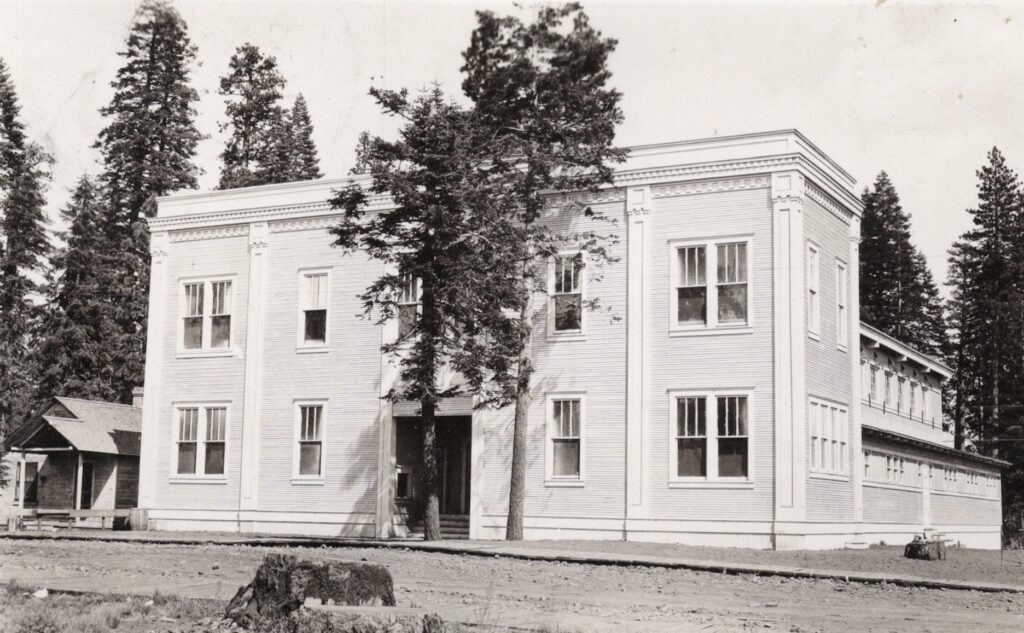
One of Red River Lumber Company’s early public buildings in Westwood was the auditorium located at northeast corner of Birch and Fourth Streets. It was in December 1917 when Red River unveiled the plans for a multi-purpose building. This much needed facility would house a fully equipped gymnasium, lodge rooms to accommodate its growing fraternal organizations, Billiard rooms and other spaces devoted for readings and meetings. The goal was have it completed by the spring of 1918, but Red River noted it could be delayed for a number of reasons due to the impacts created to meet the needs associated with World War I.
The Auditorium was put on hold, much to dismay of the residents. In January 1920, Garfield Oates, Red River’s resident engineer, announced that the plans for the Auditorium were being modified and construction would begin shortly. On May 29, 1920, the highly anticipated opening of the $30,000 Auditorium was held–by far the most expensive public building built in Westwood to date.
On the first floor was its most notable feature being a large dance floor measuring 48 by 96 feet. In the Auditorium’s later years the dance floor was converted into roller staking rink. By the early 1970s, the building was its showing its age. In 1973 the Lassen County Assessor deemed to building of no value. By the late 1970s the building was demolished. Many Westwood residents could not remember a year, but it has been gone by 1980, when the shuttered nearby Westwood Theater re-opened as the Red River Pub.
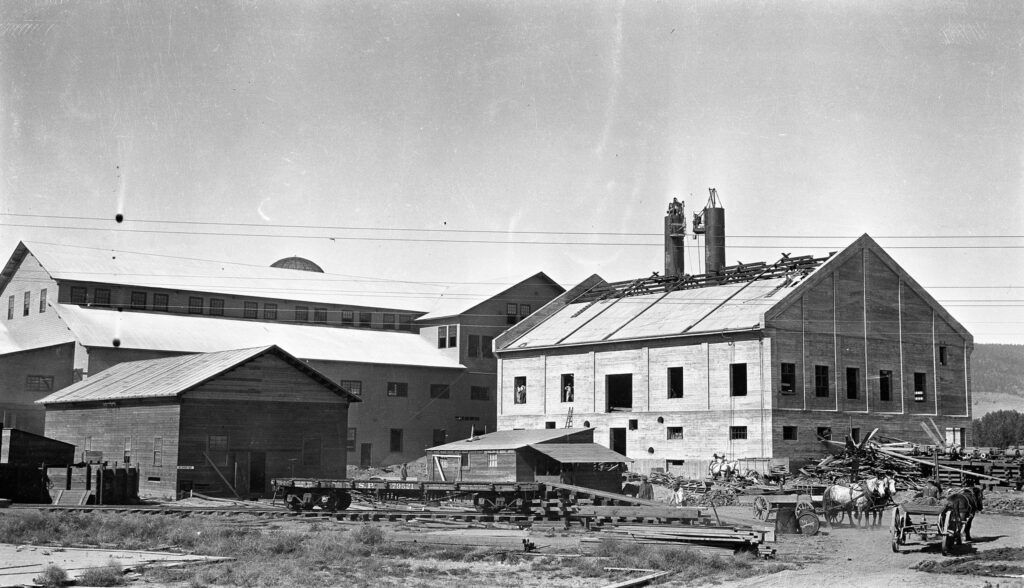
Fruit Growers Powerhouse under construction, 1920 – Courtesy of Ed Standard
In 1910, a partnership was formed between Abel Bunnell, L.R. Cady and J.E. Pardee known as the Lassen Electric Company. It should be noted, in 1901, electrical service were offered to Susanville residents. The anticipated growth with the imminent arrival of the railroad meant a larger more reliable electric plant was needed. A solution was found at Bunnell Springs, six miles west of Susanville The springs could provide sufficient hydro power. A plant was constructed at Bunnell Ranch and placed into operation on June 11, 1910. It had a capacity of 150 kilowatts, twice the capacity of the old system. In 1920, the Lassen Electric was sold to the Red River Lumber Company. This was done to meet the demands of the fast growing community. Red River, after all, had its own extra power to supply Susanville. In the summer of 1920, Red River spent $100,000 to build the transmission lines from Westwood to Susanville. In 1924, Lassen Electric reached an agreement for Fruit Growers and Lassen Lumber Box to provide for back up power.
In today’s marketing world one of the most used terms is “brand.” However, the agricultural community, brands are more than a marketing gimmick.
One would not think a lumber company would have a brand for livestock. When Red River first set up shop in Mountain Meadows, Fletcher Walker’s goal that the entire operation would be self sufficient, as possible with certain limitations. It was an admirable goal.
Initially, Red River needed horses for logging, which they did not completely phase out until the late 1920s. Red River had its own dairy herd to provide for milk, etc which all was produced in its own dairy. Since Red River owned a sizeable portion of Mountain Meadows, they initially raised their own cattle. Due to the winter weather conditions there, the cattle had to be moved elsewhere. My grandfather, John Tanner, routinely during the 1920s would pasture a portion of Red River’s herd for the winter in the Honey Lake Valley.
It was only fitting that Red River’s used the initials of TB for its brand. For those not familiar with the company, the initials are of its founder, Thomas Barlow Walker, who routinely used his initials, “TB.”
In 1942, Red River Lumber Company’s tributary timber was nearly exhausted. The company was forced to go north some thirty miles to the Poison Lake country. At Hall’s Flat they established Camp Bunyan and the Harvey Railroad Logging line.
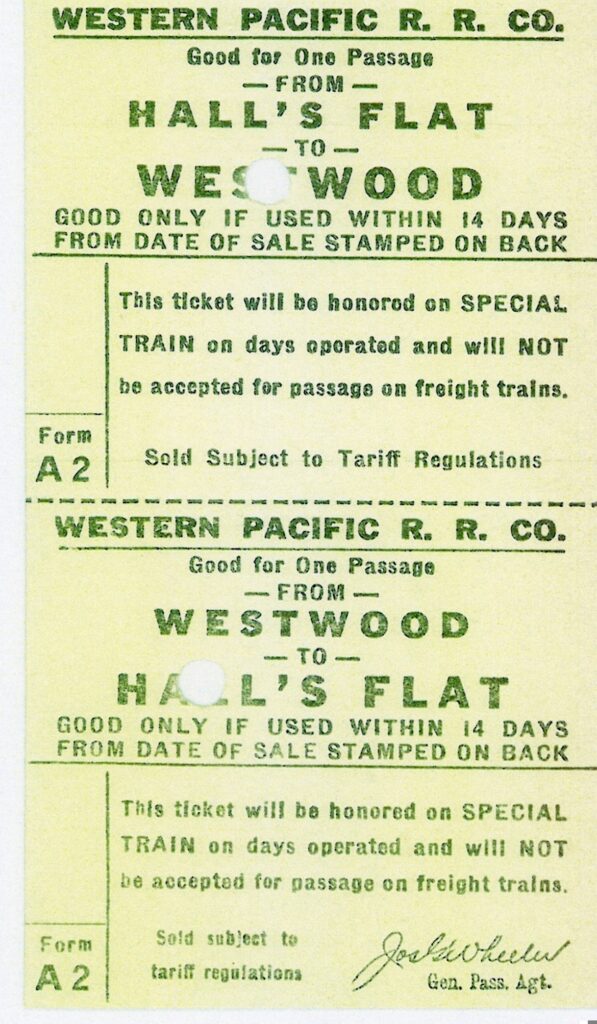
One of many obstacles Red River encountered with this expansion, how to get the loggers to work. The highway system, especially for this region was non-existent. There was Western Pacific Railroad’s Northern California Extension that went from Keddie, through Westwood and north to Bieber. It also dissected Halls Flat. In the past, Red River was able to haul logs to its mill on its own private railroad logging network. The same was true in providing transportation for loggers to the camps.
This was a game changer. Red River had to negotiate with Western Pacific on two fronts. First Red River had to contract with Western Pacific to haul logs from Halls Flat to the Westwood mill. It should be noted that Fruit Growers had to do the same with Southern Pacific to haul their logs from Westwood Junction to its Susanville mill.
Transporting the loggers to and from, resulted in a special commuter train dubbed the Paul Bunyan Express. This special train was not available to the public, nor does it appear on its timetables. It does explain why Halls Flat had a railroad depot, unusual for a remote location, especially in the 1940s.
In 1949, the Paul Bunyan Express ceased to exist when the Harvey Railroad logging line shut down.
T.B. Walker spent the winter and early spring of 1913 at San Francisco to monitor the progress of the construction of the mill and the future company town of Westwood. Not all was going well. Not only his son Clinton was adamant that Mountain Meadows was not the right place for the mill, contractor in charge agreed as well.
In the spring T.B. Walker was ready to return home to Minneapolis. He wanted to visit Westwood, but had to decline. He could not travel there via Susanville, since there was a movement on foot to relocate the mill. The other option was take the Western Pacific train via the Feather River Canyon. Walker had a fear of that canyon, that he could get caught in a rock slide.
It was not until the summer of 1917 that Walker made the trip. He had a special guest, John Andrus. Andrus was a New York investor who help finance T.B.’s acquisition of Northern California timberland. They formed the Waland Lumber Company with the intent to build a sawmill in their holdings. Andrus had never seen these holdings, thus Walker’s invite. On July 7, the entourage arrived in Westwood. It was a low key affair and most the time was spent touring the Northern California properties.
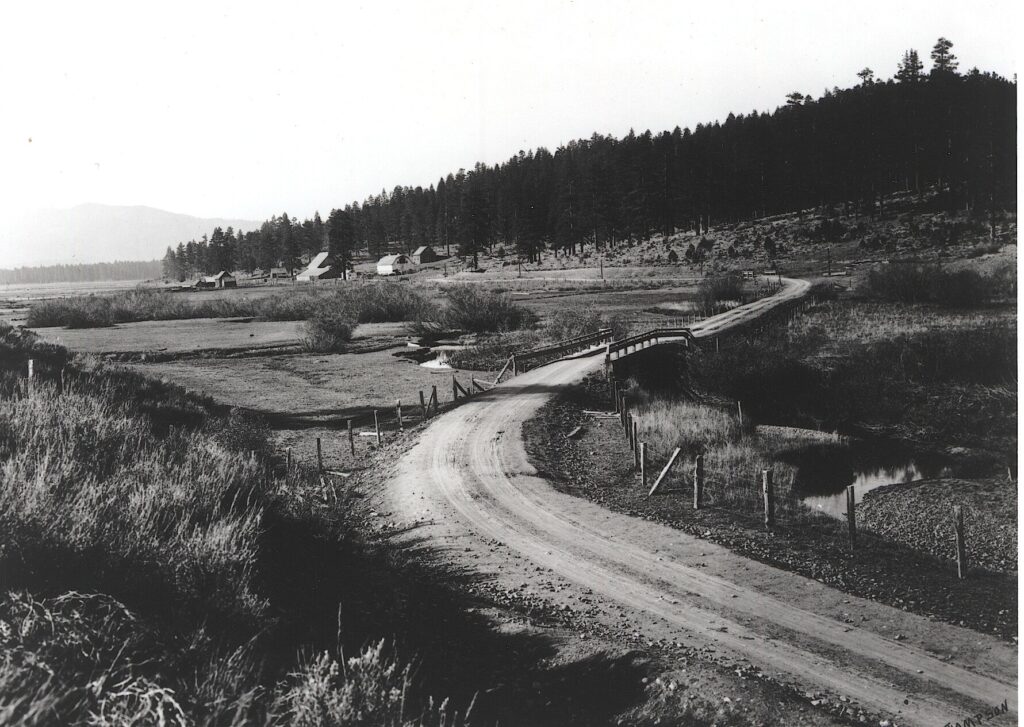
Goodrich Creek, Mountain Meadows, 1914-Minnesota Historical Society
Mountain Meadows located in the western section of Lassen County comprises some 12,000 acres. Prior to the establishment of Westwood in 1912, its hub of activity was at Coppervale. More about that in a minute.
In 1860, Dr. Atlas Fredonyer became the first settler. He remained there for two years and William B. Long briefly settled on his claim. In the early 1860s copper was discovered in the vicinity. When Carlton C. Goodrich petitioned for a post office he suggested the name of Coppervale. It was granted and the Coppervale Post Office opened for business on May 24, 1864 with Goodrich as first postmaster.
In 1885, L.M. McKenney’s Directory of Northern California provided the following description of Coppervale: “A small town with a post office situated midway between Prattville and Susanville. sixteen miles from the latter place. It has a try-weekly stage route each way between these two points. Mountain Meadows, in which the town is located, has an area of 12,000 acres, principally devoted to stock raising and dairying.”
In 1886, Goodrich passed away. He owned 7,650 acres there. He had put up on the market in 1885, but it was not until 1909 his estate sold it to John Crouch. Crouch would later sell it to the Red River Lumber Company where that Company established the town of Westwood.
In 1888, the Mountain Meadows School District was organized. A school house was built in 1892. In 1902 the school was closed for a lack of students.
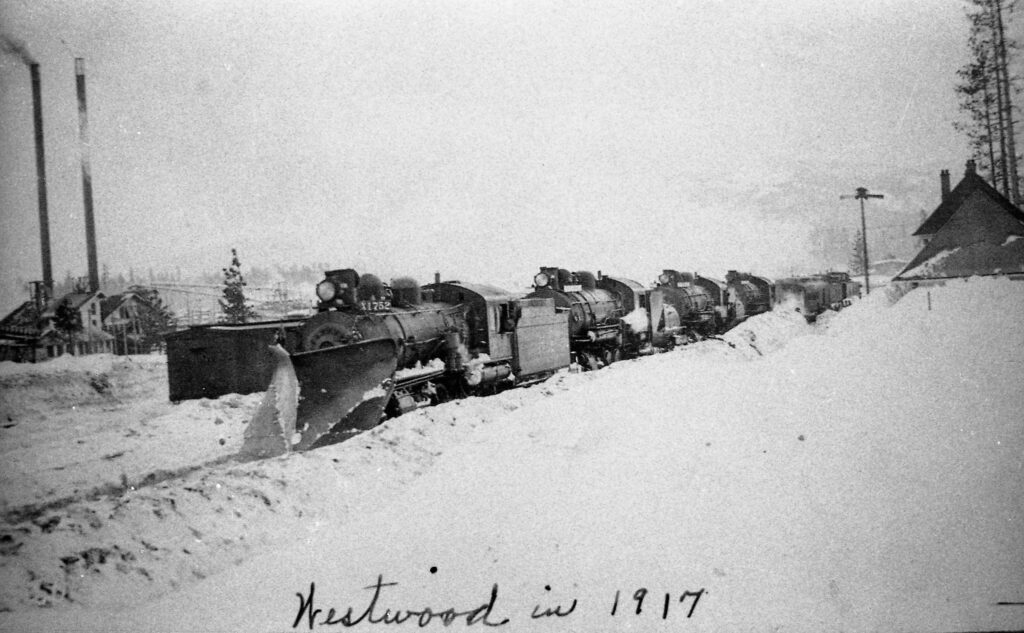
A primary reason the region did fully develop in the late 1800s was the weather. Mountain Meadows is susceptible to heavy winter snows. A number of the ranchers who located there wintered at Red Bluff.
In 1942 this railroad logging line had its origins at Halls Flat, near Poison Lake, headed into an easterly direction towards Harvey Mountain. By 1949, its entire length was just a bit over forty miles ending near Slate Mountain. A culinary workers strike abruptly shut down this line. Camp Bunyan was the initial camp at Halls Flat, established by the Red River Lumber Company. It was a mixture of portable permanent structures and housed some 350 men.
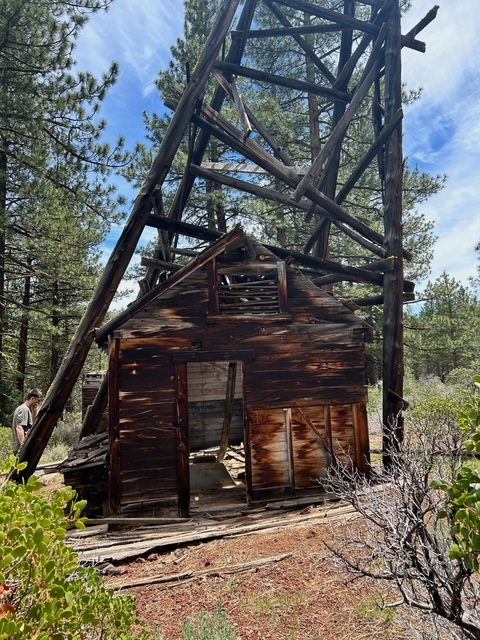
Remnants of the water tower tower and pump house at Camp Harvey, June 15, 2024-Cyndi Bera
In 1944, Red River sold to Fruit Growers Supply Company and they continued with operations until the 1949 closure. As previously mentioned in an earlier post on this topic, it depends on who owned the site where the camps were located and what type of conditions included as to removal.
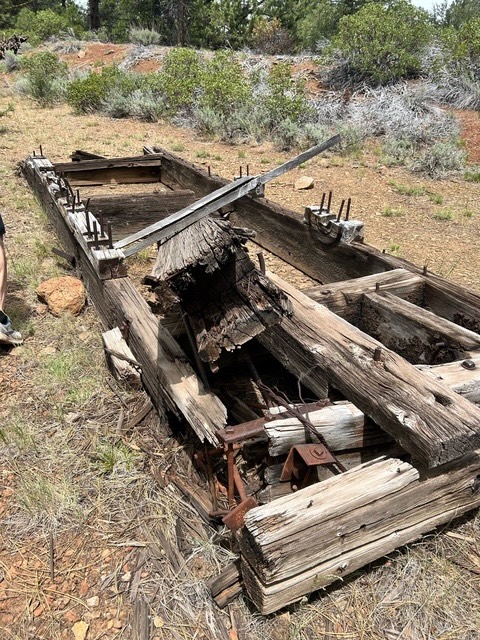
Does any one known what this Camp Harvey remnant is? June 15, 2024 -Cyndi Bera
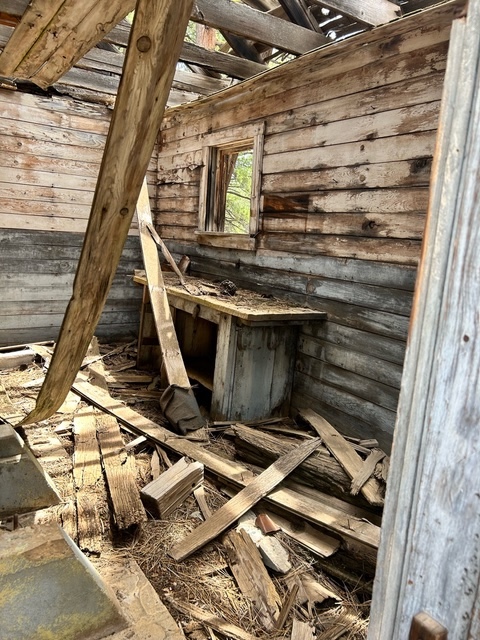
In 2024, there is hardly any remnants of Camp Bunyan, Puls Camp or Camp Stanford. Camp Harvey is an entirely different story. Fruit Growers had an agreement with Shasta Forest, who managed the property for the heirs of the Red River Lumber Company, that they could take their time in removing the structures–the agreement stated they had up to 1967. Most all of the logging cabins and related structures were removed in 1952. It was mutually agreed to keep the water tank tower with its 10,000 gallon redwood water tank, along with the pumping house and pipes in place for fire protection.
Another 2024 Camp Harvey remnant, June 15, 2024-Cyndi Bera
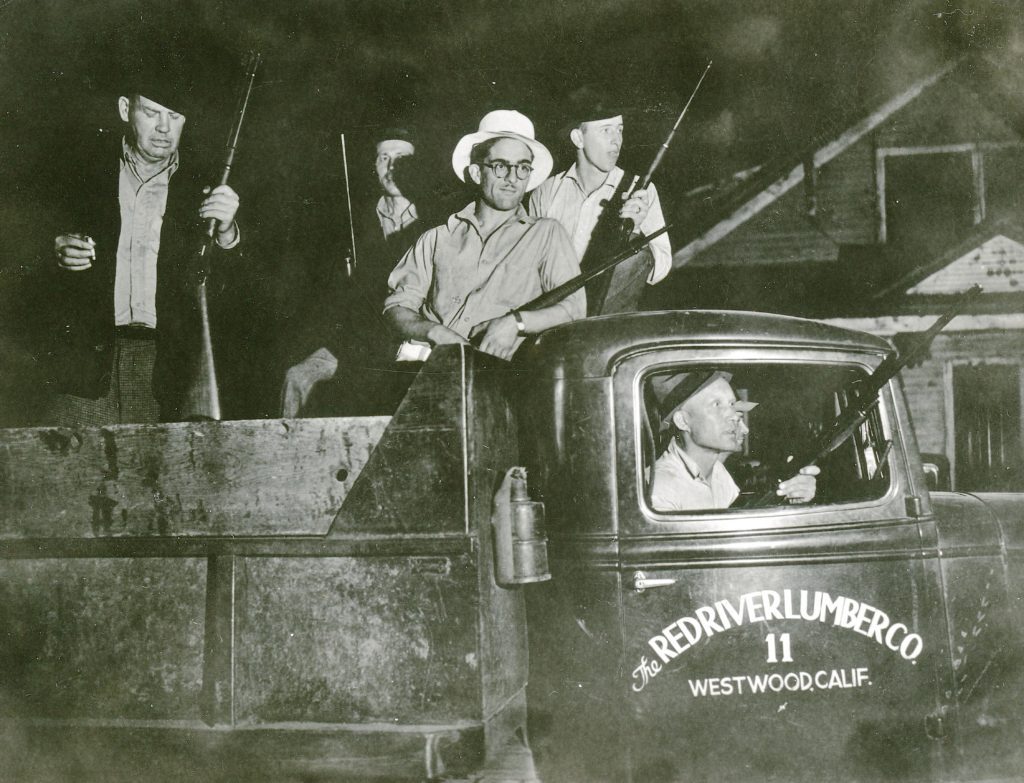
Red River Lumber Company’s labor problems in Westwood during the 1930s is a perfect case study on how to do everything wrong. There was, of course the great purge of in which nearly 400 men, women and children were forced out of their homes in Westwood on July 13, 1938 over a labor dispute. By the end of that historic day the California Highway Patrol, with the National Guard on standby placed a blockade on the community, sealing it from the outside world until things could stabilize.
I do not think we will encounter anything like this. Yes, it was a scary time during the strike of 1938 at Westwood.
According to historian Gerald Rose about the historical significance of the Red River purge he wrote, “Not until the 1941 deportation of Japanese-Americans was there a larger forced migration of United States citizens.”