Tag Archives: Red River Lumber Company

A Belfast Revival?

The Belfast District. Courtesy of Bernard McCallister

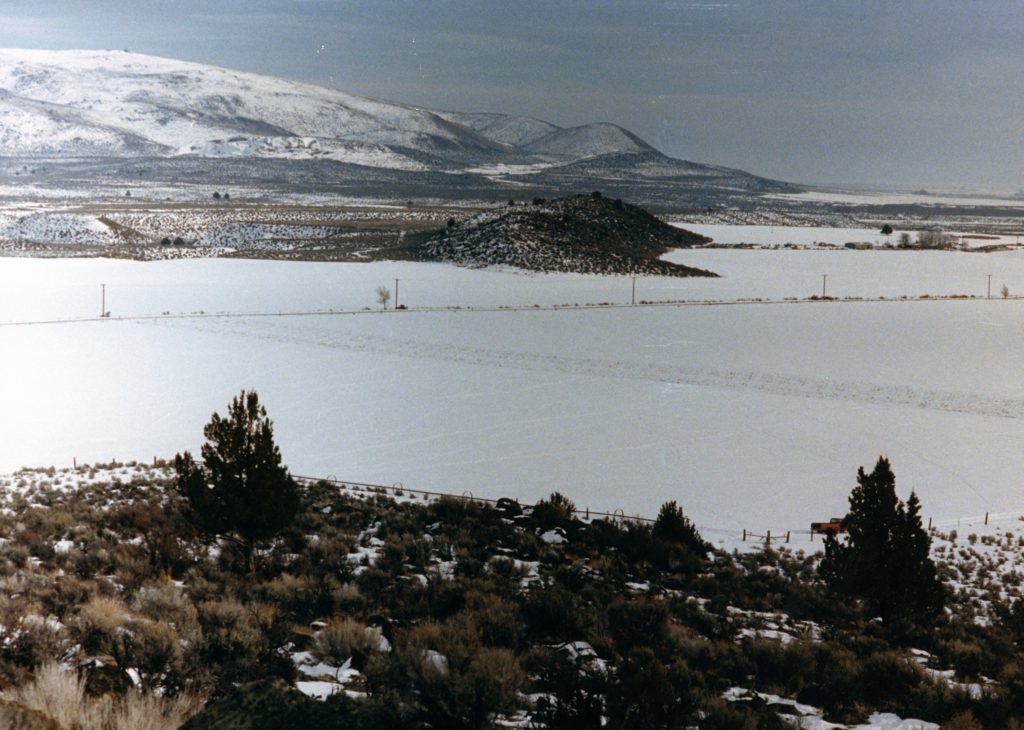
In the 1870s, Captain C.A. Merrill began work on tapping Eagle Lake for irrigation in the Honey Lake Valley. Where Willow Creek enters the Honey Lake Valley he envisioned a great city there, he named Belfast. In the 1880s, he declared Belfast was destined to become a great commercial center, a city initially serving 25,000 people.  One of his many proposals was the establishment of a lumber mill there. The source of timber was the Eagle Lake basin, which the logs would be floated across the lake and down a flume to Belfast.  However, not much ever materialized.

In 1912, the Red River Lumber Company was in a hurry to establish a lumber mill in Lassen County. Fletcher Walker liked the Mountain Meadows location. No one else did.The problem was the winter weather was not conducive for much. Clinton Walker suggested Belfast, it had ample water, far removed from other communities and the future employees could even grow gardens. However, family patriarch, T.B. Walker,  nixed that idea, as  it was too far removed from the timber, thus added costs to transport logs to the mill. T.B. Walker was not keen on the Mountain Meadows site, but when Fletcher stated he would leave the company if Mountain Meadows was not selected. So much for a Belfast revival, and the town of Westwood was created over a temper tantrum.

Never miss a story, click here to subscribe and support.


The Westwood Golf Course

Tee time at Westwood, July 13, 1935.

One would not normally associate the sport of golf in a community composed mainly of lumberjacks and sawmill workers like Westwood. However by 1920, the golfing phenomenon swept through Northern California and this lumber town was no exception.

The “divot diggers” as they were affectionaly known then took a little longer to take hold at Westwood. By the early 1920s, Susanville could boast three golf courses, albeit crude by modern day standards. Even Chester, then just a mere hamlet, had a golf course.

As early as 1921, Westwood’s golfing enthusiasts began the debate to establish a golf course. Yet, they just could not generate enough momentum to pull it off. This all changed in 1929 when Westwood’s golfing community organized a club. Those original duffers consisted of Ross Morehouse, Gene Huggins, Bob Pullman, F.W. Koerner, F.M. Jayne, Bill Corbett, Dan Taylor and C.C. Baptie. Continue reading The Westwood Golf Course

Fruit Growers Supply Company

The Susanville plant, 1921. Courtesy of Ed Standard

In February, I inaugurated  a book-of-the-month, that featured Sagebrush Reflections. After all proceeds from book sales not only help support operations, but help finance future publications, in this case the stories behind the brands of the Pioneer.

It was not that long ago when one of the main components of the lumber industry was the manufacturing of wooden boxes to ship the nation’s vegetables and fruits. The Fruit Growers Supply Company was not your ordinary lumber company. Established in 1907, it is the co-operative purchasing arm of Sunkist. To protect the citrus grower’s interest in securing a supply of woodden boxes at a reasonable price, they went into the lumber business by accident at Hilt, Siskiyou County.  With increased citrus production, in 1920 the company expanded and built a mill at Susanville. The demand continued and in 1944 Fruit Growers purchased Red River Lumber Company’s mill at Westwood along with the Burney Tract. Ten years later, the wooden box went by the wayside and the grower’s converted to cardboard.

To learn more about this book and to order simply click here.

Lake Almanor Country Club

Entrance to the Lake Almanor Country Club

During the late 1940s, the Red River Lumber Company was in the process of dissolution.  They came to the conclusion the shoreline property they owned at Lake Almanor would be better for resort development and subdivisions that the expensive task for reforestation. To make the decision was a lot easier than to implement.

It was finally decided that they should sale to a developer than to undertake it themselves. Harriett Walker Henderson and Theodore S. Walker  were designated by the family to sell the shoreline property at Lake Almanor, consisting of some 2,500 acres. They succeeded in quick order. On June 9, 1950, the property was sold to Lake Almanor Development Company for $160,000. The company was comprised of Seattle investors Warren Orr, Paul Block and Edward Clifford.  In 1953, witnessed the initial development on the peninsula as the Lake Almanor Country Club.

Never miss a story, click here to support and subscribe.

Those Rowdy Camp Followers

Construction of Miller's cut near Susanville 1913. B.R. Zimmerman collection
Construction of Miller’s cut near Susanville 1913. B.R. Zimmerman collection

Daily life got crazy in Susanville when the railroad arrived. Numerous discussions were held to make the town “dry.” It was the belief of some that if there was a ban on alcohol, that it would rid the town of certain elements. The City was not so keen  on the other hand, as it received most of its operating revenue from liquor licenses. Continue reading Those Rowdy Camp Followers

Westwood Hospital

Westwood Hospital
Westwood Hospital, 1928

In 1913, when the Red River Lumber Company was building its company town, the Great Western Power was in the midst constructing its Big Meadows dam to create nearby Lake Almanor. Great Western Power did  have a resident physician, namely Dr. Fred J. Davis to provide medical care. Red River routinely sought his services. By the fall of 1913, Dr. Davis accepted employment with Red River and remained with the company until 1939 when he moved to Susanville and opened a private practice. Continue reading Westwood Hospital

Red River Lumber Company Correspondence

The Big Store, Westwood.

The Red River Lumber Company was headquartered in Minneapolis, Minnesota. With its westward expansion to California and the establishment of its company town there, required extensive communications back and forth. For a historian, it was wonderful due to the paper trail. What is truly amazing is how much has been preserved at the Minnesota Historical Society.

The various members of the Walker family, the owners of Red River, were prolific letter writers.  Fletcher Walker, who was the resident manager at Westwood had to write in great detail about the conditions in California, since everything operated so differently than in Minnesota.

The letters, of course, also contained happenings around Westwood. Whether it was the political scene, or what their competitors were doing. With that in mind, I share a letter that Fletcher wrote to his father, T.B. Walker, exactly one hundred years to the date. You will note the letter is addressed to T.B. Walker in New York and not Minnesota. T.B. Walker then was spending a lot of time in New York wheeling and dealing as part of a re-finance bond sale for the Westwood operations.

Fletcher Walker’s Letter

Never miss a story, click here.


Paul Bunyan Trademark

Packaging tape with the Paul Bunyan trademark.
Packaging tape with the Paul Bunyan trademark.Courtesy of John Webb

In the logging camps in Canada and Northeastern United States as folklore would have it, tales of the mythical Paul Bunyan was born. Stories were passed around in the camps, no written account.

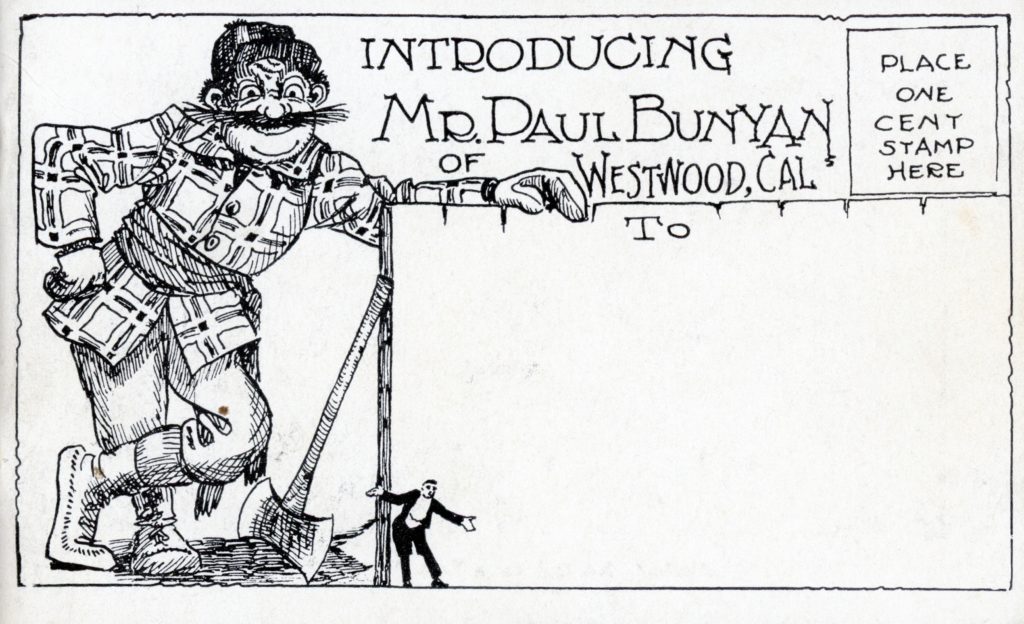
In 1900, W. B. “Bill” Laughead, a cousin to T.B. Walker, went to work in Red River Lumber Company’s logging camps at Akeley, Minnesota.  There he undertook many jobs starting as a camp chore-cook and ending as a construction engineer. After eight years of working in the woods, he decided to move to Minneapolis working odd jobs and experimented with free-lance advertising work. It was at this time, Laughead drew the first known character drawing of Paul Bunyan, in part of an advertising campaign for Red River’s new California operation.   Laughead created the company logo, of a circular design, with his Paul Bunyan’s face, accompanied on the outside with the words Paul Bunyan’s Pine and it became Red River’s registered trademark. The logo was placed on many products and even on its logging trucks. For a short time, Red River even bottled their own soda beverage, with the embossed bottles displaying the trademark. When the company expanded into other operations, they changed it to a Paul Bunyan Product.

In the 1940s, during the dissolution process of Red River, Kenneth Walker continued in the lumber business. In doing so, the trademark was transferred to him, since his own enterprise was the Paul Bunyan Lumber Company.

Never miss a story, click here.

Westwood LDS Church

Church of the Latter Day Saints, Westwood, June 14, 1943

On March 9, 1940 the Church of the Latter Day Saints held groundbreaking ceremonies on corner of Ash and Fifth Streets, in Westwood. This was the last house of worship to be constructed under Red River Lumber Company’s tenure at Westwood.

The church  was designed Caldwell and Richards, Los Angeles architects. After World War I, the LDS Church began to implement standardized plans. This particular church was the first to use this particular layout. The $9,000 church was built by volunteer labor and completed in four months.

In 1986, its congregation had grown, wherein they bought property in nearby Clear Creek and built a new church. In 1991, their old our church was acquired by Our Lady of Snows Catholic Church which they converted into a parish hall. However, with their new Lake Almanor church, it will be just a matter of time when this is placed on the market, and only time will dictate its fate.

Never miss a story, click here.

Buried Treasures

Receipt of one of cans of money that Chauncey Smith buried.
Receipt of one of cans of money found  that Chauncey Smith buried.

From time to time, someone will approach me about buried treasures.  Some stories have been embellished over the years, especially that of Harry Gordier’s gold and the Holden Dick Mine.

Then there are the lesser known tales, which are actually true,and not folklore. In the book Untold Stories, I relate the story of Chauncey Smith, since only a portion of his hidden cache of money was ever found.  There is, of course, the great Westwood bank robbery, that to this day the money has never been recovered. In August, 1926 a portion of Red River’s monthly payroll shipment consisting of $45,000 never made it Westwood from the Reno bank. One theory was the money was stashed along the mountainside between Doyle and Milford. In June 1927, Red River thought they had found thief, in one A.A. Bruce who formerly worked for the railway express offices in Reno and Westwood. Bruce was arrested and his Reno home searched. However, when a preliminary hearing was held in Susanville, Bruce was released from custody as there was insufficient evidence to charge him with the crime. No one was ever charged, and the money never found.

Never miss a story click here.