When Red River Lumber Company moved to California, its founder T.B. Walker, intention that this was to be his five sons operation: Gilbert, Willis, Clinton, Fletcher and Archie. Clinton, was at odds with his brother’s handling the affairs, and left the company in 1913, but was brought back into the fold during the company’s financial crisis of the 1930s. The Minnesota Historical Society has a large collection of the company records and from time to time I will share some excerpts from the letters between the family members that provides some interesting insight in how the company operated. Continue reading Clinton Walker’s Correspondence→
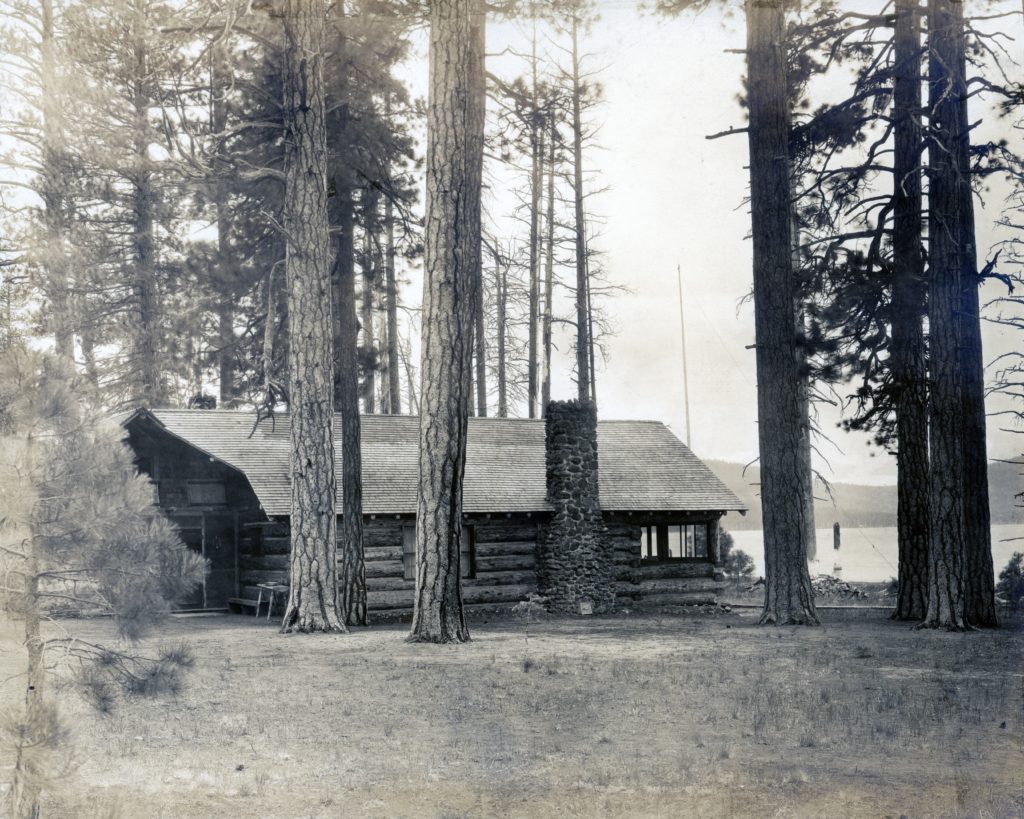
R.F. Pray’s Eagle Lake cabin. Courtesy of Wyn Wachhorst
While I have focused a lot on the Gallatins, there were a few other cabins built at the south shore of Eagle Lake, on the handful parcels the Gallatins did not own. For the record, it should be duly noted that the Gallatins at one time gave consideration of providing cabin sites on a lease basis, but that never transpired. Continue reading Eagle Lake Cabins→
The reservoir as it appeared in 1914. Minnesota Historical Society
While most reservoirs in the region were constructed for irrigation there is always an exception to the rule. The Goodrich Reservoir on Goodrich Creek near Westwood was constructed in 1912. Its main purpose was for a domestic water supply for the residents of Westwood and also as a water supply for the Red River Lumber Company’s millpond. During the winter months, it found another use as it was a popular ice-skating spot. In 1931, the State of California inspected the dam, deemed it a hazard and was removed.
Some people assume that Red River Lumber Company’s operation at Westwood was that of a sawmill. It was more than that, and was a multi-facited lumber plant. On May 2, 1924 work began on a half-million dollar veneer plant just to the north of the sawmill. As what had become customary, it too would be built on a grand scale and when completed would be the second largest veneer plant on the West Coast. The two story structure measured by 100 feet wide and a 1000 feet long, with ample room to make additions should demand warrant. Three hundred men were hired in the spring of 1925 to operate the facility. Continue reading Westwood’s Veneer Plant→
One of the peculiar oddities back in Westwood’s early history there were no accommodations for the traveling public. The Red River Lumber Company who controlled the town wanted it that way. This would hinder any “undesirables” to try infiltrate the town, i.e., such as union organizers. However, Red River needed to provide some sort of accommodations for people visiting on official business with the company. Red River constructed the El Solano at 501 Birch Street to meet those needs.
In the 1930s, during Red River’s financial crisis, the company converted its American Legion Hall into a hotel known as the Blue Ox Inn, and thus the El Solano diminished in status. It would later be converted into apartments. In the fall of 1965 the Assembly of God Church renovated the building, and the second story removed. Today, it is a private residence.
Flood waters from breached earthen fill trestle, April 1938. Courtesy of Betty B. Deal
Construction of the line was stalled during the early 1930s, while Red River went through its financial reorganization. Finally, in July 1933, construction began at the west end near Hog Flat. A station was established where the Piute line connected with the Southern Pacific, and named Blair, after Kenneth Walker’s wife. At Hog Flat, Red River established logging camp #2. That summer Red River logged eight million board feet of timber and sold it to Fruit Growers. The following year the line was extended further east to Big Springs, and Camp #8 was established.
The year 1935 was a pivotal one for the Piute. Early in the year it was announced Red River would complete the line to Susanville—a distance of twelve miles from its terminus at Worley Ranch to the Fruit Growers plant. Continue reading Piute Logging Railroad – Part II→
The completion of the Western Pacific’s highline in 1931 was not the only railroad development to make news. In the 1930s, Red River’s most unusual railroad logging line, the Piute, came to fruition—so named as it followed Piute Creek in its approach to Susanville.
Red River owned a large swath of timber west and north of Susanville. While they had already logged over its easily accessible timber in Mountain Meadows and Lake Almanor, the Piute line was not intended to service Westwood. The Piute was built to generate much needed revenue to sell timber to other parties, such as Fruit Growers and Lassen Lumber & Box. However, they had a back-up plan; should Red River’s timber sales fall flat, they could mill the timber at Westwood. Continue reading Piute Logging Railroad→
The installation of the Hammerhead Crane at Westwood, was one of many improvements to entice buyers.
Estate Sale: I need to make room for items from my mother’s estate. This a great bargain 50% off, a big deal your cost $12.50 plus shipping. What a deal!
It is only appropriate to feature this volume, number four in the Red River series, as last week featured volume number three. It was originally thought that Red River’s Westwood mill would operate into perpetuity. However, in less than thirty years in operation proved that theory wrong. There was the family drama, not all wanted to dispose of Westwood, but those that did out numbered those wanting to exit. On the bright side, with World War II, the demand for lumber soared, and so for once did Red River’s profits. Thus, it seemed conditions were ideal to unload it, but Westwood was an albatross. No one wanted a mammoth mill, let alone a company town. Red River’s bargaining chip, it still owned vast swaths of timber and that is what the buyers wanted.
In addition to the saga of Red River’s departure from Westwood, this volume also wraps up a lot of loose ends. Included are such issues of what became of many of its landmarks, and that of the roadhouses that was once a dominant feature between Westwood and Susanville. In addition, are Westwood institutions such as the Westwood Auto Club, the Westwood National Bank among other topics. To order your copy, is just a click away, here.
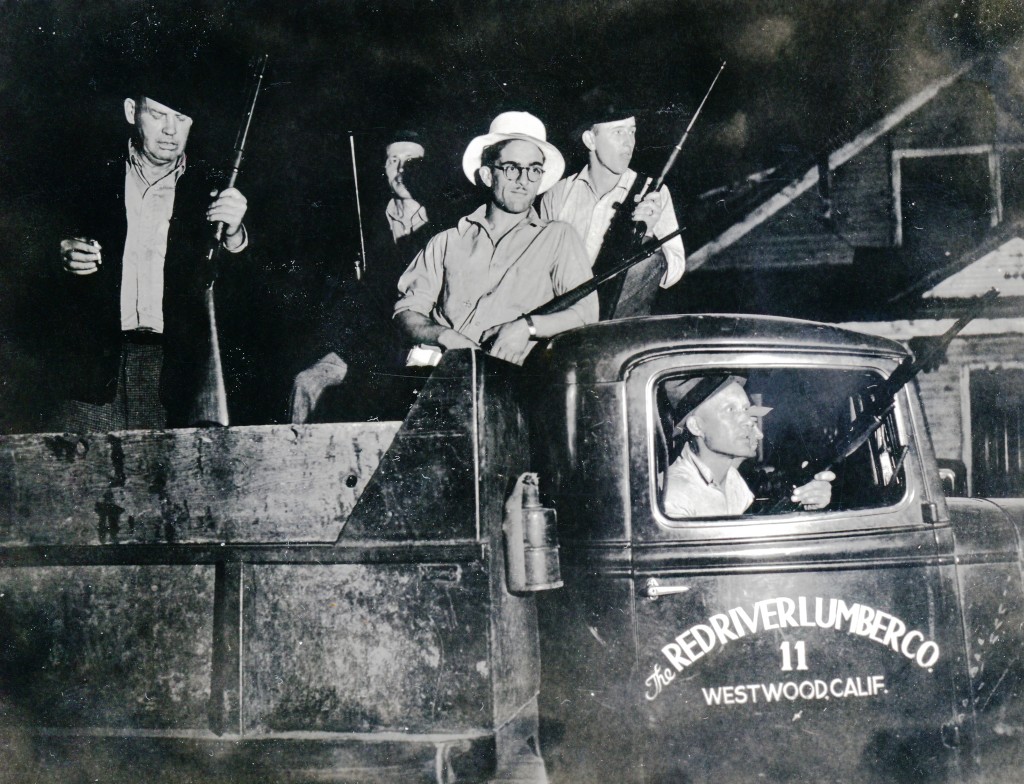
Purge Night, July 13, 1938. Courtesy of Frank Davis
Estate Sale: I need to make room for items from my mother’s estate. This a great bargain 50% off, your cost $12.50 plus shipping. What a deal!
The carefree spending days of the Red River Lumber Company came to an abrupt end. Bonds were used to finance the construction of Westwood came due. On the other hand, Fletcher Walker continued expanding operations, each at an additional cost. The bondholders on the other end were not pleased with the delinquent payment and return. A free for all battle occurred as to whether the banks or the Walkers would control Westwood. The Walkers, made concessions to keep the banks at bay.
Then there were labors problems. It began with the purge of the CIO members and their families who were driven out of Westwood in 1938. That was the tip of the ice-berg. The following year the AFL went on strike over the same issue of wage restoration that the CIO wanted. It was a mess, to say the least, and it would be one of many factors that would seal Red River’s fate. Click here to order.
If there was ever a great misnomer for a building it was one of Red River Lumber Company’s first public buildings in Westwood was dubbed the Opera House. It should be noted that when Westwood was being built in 1912-14, it was remote. There were no highways, and in the winter the only access by train. It was designed this way on purpose to keep undesirable elements, including unions out of the community. However, Red River would need to provide entertainment venues for its employees, if they wanted to recruit and retain. Continue reading Westwood’s Opera House→