Camp C, no date. Courtesyof Lenala Martin Collection
During the 1920s, Fruit Growers Supply Company operated six railroad logging camps in the vicinity of Martin Springs, located between McCoy Flat Reservoir to the south and Pine Creek Valley to the north.
Camp C had a unique feature not found in other logging camps. It should be duly noted that Fruit Growers valued their employees and took good care of them. In 1923, Fruit Growers built an outdoor boxing/wrestling area that seated 500 at Camp C. On June 23, 1923, the inaugural wrestling match was held between Susanville resident Bill Mohler and Paul Kinney of Omaha, Nebraska. A special train from Susanville was dispatched to Camp C to allow their mill employees to attend.
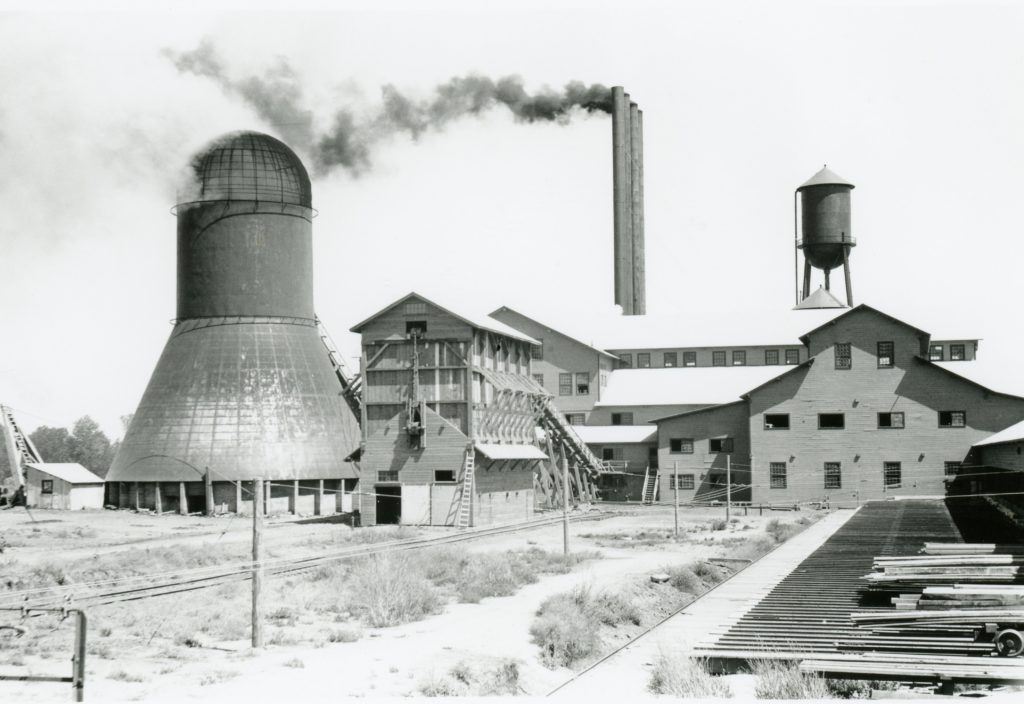
The Susanville plant, 1921. Courtesy of Ed Standard
In this era of being bombarded with the term “fake news” the City of Susanville deserves a gold medal award to distort the record to accomodate someone’s warped mind. It should be noted, after all, I have spent the majority of my life researching the region’s history to provide an accurate record versus false statements, which is different from folklore. For instance, when my Eagle Lake book was published in 1988, Bob Amesbury congratulated me, since he had written a book on the lake, too. Bob went onto say that he had all the bullshit and I had all the facts.
Fast forward to the summer of 2018, when at the City’s urging I met with with two officials, Mr. McCourt and Ms. Schuster, concerning the history of Riverside Park. It was an exercise in futility, for this dynamic duo, could care less about the history of site, and were bound and determined to change the name of Riverside Park to Fruit Growers Park, regardless of the facts, which ultimately they were successful, using a deceptive survey, that the general public was excluded.
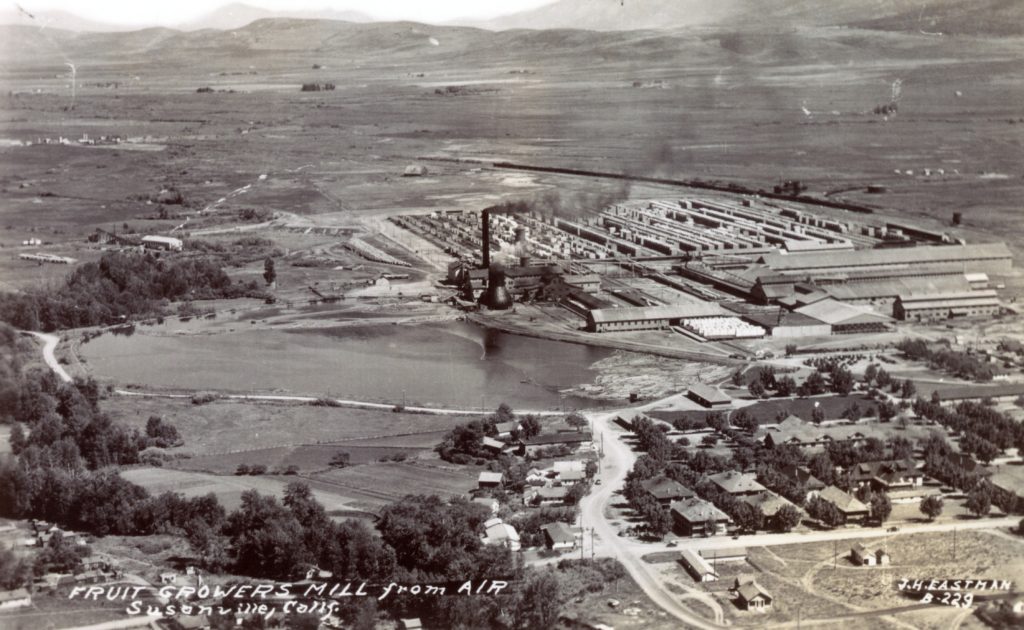
Fruit Growers Supply Company, 1936
Oh, dear reader, it gets worse. To support their claim they lied on the record at a city council meeting at the September 5, 2018, and that information then appears in the local newspaper only to get perpetuated. One of Schuster’s first comments that the city gave Fruit Growers the millsite property consisting of 256 acres, which it should be noted was larger than the city itself, and was located over a mile away from the city limits. Just the twenty acre parcel where the park is located, Fruit Growers purchased that from George and Pearl Bassett for $9,500. In all, Fruit Growers spent more than $60,000 for the millsite property and water rights. It just gets worse. Schuster noted that Fruit Growers sold the mill to Eagle Lake Lumber Company in 1944. Fact, Fruit Growers sold to Eagle Lake Lumber in 1963 for $875,000. Later on it was mentioned that Fruit Growers donated the park property. Excuse me. The city purchased it in 1976 for $23,000 from Sierra Pacific Industries, and it was not the city’s first choice. The city was trying to buy Vallejo Meadows along Piute Creek, north of Willow Street, and west of Parkdale, as part of a greenbelt program, but that deal fell through.
In closing then, with the City’s current thinking, Riverside Hospital where I was born and lots of others could not have existed under that name, as it must have been Fruit Growers Hospital.
Diamond Mountain, circa 1940. Courtesy of Margaret A. Purdy
It is interesting to note that before the Red River Lumber Company and the Fruit Growers Supply Company harvested a single tree, the two companies stated with their sustained harvesting practices they would operated into perpetuity. While both companies no longer operate sawmills, they own large swaths of timberland, which is routinely harvested. However, large swaths of territory the companies would log contained a great deal of volcanic rock, not the best soils for second growth trees. In addition, when they did a tremendous amount of logging in these areas, it coincided during a twenty year drought cycle from 1917-37, that until this time the region had never experienced since the Anglo settlement of the 1850s. On the other hand, they had a positive outlook. Take for instance during the dedication ceremony of Fruit Growers sawmill in Susanville in 1921. Charles Emerson, a well known merchant and rancher was one of many dignitaries to speak. Emerson told the crowd of his own reforestation locally. Emerson recalled that as a child [he was born in Susanville in 1868], forty years ago, he helped plant a tract of pine trees on the family ranch just south of Susanville on Diamond Mountain. Those seedlings, he said, had become a fine stand of pine timber, many of which were 22 to 24 inches in diameter.
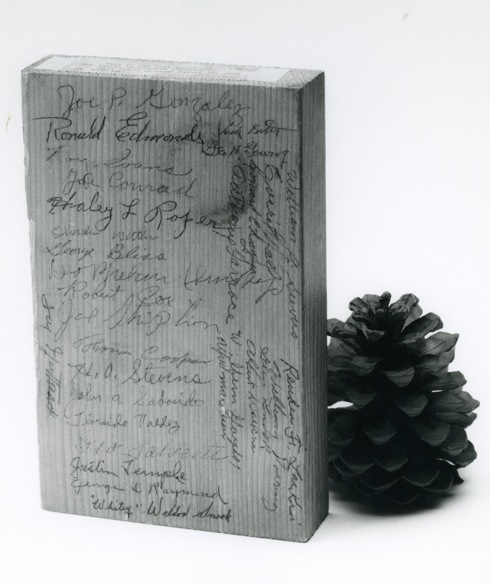
To mark the end of mill operations at Westwood, in 1956, the last board cut in the dry lumber department there was signed by the last of the workers. It was piece of Douglas fir 5 1/2 inches wide by 9 inches high. Some of the records of Fruit Growers Westwood operation were transfered to that company’s office at Hilt. In 1999, it was discovered in the old Community Center at Hilt. At that time, the board was taken to Fruit Grower’s headquarters in Sherman Oaks, California and put on display. Whether it is still on display is not known.
Recently, a subscriber sent me a link to a You Tube video with various historic film clips of railroad logging. For those so inclined you can watch it here. However, it should be duly noted for the record, the clip of the cookhouse scene of Fruit Growers Supply Company is wrong. The film notes that it was Fruit Growers operation at Hilt, but in reality it was Fruit Growers Lassen Operation at Camp B, located north of McCoy Flat Reservoir. The cement foundation of the building was still intact the last time I was there, along with railroad service pits, etc. I do have a copy of the 1925 film of the entire operations on the Lassen that includes logging scenes, and the entire sawmill process. The opening scenes are of interest since it shows the current Susanville Ranch Park back in 1919, then goes to Eagle Lake during its high water era.
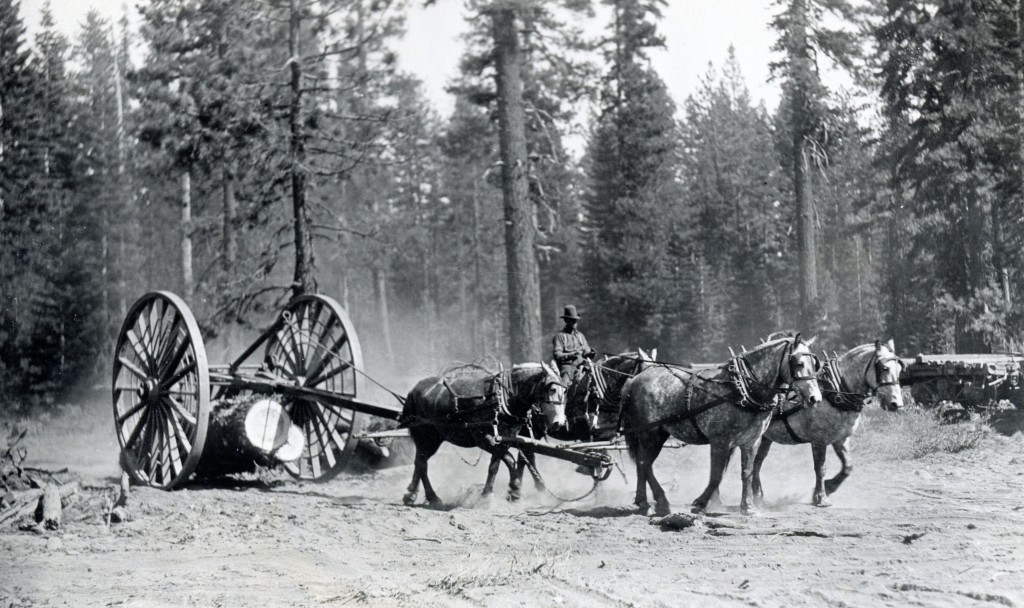
Horse logging with big wheels, at Fruit Growers Camp B, north of McCoy Flat Reservoir.
In the spring of 1925, Fruit Growers Supply Company announced a major change in their logging operations. In April, the company sold some seventy logging horses, thus a major phase out utilizing horses and Michigan Big Wheels. The company replaced the horses with six Catepillar tractors, after having two in operation the previous year. The tractors were more efficient, as they could go in terrain the horses could not. Horse logging also required additional workers known as “swampers.” Their job was to remove any debris or vegetation that could result in an injury to the horses legs.
In 1925, Fruit Growers Supply Company at its Lassen (Susanville) operation were always looking at innovative ways for efficiency and reduce labor costs at the same time. This year, they installed a Hilke Lumber Piler, the contraption had been invented in 1915 by Seattleite Henry Hilke. The piler was a very efficient means of stacking lumber outdoors. Not only did it reduce the aisle width for stacking of conventional lumber, but the machine allowed to make higher stacks. While a four man crew was involved, the piler could handle up to 10,000 board feet per hour. As one local observer noted: “To those who had never seen the new stacker in action, it is a most interesting and educational sight.”
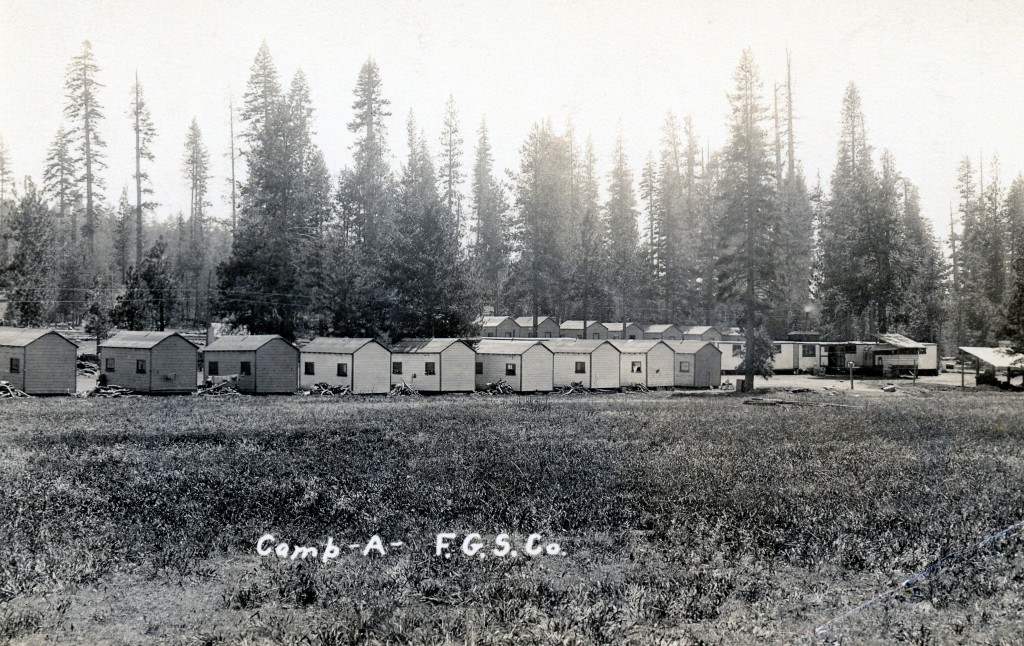
Camp A, Fruit Growers Supply Company, located just north of McCoy Flat Reservoir, 1921
There have been some interesting comments posted of late, so I take this opportunity to answer a few.
Seasoned residents may remember a row cabins near Cherry Terrace along Piute Creek, where Al & Joy Robbins is located. There was one large cabin, which was occupied by Dan Marmo. The smaller cabins, came from Fruit Growers Supply Company logging Camp 10, after it closed in 1952. Marmo rented out the cabins, some of those folks less fortunate than others. On occasion even a Lassen College student could be found there. There are still some of these old logging cabins located throughout Susanville.
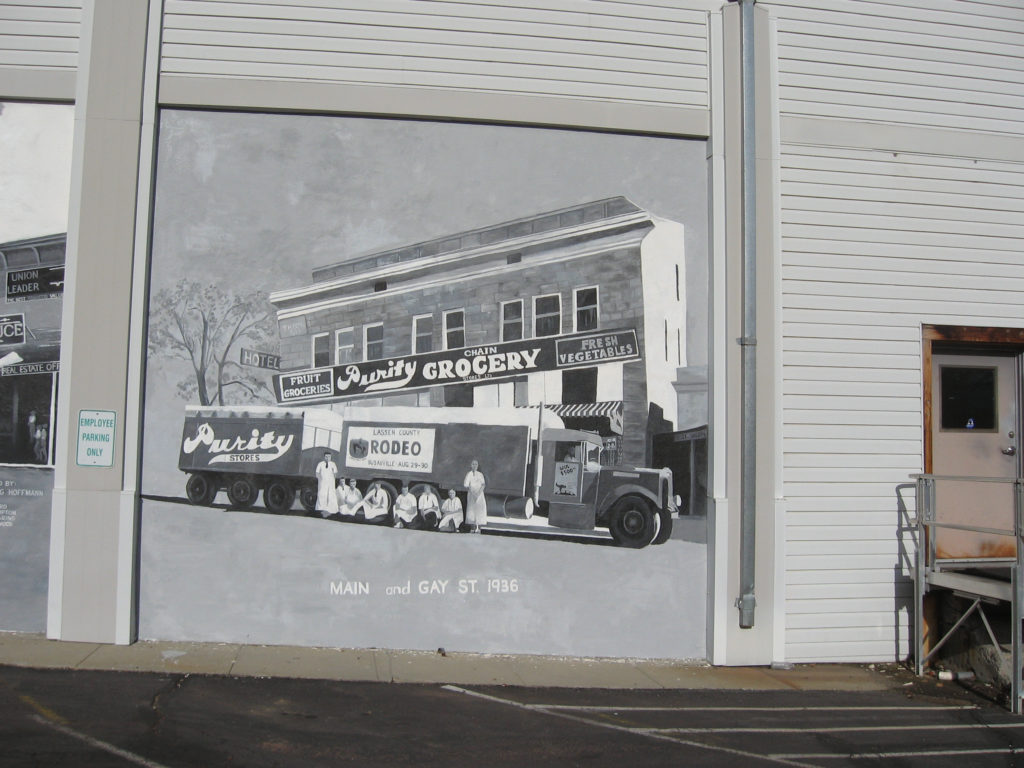
One of the panels on the LMUD building, part of a forthcoming mural tour. The building depicted iwas the home of the Telephone Company . December 26, 2016
The Telephone Company building, is a reference I had not heard in years. However, it just so happens I am writing about it. The is the two-story stone building located on the northeast corner of Main and Gay Streets. It was built in 1914 and originally known as the Star Hotel. For a number of decades it housed Susanville’s first telephone company. When Safeway came to Susanville in 1928, it was housed there.
In the early 1930s, Red River Lumber Company was going through a refinancial organization process requiring an inventory of all assets and liabilities. Not an easy undertaking, with so much territory to cover. An item of interest to me was the inventory of rails used in its logging operations. It was duly noted that Red River owned 93.7 miles of rail.
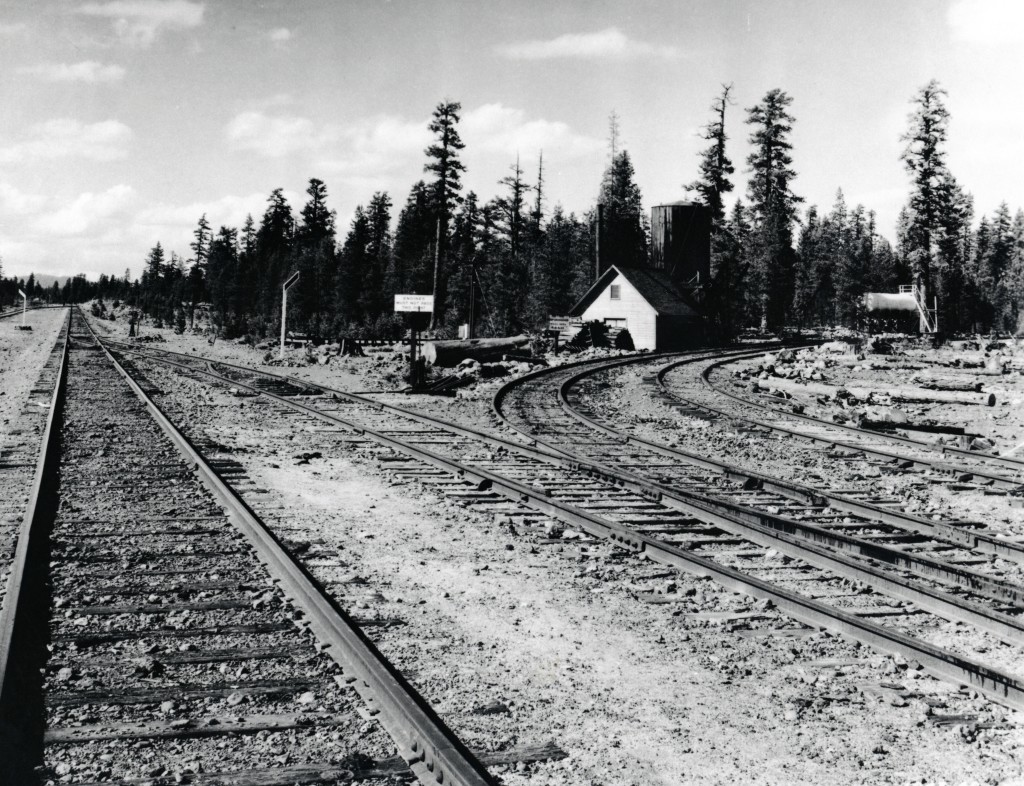
However, when it came to the Piute Line, that went from Hog Flat to Susanville, those rails were leased from the Western Pacific Railroad. This, no doubt, added more fuel to the speculation that this particular railroad was destined to be a feeder line for Western Pacific’s nearby Highline. The report noted that the initial 1917 survey of the Piute was to begin north of Westwood Junction near McCoy Flat. However, those plans had to be scrapped when Fruit Growers logging railroad traversed there.
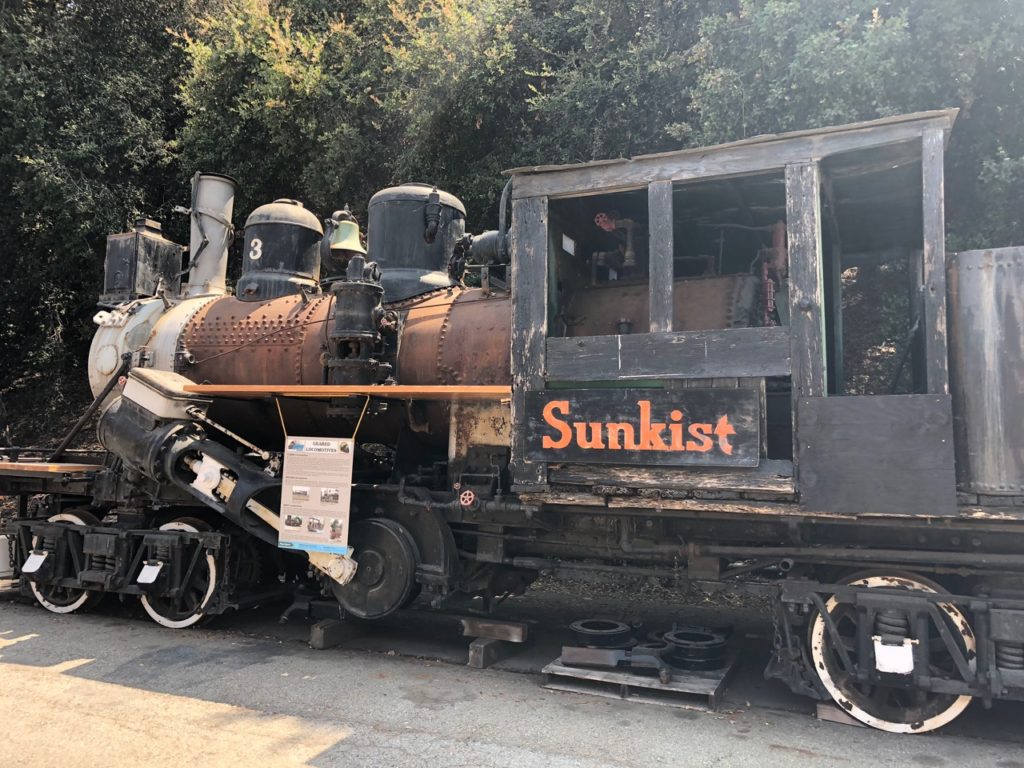
Earlier this year, Tim Stienmeier, while at the Los Angeles County Fairgrounds in Pomona sent along this photograph of the Climax No. 3 locomotive that the Fruit Growers Supply Company used at their Hilt Operation. It should be noted that Fruit Growers discontinued railroad logging at Hilt in 1933. For many years the No. 3 was parked along an old freight shed. In 1954, the Southern California Chapter of the Railway Locomotive Society became aware of this relic and inquired about its status. Fruit Growers agreed to donate it to the Society on the condition that organization would have the burden of the costs to move it from Hilt to Los Angeles. Once the mission accomplished the Climax No. 3 once cleaned up was put on permanent display at the Los Angeles County Fairgrounds, though it kind looks a bit neglected these days.