Train load of logs leaving Camp B, 1923–Courtesy of Dick & Helen Harrison
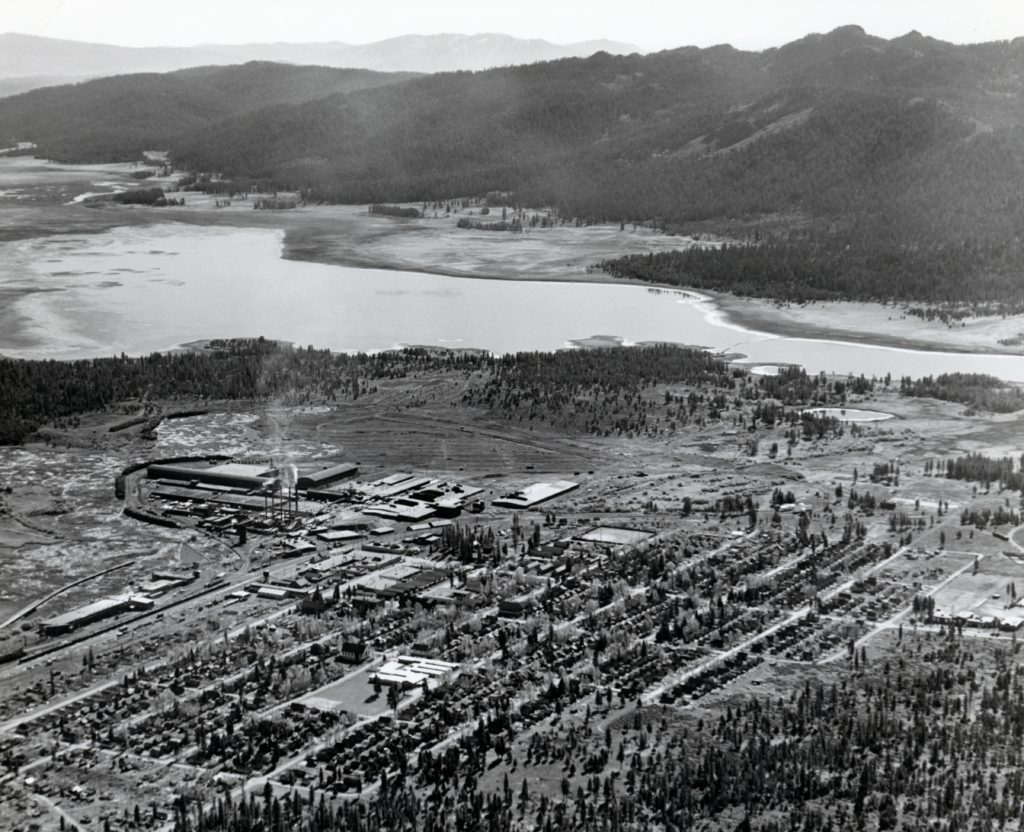
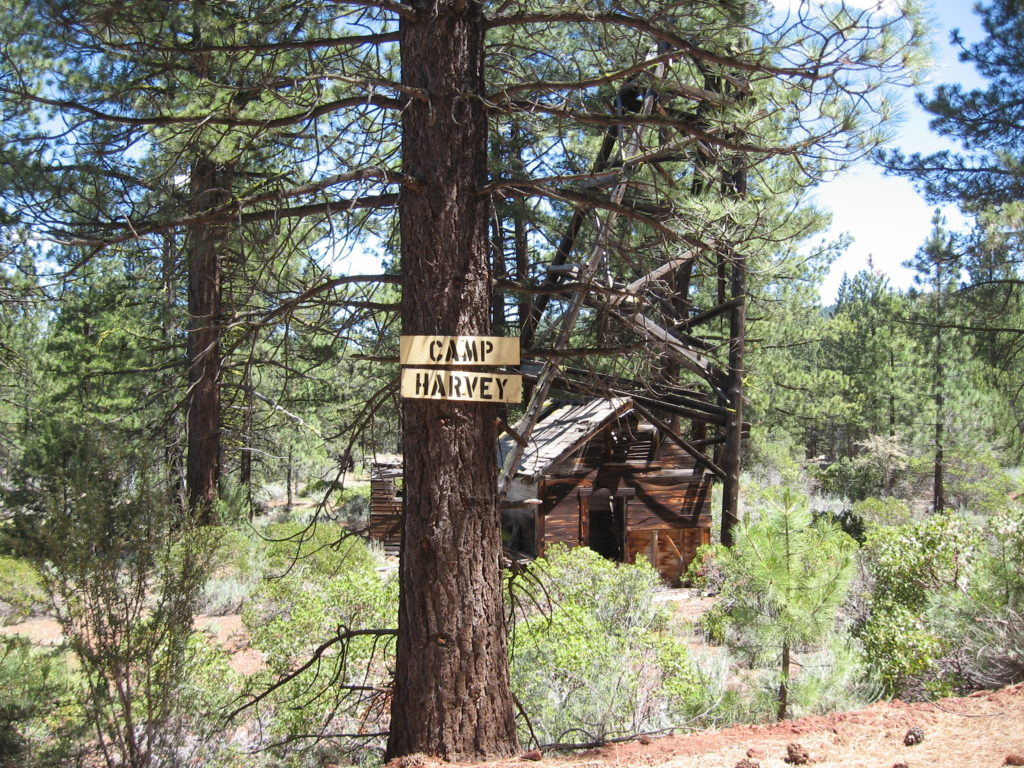
Yesterday’s topic was big timber before the arrival of the big mills. Well, that big timber became big logs. Camp B of the Fruit Growers Supply Company was located just north of McCoy Flat Reservoir. It was their second railroad logging and one of its largest. The camp operated from 1922 to 1925. Similar to Camp Harvey there are still remnants such as the concrete foundation of the commissary and service pits used to work on the locomotives.
In the late summer, and some times in the fall the Board of Directors of the Fruit Growers Supply Company would make an annual tour of their mill operations and timber holdings in Northern California, which they still do, minus the mills. It should be duly noted that Fruit Growers is the co-operative purchasing agent for the citrus growers marketing co-op known as Sunkist. The reason for these holdings, was to provide wooden boxes for the shipment of citrus, prior to the advent of the cardboard box.
In mid-August 1955, the Board made their annual tour, and no one thought much about it. This was about to change with a sudden announcement. On August 25, 1955, H.A. Lynn, President of Fruit Growers made the following announcement: “A diminishing supply of company timber and the reduce requirement for box shook, the company will permanently close the Westwood Operation.”
It came as a shock, but then it was not. After all, it was a widely held belief, just how long could the lumber industry survive. In another announcement that year, Sunkist would no longer use wooden boxes for shipping, and made the conversion to cardboard.
The logging and mill operations at Westwood would continue as normal for the remainder of the 1955 season. In 1956, the process would begin to phase out and close the Westwood mill.
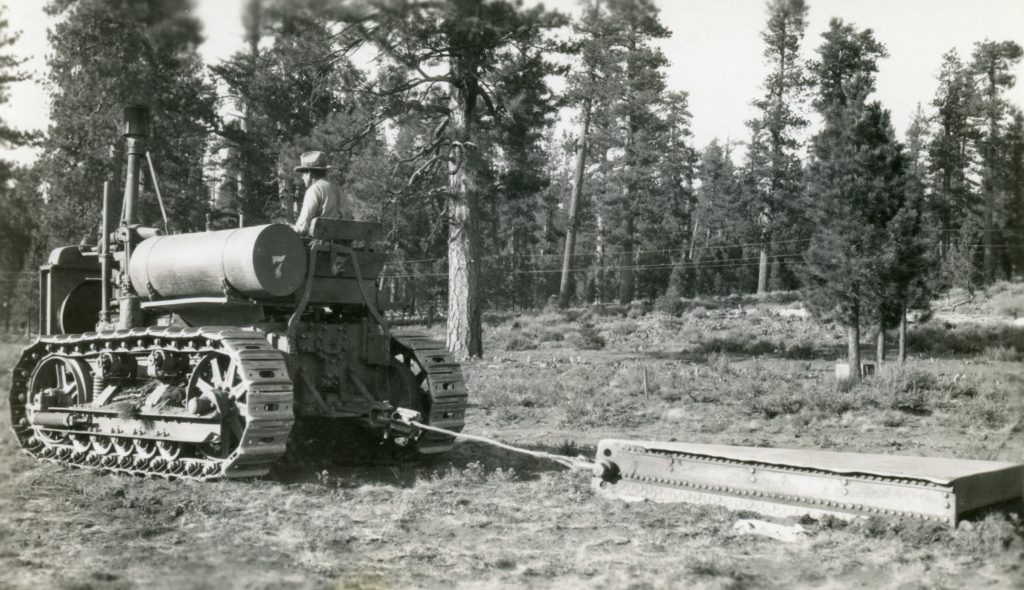
Fire trail V-drag plow, 1929. Courtesy of Fruit Growers Supply Company
After the 1924 fire on Antelope Mountain, west of Eagle Lake, Fruit Growers Supply Company (FGS) revaluated thier standard method of fire prevention. At that time they piled brush and slash (tree limbs and tops left behind once the logs were removed). They adopted a new method, building a series of fire lanes. The fire lanes were 100 feet wide and completely void of vegetation, each encircling 100-acre sections of timber. They were formed by a special V-drag plow hooked to a Caterpillar tractor which could clear up to six miles of fire lanes a day. The lanes not only served as firebreaks, but also provided quick access in case of a emergency.
After each 100-acre area was logged, all the dead trees, or snags were felled, because left standing, they deemed them a fire hazard. Once the snags were felled, however, they again became potential fuel, this time on the forest floor. After the first substantial snowfall, the fire crew burned the snags and slash.
During the fire season, two crews of eight to ten men work as a fire prevention team. It was their job to build fire lines, oversee brush and slash piling, remove dead snags and maintain the telephone lines. The telephone “boxes” were attached throughout the forest, to allow for daily monitoring between the logging camps and the mill. The telephone system was also used to report a fire or an accident when medical aid was required.
The cookhouse operations at logging camps operated at a substantial loss for the company. However, the food served in the logging camps played a pivotal role. Poorly fed loggers would move to a different logging company, and thereby impact the former company’s production. In 1948, Fruit Growers experimented at Camp Harvey by raising the price of a meal to one dollar. Complaints were loud and long. But now, instead of losing thirty-six cents per meal, they now lost only eight cents. The result was substantial and at the end of the year, Fruit Growers’ operating losses for the cookhouses at Camps Harvey and Stanford was $63,500.
On May 2, 1949, Camps Harvey and Stanford opened for another season. In an effort to further reduce the cookhouse expenses, Fruit Growers leased them along with the commissaries, to H.S. Anderson Company for one dollar. Fruit Growers thought perhaps an outside company could handle the meals more efficiently. They would never find out the answer.
Just three weeks into the logging season all operations on the Harvey line shut down. The cookhouse crews, represented by Local 768 of the Bartenders and Culinary Workers Union, walked off the job in a wage and hour dispute with H.S. Anderson Company. As the weeks passed with no end of the strike in sight, Fruit Growers closed down Camp Harvey and Stanford permanently, as well as its Harvey railroad logging line.
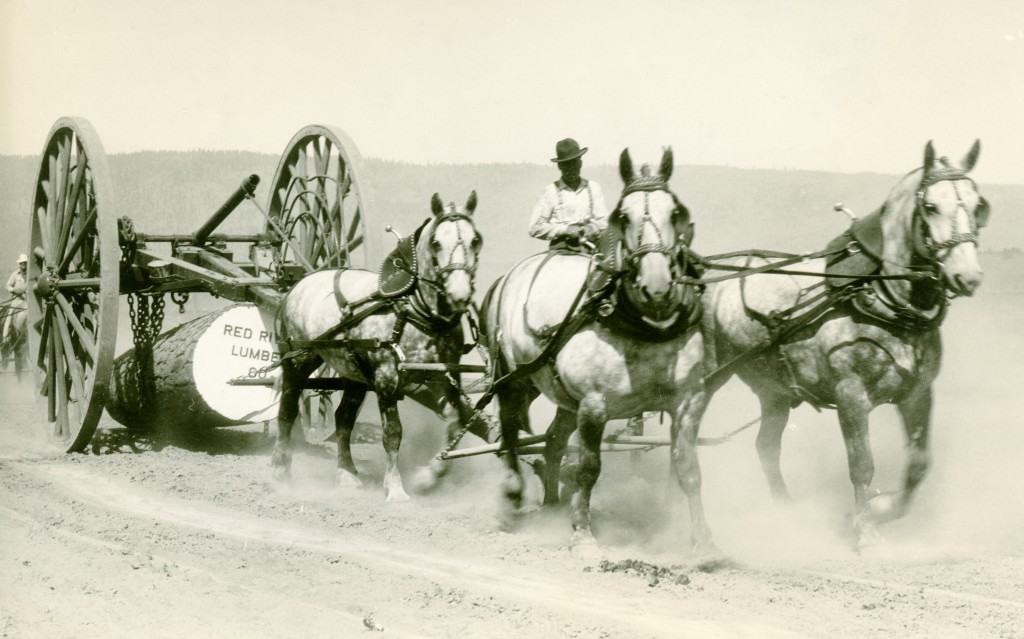
When the Lassen County Fair was revived, in 1922, it would go through an evolving process. One of the dramatic changes was the establishment of three large sawmill operations—Fruit Growers Supply Company, Lassen Lumber & Box Company and the Red River Lumber Company.
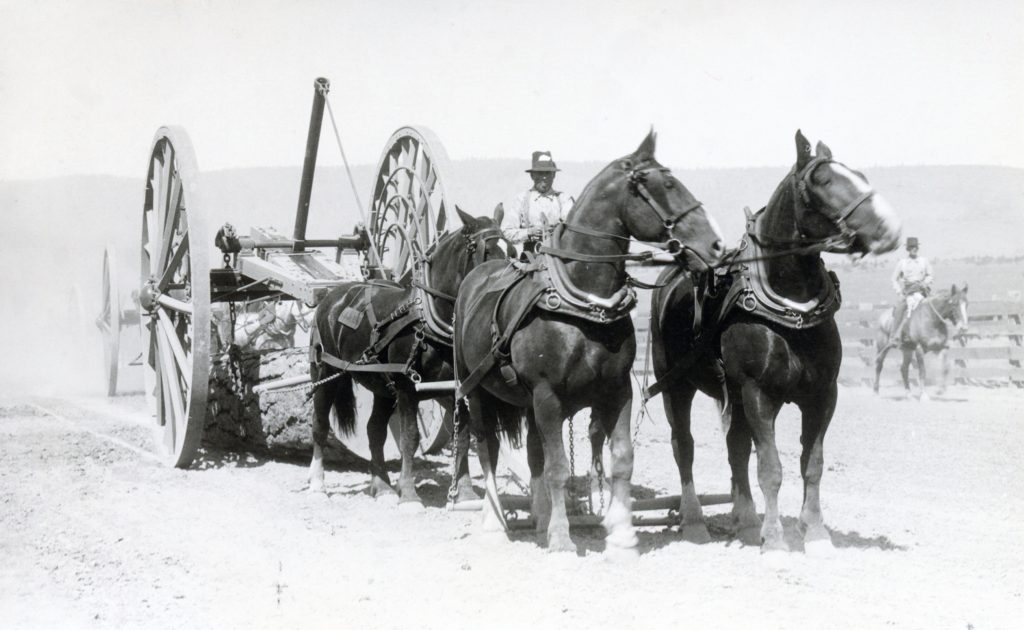
The following year, the first logging exhibition at the Lassen County Fair was held. It was certainly a noteworthy event. For many attendees it was the first time they were able to witness the current logging methods of the “big wheels.” A competition was held between the big three companies. The Fruit Growers Supply Company won top honors in this category. It should be noted by 1927, the lumber companies began phasing out the “big wheels” for the motorized Caterpillar traction engines.
In a very belated follow up on the history of Halls Flat. For a refresher for those new to the area, Halls Flat is located in western Lassen County, north of Poison Lake, which some times is a lake that Highway 44 skirts around the south shore.
Anyhow, Halls Flat came to life in a big way starting in August 1941 when the Red River Lumber Company established Camp Bunyan. This was a new experience for company. Its timber was no longer tributary to its Westwood mill—as a fact the camp alone was thirty-five miles to the north. The bottom line, this is where the timber was. Camp Bunyan was unique from other Red River logging camps. Not only did this camp have a name and not a number, it was their largest camp that consisted of both temporary and permanent buildings. At its peak time, it was the home to some 350 loggers, making it one of the largest seasonal communities in Lassen County. However, it got off to a rough start when not long after the loggers went on strike over wages and poor living conditions. Once those issues were resolved everything went smoothly. From Camp Bunyan a railroad logging line was constructed to the east in the company’s Blacks and Harvey Mountains tracts. In 1943, a second logging camp named Camp Harvey was established. At the end of the following of year, a major change happened when Red River sold to the Fruit Growers Supply Company. At the end of the 1946 logging season Camp Bunyan had served its intended purpose and was shut down. Its location remained a hub of activity since the log trains from Camp Harvey went to the Camp Bunyan site to connect with the Western Pacific Railroad that relayed the loaded log cars to the Westwood mill.
In the spring of 1948, though the hustle and bustle of the connections of the Harvey railroad line connecting with the Western Pacific at Halls Flat came to a sudden halt. In essence, it was similar to the opening of Camp Bunyan. This time, however, it was the cookhouse employees at Camps Harvey and Stanford that went on strike over wages. With no end in sight Fruit Growers permanently closed down those logging camps and the railroad logging line.
Camp C, no date. Courtesyof Lenala Martin Collection
During the 1920s, Fruit Growers Supply Company operated six railroad logging camps in the vicinity of Martin Springs, located between McCoy Flat Reservoir to the south and Pine Creek Valley to the north.
Camp C had a unique feature not found in other logging camps. It should be duly noted that Fruit Growers valued their employees and took good care of them. In 1923, Fruit Growers built an outdoor boxing/wrestling area that seated 500 at Camp C. On June 23, 1923, the inaugural wrestling match was held between Susanville resident Bill Mohler and Paul Kinney of Omaha, Nebraska. A special train from Susanville was dispatched to Camp C to allow their mill employees to attend.
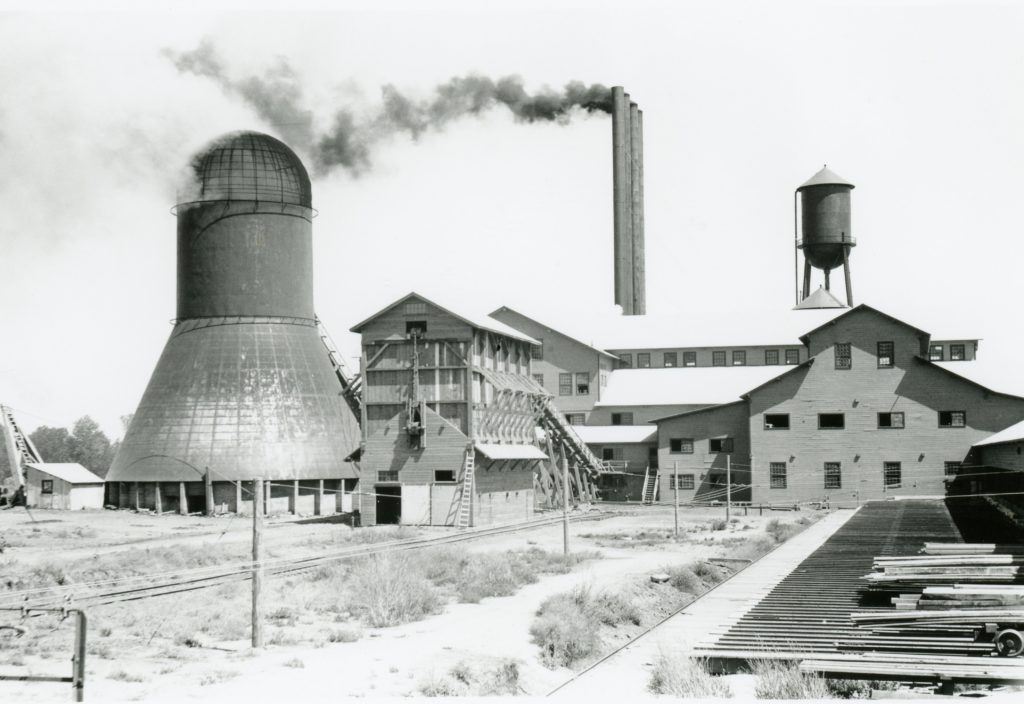
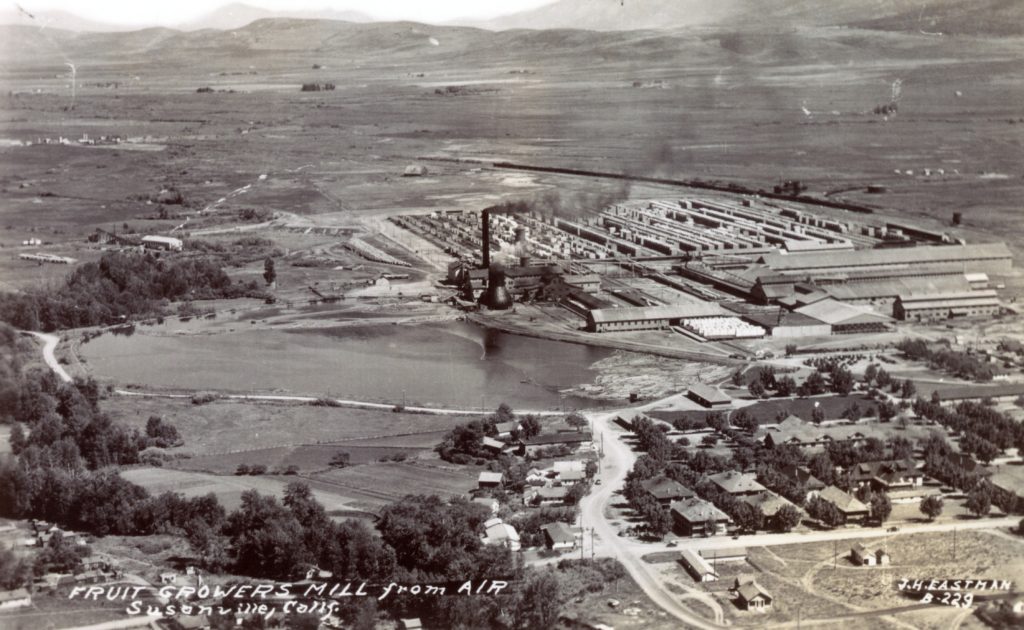
The Susanville plant, 1921. Courtesy of Ed Standard
In this era of being bombarded with the term “fake news” the City of Susanville deserves a gold medal award to distort the record to accomodate someone’s warped mind. It should be noted, after all, I have spent the majority of my life researching the region’s history to provide an accurate record versus false statements, which is different from folklore. For instance, when my Eagle Lake book was published in 1988, Bob Amesbury congratulated me, since he had written a book on the lake, too. Bob went onto say that he had all the bullshit and I had all the facts.
Fast forward to the summer of 2018, when at the City’s urging I met with with two officials, Mr. McCourt and Ms. Schuster, concerning the history of Riverside Park. It was an exercise in futility, for this dynamic duo, could care less about the history of site, and were bound and determined to change the name of Riverside Park to Fruit Growers Park, regardless of the facts, which ultimately they were successful, using a deceptive survey, that the general public was excluded.
Fruit Growers Supply Company, 1936
Oh, dear reader, it gets worse. To support their claim they lied on the record at a city council meeting at the September 5, 2018, and that information then appears in the local newspaper only to get perpetuated. One of Schuster’s first comments that the city gave Fruit Growers the millsite property consisting of 256 acres, which it should be noted was larger than the city itself, and was located over a mile away from the city limits. Just the twenty acre parcel where the park is located, Fruit Growers purchased that from George and Pearl Bassett for $9,500. In all, Fruit Growers spent more than $60,000 for the millsite property and water rights. It just gets worse. Schuster noted that Fruit Growers sold the mill to Eagle Lake Lumber Company in 1944. Fact, Fruit Growers sold to Eagle Lake Lumber in 1963 for $875,000. Later on it was mentioned that Fruit Growers donated the park property. Excuse me. The city purchased it in 1976 for $23,000 from Sierra Pacific Industries, and it was not the city’s first choice. The city was trying to buy Vallejo Meadows along Piute Creek, north of Willow Street, and west of Parkdale, as part of a greenbelt program, but that deal fell through.
In closing then, with the City’s current thinking, Riverside Hospital where I was born and lots of others could not have existed under that name, as it must have been Fruit Growers Hospital.
Diamond Mountain, circa 1940. Courtesy of Margaret A. Purdy
It is interesting to note that before the Red River Lumber Company and the Fruit Growers Supply Company harvested a single tree, the two companies stated with their sustained harvesting practices they would operated into perpetuity. While both companies no longer operate sawmills, they own large swaths of timberland, which is routinely harvested. However, large swaths of territory the companies would log contained a great deal of volcanic rock, not the best soils for second growth trees. In addition, when they did a tremendous amount of logging in these areas, it coincided during a twenty year drought cycle from 1917-37, that until this time the region had never experienced since the Anglo settlement of the 1850s. On the other hand, they had a positive outlook. Take for instance during the dedication ceremony of Fruit Growers sawmill in Susanville in 1921. Charles Emerson, a well known merchant and rancher was one of many dignitaries to speak. Emerson told the crowd of his own reforestation locally. Emerson recalled that as a child [he was born in Susanville in 1868], forty years ago, he helped plant a tract of pine trees on the family ranch just south of Susanville on Diamond Mountain. Those seedlings, he said, had become a fine stand of pine timber, many of which were 22 to 24 inches in diameter.
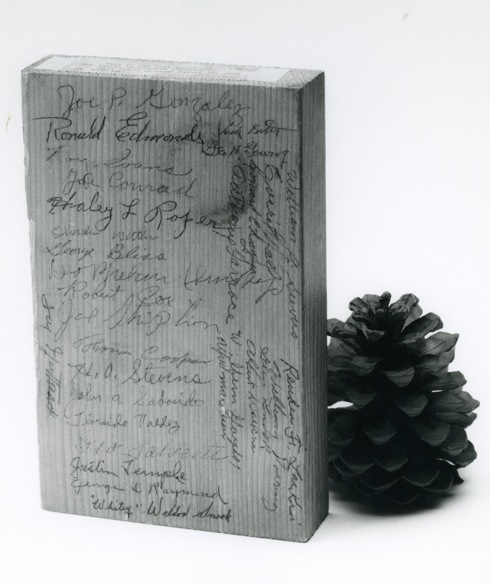
To mark the end of mill operations at Westwood, in 1956, the last board cut in the dry lumber department there was signed by the last of the workers. It was piece of Douglas fir 5 1/2 inches wide by 9 inches high. Some of the records of Fruit Growers Westwood operation were transfered to that company’s office at Hilt. In 1999, it was discovered in the old Community Center at Hilt. At that time, the board was taken to Fruit Grower’s headquarters in Sherman Oaks, California and put on display. Whether it is still on display is not known.