Category Archives: History

Lassen County’s First Newspaper

The 1878 staff of the Lassen Advocate

The first bona fide newspaper the Sage Brush made its debut on the streets of Susanville on July 15, 1865. This was a substantial undertaking since Lassen County may have had barely a thousand residents. It should be noted that the County of Lassen subsidized the publication at $100 a month until it was able to sustain it on its own.

It was a typical rural press newspaper. It was four pages in size, published weekly. A Washington hand press was used, and the type set by hand.

The newspaper’s founder, A.C. Longmore remained at the helm until August 10, 1867 when he sold it to A.T. Bruce. Bruce’s ownership was short-lived and sold the paper in the fall to John C. Partridge.  Partridge changed the name to the Lassen Sage Brush. Yet, besides operating  the newspaper, he had many other interests. He spent five years as a U.S. Deputy Surveyor and did many of initial Government Land Office surveys of northern Lassen County, as well as Modoc County. Because his work as a surveyor required him to be away for long periods of time, he sold a half interest in the newspaper to George Pierce. It did not work out well, by June 3, 1871, Partridge was once again sole proprietor. In March 1872, he brought in another partner, D.C. Slater, who also happened to be his brother-in-law. More changes were on the horizon when on January 4, 1873,  displayed an entirely new format. Not only that, but a new name as well—The Lassen Advocate. The Advocate would chronicle the news of the region until 1987 when it closed due to bankruptcy.

Support

Moon Valley – The Promised Land

Moon Valley
Cover of the Moon Valley brochure

The Occidental Petroleum Company’s published a very enticing portfolio of the wonderful virtues of Moon Valley for perspective buyers. The advertising of the region made it too good to be true. “Now you get it all at Moon Valley Ranch: prime recreation land, within 4 miles of a 2,500 acre lake, in Northern California, the next recreational capital of the West and profitable investment property almost certain to appreciate as California’s recreation-hungry population continues to explode . . .And what a price now you can buy 20-acre parcels for less than $199 an acre–$150 down, $29 monthly.” Their portfolio expands on all the nearby wonderful recreational areas, such as skiing and golfing at Westwood, though they did not mention that Westwood was some seventy miles away. Also they did not disclose the fact that the golf course at Westwood was only proposed. The Company was correct in their advertisement that is was “The magnificent, away-from-it-all Moon Valley Ranch” to “land-that-time-forgot.”

Don’t forget to look at the Subscribe

The Wolfskill Factor

A Southern California citrus grove—Sunkist, Inc.

William Wolfskill, native of Kentucky, (1798-1866) had an interesting life. He leaves many legacies to California history. In his westward journey he became a Hudson Bay trapper and even traipsed around Northeastern California, that would later have an impact on the timber industry—but he is credited to establish California’s first commercial orange grove.

In 1831, he settled at Los Angeles. Wolfskill like what he saw and two years later acquired a small tract of land, complete with its own vineyard. In time. this vineyard and winery did quite well.

In 1841, Wolfskill intrigued with thirty-five orange trees owned by his neighbor Dom Luis Vignes (and thinking that oranges just might have commercial value) planted a two-acre grove with trees from the San Gabriel Mission. His experiment was successful. He expanded his acreage to seventy acres. The year of his death, 1866, his orange crop sold for $25,000.

It wasn’t Wolfskill’s skill as a grower, however, as much as it  was his marketing abilities—and the effects of disease—that led to his success. Wolfskill took an advantage of a scurvy epidemic in Mexico to export his citrus and another new market was brought on by California Gold Rush. In the early 1850s, oranges were selling a few pennies a pound in Los Angeles, were going for much as a $1 pound in the Northern California gold fields, and that is where Wolfskill sent his fruit.

Wolfskill’s son, Joseph is credited with shipping the first oranges to eastern markets. In 1877, his fruit took one month to travel via Southern Pacific Railroad to St. Louis, Missouri. Wrapped in paper and packed in ice (which had to be replaced eleven times en route) they arrived in very good shape—and made young Wolfskill a very good profit.

Next Week: Chaos among citrus growers and the birth of an co-operative.

Support


The Susanville Arch

The arch was a temporary affair, and a windstorm two weeks later, blew it over.

Community archways have been around for a long time. Of course, in this region the best known one is the Reno Arch, which the first one dates back to 1928.  Susanville had its own Arch, even though it was short-lived.

1913 a new fraternal organization was organized–Susanville Lodge 1397, Loyal Order of Moose, commonly referred to as the Moose Lodge. They decided to hold a Harvest Festival in conjunction with California’s Admission Day, September 9.

It was a four day festival. On the northwest corner of Main and Gay Streets (the former Bank of America parking lot, now owned by LMUD) an open air pavilion was constructed, where many activities were held. To give the event a special festive air, the lodge constructed an arch over Main Street at the Gay Street intersection.

Tim

A Change of Name

Lassen County High School Basketball Team, 1914. Notice L.C.H.S on the basketball ball. Left to Right:Will Raker, Donald Shanks, Claude Wemple, Burton Spalding, Ira Baldwin.

Name changes can be a tricky issue. After all people are a creature of habit, so name changes can be disruptive. This is different from were names slowly fade away. Take for example Seven Bridges in the Honey Lake. Valley, if you know the locale, you are dating yourself. Anyhow, back to the name topic at hand—Lassen High School.

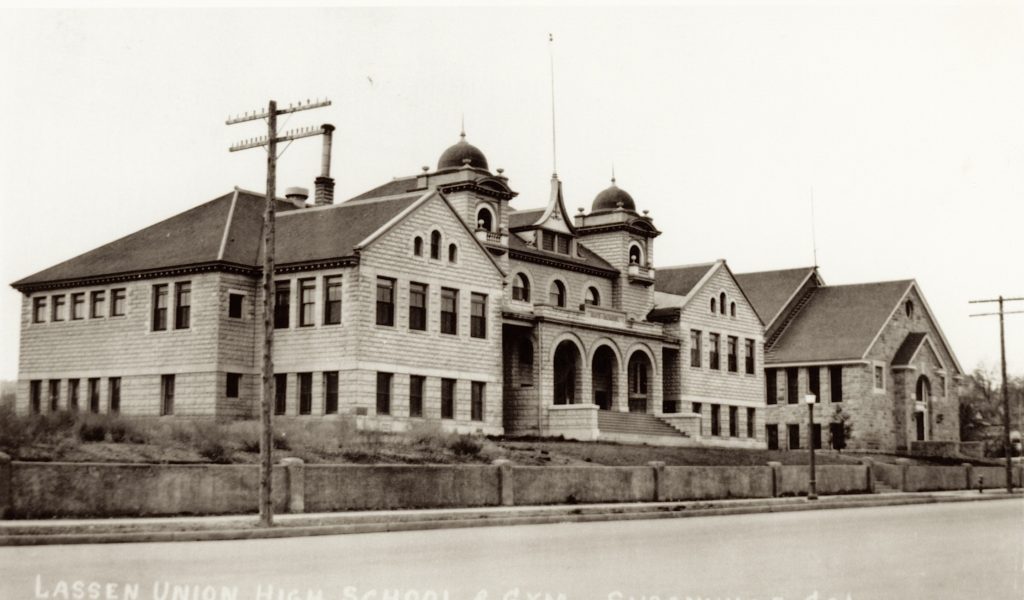
When high school was created in 1902 it was known as Lassen County High School. When it was established it was the only high school in the county. That changed in 1916, when two new county high schools opened—Big Valley and Westwood. California state law required Lassen to drop “County” and adopt “Union” to embrace all the districts in the county—thus is became known as Lassen Union High School.

A lot of people grumbled about the name change, since it was all they ever knew. Years later there is a generational change. The older insist its Lassen Union High School and the younger simply refer to their alma mater as Lassen High School.

Subscribe

Tuesday Tidbit—Amedee Lime Kiln Update

Amedee Lime Kiln, January 26, 2020

An astute reader, asked an astute question. Why the kiln, and where did the lime come from?  Very good questions, indeed. Lime is found in rock deposits of calcium carbonate, which the rock has to be heated to extract the lime.

It should be noted, there is an interesting lime kiln remnant near the Wendel Hot Springs, but as it is on private property not accessible to the public.

Tim

Susanville’s Piute Creek

M. Moses was the second claim recorded in Roop’s Land Register. He settled on present day Susanville Ranch Park and referred to Piute Creek as Smith’s Creek.

This small stream a tributary to Susan River is approximately ten miles in length. For a brief period it was originally known as Smith’s Creek, who and why it was so named such we may never be known.

Another peculiarity is the spelling of Piute. Back in the 1850s and 1860s that was how the Anglo settlers of the western Great Basin spelt the name for the Native American tribe now referred to as Paiute.

Piute Creek was also the source for the original water supply for Susanville. It would be replaced with what is now known as Cady Springs in the Susan River Canyon.

Flood waters from breached earthen fill trestle, April 1938. Courtesy of Betty B. Deal

In 1935, the Red River Lumber Company completed its railroad logging line known as the Piute that traversed a portion of the canyon the creek flows through.  Just above Desmond Meadows, the Piute line crossed Piute Creek. In an effort to save money, Red River decided to forgo a wooden trestle, and substitute an earthen fill. It was a rather substantial one at that, being over twenty-five feet tall. The winter of 1937-38, was one for the record books. By the end of March, 1938, the spring run-off was in earnest. The earthen fill at Desmond Meadows was equipped with a culvert to handle the stream flow. It was no match for this type of heavy water flow and then the culvert became blocked with debris, creating a substantial reservoir. As one eyewitness observed, this newly created lake extended back 300 feet from the fill with an estimated depth over twenty feet. On April 9, the fill breached, sending a wall of water downstream creating havoc in its path and washing away segments of the Piute railroad tracks into the fields of its dairy property now known as Susanville Ranch Park. In the aftermath, Red River decided not to repair the destroyed trackage. Red River took its time salvaging the line, since the company had given consideration to abandon railroad logging. In the 1940s, the abandoned railroad grade was converted into the Paul Bunyan Logging road.

Support by subscribing.

Have $4.7 Million to Spare?

Hotel Mt. Lassen, 1947

During the winter months, I spend some time cataloging documents and photographs. A tedious chore, but one that has to be done. With that in mind, I came across two 1947 photographs of the aftermath of the fire that destroyed Susanville’s Hotel Mt. Lassen. Since the cement walls were structurally sound, the hotel was rebuilt.

Hotel Mt. Lassen, 1947

The Hotel Mt. Lassen has now been closed for well over a decade. The current realtor has a firm asking price of $1.7 million. Last summer, I happen to had a discussion with a building contractor who inspected the hotel on the urging of the realtor. It was the contractor’s opinion that it would cost at least $3 million to put in back into operation. With inflation since then, the cost is probably higher. It appears the hotel will sit vacant for a long, long time.

Tim

Moon Valley – A Beginners Guide

A view of the western Madeline Plains, August 4, 2016.

Moon Valley is not really a valley per se,  but a very large subdivision on the Madeline Plains. In 1968, the Occidental Petroleum Company purchased a large portion of the lands owned by the Rees T. Jenkins Land & Livestock Company. On the west side of the Madeline Plains, they subdivided thousands of acres into 20-acre parcels they named Moon Valley Ranch. The first unit was recorded on July 12, 1968.

Moon Valley conjures up many images depending on one’s perspective. For some Lassen County officials it presents many challenges. Law enforcement officials have to contend with illegal marijuana grows and from there the list goes on.

A number of these parcels are sold sight unseen. Once sold the new buyer who finally makes the pilgrimage there, realizes the land is not what they envisioned and that it was not such a great deal after all. I recall, in one instance a young man from England came into the Lassen County Assessor’s Office wanting to know about a parcel he recently inherited there.  Of course, in his mind, he thought he found the proverbial pot of gold, after all it was real property in California. The Assessor’s Office did the best they could to describe the property, yet the young man was undeterred. After he left, we all agreed that he probably spent more money to make the trip from England than what the property was worth.

Tim