Category Archives: History

Sacred Heart’s St. Patrick’s Dinner

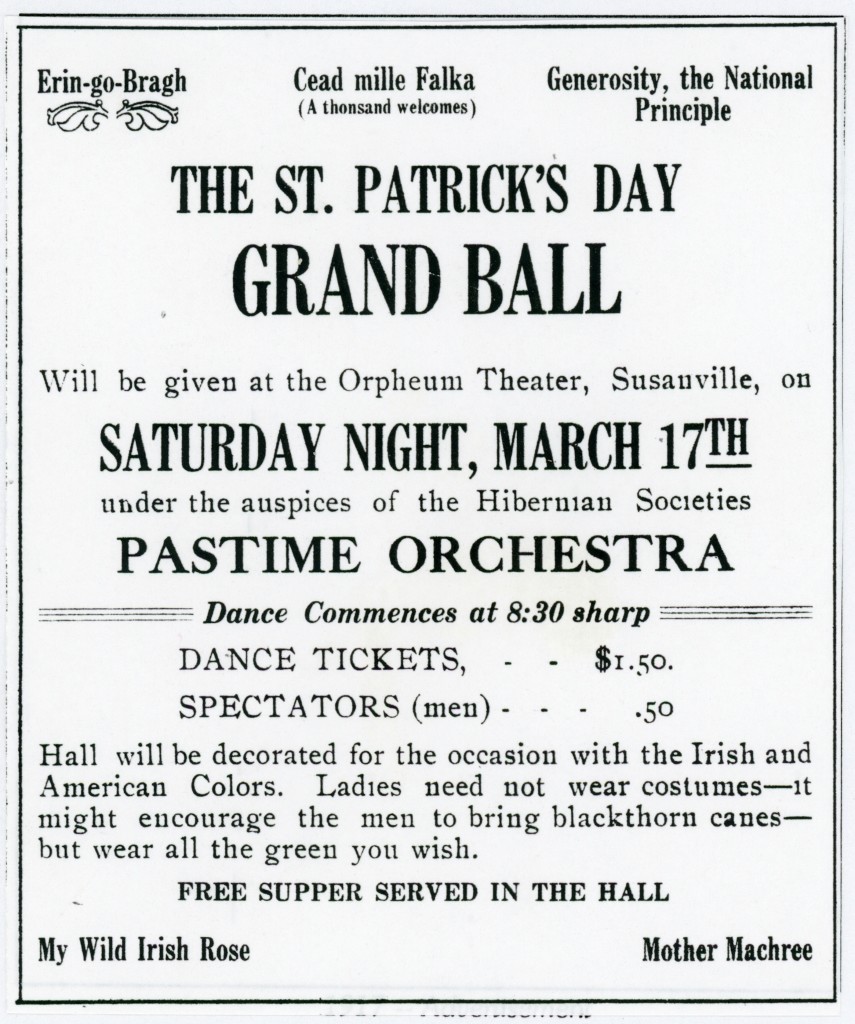
1917 Advertisement for the first St. Patrick's Dinner sponsored by the Sacred Heart Church
1917 Advertisement for the first St. Patrick’s Dinner sponsored by the Sacred Heart Church

Who knew back in 1917, when Father P.J. O’Reilly announced the Sacred Heart Church would celebrate St. Patrick’s Day, that it would be an enduring tradition now in its 100th year.  It is the oldest continuous event in Lassen County, surpassing even the Lassen County Fair. This year’s event will be held on Saturday, March 18 from 4 p.m. to 7 p.m., at Monsignor Moran Hall on Weatherlow Street  Believe me, as I can attest they serve the best corned beef around. There is always the cake wheel that can be very entertaining.

Father O’Reilly’s first event was nearly an all nighter.  As was the custom of the day, entertainment and dancing occupied the first half of the evening. Then at 11 p.m. a supper was served and then the dancing resumed into the “wee hours of the morning.”  At the conclusion, Father O’Reilly commented that it was a  a very successful affair  socially and financially.

Subscribe!


Milford Flour Mill

Milford Flour Mill
The abandoned Milford Flour Mill as it appeared in 1901. Courtesy of the A.J. Mathews family

One of the first agricultural enterprises undertaken in Lassen County was the establishment of flourmills. Due to the region’s isolation during the 1800s it was important for the region to self sustain itself. One of the most important products needed by the residents was flour. In 1861, J.C. Wemple and Judson Dakin built the region’s first flour mill at Milford. In 1882, H.H. Dakin, built a larger, more efficient mill at Janesville, which eventually replaced the Milford mill. The Milford mill did remain in operation until the late 1880s. In the 1890s, the mill was abandoned and in the early 1900s it finally collapsed. Other flourmills were established at Bieber, Janesville, Johnstonville and Susanville, more on those later.

Subscribe!

Red River: End of an Era

The installation of the Hammerhead Crane at Westwood, was one of many improvements to entice buyers.

Estate Sale: I need to make room for items from my mother’s estate. This a great bargain 50% off, a big deal your cost $12.50 plus shipping. What a deal!

It is only appropriate to feature this volume, number four in the Red River series, as last week featured volume number three.  It was originally thought that Red River’s Westwood mill would operate into perpetuity.  However, in less than thirty years in operation proved that theory wrong. There was the family drama, not all wanted to dispose of Westwood, but those that did out numbered those wanting to exit. On the bright side, with World War II, the demand for lumber soared, and so for once did Red River’s profits.  Thus, it seemed conditions were ideal to unload it, but Westwood was an albatross. No one wanted a mammoth mill, let alone a company town. Red River’s bargaining chip, it still owned vast swaths of timber and that is what the buyers wanted.
In addition to the saga of Red River’s departure from Westwood, this volume also wraps up a lot of loose ends. Included are such issues of what became of many of its landmarks, and that of the roadhouses that was once a dominant feature between Westwood and Susanville.  In addition, are Westwood institutions such as the Westwood Auto Club, the Westwood National Bank among other topics. To order your copy, is just a click away, here.

Subscribe!

1940 Population Figures

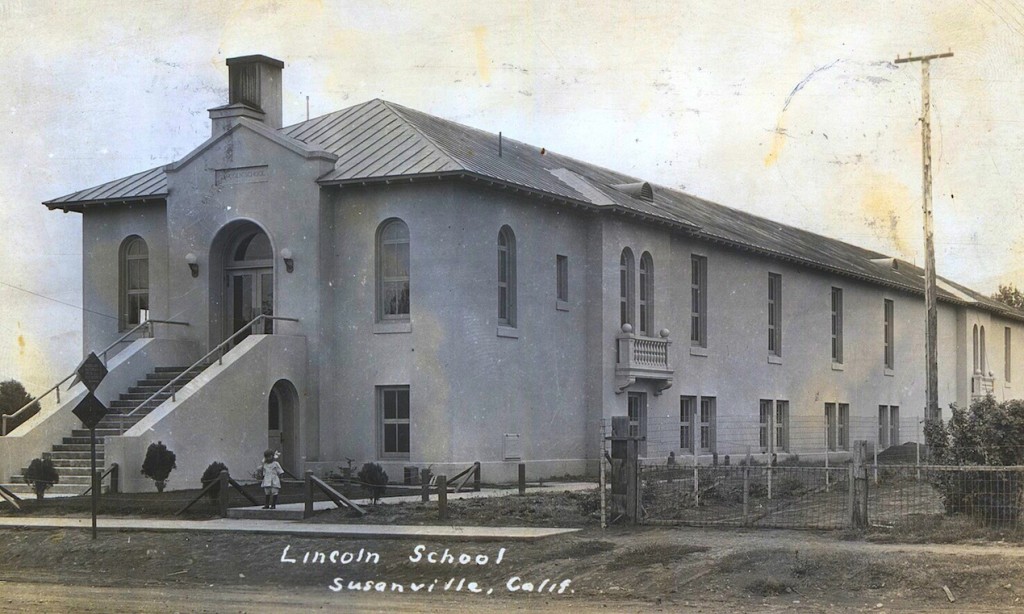
Lincoln School
Lincoln School, 1924. I purchased this photograph on Ebay. Your donation and/or subscription is a great boost to acquire and save  items, to share with everyone.

While researching the pre-history of Eagle Lake’s Spaulding Tract, one just never knows what I locate in the search. I thought the following would be an interesting tidbit to share.

In 1940, the school enrollments for elementary (Washington, McKinley, Lincoln and Roosevelt) along with the Lassen High School and the junior college totaled 1,445. In contrast, the population for Susanville was 1,575. Confused? First of all, the Susanville city limit stopped at Weatherlow Street to the east, and to Susan River on the south. The Lincoln and Roosevelt elementary schools, as well as Lassen High School, were located in the county.

Support by subscribing.

Eagle Lake’s North Shore

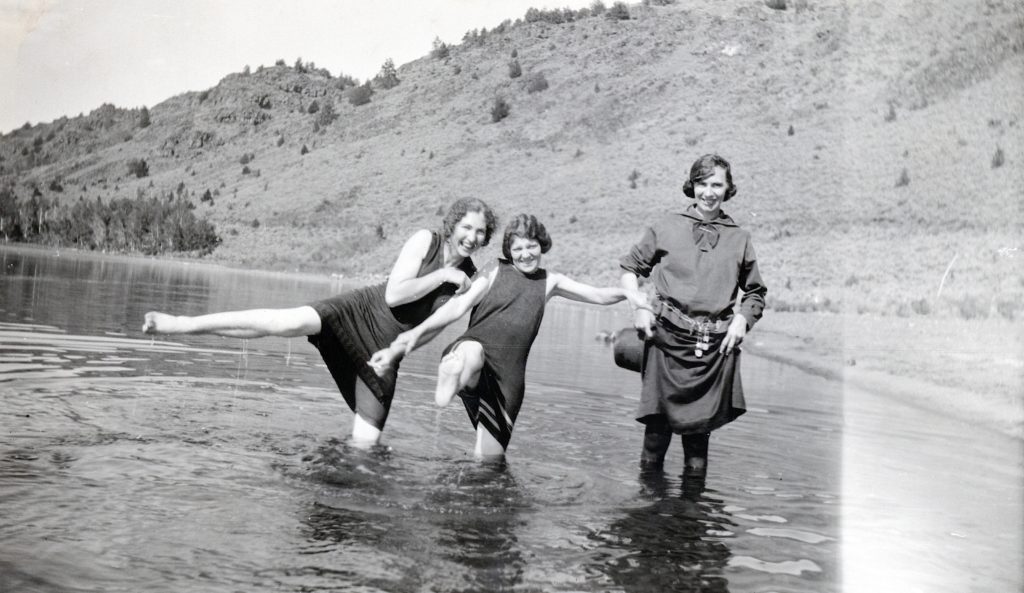
Having a bit fun at Eagle Lake's north shore, 1923.
Having a bit fun at Eagle Lake’s north shore, 1923.

While the calendar and the weather indicates it is March, many us can start thinking of a variety activities for the coming summer. For recreational aspects at Eagle Lake, the emphasis is usually centered around the south shore.  Those who resided closer to the lake’s northern shore did not prevent them frolicking in the water. Continue reading Eagle Lake’s North Shore

Red River: The Turbulent Thirties

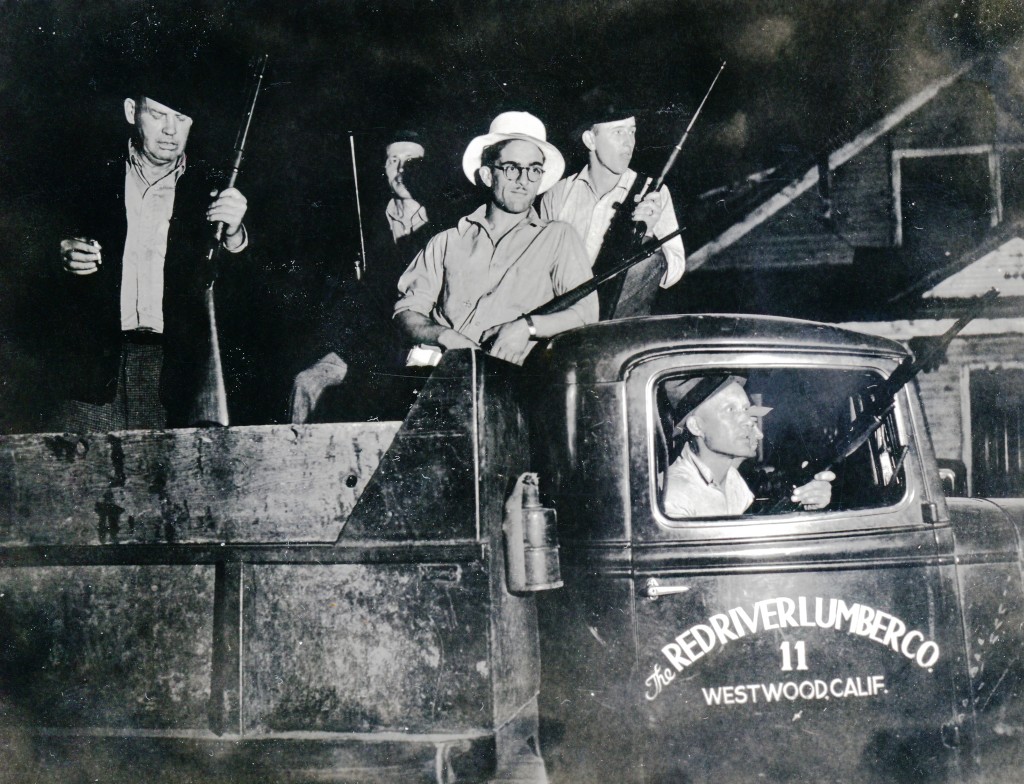
Purge Night, July 13, 1938. Courtesy of Frank Davis

Estate Sale: I need to make room for items from my mother’s estate. This a great bargain 50% off, your cost $12.50 plus shipping. What a deal!

The carefree spending days of the Red River Lumber Company came to an abrupt end. Bonds were used to finance the construction of Westwood came due. On the other hand, Fletcher Walker continued expanding operations, each at an additional cost. The bondholders on the other end were not pleased with the delinquent payment and return. A free for all battle occurred as to whether the banks or the Walkers would control Westwood. The Walkers, made concessions to keep the banks at bay.
Then there were labors problems. It began with the purge of the CIO members and their families who were driven out of Westwood in 1938.  That was the tip of the ice-berg. The following year the AFL went on strike over the same issue of wage restoration that the CIO wanted. It was a mess, to say the least, and it would be one of many factors that would seal Red River’s fate. Click here to order.

Subscribe!

Alfalfa Weevil Infestation

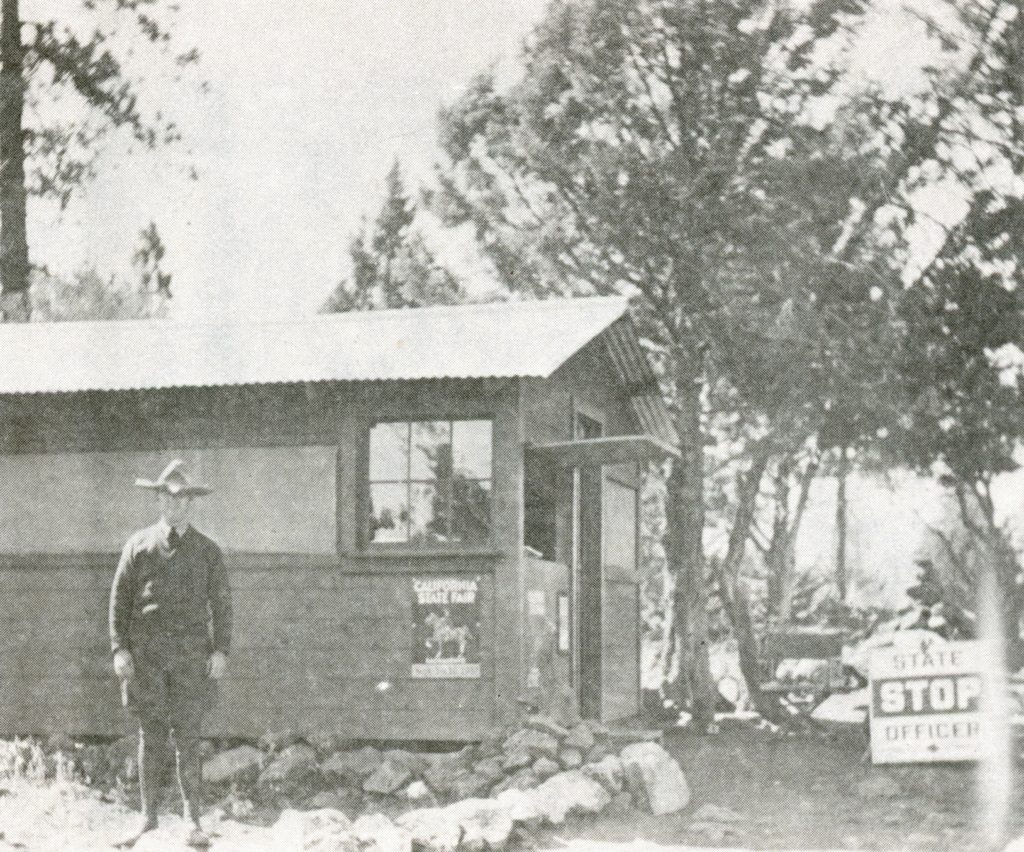
The inspection station at Jacks Valley, ten miles north of Susanville. It operated from 1931-1934.  Many folks know the location as the cement water trough on Highway 139.

Most people may not be aware the agricultural inspection stations originated with an alfalfa weevil infestation in the southern portion of Lassen County in 1921. The county originally conducted the operations, and in 1923, the state took over.

The infestations spread and more stations were opened one just west of Susanville near the present day intersection of Highway 36 and Eagle Lake Road. Another one ten miles north of Susanville, just before approaching Willow Creek Valley.  These would later be replaced and in 1953, the main station was at Long Valley. In 1976, when the segment of highway 395 was to become a divided highway, the station was in limbo, and the current one was put into place in 1986.

Subscribe!


Roosevelt Pool Revisited

Last year's invite to the groundbreaking ceremony.
Last year’s invite to the groundbreaking ceremony.

Yesterday marks the second anniversary of the daily postings. The first topic I covered was Roosevelt Pool. At that time the pool was being demolished. A lot has happened since then. I asked Jim Chapman to provide us with an account along the way, and he obliged. So without further ado  . . .

After almost two years of going thru every imaginable bureaucratic hoop, the JPA board was finally able to award a Design-Build contract to Modern Building Company Inc (MBC) of Chico for the new pool in late 2015.  It must be noted that during the first couple of years of the existence of the JPA, considerable time was spent evaluating potential locations for a new pool, along with the demolition of the old Roosevelt Pool, so the process to begin constructing the new pool really didn’t begin until the middle part of 2015. 

Resolution 15-07 was adopted on December 3, 2015 authorizing Phase 1 for the design portion, based on months of discussion preceding the action.  MBC had 120 days to complete that task.  The 120 days ended around the first of April 2016.  Based on their initial presentation, another 6 weeks was taken by Jared and his staff to narrow the proposal down to something that fit within the expected budget. 

One of the big sticking points that frustrated the JPA board was the fact that MBC in putting together the their design, they based it on communications from city staff, and initially designed the pool to be heated by the city natural gas service and not the geothermal resources that are available.  Whether it was intentional or not will probably be debated for years to come.  So a part of the delay in April and May was necessitated by the fact that MBC had to modify its construction documents to incorporate how to utilize the city geothermal heating system.  To the distress of some of the board members, the on-site low-temperature geothermal well that produces 106˚ warm water is not being utilized in the new pool.  The on-site well was the water that not only filled the pool, but it heated the original Roosevelt Pool. From its construction in the late 1930s until around 1985, Roosevelt Pool used the on-site well to fill it and keep it warm. Around 1985 the city shifted the heat source to the new city “hot” geothermal well (aka, Richardson-1) located on South Lassen Street near the Susan River producing 180˚ water. The old pool was served on the back end of the city geothermal system loop to maintain the heat in the pool.  It is Richardson-1 well that will be the primary heat source for the new pool, with the natural gas system being considered a back-up heat source.  One issue still to be worked out between the JPA board and the city is the cost of the domestic water being provided and then heated by the hot geothermal well. When the city operated the old pool, it was an in-house budget and finance issue.  Now that the JPA is an independent agency, the city will be treating the service like they would with any other customer. The JPA will have, at some point, decide if it is more feasible to obtain water and heating from the city or to utilize the JPA-owned on-site geothermal well, which sits about 20 feet from the new pool and the new pool house.

Continue reading Roosevelt Pool Revisited

A sawmill burns down . . .

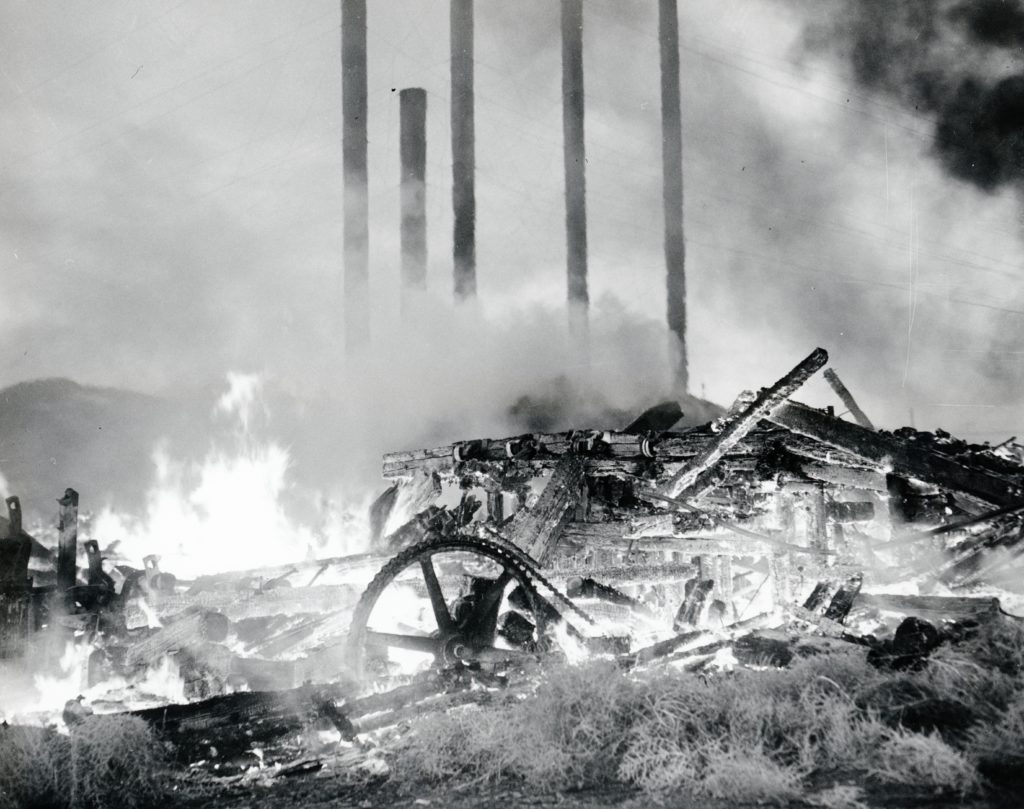
The mill engulfed in flames. Courtesy of Fred Lendman

Susanville’s Paul Bunyan Lumber Company was located in the current neighborhood of Wal-Mart. It was built in 1936 and originally referred to the Cedar Mill, as it was operated by the Springfield Cedar Company.

In 1945, during the long dissolution process of the Red River Lumber Company, one family member, Kenneth Walker continued to carry on in the family business and he took over the Cedar Mill. He also retained Red River’s company Paul Bunyan logo, and he named his new enterprise the Paul Bunyan Lumber Company.

However, it was not too long when disaster struck. A little after midnight on May 22, 1946, Charles Bannerman, the night watchman, signaled the fire alarm. By dawn the mill had been completely destroyed. Like the proverbial phoenix rising from the ashes, Walker would build a new mill, which was placed into operation on February 16, 1947.

Subscribe!

Flanigan, Nevada

Flanigan, was a railroad town in far eastern Honey Lake Valley, in Washoe County.

Flanigan, 1976
Flanigan, 1976, courtesy of Christopher Moody

In the fall of 1909, the Western Pacific Railroad established a station in eastern Honey Lake Valley that they designated as Flanigan. Patrick L. Flanigan was a prominent rancher and former Nevada Senator who had also granted the railroad a right of way across his lands. In 1912, the Southern Pacific began construction of its Fernley & Lassen line, and at Flanigan, their tracks crossed those of the Western Pacific’s. On July 22, 1913, the Flanigan Townsite was recorded with Washoe County on lands that had been recently purchased by Charles A. Ross and George L. Warnken of Oakland, California. As land speculators, Ross & Warnken had high hopes for this town, but they never transpired. In 1916, there was the bright prospect that Flanigan would be linked to a third railroad—the Surprise Valley Railway—but it never materialized. In 1921, a hopeful oil discovery in the area fizzled. Flanigan existed only as a railroad town, its promoters hopes of grandeur diminished as the years passed by. On March 31, 1961, the Flanigan Post Office closed.

Milne Store
Milne Store

On January 2, 1969, the town’s most notable landmark, Gertrude Milne’s combination store and residence, was destroyed by fire. This was followed with another event that year that marked the end of the community. On June 19, 1969, the Bonham School, located at Flanigan, closed. It was the last one-room school house in operation in Washoe County.

Flanigan, 1984
Flanigan Real Estate Promotion sign, 1984

Note: This article originally appeared on April 3, 2015. I am selecting some early posts, to fill in while I get my Mother’s affairs organized.