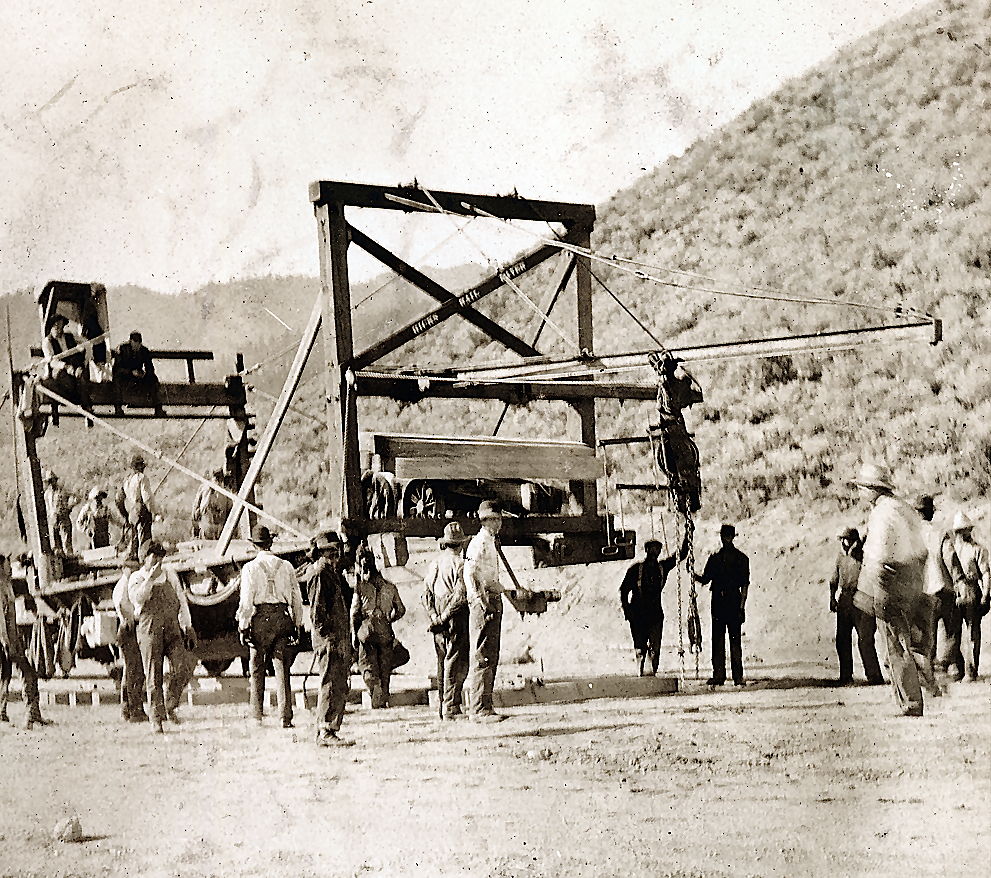
The boat at Amedee before being launched. Courtesy of Marie H. Gould
1907 was a banner for lumber exports from Lassen County. There were two factors at play. The rebuilding of the San Francisco Bay Area after the 1906 earthquake and a mining bonanza in Nevada created a huge demand for lumber. Continue reading The Honey Lake Tugboat→
In 2015, Sierra Pacific Industries purchased the iconic 101 Ranch in Mountain Meadows, near Westwood, from Dye Creek Cattle Company. The history of ranch dates back to the 1860s, when it was a part of Carlton Goodrich’s ranch there. In 1887, the Goodrich Estate sold to Abner Nanney, and thus the 101 was officially born.
In 1900, Abner’s daughter, Lulu married Bert McKenzie and took over the Mountain Meadows property. Bert died at a young age in 1917 from appendicitis. Lulu with her four children: Thelma, Jack, Abner and Beryl carried on. In 1948, Lulu turned the ranch over to her son and daughter-in-law, Abner and Shirley McKenzie. In 1966, they in turn sold to Dye Creek Cattle Company.
The Belfast District, 1898. It was to be the center piece of Merrill’s reclamation project.
In the early 1870s, when Captain Charles A. Merrill proposed to tap Eagle Lake, he found it necessary to have Congress pass a homestead act that focused on arid lands, as nothing existed. Thus, on March 3, 1875, Congress approved the Lassen County Desert Land Act. Under the Act, an individual could claim up to 640 acres of government land. They had two years to reclaim the land by irrigation, and then could purchase the land from the government for $1.25 per acre. Residence on the land was not a requirement. It proved so popular that in 1877, Congress approved the Desert Land Act, which covered all arid lands in the western United States. The latter Act has had a lasting impact, and is still one of very few homestead acts in existence. In the 1980s when Franklin Jeans proposed his water export scheme of the groundwater on the Nevada side of the Honey Lake Valley, he used the Desert Land Act to increase his holdings and to put more wells to accomplish that goal.
Shinn family plot, Susanville Cemetery, November 19, 2015
Over the years in the area surrounding and including the Susanville Cemetery various Native American artifacts have surfaced. In one particular instance the Lassen Advocate of 10 June 1881 reported the following: Indian Relics. In digging the ditch to lay pipe for conducting water to the cemetery, eighteen inches below the surface, Mr. Frost came upon four stone implements that were once used by Indians or some other race of people. One of the stones is evidently a mill for making flour from seeds or acorns, the other three were probably used for dressing skins. They have fallen into good hands, Mr. Frost is collecting these interesting relics of the past to be preserved.
Of particular note the grave of Mr. Frost will be included in September’s cemetery tour, as part of the centennial celebration of the Lassen County Courthouse.
It will not be too much longer when the new community pool, that replaced the Roosevelt, will open. Yet, it was on this date, April 17, 1938 that the Roosevelt Pool opened.
The Works Projects Administration (WPA) was part of President Roosevelt’s New Deal program to help stimulate economic recovery brought upon the Great Depression of the 1930s. For years Susanville residents desired a swimming pool. Frank O’Kelly spearheaded the movement and wanted to convert the Fruit Growers ranch (now Susanville Ranch Park) into a recreational facility complete with a golf course, swimming pool, picnic area and playground. Everyone liked the concept except for Fruit Growers who owned the property and were not interested in leasing or donating the property. O’Kelly undaunted by the setback persevered and it was decided to move forward with a community pool. The plans were submitted and the WPA approved it for a cost of $28,433.
Of what was one of the more unusual uses of Eagle Lake water was a proposal to use that resource in the mining operations at Hayden Hill, located some twenty-five miles north of the lake.
During the 1920s and 1930s, both the mining activity and the population at Hayden Hill declined. In 1934, Stratton & Stratton of Spokane, Washington consolidated the mine ownership. They had high hopes to revive the Hill. One of the main drawbacks that Hayden Hill suffered was the lack of water for milling. In 1938, Stratton & Stratton proposed to pipe water from Eagle Lake, at a rate of 2,500 gallons per minute. This scheme never came to fruition.
The Western Pacific Railroad’s Highline also referred to as the Northern California Extension went from Keddie, Plumas County north to Bieber, Lassen County where it connected with the Great Northern Railroad. A major disappointment to many was that regular passenger service was never instituted. Continue reading The Snowball Special→
Town of Doyle was surveyed and subdivided in 1911. However, there was plenty of activity there, since the Western Pacific Railroad had already established a station. So, the new town of Doyle was serviced, not by one, but two railroads, the other being the NCO. Yet, changes were on the horizon and Doyle like so many rural communities suffered from the effects of World War I. Many of its residents, and the regional homesteaders, never returned seeking new opportunities elsewhere.
In the 1940s, Doyle experienced a revival, due in part of the establishment of the nearby Sierra Ordnance Depot. In 1948, the Doyle Civic League proclaimed: “There is a boom on in Doyle.” The League cited among other things that the community boasted three grocery stores, three gas stations and two taverns with cafes.
Hayden Hill’s first mine, was named the Providence. In the early 1870s, Hayden Hill was sometimes referred to as Providence. The following whimsical account is from the Mountain Tribune of Bieber, April 22, 1882 that explains how the name came to be: “While at Hayden Hill this week in search of information, we inquired of Ben Bradshaw which was the first claim located on the Hill and he informed me that the Providence was the oldest claim. Being curious to know why it was so named he said it was located and owned by ‘seven preachers and two white men.’ We record this fact for the benefit of the future historiographer of the Hill.”
As county property taxes are due today, throughout time there are those who protest the taxes and the valuation of their properties. Today, we examine one episode that involved Lewis W. Brubeck and his Amedee Hotel property.
S.N. Griffith had the hotel constructed in the spring of 1892, at a reported cost of $25,000. On August 26, 1892, Brubeck acquired the hotel for $5,000. On July 10, 1899, Brubeck filed a protest over the hotel’s assessed value with Lassen County. In his affidavit, he stated not only had the property depreciated over the years, but the railroad’s intention to extend its line north, the property value would even be worth less. Brubeck informed the Assessor that he would take $2,000 cash for it, though the Assessor had it valued at $3,000. Brubeck’s appeal was rejected. In November 1900 he sold the property, though the record is not clear whether he received his asking price of $2,000.