Lassen Advocate file photo of May 14, 1976 The Susanville Fire Department held a training excerise at the gutted building.
In 1954, after the death of Jean “Shirley” Tilton, Gene Garayoa purchased her establishment, Shirley’s located at 635 Hall Street. Garayoa did a complete renovation of the place and renamed it the Juniper Inn, and soon became a popular social hub. Garayoa, it should be noted was also in the bowling alley business and in 1960 was operating the Sierra Lanes.
Fast forward to February 1976. At that time Howard and Judy Duvall had leased the Juniper Inn. There were two fires of mysterious origins on February 22 and 29, leaving the building gutted. Garayoa replaced the Juniper Inn with the Juniper Arms Apartments.
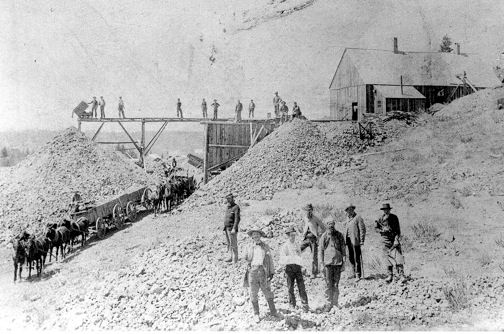
One of the mines not located on top of Hayden Hill, 1910
One misconception of Hayden Hill was that all the mining took place at Hayden Hill proper where the town and some of major gold mines were located. However, there were small satellite mining communities surrounding Hayden Hill, such as Franktown and Lewiston. Take for instance the California State Mineralogist 1892 report concerning the Juniper Mine. It stated the three miles from the mine, on Willow Creek, the company own a water power and four arrastras eight feet in diameter.
Main Street, Susanville, circa 1906. Courtesy of Mark Reed
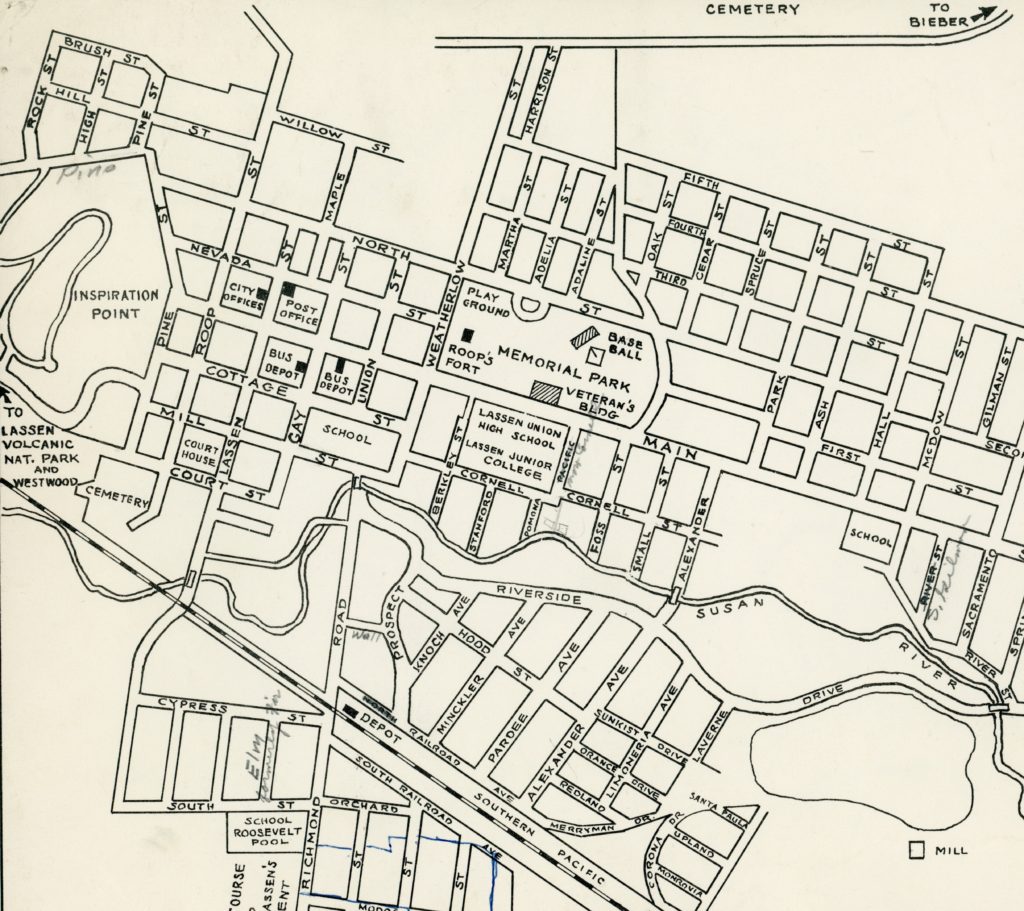
This is just one of those little things that we take for granted. Susanville happens to be one of the oldest towns of the western Great Basin. The town which had been laid out in the 1850s, is unique from other western towns of the same vintage. The town’s Main Street is unusually wide and there is a reason for that. The wide street acted as a fire buffer, so to keep a fire contained to one side of the street, and it worked except for once in 1893, when the whole business district went up in flames.
In 1843, Pierson B. Redding gave the river and the Native American tribe located there, the name Pit. Reading noted there were numerous “pits” along the river, and some could be hazardous to your health.
Then there is the small community of Pittville that is on the Lassen and Shasta county line. As to the spelling with the double “t” the Shasta Courier noted in 1900 that the only folks who spell Pit with a double “t” are the ones who do not know the history of the naming.
For what ever unknown reason, I have been intrigued by this photograph. It was taken in 1932, by well known photographer Clark Kinsey. The Fruit Growers Supply Company hired Kinsey to photograph their operations at Hilt and Susanville. Fruit Growers it should be noted is the purchasing agent for the citrus growers marketing co-operative known today as Sunkist. Photographs such as these, in addition to filming the operations were important tools to show the citrus growers how their money was being invested to provide them wooden boxes at a reasonable price to ship their fruit.
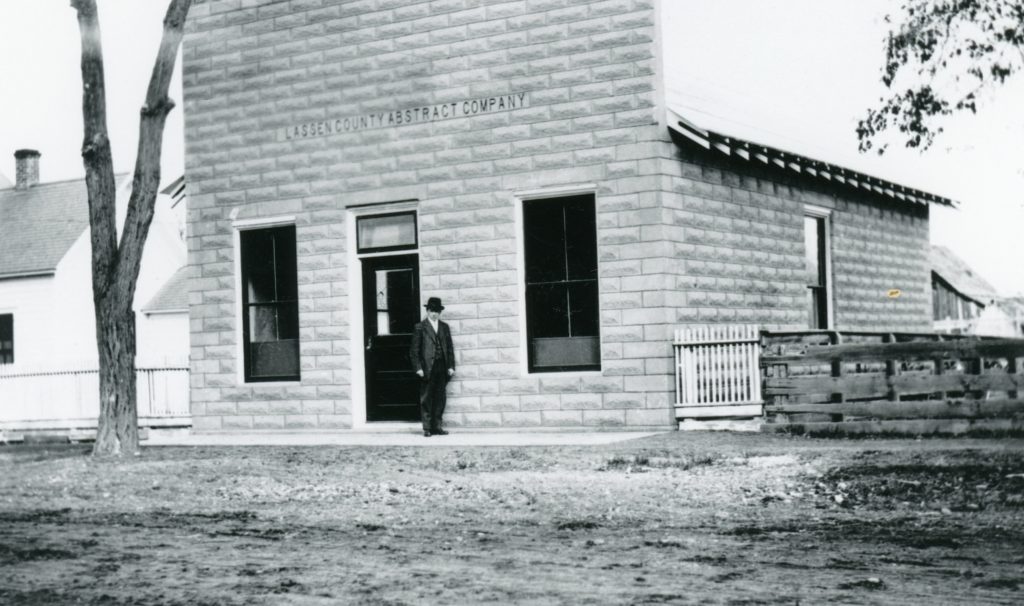
In 1938, Ernst Antevs research on the Rainfall and Tree Growth in the Great Basin was published. A segment concerns Lassen and Modoc Counties. The following is an interesting footnote from that study: “The sources of Pine Creek, the only large tributary of Eagle Lake, are less than a mile from those of the Susan River, the main feeder of Honey Lake. The seasonal runoff in these streams may therefore undergo similar fluctuations, and with undisturbed conditions, the lakes should do the same. Actually, Honey Lake has fluctuated in harmony with the known precipitation of the region, but this has not been the case with Eagle Lake. The moistest times since 1850 have been 1868, 1890-93 and 1904-07, and since 1907 the measured rainfall and runoff have on the whole decreased, while the highest recent stand in Eagle Lake was recorded in 1917. The fact that from 1801 to 1821 a thicker wood mantle was formed in the Susanville trees than during any two later decades prevents us from concluding from the stump at the 82 foot level that the precipitation from 1760 to 1860 was continuously light and much smaller than it has been since 1860. In short, the levels of Eagle Lake cannot be used as a basis for conclusions about the rainfall before 1850. A reasonable explanation of this controversial problem was given the writer in 1931 by Mr. G.N. McDow, president of Lassen County Abstract Co., Susanville, who expressed the opinion that the rise of Eagle Lake was due to a closing of its subterranean outlet about 1890 by an earthquake.”
In May 1857, Reuben F. Mastin purchased this valley from L.N. Breed and George Lathrop for $150. That was a bargain, even back then. It was Mastin who named this beautiful valley, Elysian, located a short distance from Janesville. Later that year, or to be precise, on November 19, Mastin sold out to Richard D. Bass for $1,000 and Bass would reside there for the next forty-six years. A portion of the original family ranch remained in the Bass family ownership until 1981.
The A.C. Herring family on a NCO speeder at Amedee, circa 1909.
This was something I had always wanted to do, was ride on an old fashioned railroad speeder. They were so named, as I understand, that they were faster than a handcar. Speeders were used to examine maintenance of the railroad track. You might have seen the modern version were pickup trucks that have flanged wheels that can be lowered onto the rail, and I think that would be fun too.
A 1906 4th of July parade entry. Courtesy of Leona Byars
Today’s featured photograph is that of Fred Bagin’s Honey Lake Meat Market 1906 parade entry, taken at 815 Cottage Street, Susanville. At the helm is his step-daughter, Leona Jackson and her companion Mary Fern Long. Bagin was an interesting person who had as many careers as he did wives.
Prepping the anvils, Desmond Meadows, September 18, 1982.
A common highlight of 4th of July festivities in the early 1900s was the firing of anvils. Two anvils are used, one for a base and the other place on top. The base anvil has a small cavity where black powder is placed with a fuse. Depending on the kind of charge, depends how high the top anvil will shoot up. More importantly, is for the the fired anvil to come crashing down on the base anvil creating a spectacular sound. You can see examples of this on You Tube.