Category Archives: History

Lassen Monument Rehabilation

Lassen’s Monument, 1905. Courtesy of Philip S. Hall

With the daylight hours getting longer, coupled with temperatures getting warmer, it is time to put away those skiis or snowshoes, and change your footwear. Whether you are a native, recent newcomer or traveller, one has to check out how the Lassen Monument five miles south of Susanville that went through a major transformation last fall.

For the uninitiated, this is the final resting place of trailblazer, Peter Lassen—a name well known throughout Northern California. This Danish adventurer was born in 1800. He left his native country in 1830 to come to the United States, like so many others to escape poverty. The following year he embarked on his westward expansion and moved to Missouri, where he applied his blacksmith trade, a skill he learned from his uncle—a good one at that, for he always had something to fall back on when other ventures failed.

In 1839, Lassen made the gigantic leap to the West Coast, first to Oregon, then to the Russian colony of Fort Ross on the Northern California coast. It was then onward to John Sutter’s Ranch, known today as Sacramento. On a expedition to the northern Sacramento Valley Lassen came upon the confluence of the Sacramento River and Deer Creek. So impressed with the site, Lassen obtained Mexican citizenship. This allowed him to claim the property and was granted five Spanish leagues (22,000 acres) at Deer Creek, he named it Bosquejo Ranch. Lassen’s next enterprise there was the establishment of Benton City.  In 1847, Lassen returned to Missouri to recruit settlers for his new community.  In the spring of 1848, he brought back a small group of emigrants and they were the first to cross over the infamous Lassen Trail, that was a disaster.

In a sense the trail crossing was an omen of more bad things to come. Within two years, Lassen had lost his ranch. Lassen, now freed as a landholder, relocated to Indian Valley, Plumas County.  Lassen, like so many others, had become intrigued by the possible existence of the fabled Gold Lake.  In the late summer/early fall of 1850, Lassen, J. Goldsborough Bruff, and a small group of men explored Northeastern California in search of Gold Lake, though they never found it.  In 1855, Lassen did find gold, in the Honey Lake Valley.  That fall, Lassen, and six companions, built a log cabin near Lassen Creek and spent the winter there, making the Honey Lake Valley his new home. In the fall of 1858, news circulated of a silver discovery in the Black Rock Desert, Nevada.  In the spring of 1859, Lassen organized a prospecting party.  It was divided into two groups, one led by Captain William Weatherlow and the other by Lassen—that group consisted of Lassen, Edward Clapper and Lemericus Wyatt.  The two groups were to meet at Black Rock Canyon.  Lassen and Company arrived first and remained to wait for Weatherlow’s party—a fatal mistake.  On the morning on April 26, 1859, Lassen’s camp was awakened by a gunshot, a fatal one, striking the head of Clapper.  Lassen was killed by the second shot.  Wyatt escaped and rode horseback 124 miles to Susanville to safety and to relay the tragic event.

Tomorrow: The conclusion.

Support

Eagle Lake’s High Water Level

A view of Eagle Lake, looking towards Spaldings, 1921. Courtesy of Lola L. Tanner

While there are numerous citations that Eagle Lake had reached its highest level at 5,125.2 feet in 1917, though what is peculiar was that this benchmark occurred in late March. One would think that a final observation would have been made in May, after the spring run-off. Then again, no one knew what the future had in store. First of all, 1917 marked the beginning of a twenty-year drought. That would be a rude awakening for many as nothing like that had happened since the Anglo settlement of the region. Then there would be another culprit to greatly affect the dropping of the lake’s level to historic lows. In 1923, water started to flow out of Eagle Lake to the Honey Lake Valley for irrigation through the Bly Tunnel.

To provide a better comprehension just how high the lake was in 1917, is that of March 1, 2019 the level of the lake is pegged at 5095, that is a difference of some thirty feet!

Support

Susanville Logging Company

Joe “Tunney” Zunino posing with his one log load. Courtesy of Margaret Purdy

In 1941, this company was created by a partnership between J.S. “Sam” Dotson, William Barbee and Sherman Rea. They initially acted as logging contractors, their biggest client was Lassen Lumber & Box Company. While Lassen Lumber & Box was in decline, Susanville Logging saw there was still opportunities in the milling business. In January 1947, they began construction of a sawmill east of Susanville, the property known today as Lassen Ale Work’s The Boardroom on Johnstonville Road. The mill was completed in April 1947 and had a daily capacity of 40,000 board feet. In July 1947, the company proposed to build a truck bypass from Eagle Lake Road, down the stock trail to the end of Roop Street. They asked the City and County to secure the right-of-ways and they would do the rest. Nothing happened.

In 1954, Dotson died and Barbee & Rea carried on. They sold out in 1958, and the operation was renamed the Susanville Lumber Company. It would undergo numerous ownerships, the last one Jeld-Wen, who closed the mill in the spring of 1993.

Support

Fruit Grower’s Last Board

A remnant of Westwood’s better days.

To mark the end of mill operations at Westwood, in 1956, the last board cut in the dry lumber department there was signed by the last of the workers. It was piece of Douglas fir 5 1/2 inches wide by 9 inches high. Some of the records of Fruit Growers Westwood operation were transfered to that company’s office at Hilt. In 1999, it was discovered in the old Community Center at Hilt. At that time, the board was taken to Fruit Grower’s headquarters in Sherman Oaks, California and put on display. Whether it is still on display is not known.

Support

The Pioneer Saloon, 1920

Pio advt.
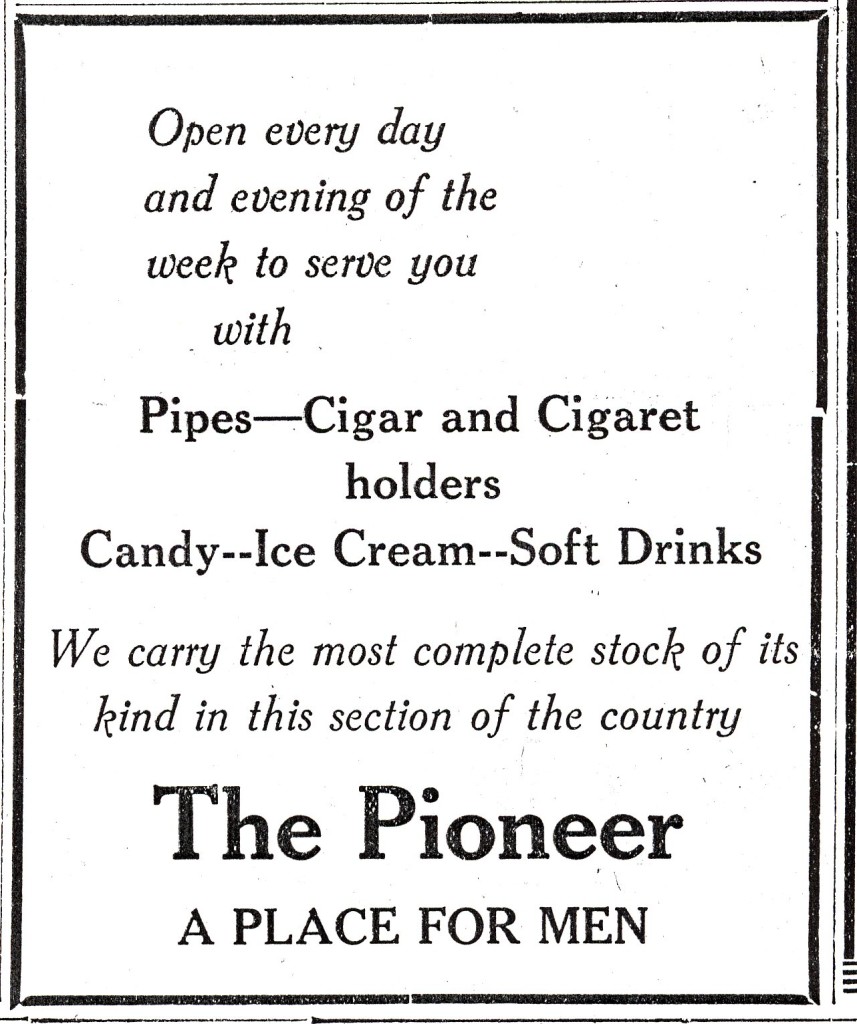
A 1920s advertisement for the Pioneer. It had to change its ways during prohibition.

Some times, when I look at historical events, and just do not get it. This is one of them. In 1920, Grass Valley resident, W.H.Tuttle, purchased Susanville’s Pioneer Saloon that had been in existence since 1863. (Now home to Lassen Ale Works) After all, on June 30, 1920, national prohibition would take effect. Not only that, Tuttle announced he was going to replace the one-story wooden structure, with a two-story concrete, which he did and still stands. This, of course, changed the dynamics of the business, founded on providing alcholic beverages to one engaging of selling soft drinks, tobacco and similar merchandise. The one item it had in its favor was a card room, where games of chance were played and lots of money changed hands, which carried on decades after the repeal of prohibition.

Brands
The interior wall at the Pioneer courtesy of Lassen Ale Works

Support

The Popcorn Machine Explosion

The explosion, February 17, 1930. Courtesy of George McDow, Jr.

In 1920s, William “Dad Popcorn” Vellenworth located his popcorn stand to the corner of Main and South Gay Streets, Susanville. Out of nowhere for no apparent reason on the afternoon of February 17, 1930 the steam boiler connected with the apparatus exploded, injuring not only “Dad Popcorn”, but two small girls, Shirley Shoemaker and Fannie Frizzie. The popcorn machine was blown to shreds, and it was a miracle that the three only sustained moderate injuries. Flying debris broke a window of the Bank of Lassen County, and also broke the rear window of Floyd Bass’ sedan among other items.

It was a devastating moment for Vellenworth, now approaching 80 years of age. The community came to his aid. Vellenworth, was a member of the fraternal organization, Loyal Order of Moose. That organization, along with donations by individuals raised funds and purchased him a new electric popcorn machine. He carried on for four more years, having a very loyal clientele, until his death in May 1934.

Support

W.M. Vellenworth aka Dad Popcorn

“Dad Popcorn” with the Pearce children: Frances, Kathryn and Harry. Courtesy of George McDow, Jr

In 1912, William Vellenworth, who later become known as “Dad Popcorn” arrived in Susanville as bridge carpenter for the Fernley & Lassen Railroad construction. It was during that winter he contracted pneumonia, and nearly died. After he was released from the hospital, Vellenworth who was 61 years old, did not have the strength needed in his former line of work. Nearly destitute, his carpentry tools would be his saving grace. Using the tools as collateral, he acquired a Hot Tamale wagon and began peddling tomales on the 700 block of Main Street, one busiests areas in Susanville. Two years later he was able to upgrade to a popcorn wagon to sell his wares, which now included roasted peanuts.

Vellenworth soon learned that it was in the afternoons was the busy time for his popcorn business. In mornings he spent his time doing furniture repairs, making cabinents and assorted carpentry work. For the next sixteen years, life was good for him. In 1930, tragedy struck.

Part Two: Tomorrow

Support

Spalding vs. Spaulding

Pine Creek
Pine Creek, circa 1914. It sholuld be noted that John Spalding’s original homestead was on the north side of Pine Creek. Courtesy of Wyn Wachhorst

From time to time, I am asked about the spelling of Spaulding Tract, as the Spalding name does not contain a “u.” This no doubt is an issue of property title. There were two separate Spalding subdivisions. First one done in 1914, and the second the Spaulding Tract we know today was subdivided in 1924. A portion of the two subdivisions are identical, hence the need for clarification.

Support

Richmond, Lassen County

Richmond School, 1916. D.M. Durst Collection

Yesterday, I made reference to the town of Richmond where the local Masonic lodge was organized. After all, for many people they are just aware of a road and school of the same name.

Richmond came into prominence with gold being discovered along the base of Diamond Mountain. By 1859, a nucelus of a town was in earnest with a hotel as well as houses built. The following year the region’s first newspaper, the Richmond Times, made its debut. In 1861, the townsite was surveyed and plotted, a first in the Honey Lake Valley. In 1862, things were rather bleak and the town nearly abandoned. Years later, E.R. Dodge wrote, “Richmond had gone up like a rocket and came down like a stick and Susanville had been left to glory over her rival.”

In a 1878 traveler on his way to visit Lassen’s Monument, described what was left of the abandoned town: “This was formerly a populous town with its stores, saloons and busy life, now nothing is left but a dilapidated hotel to mark the spot; and this with its windows gone, its sides warped and uncouth, is fast giving way to time’s relentless hand.  A schoolhouse has been erected since the demise of the town, and Mr. Bantley and family are now the only inhabitants of this once busy place.”      

On a final note, the abandoned hotel was converted into barn and on March 24, 1908, it fell down during a windstorm.

Richmond Road
Richmond Road, 1906

Support

Lassen Lodge F.&A.M.

Lassen Lodge #149 F.&A.M. in Susanville, 1879

On March 21, 1861, the local Masonic Lodge was organized. When this event occured it was not in Susanville, as many would presume, but in the town of Richmond, a few miles to the south. The charter was granted in 1862 and the lodge placed into formal operation on June 24, 1862. In October of the same year the lodge relocated to Susanville, where it still is in existence—the area’s old fraternal organization.

Some may recall an article I wrote about Meet the Masons back in September 2017. There is a collection of about 35 photographs of individual Masons taken in the early 1900s. It is an interesting study. I just need to prod a certain some one to provide the scans. Stay tuned.

Support!